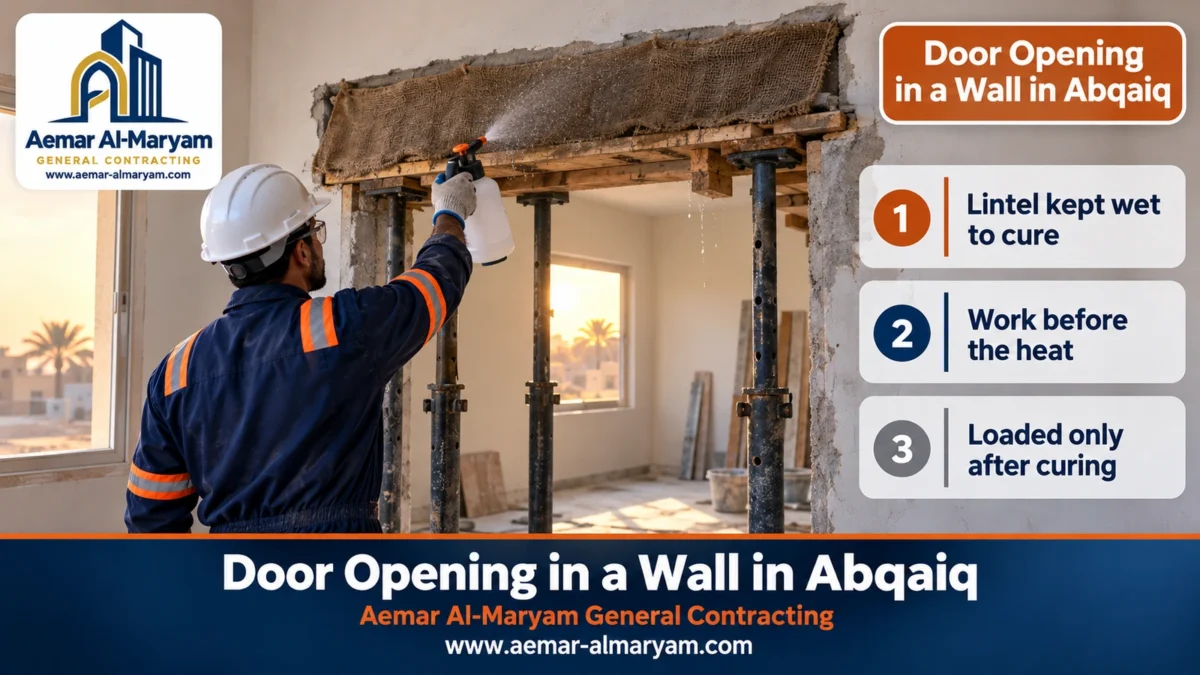
In Abqaiq the working day starts close to dawn, because concrete placed in the midday sun loses its water before it has had a chance to harden. So a door opening in a wall in Abqaiq with Aemar Al-Maryam General Contracting depends as much on timing as on cutting. We cast the lintel above the future opening early in the morning, wrap it in wet hessian and keep it damp for a week with the props still underneath, then cut, plaster the reveals and paint them to clean straight lines. Outside, we form driver doors in villa boundary walls and get them ready for their steel door. Here the plain cut is from SAR 140, a frame-ready opening from SAR 280 and a driver’s entrance from SAR 140, while the journey from Dammam is settled at the visit; treat each Abqaiq number as an estimate until inspection and agreement. Our line is 0547879578, voice or WhatsApp.
A quick word on what this page covers: we make openings in walls. That means a new door or window where there was none, a wider version of an existing one, or an old one closed up. We do not open locks or locked doors; that is a locksmith’s trade.
Door and window openings in Abqaiq at a glance
- Lintels in the heat: cast in the early morning, wrapped in wet hessian and sprayed for at least 7 days, with the props left in place until the lintel has gained strength.
- Driver doors: an opening in the boundary wall no wider than 0.80 m under the residential building requirements, with plastered side piers and a lintel, then the steel door.
- Reveals: metal corner beads, mesh over every joint between old and new work, plaster kept damp, and paint only once it is fully dry.
- From-prices in SAR: plain cut 140; finished opening 280; driver’s entrance 140; wider door 140; hanging a wooden door 230; paint 14 per m²; rubble 90 a load.
- At inspection: the lintel, fitting the steel door, a car gate, any load-bearing wall, and travel.
- Send us: photos of the wall or boundary wall from both sides, the size you want and your location pin on WhatsApp 0547879578.
Door opening in a wall in Abqaiq: how a working day is planned
A door opening in a wall in Abqaiq follows a timetable built around the heat. Anything that involves water, concrete or plaster happens in the first hours of daylight; cutting, block removal and bagging debris come after; and nothing is cast or plastered outdoors at the peak of the afternoon. Because our crews travel from Dammam, visits are booked in advance and we bundle as many jobs in the house as possible into each one. Fewer trips means a lower travel share per item, and travel itself is agreed at inspection.
| Time of day | What we do | Why |
|---|---|---|
| Early morning | Casting the lintel or plastering, then covering with wet hessian | Materials are cooler and evaporation is slower |
| Late morning | Cutting the outline, taking out blocks, moving debris | Mechanical work is not harmed by heat the way fresh concrete is |
| Peak heat | No casting and no external plaster | Rapid drying causes plastic shrinkage cracks |
| Late afternoon | Re-wetting the lintel and plaster, covering the opening | Hessian dries out quickly and needs soaking again |
It also helps to know from the start that a complete opening is not a one-day job. The lintel needs its week before anything is opened beneath it or any load is placed on it. That is not slowness; it is the reason the opening still looks the same years later.
When does a home in Abqaiq need a new opening?
Most requests in Abqaiq come from a change in how the house is used rather than how it looks. A family grows and builds a bedroom against the hall, which then needs a door into it. A new driver needs his own way in through the boundary wall without opening the big gate every time. A men’s majlis gets a separate outside entrance so guests no longer walk through the house. Some requests come from the climate itself: moving a door that opens straight onto a sun-baked courtyard to a shaded side, or adding a small high window to a dark corridor so daylight comes in without the midday glare.
■ Added room
A door from the hall into a room built against the house, through a wall that used to be external.
■ Driver entrance
A narrow steel door in the boundary wall next to the gate, leading to the driver’s room.
■ Separate majlis
An independent outside door for the majlis, and its old internal door closed up.
■ Light without glare
A small high window in a corridor or stairwell with insulated glass to limit solar heat.
■ Room to manoeuvre
Enough width for a wheelchair, or for that big sofa to come in.
■ Two rooms into one
A door between two rooms, or removing the whole wall where it is not load-bearing.
Casting a lintel in the Abqaiq heat: hessian, water and props
Casting a lintel in the Abqaiq heat needs three things working together: concrete that is not already hot when it is placed, wet curing that never lapses, and props that stay under the formwork until the lintel is strong. The Saudi concrete code’s hot-weather provisions cap the temperature of fresh concrete at placement at 35 °C and call for at least 7 days of moist curing. That is why we pour at first light, keep water, cement and aggregate in the shade, and never add extra water to the mix just to make it easier to place.
- 1Formwork and props
A level, tight soffit form under the lintel position, carried by adjustable steel props standing on firm ground. - 2Steel and cover
Reinforcement sized by the engineer for the span, set on spacers that hold about 2.5 cm of cover. - 3Morning pour
A mix placed without added water and vibrated or rodded until the bars are fully embedded. - 4Wet hessian
Once the surface has stiffened, the lintel is wrapped in hessian and sprayed, and re-wetted through the day. - 5A week of curing
Daily spraying for at least 7 days; nothing is loaded or opened beneath it before then. - 6Striking the props
Only after the lintel has gained strength, and only then does the opening below begin.
Why not pour at noon and leave it?
Concrete exposed to the noon sun loses surface water fast. Fine shrinkage cracks appear within hours and the lintel is weakened before it has even set. A weak lintel does not show itself straight away; it shows months later as a horizontal crack running over the new door.
The lintel rules we follow in Abqaiq
| Item | Rule |
|---|---|
| Thickness | Equal to the wall it sits in |
| Seat | A minimum 15 cm seat at each end, more on wide spans |
| Depth | At least 15–20 cm deep, growing with span |
| Steel embedment | Bars kept roughly 2.5 cm in from every face |
| Curing | Spraying and wet hessian for 7 days, no load before that |
| Wide openings | Past roughly two metres, an engineer designs it as a beam |
| Old lintels | Removed whole when widening; a new lintel is never joined onto an old one |
Factory lintel or one poured on site?
A factory-made unit sidesteps the hot-weather curing problem because it arrives already cured, and it saves time. It is a sound choice when its depth and bearing suit the opening and it has been measured accurately. Thin 10 cm sections laid over a wide door are a common shortcut that we do not install. A lintel cast in place takes the exact shape of the wall and suits unusual openings, but it needs its full week of curing. Either way the lintel is priced at inspection, and anyone who wants more detail on placing concrete in summer will find it in concrete pouring in Abqaiq.
Opening a driver door in a villa boundary wall in Abqaiq
Cutting a driver’s entrance into an Abqaiq courtyard wall (from SAR 140) begins with three choices: its position beside the main gate, its width, and the load above it. National housing rules permit a separate door to the driver’s quarters provided it sits in harmony with the wall and gate and stays within 0.80 m. Since that wall fronts the street and appears on the approved plans, have an engineering office clear the change with the municipality first.
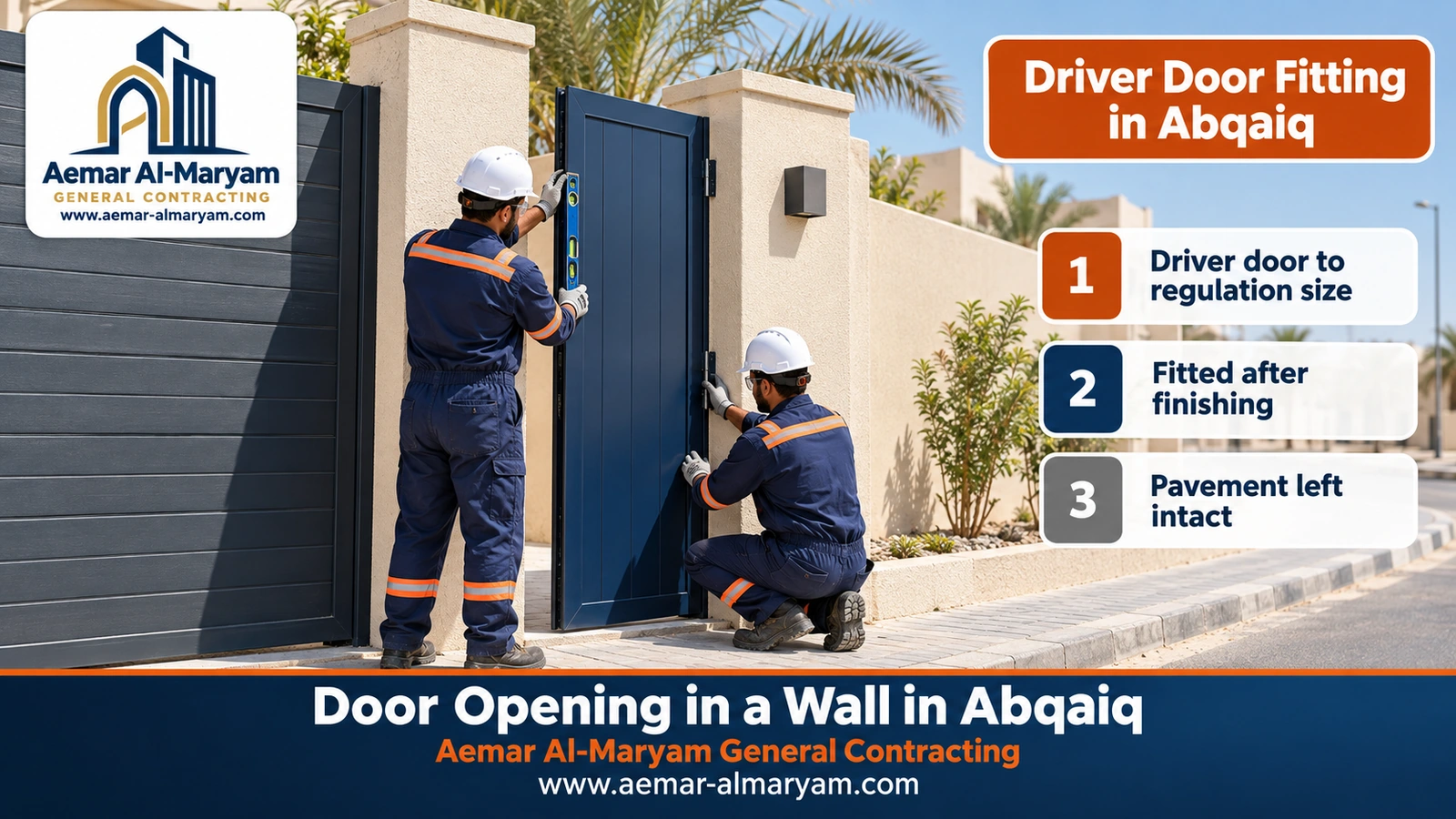
Villa boundary walls are usually blockwork between concrete columns. We keep the cut clear of the columns, cast a lintel over the opening, and build small piers or strengthen the edges on each side so they can take the hinges of a steel door without crumbling. The piers and lintel are then plastered and the opening is left true and square, ready to be measured for its door.
The steel door: who makes it and who hangs it?
The steel door is made by a blacksmith to the size of the finished opening, after plastering and not before, so it never arrives too tight or too loose. Hanging it on its hinges and levelling it is done by the blacksmith or by us by agreement, and that is priced at inspection. Our advice for Abqaiq: a dark, sun-resistant colour, heavy hinges that can stand up to wind, a lock suited to daily use, and a door that opens inward so it never blocks the pavement.
Car gates, ramps and the footway
Vehicle gates are another scale entirely. The same requirements set villa vehicle entrances at 3 m or more and keep any ramp inside the plot rather than projecting over the pavement. An opening of that width in an existing wall needs a longer lintel and side piers, and it is priced at inspection, with linear-metre cutting from SAR 75 as a reference point. The footway belongs to the public, so ramps or alterations there need the municipality’s consent, and pavement violations carry fines under the municipal penalties schedule.
■ Width
Driver door up to 0.80 m; villa car entrance at least 3 m.
■ Lintel and piers
A lintel over the opening and piers or strengthened edges to carry the hinges.
■ Pavement
Left intact; any change only with municipal approval.
■ The door
Measured after plastering, made by the blacksmith, hung by agreement.
Eight stages from first visit to handover in Abqaiq
Opening a door in a wall in Abqaiq takes eight steps, and we skip none of them even on a small opening, because getting the order wrong is exactly what produces cracks later on:
- 1Inspection and measuring
We identify the wall type, its thickness and what sits above it, and look for pipes or cables running through the opening area. - 2Marking the outline
The opening is marked on both faces, adding the thickness of plaster and frame to the clear size you want. - 3Moving services
Any socket, switch or pipe in the way is relocated before a single cut is made. - 4The lintel
Cast in the morning with formwork and props, then a week of hessian and spraying. - 5Cutting
Scored on each face with a cutter, so the arrises stay crisp and nothing extra breaks away. - 6Removal and debris
Blocks come out from the top down and debris is bagged the same day. - 7Reveals
Corner beads, mesh and plaster that is kept damp while it cures. - 8Fitting and painting
Door and frame go in when the render has dried; paint follows.
Block walls and concrete walls in Abqaiq homes
With Abqaiq blockwork, the cured lintel goes in first; then the outline is scored on each face and the blocks are eased out course by course. Reinforced concrete gets a wet diamond saw instead, explained under concrete cutting in Abqaiq. Small holes for AC pipes or drains are a different job, handled in core drilling in Abqaiq.
| Wall | How it is opened | Starts from |
|---|---|---|
| Internal block partition | Cutter for the outline, then hand removal | SAR 140 per opening |
| Block boundary wall | Cut clear of the columns, with lintel and side piers | SAR 140 for a driver door |
| Concrete wall of normal thickness | Diamond saw with water | SAR 140 per opening |
| Load-bearing wall in an older house | To the engineer’s design | At inspection |
Older houses in Abqaiq: is the wall load-bearing?
Certain older Abqaiq homes were built with masonry walls holding up the roof directly, without a reinforced frame. There, each new opening is a structural alteration for a civil engineer to design. Signs that a wall is load-bearing include a thickness above 20 cm, a roof slab resting directly on it with no column nearby, or another wall standing on top of it on the floor above. Columns and beams are never cut by us, and structural walls are opened only to an engineer’s drawing.
Paperwork in brief: a doorway through an inside partition carrying no load is routine upkeep. Piercing a structural wall, altering the frontage or cutting the street boundary is a building alteration, so an engineering office reports on it and a Balady permit may be required. If you notice diagonal cracks around an existing door, have them looked at first through crack repair in Abqaiq.
A door into an added room or annex in Abqaiq
A door into an added room is one of the most frequent jobs in single-storey houses in Abqaiq, where a bedroom or majlis is built against the house and then needs a door from the hall. The wall we open was an external wall before the extension, so we confirm its thickness and what it carries, cast the lintel before opening, and then treat the joint between old and new construction at the reveals with mesh and plaster so no crack appears there later. If you are still planning the extension itself, see annex and majlis building in Abqaiq.
Linking two rooms inside the house uses the identical sequence: from SAR 140 cut, from SAR 280 handed over finished. To merge them into one generous majlis instead, an ordinary non-structural partition is removed from SAR 185, described in demolition contractor in Abqaiq.
Opening a window or widening a door in Abqaiq
A new window in an external wall in Abqaiq is possible once the facade has been checked, respecting the housing rules: bathroom windows capped at 0.30 m² and half openable, and upstairs annexes kept from overlooking adjoining plots. In this climate we favour a window with insulated glass, and we leave the final ordering size until after the reveals are plastered.
Enlarging a doorway is from SAR 140: frame off, jambs trimmed back, the old lintel removed in one piece and a continuous new one poured across the whole new span and cured under wet hessian, then fresh render on the reveals. Planning for a wheelchair? Accessibility guidance usually targets 815 mm of clear passage, so think 90 cm leaf or wider.
Bricking up redundant openings in Abqaiq
Closing an old opening in Abqaiq is priced at inspection, and it often goes hand in hand with the jobs above: the old majlis door sealed once its outside entrance is open, a window that now looks into an added room and sits inside the house, or the hole left by an old window AC after the switch to a split unit. The method is the same each time. We remove the frame, clean loose mortar off the edges, lay block with fully filled joints, and tie it into the existing wall roughly every second course so it cannot separate.
The weak point of any infill is the joint between new and old block. We cover it with mesh before plastering, keep the plaster damp morning and evening for the first days, and do not paint until it is completely dry; otherwise the outline of the old opening shows through the paint a few weeks later as a hairline. Where the closed opening is in a sun-facing external wall, we recommend painting the whole elevation rather than a patch.
What about the old lintel over a closed opening?
We leave it where it is as long as it is sound, since it still carries the wall above. If it is cracked or its steel is rusting, the engineer looks at it before we close the opening, because infilling below a damaged lintel does not repair it; it only hides it.
Finishing the reveals in Abqaiq: plaster, corner beads and paint
The reveals are what visitors see every day, so we give them the time they need. Metal corner beads on the arrises keep the edges straight and sharp; mesh tape bridges each seam between fresh and existing masonry; and the plaster is sprayed for about a week and covered in the heat so it does not dry before its time and craze. Once it is properly dry we paint the reveals and the wall, protecting any fitted window frame with masking tape.
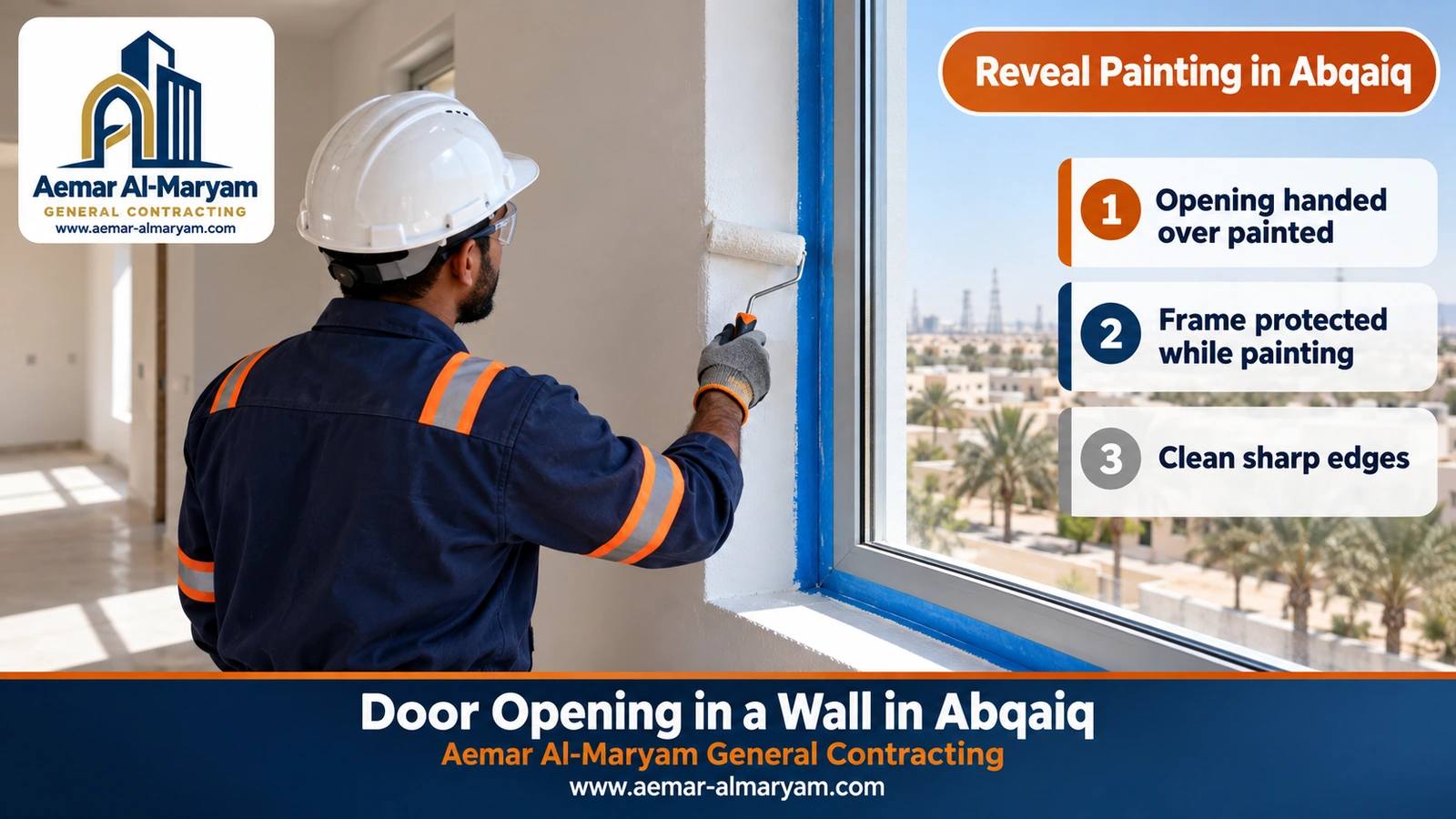
| Item | Unit | Starts from |
|---|---|---|
| Render round the new opening | per square metre | SAR 11 labour, SAR 13 supplied |
| Economy paint for the whole wall | per square metre | SAR 14 |
| Plastered reveals as part of a complete opening | Opening | Included in SAR 280 |
We usually recommend painting the whole wall rather than touching up around the opening, because fresh paint on part of an old wall shows a difference in colour and sheen, especially under the Abqaiq sun, which fades older paint. More detail is in plastering contractor in Abqaiq and painting contractor in Abqaiq.
Fitting frames and sealing windows against dust in Abqaiq
In Abqaiq a frame is set only once the reveal render has dried right through; the narrow margin round it is foamed rather than packed with mortar, then anchored and levelled. Hanging a bought wooden door complete with frame is from SAR 230. Out here windows must keep out sand as well as rain, so the joint is kept even, deep joints get a foam backing rod, neutral silicone goes on both faces and the weep slots stay clear, from SAR 11 a metre.
If you have bought an aluminium window or a ready door from a supplier in the Eastern Province, we form the opening to the supplier’s stated dimensions before anything is fabricated; the supplier fits it, or we do by agreement, and aluminium fitting is priced at inspection. It is best for the supplier’s technician to measure after we have plastered the reveals, not before, because plaster takes about a centimetre or more off each side.
Ten days, three visits: timing and protecting a lived-in Abqaiq home
A door opening in Abqaiq usually takes three visits spread over about ten days: one to cast the lintel, a week of curing, a visit to cut, remove and plaster, and a final visit to fit the frame and paint once the plaster is dry. The cut itself in an ordinary block partition takes only a few hours; the waiting is for the lintel and the plaster, not for the work.
- ✓Sealing off the room: plastic sheeting from ceiling to floor around the work area, and nearby AC grilles closed.
- ✓Protecting floors: cardboard or boards over the tiles along the debris route.
- ✓Dust: light water spray while cutting and continuous extraction; concrete walls are cut wet, which keeps dust down.
- ✓Debris: bagged on the day of the opening and not left sitting in the courtyard in the sun.
- ✓Working hours: an early start, with the noisy work finished before the afternoon rest wherever possible.
Prices for a door opening in a wall in Abqaiq
Abqaiq homeowners get our standard Dammam from-prices, plus a travel element fixed on site. Each line is an estimate until inspection and agreement; heavier walls, bigger holes, upstairs work, awkward access and a longer lintel all push it up.
| What you want in Abqaiq | Price from | Charged per |
|---|---|---|
| A new hole in a house wall for a door or window (block or ordinary concrete) | SAR 140 | opening |
| A fully prepared opening: cut, sides plastered, rubble in sacks | SAR 280 | opening |
| Enlarging an old doorway once its frame is out | SAR 140 | door |
| A driver’s entrance in the courtyard wall, 80 cm at most | SAR 140 | entrance |
| Clearing away the whole dividing block wall | SAR 185 | non-structural wall |
| Setting a wooden door you bought complete with frame | SAR 230 | door |
| Dust-tight window sealant, old bead out and new in with materials | SAR 11 | running metre |
| Rendering around the opening | SAR 11 labour, SAR 13 with materials | square metre |
| Painting the wall when the work is done (economy) | SAR 14 | square metre |
| Taking rubble out of the house | SAR 90 | load |
| A lintel cast at dawn plus a week of curing | After inspection | — |
| Hanging the steel driver door | After inspection | — |
| A car gate of 3 m or more | After inspection; cutting from SAR 75 per running metre as a guide | — |
| Infilling an opening you no longer need | After inspection | — |
| A load-bearing wall or thick concrete, after the engineer’s view | After inspection | — |
| The crew’s trip to Abqaiq | After inspection | — |
What makes an Abqaiq opening cost more or less?
The cost rises with a thicker or harder wall, with a wider opening that demands a longer and deeper lintel, with an upper floor where debris is harder to bring down, and with a load-bearing wall that needs an engineering design. It falls when the opening is in an internal block partition, when several jobs share one visit so the travel is spread across them, and when the door or window is already on site on fitting day so no extra visit is needed.
Worked example: a driver door and a door to an added room in one visit
An illustration of how the figures add up, nothing more: a single-storey villa where the owner wants a 0.80 m driver door opening in the block boundary wall and a complete door opening between the hall and an added bedroom, with a ready wooden door he has already bought fitted to it, and one debris load for both jobs.
| Item | Calculation | Amount |
|---|---|---|
| Driver’s entrance in the block boundary wall | 1 × 140 | SAR 140 |
| Bedroom doorway, rendered and frame-ready | 1 × 280 | SAR 280 |
| Hanging the owner’s wooden door | 1 × 230 | SAR 230 |
| Rubble from both jobs | 1 trip × 90 | SAR 90 |
| Total | 140 + 280 + 230 + 90 | SAR 740 |
| Added at inspection | Both lintels, the steel driver door, and travel | — |
Done as two separate trips, the travel and the lintel curing days would both be repeated. So we cast both lintels on the same morning and open both a week later in a single visit. More in the price guide, and the full explanation in door opening in a wall in Dammam.
Mistakes we see in house openings in Abqaiq
■ A lintel poured at noon and left
It loses its water, its surface cracks, and it weakens before it ever carries the wall.
■ Props struck too early
Opening under a two-day-old lintel risks it sagging and cracking.
■ A driver door with no lintel
Blocks above the opening crack as the steel door slams day after day.
■ A steel door made before plastering
It arrives wider or narrower than the finished opening.
■ Plaster left unsprayed in the heat
It dries too early and develops hairline cracks.
■ Building a ramp on the footway
Without municipal consent it is an offence that attracts a fine.
What to send on WhatsApp for a door opening in Abqaiq
Message these to 0547879578; our reply carries a provisional figure and a morning slot for casting:
- ✓Photos of the wall or boundary wall: inside and outside, ideally with tape showing the outline.
- ✓Measurements: how wide and tall the new door or window should be, and the driver’s entrance width.
- ✓A photo of the pavement: if the opening is on the street side.
- ✓Wall depth: tape it across any doorway already in that wall.
- ✓Your location pin: so we can price travel and group visits.
- 1Your message
Photos, sizes and location. - 2Estimate
Items, starting prices and what needs an inspection. - 3Inspection and lintel
Early morning, with hessian and props. - 4Opening and reveals
After a week of curing, then plaster and spraying. - 5Fitting and paint
Frame and door, the driver’s steel door, then paint once dry.
Why Abqaiq families book us
Because we know the heat is unforgiving to rushed concrete, so the lintel gets its full week of hessian and water and nothing is opened beneath it before it is ready. Because we treat the boundary wall as part of the house front and the street, we respect the driver door width and the pavement. Because straight reveals and clean paint are what stay in front of you, we do not hand over an opening with wavy edges. And we plan visits from Dammam and bundle the work to keep travel down. See similar work in projects and the service at door and window openings.
Coverage in Abqaiq
Crews reach homes throughout Abqaiq governorate in courtyard houses, villas, flats and annexes, reaching it from Dammam. A trip may be combined with work already under way on a Jubail steel-frame doorway or a Ras Tanura window resealing. For everything beyond openings, see renovation contractor in Abqaiq.
Need a driver door or a new opening in your Abqaiq home?
Photograph the wall or boundary wall, send the size and your location, and we will book a morning visit to cast the lintel.
Useful reading for Abqaiq homeowners
Tags