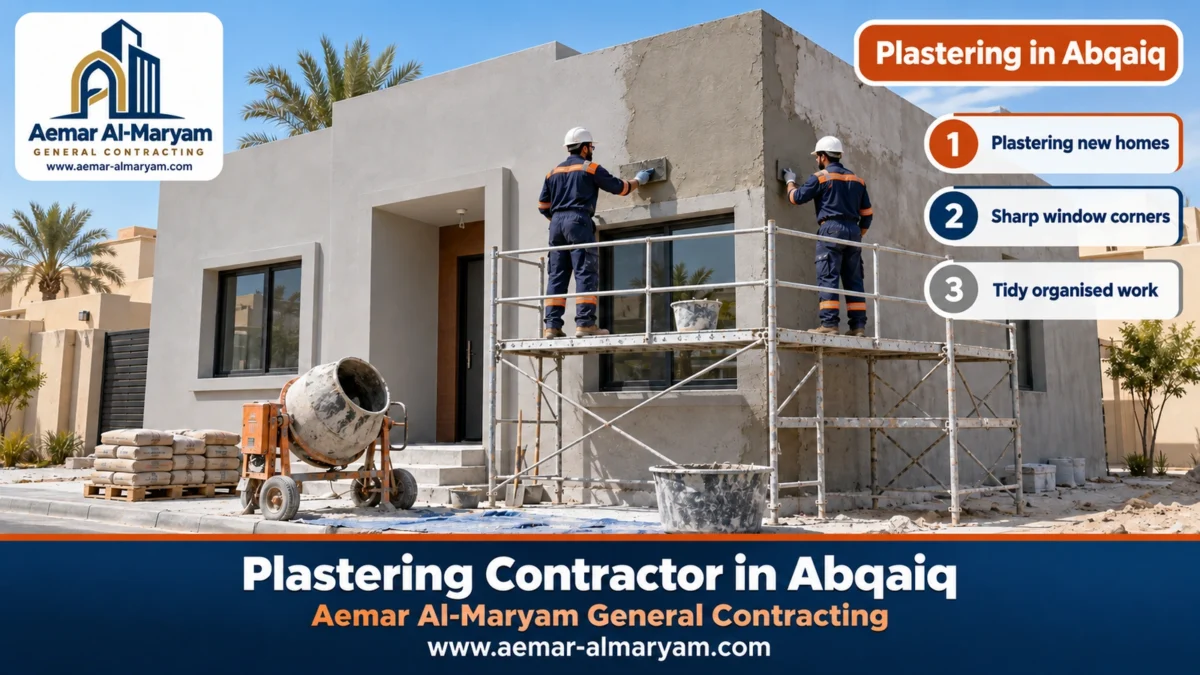
A plastering contractor in Abqaiq from Aemar Al-Maryam General Contracting renders house facades and boundary walls, plasters rooms and ceilings, fills the chases left after rewiring or re-plumbing, and re-plasters old walls, all with one local priority in mind: what Abqaiq’s heat does to fresh plaster. We wet the blockwork before we start, pick our hours on facades in summer, and keep the new plaster sprayed for days afterwards. Our floor price is SAR 6.5 per square metre for indoor labour, SAR 13 indoors with our materials and SAR 18 for external render with our materials, with travel from Dammam set at inspection. Treat the figures as provisional until the site visit; phone or message 0547879578.
Abqaiq is an inland governorate on the Dhahran road, far from the sea, with hot, dry summers, and that alone reorders the priorities in plastering. The enemy here is not sea salt as in the coastal towns but speed of drying: hot blockwork pulls the water out of the mortar within minutes, and sun and dry wind take what is left, so the plaster cracks before it has gained its strength. This page is built around three questions: when do we work, how do we protect plaster in its first days, and what will your house or wall cost?
Abqaiq plastering in brief
- The challenge: summer heat and dry air dry mortar fast; the answer is wetting the blockwork first, spraying afterwards and shading the wall.
- Timing: in summer we start at first light, avoid sun-facing walls at midday and work round the facades as the shade moves.
- What we do: single-storey house and villa facades, boundary walls, rooms and ceilings, chase filling after rewiring, and re-plastering old walls.
- What it costs at minimum: indoors 6.5 (labour), 11 (screeded with beads) or 13 (we supply); outdoors 14 (labour) or 18 (we supply), all SAR per m² and confirmed on site.
- Travel: planned visits from Dammam, costed at inspection and spread across more metres when you group the work.
- To order: wall photos and sizes on WhatsApp 0547879578.
Plastering contractor in Abqaiq: heat comes before everything else
A plastering contractor in Abqaiq has to account for heat before counting square metres, because cement plaster needs water to set and gain strength, and anything that takes that water away early weakens it. In an Abqaiq summer, three things draw water out of soft mortar at the same time:
■ Hot blockwork
A wall that has stood in the sun for hours sucks water from the back of the mortar, weakening the layer against it and reducing its bond.
■ Direct sun
Evaporates water from the face, so the surface shrinks faster than the body of the plaster and map cracking appears.
■ Dry, dusty wind
Speeds evaporation, sticks dust to soft plaster and clogs the pores of the blockwork before work starts.
Ignore those three and the results are predictable: hairline cracks that show after painting, hollow patches you can hear when you tap, and a surface that crumbles when you rub it. The cure is no magic additive, just three simple habits we stick to: wet before, time it well during, and spray steadily after.
Summer working hours in Abqaiq: when to plaster and when to stop
Through the summer months in Abqaiq we start plastering at first light and organise the facades around the shade: we take the wall that is shaded in the morning first, then move to the other side once the sun has left it. We avoid plastering a sun-facing wall at midday, because mortar there dries faster than the straightedge can level it. Indoors is easier, so we use the hottest hours for rooms and ceilings.
| Time of day in summer | What we do | Why |
|---|---|---|
| Early morning | Facades and boundary walls that are in shade | Cooler blockwork, less evaporation |
| Midday | Indoor work: rooms, ceilings and chase filling | Sunny facades dry mortar before it can be levelled |
| Afternoon | Sides now in shade, and the second spray of earlier work | Those walls have cooled |
| Evening | Spraying and covering what needs it | Water stays in the wall through the night |
Winter changes the timetable
In the milder months we can work facades most of the day, and spraying is still needed but less often. If your dates are flexible, the milder season suits large facades and long boundary walls best.
Curing plaster with water in Abqaiq: the step that cannot be skipped
Curing plaster with water in Abqaiq means keeping the new cement wall wet for about a week: a mist early in the day and another late in the day as a minimum, with extra sprays whenever the heat builds or the wall faces the sun. Here we treat it as the most important step after the plastering itself, because heat and dry air steal water from a wall faster than in any coastal city. We agree with the owner who carries on spraying after the crew leaves, because the last days matter as much as the first.
- 1Damp the blocks beforehand
We spray absorbent blockwork well before plastering so it does not drink the mortar’s water, stopping when it is damp rather than running wet. - 2Do not flood concrete
Dense columns and soffits are not soaked; they get a scratch coat, which is then kept damp. - 3First spray
Once the surface has firmed enough not to wash away, as a fine mist rather than a jet. - 4Shade
We cover sunny facades and boundary walls with shade netting or plastic in the first days when needed. - 5Seven days
At least two sprays a day, more in the heat, with a written schedule for whoever continues.
⚠ Do not paint before the plaster has dried
Spraying strengthens plaster, but paint needs a dry wall. Ordinary paints on cement plaster may need up to 28 days for the plaster to dry fully. See painting contractor in Abqaiq for timing.
Dust and wind in Abqaiq: protecting soft plaster
Dusty wind in Abqaiq does more than dry plaster. It sticks fine sand to the soft surface, leaving it rough and dirty, and it fills the pores of the blockwork before work starts, weakening the bond. So we clean and wet the wall on the morning we plaster, not days earlier, we stop rendering facades on days of heavy dust storms, and we cover finished sections with plastic until the wind drops. Losing a day or two is far cheaper than redoing a facade whose surface has been spoiled.
From Dammam to Abqaiq: a planned visit, with travel set at inspection
We work in Abqaiq on visits planned from our base in Dammam and cost the travel once we have seen the job, since a two-day boundary wall and a week-long house are very different trips. Since spraying continues for days after plastering, we agree a clear arrangement with you: we spray on the days we are there, and you, or someone you choose, carry on from a written schedule we leave behind. We always suggest grouping the house’s work into one visit, such as the facade, boundary wall and indoor chases together, so each square metre carries less of the travel.
External rendering and facade plastering in Abqaiq
Outside walls in Abqaiq get a base coat and a finish coat, together about 15–20 mm. The base coat fills hollows, trues the wall and is left with a key; the finish coat follows no sooner than two days later, with spraying in between. External mortar carries more cement than internal. In the heat we apply the second coat onto a damp first coat, never a dry one, because a dry coat pulls water from the new layer and weakens the bond between them.
Single-storey houses in Abqaiq
Many new houses in Abqaiq’s residential districts are single-storey, which makes the job easier: low steel trestles usually replace tall scaffolding, and the crew can reach the whole facade without heavy equipment. Low houses have their own details, though. Window reveals and corners must be sharp and true because they sit at eye level; the bottom of the wall near the ground needs protecting from splashback and dust; and the top of the parapet needs a finish that stops water getting behind the render.
Boundary wall plastering in Abqaiq
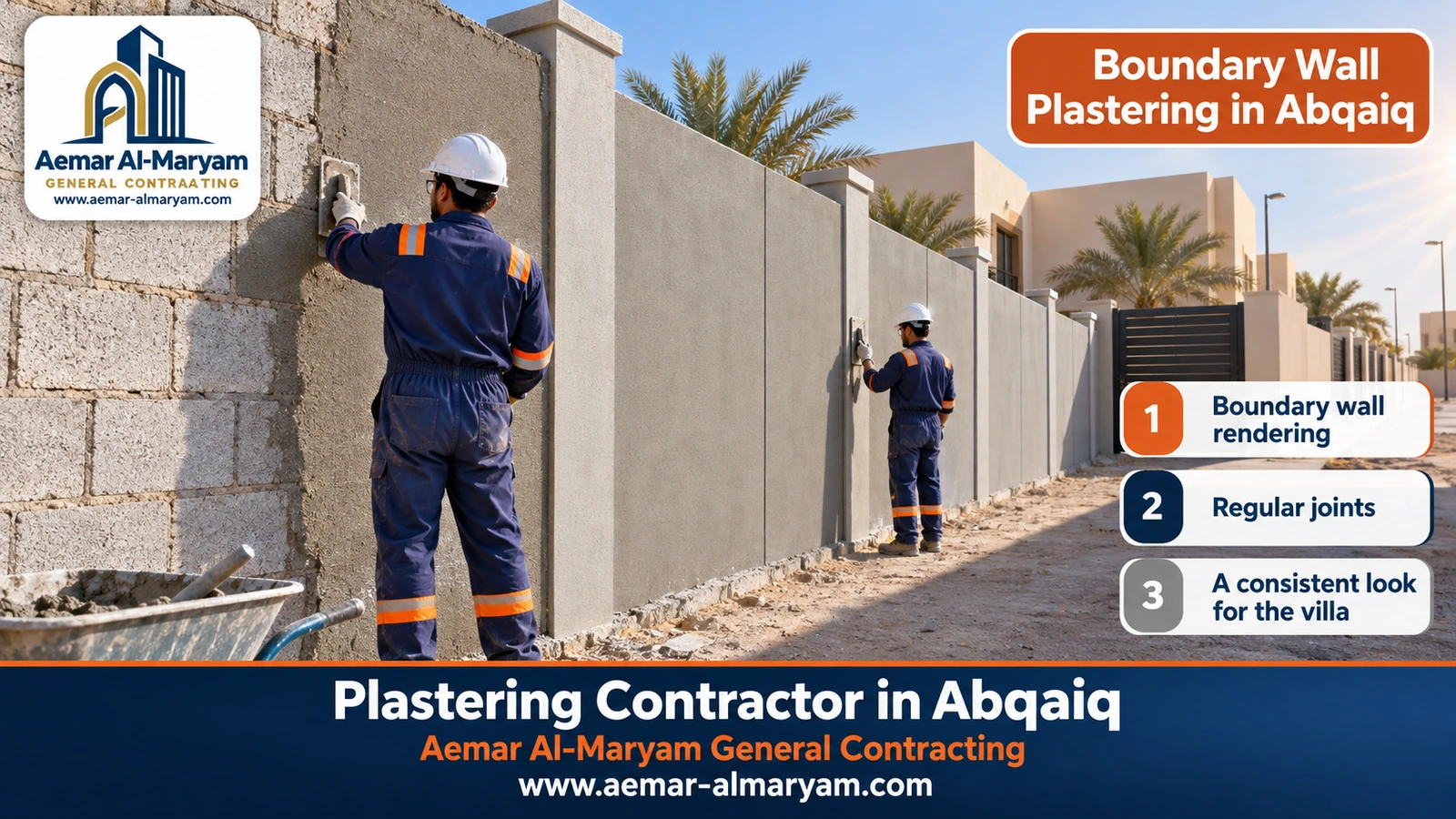
A long boundary wall is among the elements most likely to crack in the heat, because it is a thin wall exposed to sun on both faces. We render both sides, build in regular vertical joints so it can expand and contract without random cracks, plaster it in stretches that can each be finished and sprayed the same day, and start on the shaded face in the morning. The longer the wall, the more the spraying matters, because its entire length sits in the sun.
Coloured render in Abqaiq
Coloured render suits long boundary walls whose owners are tired of repainting them, since the colour is in the mix itself. On our list it begins at SAR 32/m² including materials. In the heat it needs extra care with spraying, because uneven drying gives uneven shading, which is why we run a trial patch before you approve the colour.
Internal plastering in Abqaiq: rooms, ceilings and corridors
Indoors in Abqaiq we normally apply one cement coat, 12–15 mm thick, filled out between levelled screeds and cut flat with a long rule so the wall is ready for filler or tiling. Closed rooms are kinder to plaster than facades, but strong air conditioning blowing onto a soft wall dries it just as the sun does, so we ask for it to be switched off or redirected away from new walls in the first days. In kitchens and bathrooms we use only cement plaster.
Ceiling plastering in Abqaiq
The slab underside gets its scratch coat first; once that has hardened, the plaster overhead is kept thinner than on the walls. On a top-floor ceiling the concrete runs hotter in summer, so we keep the scratch coat well dampened before plastering, and we ask about roof insulation, because heat and leaks both affect ceiling plaster.
Corner beads in the house
We fit metal corner beads on projecting wall corners and around door openings, plumbing each with a level before bedding it in mortar, so the arrises stay straight and do not chip when furniture is moved.
Filling wiring and plumbing chases after rewiring
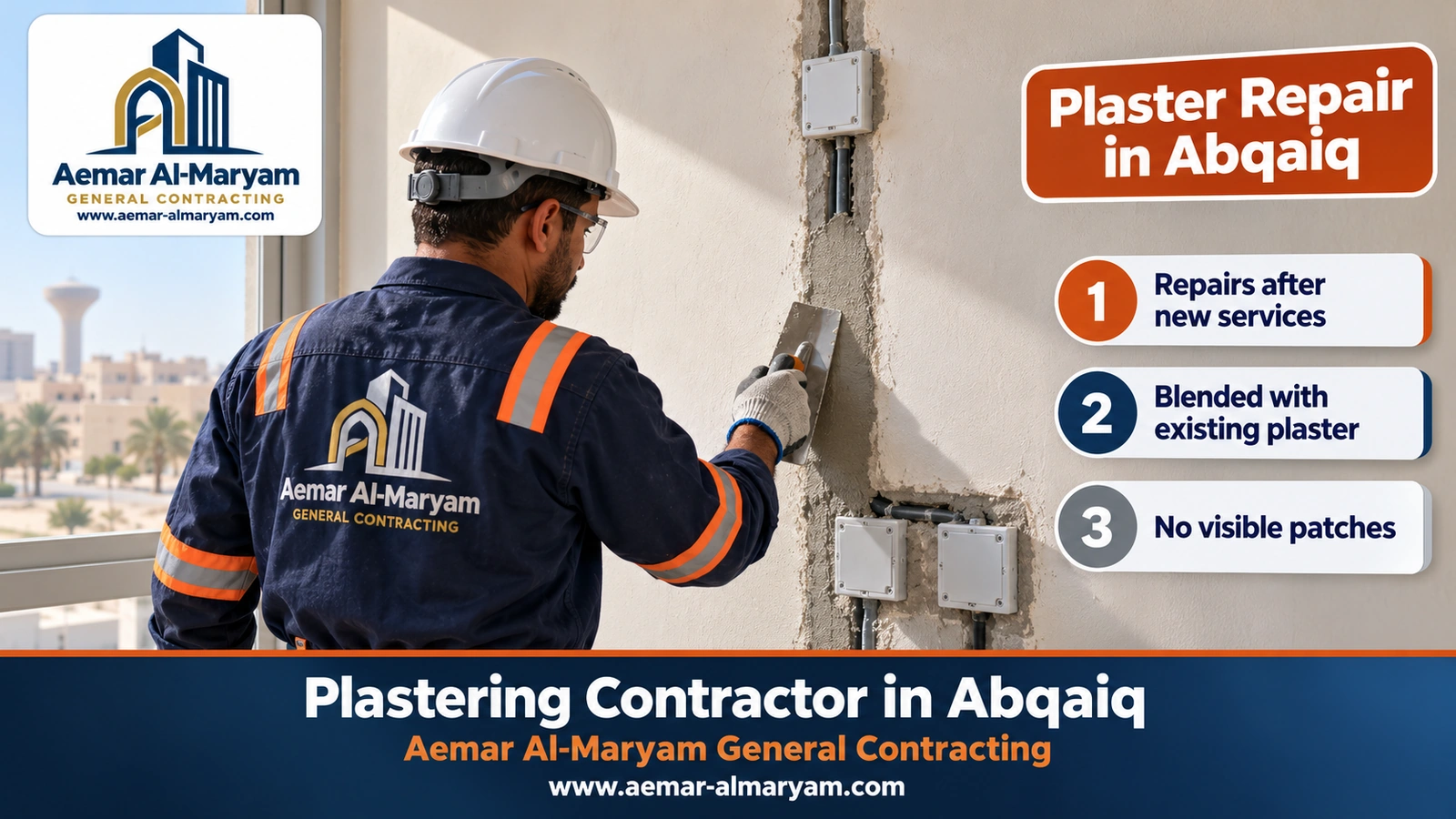
A common job in Abqaiq flats and houses after the services are renewed: walls cut with channels for cables or pipes that need making good. We fill the chases with mortar, in two stages if they are deep, lay a mesh strip that overlaps their edges, then level them with the existing plaster so their line does not show after painting, keeping the electrical boxes covered while we work. This is priced from photos according to the length and depth of the chases, and it can be combined with other work on the same visit.
Scratch coat, dots and screeds in Abqaiq
In Abqaiq the scratch coat, dots and screeds set both the bond and the straightness of the finished wall. For the scratch coat we use a strong 1:2 mix, flicked forcefully at smooth concrete and left coarse, and in this climate nobody plasters over it until it has spent at least a day being kept wet. The dots, spaced about 1.5 m apart, are levelled to mark the final face; the screeds link them in vertical bands that guide the rule. In summer we form the dots and screeds close enough to plastering time that they do not dry out completely and part from the new coat.
Plaster mix ratios and thickness in Abqaiq
We usually mix plaster at one part cement to four to six parts sand, staying near four on the outside and going as rich as two in the scratch coat. We do not add extra cement to the finish coat to “strengthen” it: a very rich mix shrinks more, and in the heat that shrinkage multiplies into map cracking.
| Coat | Ratio | Thickness | Heat note |
|---|---|---|---|
| Scratch coat | Near 1:2 | Thin and rough | Keep damp at least a day |
| Inside walls | 1:4 up to 1:5 | Between 12 and 15 mm | Turn air conditioning away |
| Facade in two coats | Close to 1:4 | From 15 up to 20 mm | Second coat on a damp first |
| Ceiling | Similar to inside | Lighter than walls | Top-floor slabs run hotter |
Cement estimate: ten square metres of plaster two centimetres thick at 1:4 use about one 50 kg bag.
Plaster with mesh in Abqaiq
Plastering with mesh in Abqaiq is essential wherever blockwork meets concrete, since each material grows by a different amount as it warms, and inland nights are much cooler than the days. Before plastering, a band of mesh roughly 15 cm across is laid along the junction, and add mesh around door and window corners and over service chases. On long boundary walls or walls that move a lot, the whole surface can be covered with fibre mesh, from SAR 20 per square metre.
⚠ A widening crack is not a plaster crack
Cracks that pass through the blocks, open up over time or run at an angle from door corners must be diagnosed first; see crack repair in Abqaiq.
Plasterer in Abqaiq: signs of one who understands the heat
A plasterer in Abqaiq who deserves your walls asks before he starts: what time do we begin, who sprays the wall in the afternoon, and is there enough water on site? Then he tells you he will wet the blockwork before plastering, key the concrete with a dash coat, work to levelled screeds, and not render a sunny facade at midday. Someone who promises to finish the whole house in two days without a word about spraying will show you the result in cracked paint a few months later.
Plasterer phone number in Abqaiq
Call or message 0547879578 for plastering in Abqaiq. Include pictures of the walls and the boundary wall, rough sizes and a map pin, and we will come back with the right approach and a first figure before booking the visit.
Plasterer in Abqaiq: day rate or price per m²?
Paying a plasterer in Abqaiq by the day is usually expensive for work that involves travel from another city, and more so in summer because the hours on facades are shorter. Per square metre, you know the full cost in advance and the contractor carries the burden of organising the hours. So we price rooms, facades and boundary walls by area, and chase filling and patches from photos, preferably grouped with a larger job on one visit.
Machine-sprayed or hand plaster in Abqaiq?
A plastering machine earns its place in Abqaiq only on big, uninterrupted areas, like a large villa or several houses being built together, where its speed and uniform batching pay off. But it needs uninterrupted work, which sometimes clashes with the short summer hours on facades, and it needs transporting and setting up. So we price it at inspection, and for most houses and boundary walls hand plastering remains the better fit. Either way, straightness comes from the screeds and strength from the curing.
Gypsum plaster or cement plaster in Abqaiq?
Gypsum plaster in Abqaiq is tempting in summer because it needs no spraying, sets in about thirty minutes and takes paint after three or four days. Its place is still limited to dry interior walls: bedrooms, majlis rooms and living rooms. Facades, boundary walls, bathrooms and kitchens are not for gypsum. Supplied and fixed it costs from SAR 41/m², compared with SAR 13/m² for cement plaster indoors.
| Criterion | Gypsum plaster | Cement plaster |
|---|---|---|
| Copes with heat without spraying? | Yes, no spraying needed | Needs about 7 days of spraying |
| Facades and boundary walls | Not suitable | Suitable |
| Bathrooms and kitchens | Not suitable | Suitable |
| Painting | After 3 to 4 days | After full drying, possibly up to 28 days |
| Starting price | 41 SAR/m² supplied | 13 SAR/m² supplied |
Re-plastering old walls in Abqaiq
Re-plastering old walls in Abqaiq starts with tapping the wall to find what has parted from the blockwork, cutting it back to a sound edge, cleaning dust off the block and wetting it, then scratch-coating and plastering in coats, and finally spraying. We do not lay new plaster over old hollow plaster, because it will come down with it. If salt or damp shows at the base of the wall, we look for the source first, which can mean bringing in our Abqaiq renovation team. Taking plaster off costs from SAR 7.5/m², and taking it off and replacing it from SAR 23/m².
Plaster defects in Abqaiq and their causes
Most plaster defects in Abqaiq trace back to fast drying. The common ones:
| Defect | Usual cause in Abqaiq | Remedy |
|---|---|---|
| Fine map cracking | Plastering in sun without spraying, or a cement-rich finish coat | Regular spraying, filling hairlines, redoing the finish if widespread |
| Hollow patches | Hot, dry blockwork drew the water out, or concrete without a scratch coat | Cut back to a sound edge, wet, scratch-coat, re-plaster in coats |
| Surface crumbles when rubbed | Dried out before the cement had set | Remove the weak layer and redo with curing |
| Straight crack beside a column | No mesh | Open, mesh and redo |
| Random cracks in a boundary wall | Long wall without joints | Vertical joints and crack repair |
| Visible line over a cable chase | Chase filled without mesh | Open, mesh strip and re-level |
Plastering price per square metre in Abqaiq
Plastering prices per square metre in Abqaiq, as minimums: SAR 6.5 indoors when the materials are yours, SAR 13 when they are ours; outside, SAR 14 for the work alone and SAR 18 including our materials. Since nobody in Abqaiq publishes plastering prices, we went back to the nearest published figures in Dammam and the surrounding area and set ours below them. Travel is added after inspection.
| Item | Unit | From | Suits in Abqaiq |
|---|---|---|---|
| Indoor labour, your materials | m² | SAR 6.5 | New house with materials on site |
| Screeded indoor work with corner beads | m² | SAR 11 | Majlis rooms |
| Indoor including cement and sand | m² | SAR 13 | Rooms and corridors |
| Concrete ceilings | m² | SAR 14 | With scratch coat |
| Outside work, labour | m² | SAR 14 | Single-storey facades |
| Outside work, supplied | m² | SAR 18 | Facades and boundary walls |
| Smooth paint-ready finish | m² | SAR 17 | Before painting |
| Fibre mesh across the whole wall | m² | SAR 20 | Long boundary walls |
| Kitchen and bathroom walls | m² | SAR 18 | Cement only |
| Removal without replacement | m² | SAR 7.5 | Hollow sections |
| Removal and new plaster | m² | SAR 23 | Old walls |
| Room cracks before painting | room | SAR 140 | Hairline only |
| Gypsum plaster with our materials | m² | SAR 41 | Dry rooms |
| Coloured render with our materials | m² | SAR 32 | Boundary walls |
| Filling service chases | — | From photos | By length and depth |
| By machine | — | At inspection | Large areas |
| Plaster parted from the wall | — | At inspection | After tapping |
| Damp and salts at the wall base | — | At inspection | Source first |
Final prices follow the site visit; they climb with poor wall condition, thickness, height or difficult access. Every other service is priced on our rates page.
Worked example: a 4.5 × 5.5 m majlis in Abqaiq
Take, for illustration, a majlis 4.5 m by 5.5 m and 3 m high, with a 2.2 m² door and a 2.3 m² window. Both are over 2 m², so both are deducted:
| Item | Result |
|---|---|
| Walls (4.5 + 5.5) × 2 × 3 | 60 m² |
| Less door and window 2.2 + 2.3 | 4.5 m² |
| Net walls | 55.5 m² |
| Ceiling 4.5 × 5.5 | 24.75 m² |
| Total | 80.25 m² |
| Labour only × 6.5 | about SAR 522 |
| Screeds and beads: 55.5 × 11 + 24.75 × 14 | 610.5 + 346.5 = SAR 957 |
| With materials × 13 | about SAR 1,043 |
| Cement at 2 cm | roughly 8 bags |
Example: a villa boundary wall in Abqaiq
A boundary wall 60 m long and 2.5 m high, rendered on both faces, gives 60 × 2.5 × 2 = 300 m². External labour from 300 × 14 = SAR 4,200; external render with materials from 300 × 18 = SAR 5,400; coloured render with materials from 300 × 32 = SAR 9,600, with no painting afterwards. Travel is added after inspection.
How long does plastering take in Abqaiq?
A medium room or majlis takes about a working day; a single-storey house facade two to three days because of the wait between coats; a boundary wall depends on its length. In summer the job may run a little longer because facade hours are shorter, and then come the curing days. We write the schedule with the price so you know when we start, when we finish and when you can paint.
Can you paint without plastering in Abqaiq?
Not on ordinary blockwork, facades or boundary walls: paint does not cover block joints or protect the wall, and it cracks as the blockwork expands in the heat. Indoors only, plaster can be skipped on smooth cast concrete or gypsum board, provided a suitable coat of filler goes on first.
Plastering within renovation and finishing in Abqaiq
Many plastering requests in Abqaiq are part of something bigger: an old house being refreshed, an annex going up in the courtyard, or a flat being rewired before repainting. In these cases we put plastering in its proper place in the programme: after demolition, services and insulation, and before filler, paint and tiles. That order prevents the thing owners hate most, breaking new plaster to run a forgotten cable or pipe. See our finishing works and renovation service pages, and if the project is a new annex, read annex and majlis building in Abqaiq.
How plastering is carried out in Abqaiq
- 1Photos and sizes
Sent on WhatsApp; we reply with a first figure and suggest dates that suit the season. - 2Inspection
Tapping and level checks, marking where mesh and joints go, and confirming there is water on site. - 3Work plan
Facades ordered around the shade, and agreement on who continues spraying after us. - 4Preparation
Damping the blocks, keying the concrete, setting dots, screeds, beads and mesh. - 5Plastering
A single coat inside; outside, a base coat and a finish coat at least 48 hours apart. - 6Spraying and shading
About 7 days, at least twice daily. - 7Handover
A joint check, then a clean site.
What to check when accepting plaster
- ✓Flatness: a two-metre rule laid in different directions.
- ✓Hairline cracks: look at the wall just after it has been sprayed; hairlines show up more clearly on a wet surface.
- ✓Tapping: no hollow sound.
- ✓Arrises: straight and unchipped.
- ✓Chases: no visible line over filled cable runs.
- ✓Spraying schedule: who continues it and how many days remain.
Common plastering mistakes in Abqaiq
- Rendering a sun-facing facade at midday.
- Plastering hot, dry blockwork without wetting it.
- Stopping the spraying after one day.
- Adding cement to the finish coat to “make it stronger”.
- A long boundary wall with no joints.
- Filling cable chases without mesh tape.
- Strong air conditioning blowing onto new walls.
Ordering a plastering contractor in Abqaiq
Send the following to WhatsApp 0547879578 and we will reply with the method, a first figure and suggested dates:
- ✓Photos: each wall, facade or boundary wall from a distance, plus close-ups of cracks and hollow areas.
- ✓Sizes: lengths and heights, and the boundary wall length if there is one.
- ✓Scope: new plaster, redo, or chase filling after rewiring.
- ✓Water: whether there is enough water on site for mixing and spraying.
- ✓Materials: yours or ours.
- ✓Location and timing: a map pin and your preferred dates.
What the Aemar Al-Maryam team offers in Abqaiq
■ Heat know-how
Wetting, timing, spraying and shading; no midday render on a sunny facade.
■ Open pricing
Every line has a stated minimum; travel is agreed once we have seen the job.
■ A complete visit
We group the house’s work into one trip and bring enough to finish it.
■ Written spraying plan
You know what to do after we leave, and when.
■ Work before plaster
As general contractors we treat cracks and damp first.
■ From our projects
Real photos in the projects gallery.
Coverage in Abqaiq
We serve houses, villas and flats across Abqaiq governorate on visits planned from Dammam. Our other services there are on the Abqaiq page, and the full guide to every plastering stage is at plastering contractor in Dammam. If you have another site, we also cover Jubail plastering and Ras Tanura plastering.
Plaster that holds up in Abqaiq’s heat
Send photos of your walls and boundary wall or give us a call; we will agree the method, a first figure and the best dates for the season.
More of our work in Abqaiq
Article tags