
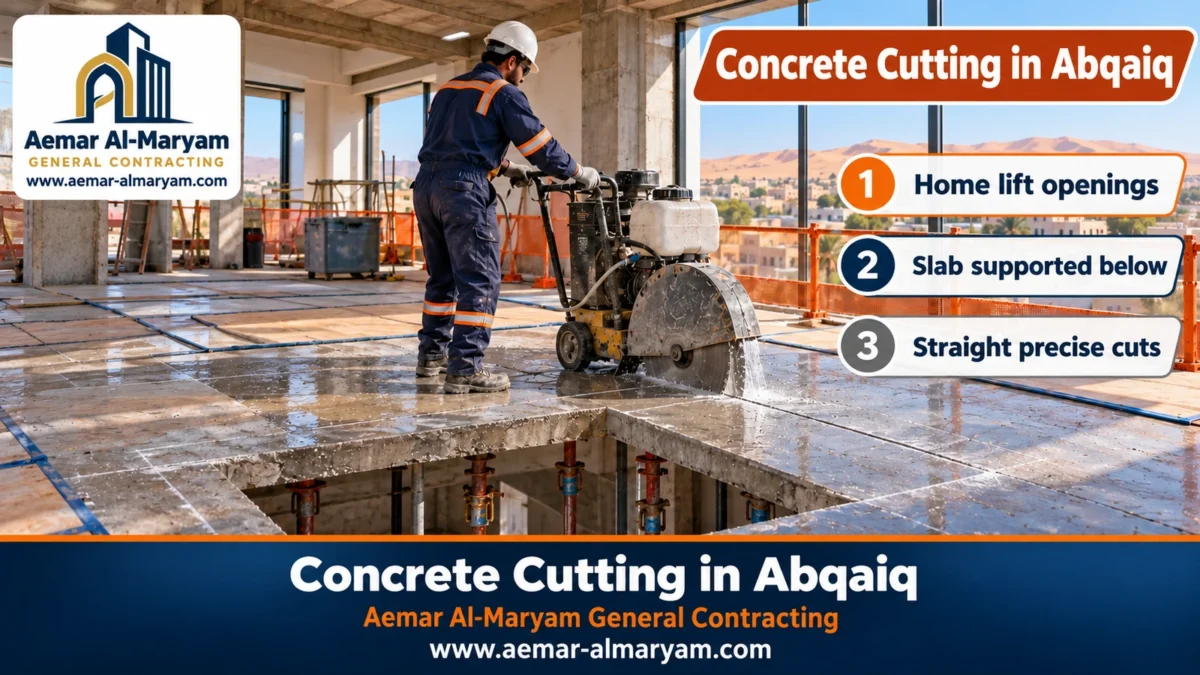
Need concrete cutting in Abqaiq? The service means we open the wall, slab or floor exactly where and as wide as you want, using diamond saws and core bits that slice cleanly instead of the hammering that cracks everything around an opening. We reach Abqaiq from our Dammam base on a scheduled visit, and for homes, shops and small workshops we carry out core holes for AC and drainage, new doors and windows, wall and step alterations, and slab openings to an engineer’s drawing. Rates at Aemar Al-Maryam General Contracting begin at SAR 90 for a small opening, confirmed after inspection. Phone and WhatsApp: 0547879578.
Abqaiq is a governorate seat lying between Dammam and Al-Ahsa, and the town is seeing fast urban growth: houses going up, others being reworked for growing families, shops being fitted out for a new trade, and workshops needing routes for their services. Because our crew travels in from outside the town, the most useful part of this guide is not an explanation of saws. It is how to turn everything you need into one “job list” that we finish in a single day, and what to have ready before we arrive so that none of that day is lost.
Before you call: the essentials
- Type of visit: scheduled trips to Abqaiq on a date agreed in advance, not a same-hour emergency service.
- The key to saving: put every opening on one list, so each item carries a smaller share of the travel cost.
- What we do: core holes, wall, slab and floor sawing, door and window openings, and alterations to steps and low walls.
- Who for: houses, villas and small apartment blocks, shops, and small workshops.
- Starting prices: small holes from SAR 90, sawing from SAR 75 per linear metre, door or window openings from SAR 140; estimates until inspection and agreement.
- First step: photos, sizes and your location on WhatsApp 0547879578.
Concrete Cutting in Abqaiq in One Visit: How to Build Your Job List
Concrete cutting in Abqaiq is cheaper and quicker when every job reaches us at once. The reason is practical: when the crew leaves Dammam, the van holds machines, core bits and blades chosen for specific jobs. If we discover on site an opening nobody mentioned that needs a bit diameter we did not pack, it either waits for another trip or gets a second-best solution. A written list prevents that completely.
You do not need engineering knowledge to write the list. Simply walk through the house or shop room by room and note every place where you want a hole, an opening or a cut. Here is a simple template you can copy and send us on WhatsApp:
| No. | Location | Type of work | Size | Note |
|---|---|---|---|---|
| 1 | Master bedroom | Split AC core hole | About 65 mm | First floor, external wall |
| 2 | Kitchen | Rectangular extractor opening | e.g. 30 × 30 cm | Poured concrete or block? |
| 3 | Majlis | New doorway into the hall | Per the door you bought | Is the wall load-bearing? |
| 4 | Courtyard | Floor cut for a drain run | Length in metres | Type of tiles over the concrete |
| 5 | Villa entrance | Trim a concrete step | Required width | A photo from the side |
Make the list visual
Next to each line, send a photo of the spot with a simple pen mark or a strip of masking tape on the wall showing where the opening goes. A marked photo answers half our questions before we ask them.
When the list arrives, we reply with three things: the right method for each item, the estimated cost for the whole job, and what we need from you on the day. If an item needs an engineering opinion before it can be done, we tell you at the outset so the work does not stall halfway through.
Why a Scheduled Visit Suits Abqaiq Better Than an Urgent Call-Out
An urgent request may sound faster, but in a town outside the company base it usually means a crew arriving with whatever equipment happens to be on hand, and inspecting and cutting at the same moment with no time to check thicknesses or steel. A scheduled visit gives us a day or two to study your photos, choose the right diameter for each bit, prepare props if they are needed and plan the order of work. The outcome is a shorter day at your property, a clearer cost and fewer mistakes.
If something genuinely cannot wait, such as a broken drain pipe that needs a replacement hole, say so plainly in your first message, and we will look for the earliest possible slot with you or suggest a temporary fix until the visit.
What to Prepare Before the Cutting Crew Reaches Abqaiq
A working day in Abqaiq is counted from the moment we leave Dammam, and every half hour of waiting on site delays the rest of the list. This is the preparation checklist we ask every Abqaiq customer to complete before the appointment:
- ✓Clear the work area: move furniture and appliances well away from every wall to be cut, and lift nearby rugs and curtains.
- ✓Mark every opening on the wall: with tape or a pen, so we can start measuring straight away.
- ✓Have a power point nearby: a sound socket or a board we can connect to, because the machines need a steady supply.
- ✓Have a water source: a tap or a tank close by, since diamond cutting is water-cooled the whole time.
- ✓Leave space for the van: near the entrance, because some equipment is heavy and carried in by hand.
- ✓Isolate power to the target wall: if you know cables run through it, or tell us so we can scan it.
- ✓Tell the neighbours: in adjoining apartments and shops, as saw noise carries and water may reach the other side of a shared wall.
- ✓Have engineering papers ready: the engineering office report or drawing for any work in a slab or a load-bearing wall.
Do not start breaking before we arrive
Some customers try to “help” by knocking part of the wall out with a hammer before the appointment. The edges shatter and a clean cutting job turns into a repair job. Leave the wall as it is; we will cut and free the block, then it is broken up or lifted out.
Concrete Cutting Company in Abqaiq for Homes, Shops and Small Workshops
A concrete cutting company in Abqaiq is only really useful if it understands the kind of place it is working in. An occupied home is different from a shop whose owner wants to open soon, and a workshop is different again. These are the jobs we receive in Abqaiq, grouped by property:
Houses, Villas and Small Apartment Blocks
In homes, the request is usually part of an interior rework: joining two rooms with a wide opening, turning a kitchen wall into an open counter, a doorway into a new annex, or AC holes after the rooms have been rearranged. In small apartment blocks, drainage holes in the basement and ground floors come up often when the old network is replaced. The advantage of cutting here is that the home stays liveable during the work, because water holds the dust down and vibration is low.
Shops
A shop changing its trade usually needs a quick alteration: an internal door between two adjoining units rented by one tenant, an opening into a rear store room, or holes for ventilation ducts and extractors if the new business is a restaurant or bakery. The shop owner cares about time, so we suggest working on a closing day or before trading starts, and we prepare all the equipment the evening before. A new opening in the shopfront may need municipal approval, so check that before the appointment.
Small Workshops
A workshop usually needs work in the floor rather than the walls: a cut channel in the slab for an electrical or drainage line to a sink or machine, removing part of the floor to cast a new base for heavy equipment, or holes through a wall for air ducts. This is where the floor saw comes in: it runs along the slab cutting straight lines to a set depth, and the cut strip is lifted out without cracking the rest.
■ Houses and villas
Openings between rooms, kitchen counters, annex doorways, AC holes, and a home-lift opening to a drawing.
■ Small apartment blocks
Drainage holes in basements and ground floors, and service openings between flats and stairwells.
■ Shops
Doors between units, store-room openings, ventilation and extractor holes for a new business.
■ Small workshops
Floor channels for services, and removing slab sections for equipment bases.
Concrete Cutting and Coring in Abqaiq: One Job, Two Tools
Concrete cutting and coring in Abqaiq turn up together on most of the lists we receive; a house or shop rarely needs only round holes or only rectangular openings. A core bit leaves a circular passage for pipework or ducting; a saw leaves a square-cornered gap you can hang a door in, glaze, or top with a counter. Once we have the full list we bring both machines and plan the order so the wettest jobs are done first and the cleaner ones after, leaving the place tidy at the end of the day.
A practical example: a villa in Abqaiq whose list has three AC holes, a kitchen extractor opening and a wall turned into a counter. We start with the counter because it involves the most water and cutting, then the extractor opening, and finish with the three AC holes, which go quickly one after another once the rig is set up in each room. In that order the vacuuming and cleaning happen once at the end instead of after every item.
Core Drilling in Abqaiq for Split Units, Drains and Kitchen Fans
Core drilling in Abqaiq is done with a core rig fixed on a stand bolted to the wall or slab, and a tubular diamond bit fed with water from inside to cool it and carry off the dust. The hole comes out round and true, and the removed piece leaves the wall as a complete cylinder, so there is no breakage around the opening and little making good afterwards.
AC Core Holes in Abqaiq
The usual split AC hole is around 65 mm, and we drill it falling slightly towards the outside so water does not run back into the room. If you have several units, put them all on the list with the floor and wall for each; once the rig is in place an extra hole is quick, and it costs far less than a hole that needs its own visit.
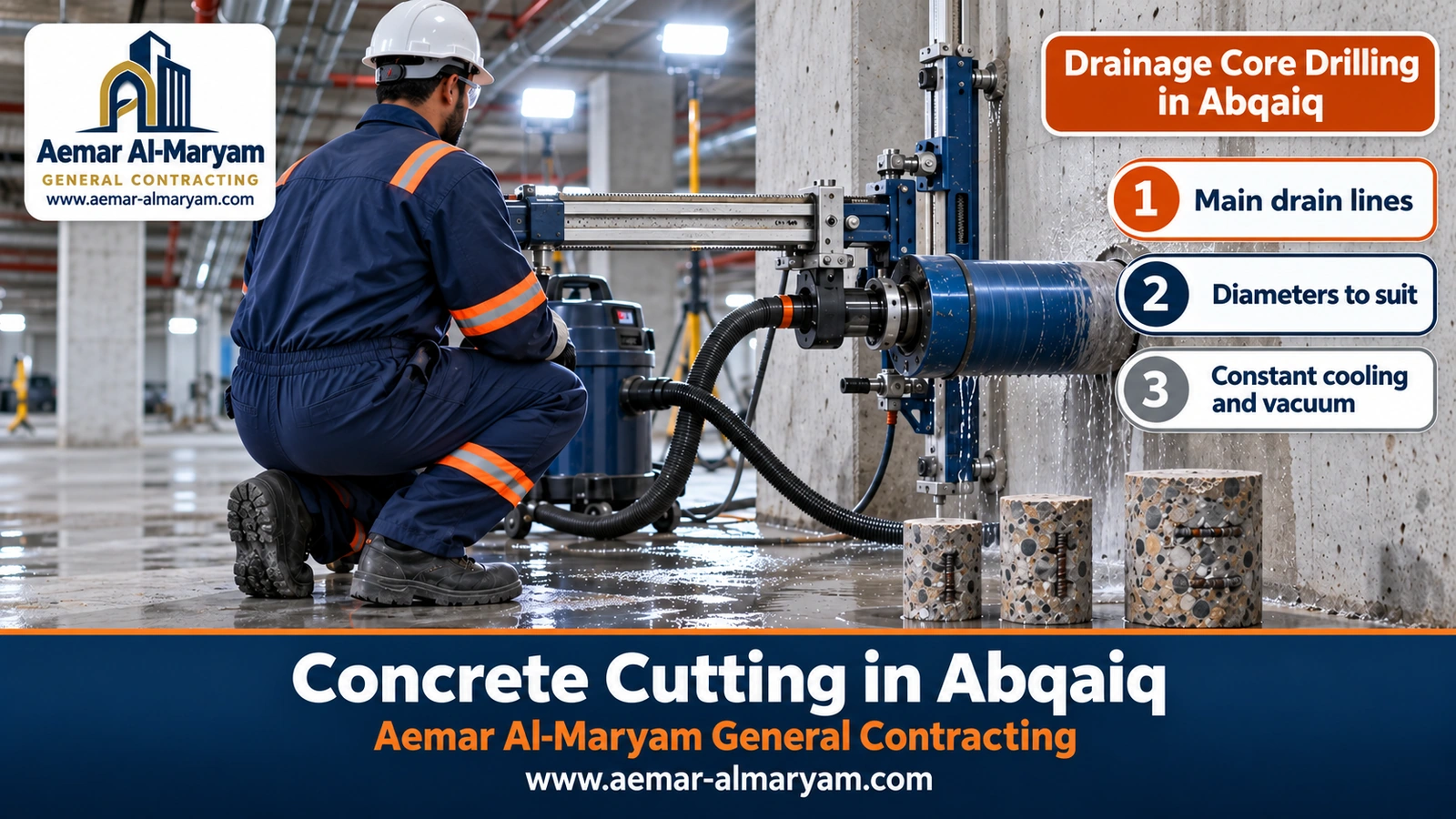
Drainage Core Drilling in Abqaiq Basements and Apartment Blocks
Drainage holes are bigger than AC holes, and their size follows the pipe and how it will be fixed, so we only set it once the plumber has chosen the pipe or we have seen the network drawing. In basements especially the wall tends to be thicker, the steel denser and the work close to the floor, so we vacuum water continuously to keep the floor dry and let the plumber start straight after us.
Core Holes in Slabs and Floors
A hole through a slab needs checking first, because the slab carries the whole floor and may contain electrical or plumbing runs. We use a rebar detector to choose a spot clear of the main bars, and we never core a beam unless an engineering office has decided it. Diameters and uses are covered on our core holes page.
Wall Sawing in Abqaiq with a Diamond Saw
Wall sawing in Abqaiq is done with a wall saw whose rail is anchored to the wall; the saw head travels along it carrying a large diamond blade that cuts concrete and steel together under cooling water. We cut each line in passes, going deeper each time, until the required section is free of the rest of the wall. This is what any rectangular job in a concrete wall calls for.
Abqaiq Door Openings and New Windows in Poured Concrete Walls
A new door in a concrete wall in Abqaiq starts with two questions: is the wall load-bearing, and what size is the door you bought? Tell-tale signs of a bearing wall are a thickness beyond 20 cm, a column landing on top, or a beam running underneath, and an opening in it needs an engineering office report that sets the lintel or strengthening above the door. As for the size, we take it from the actual door frame, not from a sketch alone. A new window in a wall facing the street alters the façade and the municipality may require a permit for it. More on our door and window openings page.
Cutting Through Tiles and Concrete Without Damaging the Surroundings
When the wall to be opened is clad in tiles or marble, as in kitchens, bathrooms and entrances, the first step is to cut the tiles exactly along the outline, then cut the concrete behind. That way the surrounding tiles stay intact with a straight edge, and you do not have to replace a whole row because one tile cracked under a hammer. The same applies to tiled floors.
Lowering a Wall or Turning It into an Open Counter
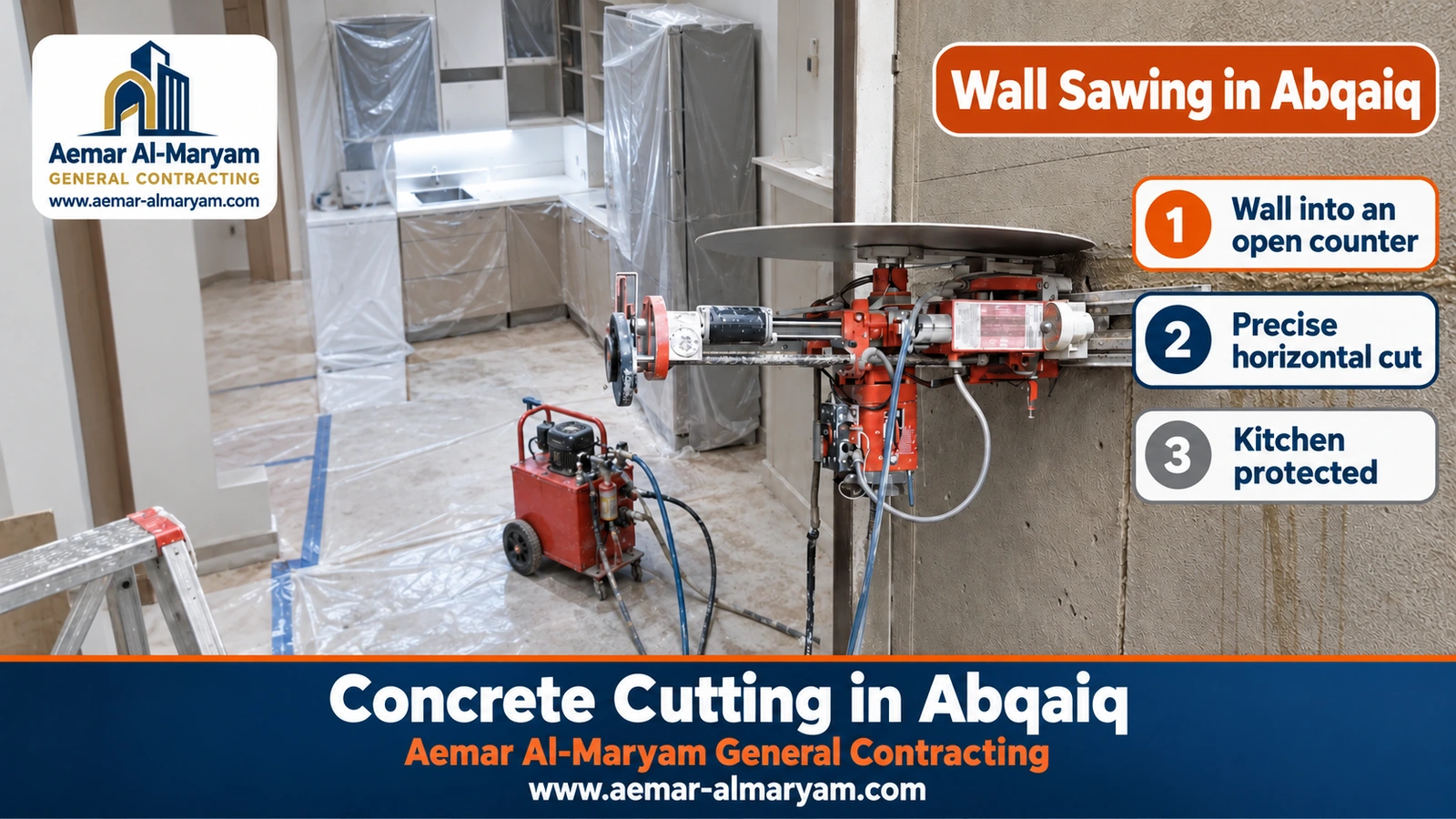
One job we are asked for in Abqaiq is lowering an interior wall between kitchen and living room to make a counter, or opening its upper part as an internal window. The wall saw cuts a horizontal line along the wall and then two vertical lines at the ends; the upper part is lifted out in pieces, and the lower part keeps a level edge ready for a marble or timber top to be fitted directly.
Laser Wall Cutting in Abqaiq: Separating the Myth from the Method
Plenty of people in Abqaiq type “laser wall cutting” into Google, yet building contractors simply do not own a laser that slices steel-reinforced walls. The adverts using that label are selling diamond-blade sawing on a fixed track, with a laser line projector used to mark out and square up the cut. Experiments with high-power lasers on concrete stayed at shallow surface stripping in research on dismantling facilities. We give you the same precise result with the right tool; the details are in our article on what laser cutting really is.
Slab Cutting in Abqaiq: A Home-Lift or Internal Stair Opening
Most slab cutting we do in Abqaiq is for villas fitting a residential lift so older parents can reach the upper floor, for a staircase up to a rooftop annex, or for a large ducted-AC riser. Because the slab is part of the frame, so we do not carry it out without an engineering office drawing that sets the size and the strengthening around the opening. On site we follow a fixed order:
- 1Matching the drawing on site
We mark the opening on the slab from above and below, and confirm it stays clear of the beams as drawn. - 2Support from below
Adjustable steel props go under and around the opening before the blade touches the slab. - 3Drawing a cutting grid
We divide the opening into squares that can be lifted safely instead of one heavy mass. - 4Cutting with the floor saw
The saw cuts the grid lines from the top of the slab with cooling water, and we protect the floor below from water. - 5Lifting out and handing over
The pieces come out one at a time, and the edges are handed over straight and ready for strengthening and finishing.
For this kind of job the price is set after inspection and the drawing, because it depends on the area, the thickness, the number of props and how the pieces will be removed. If you are still at the planning stage, send us the drawing itself and we will tell you what is needed on our side.
Concrete Saws in Abqaiq: Which Tool for Which Job?
The right concrete saw in Abqaiq depends on where you are cutting (wall, slab or floor), how thick the element is and what shape the opening takes. Rather than a long table, here is the practical rule we choose by:
■ Wall with a rectangular opening
The rail-mounted wall saw; heavy models cut about 73 cm deep from one side.
■ Floor or slab from above
The walk-behind floor saw pushed along the slab; it reaches about 24 cm deep.
■ Round hole
The core rig with a bit of the required diameter; common rigs cover 12 mm to 500 mm.
■ Very thick mass
The diamond wire saw, since it wraps around the element and has no blade-diameter limit.
■ Light work or trimming
The hand-held cutter (“grinder”), which reaches only about 12.5 cm.
■ Before any cut
A detector for steel and services, and a laser level for setting out lines.
Grinder Wall Cutting in Abqaiq: Where It Works
A grinder suits jobs shallower than its blade can reach: trimming the end of a concrete step, a small opening in a block wall, or cutting tiles and a surface layer before breaking. A reinforced concrete wall thicker than about 12.5 cm cannot be cut through from one side with a grinder, so the job then needs the wall saw.
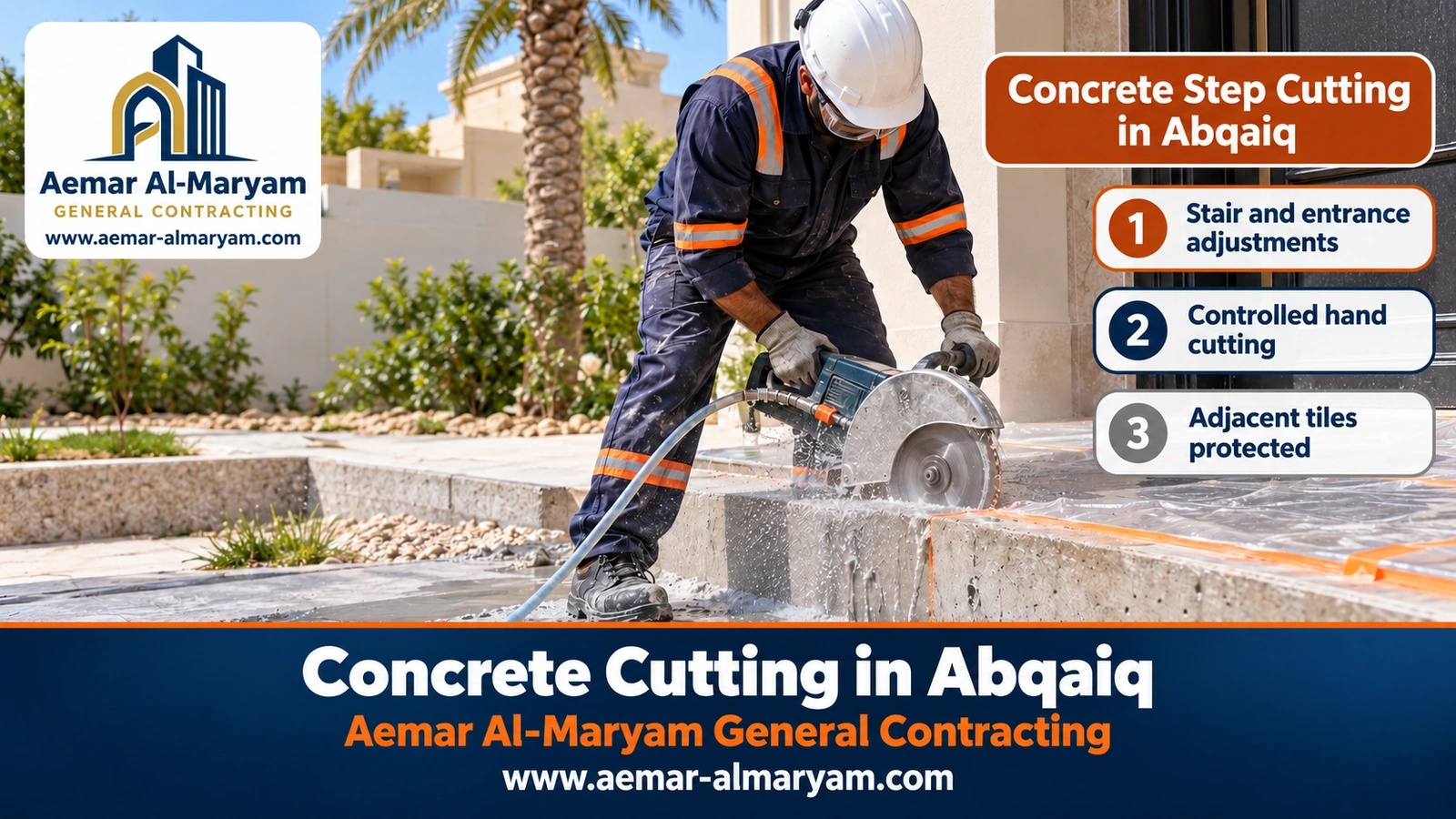
Altering outdoor steps is a common Abqaiq request: a step that sticks out and gets in the way of a car or wheelchair, or a stair narrowed to make a side path. Light trimming is fine with a grinder and water, while removing a whole step or making a big change to the stair needs the saw and then lifting out the blocks.
Floor Sawing in Abqaiq for Workshops, Courtyards and Shops
Floor cutting is a different job from wall cutting, and it gets its own section because it is what small workshops in Abqaiq ask for most, along with many homes replacing the drainage in their courtyard. What is needed is usually a straight channel of set width in a ground slab, with the concrete lifted out so the plumber or electrician can lay the line, then cover it again.
- 1Setting out the route
We mark the two edges of the channel on the floor at the required spacing, and check as far as possible that no old services run beneath. - 2Sawing both lines
The floor saw travels along the slab and cuts both lines to full depth, under a steady water feed. - 3Sectioning the strip
We cross-cut the strip between the lines at intervals so it becomes short pieces that are easy to lift. - 4Lifting and cleaning
The pieces are lifted and the bottom of the channel cleaned, ready for the trade that follows to dig or lay the line.
If the floor is tiled, we cut the tiles along the same two lines before the concrete so the neighbouring tiles do not break, which makes re-tiling after the new line is laid easier and cheaper. In outdoor parking areas and paths, an asphalt layer and the concrete beneath it can be cut the same way when a line has to run underneath.
For workshop owners
If you are going to set a heavy machine on a new base, ask the supplier for the base dimensions and depth before we come, so we cut the right section of floor once, at the right size.
Reinforced Concrete Cutting in Abqaiq: When We Cut the Steel and When We Avoid It
Reinforced concrete cutting in Abqaiq is technically no different from cutting plain concrete; the diamond blade goes through steel and concrete together. The difference lies in the decision: may the steel be cut at this point? For small holes we move the opening away from the main bars where the space allows, after locating them with the detector. For doors and slab openings, the engineer decides which bars are cut and what strengthening replaces them.
Limits we never cross, in Abqaiq or anywhere else
Columns stay untouched, beams stay un-cored, and bearing walls and slabs stay closed until an engineering office has put its approval in writing. If post-tensioned tendons show up in a slab, we stop and go back to the engineer, because cutting one puts the whole slab at risk.
A Working Day in Abqaiq: From Arrival to Handover
Many customers ask how long the work will take and whether they need to be there all day. The duration depends on the list and the thicknesses, but the shape of the day is almost always the same, and knowing it helps you plan:
- Arrival and walk-round: we go through every item on the list with you on site and confirm the sizes and marked positions.
- Protection: we cover floors and nearby furniture and put barriers round the work areas.
- Scanning: we check hole and opening positions with the steel and services detector before any cutting.
- Wettest jobs first: floor cuts and large openings, then small holes and trimming.
- Vacuuming as we go: a wet vacuum removes water and slurry during the work, not after it.
- Handover: we review each item with you, lift out the pieces as agreed and leave the place tidy.
If something on site calls for an item to change, for example dense steel where a hole was planned, we pause that item and explain the options before carrying on; we do not decide on your behalf.
Safety, Water and Dust When Cutting in Abqaiq Homes and Shops
Water in diamond cutting is not a detail: it traps the respirable silica that dry concrete cutting would throw into the room, and what keeps the blade and bit from burning. But it needs organising so the house or shop does not become a pool of slurry. These are the rules we follow on every site:
■ Water-resistant connections
All electrical connections are protected and on a safety breaker, because water runs near the machines the whole time.
■ A closed-off work zone
Only the crew enters it, especially in homes with children and shops open to customers.
■ Pieces always supported
Every cut section is supported and removed under control, never left to drop.
■ Drains protected
We keep slurry out of bathroom and kitchen drains so they do not block.
Concrete Cutting Prices in Abqaiq
Concrete cutting prices in Abqaiq are our standard Eastern Province rates, plus travel to Abqaiq, which we state alongside the estimate. Small cores of up to roughly 100 mm are listed from SAR 90, sawing is charged from SAR 75 for each linear metre, and a doorway or window cut-out from SAR 140:
| Item | From | Example from Abqaiq lists |
|---|---|---|
| Small hole or simple opening up to about 100 mm | SAR 90 | Split AC, a cable or a narrow pipe |
| 5-inch hole (about 125 mm) | SAR 140 | Drain pipe on a ground floor |
| 6-inch hole (roughly 150 to 160 mm) | SAR 140 | Restaurant or bakery extractor |
| 8-inch hole (about 200 mm) | SAR 230 | Main drain line in a block basement |
| 10-inch hole and larger | After inspection | Central AC ducts |
| Sawing per linear metre | SAR 75 per metre | Service channel in a workshop floor |
| New door or window in a wall | SAR 140 | Passage between two adjoining shops |
| Wall cutting job | SAR 280 | Turning a kitchen wall into a counter |
| Slab opening for a lift, stair or duct | After inspection and drawing | Home lift in a villa |
| Wire saw and thick masses | After inspection | Old machine base in a workshop |
Figures are estimates until inspection and agreement, and they shift with the element thickness, steel density, floor level, how easily equipment can be brought in, and whether we handle lifting out the pieces and taking away the debris.
Why Does the Cost per Opening Fall as the List Grows?
The cost of travelling to Abqaiq and preparing the equipment is roughly fixed whether we make one hole or ten. If your list is a single AC hole, that hole carries the whole cost of the trip. If you add the other AC holes, the extractor opening and the step alteration, the cost is shared across all of them and each item’s share drops. That is why we suggest waiting a few days for the list to be complete rather than asking for one opening today and another next week.
See also our estimated price list for the rest of our services.
Engineer or Balady Licence: What Abqaiq Jobs Need Paperwork?
Small holes for AC, plumbing and electrics, once their position has been checked, usually leave the building structure untouched and need no formalities. It is different when the job alters the load path: punching a door through a bearing wall, cutting a slab for a lift or stairwell, or touching a beam. For those, line up an approved engineering consultant first, and expect that Balady may want a restoration licence or a component-change licence on top. Changing the front of a shop or house with a new opening usually falls within the same framework.
How we help with this
From the photos on your list we tell you which items are routine and which need an engineer, so you can start that process early, and we can carry out the routine items on the same visit if you wish, without waiting.
Mistakes That Lengthen the Day or Raise the Cost in Abqaiq
- An incomplete list: items added on site may need equipment we did not bring.
- Vague sizes: “a normal door” is not a size; send the real width and height of the frame.
- A site that is not ready: furniture not moved, power off and no water available.
- Breaking beforehand: a labourer starting with a hammer before us ruins the edges and makes cutting harder.
- No decision-maker present: if an opening has to move on site, someone needs to decide on the spot.
- Forgetting the neighbour: on shared walls, water or noise may reach the other side.
What to Send on WhatsApp from Abqaiq Along with the List
The list tells us what you want; this extra information tells us how to get there. Send it with the list to 0547879578:
- ✓Thickness of each wall or slab a rough figure is fine, and a tape measure held against a door reveal in that wall gives it to you.
- ✓What the wall is made of poured concrete or block? A photo of an exposed part of the wall is usually enough.
- ✓Floor level and access route is there a narrow stair or a lift? Some equipment is heavy and long.
- ✓Your map location especially if the property is outside the town centre or in one of the villages.
- ✓What is behind the wall an occupied room, a neighbour’s shop or the street.
- ✓The days that suit you and we will tell you the nearest one we have free.
How to Order Concrete Cutting in Abqaiq, Step by Step
- 1Write and photograph the list
Each item on its own line with a marked photo, sent on WhatsApp 0547879578. - 2Receive the reply and estimate
The method for each item, the total estimated cost including travel, and any items that need an engineer. - 3Agree the visit date
We pick a day that suits you and fits around the shop’s trading or the household. - 4Prepare the site
Following the preparation checklist: cleared space, power, water and room for the van. - 5Work and handover
We complete the list, vacuum the water, tidy up, and you check every item before we leave.
Alternatively, the online booking form gets your details to us and we ring you.
What Abqaiq Customers Get from Aemar Al-Maryam
- ✓Planning before we set off: we review your whole list and bring what every item needs.
- ✓A published starting price: from SAR 90 for a small hole, with the travel cost made clear before the appointment.
- ✓A tool for every job: wall saw, floor saw, wire saw, core rig and a grinder for light work.
- ✓Respect for homes and shops: clean work with water and vacuuming, and timing that fits your business.
- ✓Structural honesty: we tell you what needs an engineer, and we never cut a column or a beam.
What sets our approach to Abqaiq apart is that we do not treat it as a side stop on the way somewhere else, but as a full working day devoted to your list. We review the photos beforehand, call you if anything needs clarifying, and arrive on time with what each item needs. If one item needs an engineering opinion that has not yet been issued, we complete the rest of the list and return for it on a new date agreed with you.
We also care about what happens after the cut: straight edges save time for the carpenter, mason and plumber who follow us, and a tidy site means the home goes back to the family and the shop to its customers on the same day. You can see examples of our work on the completed projects page.
Abqaiq and Surroundings: Where Do We Go?
We cover the town of Abqaiq, the governorate seat, along with the villages and hamlets that belong to it, on scheduled visits. Because Abqaiq lies between Dammam and Al-Ahsa, your visit can sometimes be combined with a job of ours at either end on the same day. Everything else we do locally is on the Abqaiq area page.
We do not need you to know the exact district or plan name; a location shared from your maps app is enough for us to work out the route and the departure time from Dammam. If the property is in a village and the last stretch of road is unpaved, describe it so we choose the right vehicle for the equipment.
Concrete Cutting in Al-Ahsa and Dammam
If you or someone you know has a job in Al-Ahsa, read our Al-Ahsa concrete cutting guide; for Dammam and the nearby cities, the Dammam cutting and coring guide covers every service. The cutting and coring service page gathers the general information.
Is your list ready? Send it now
Photos of each item, their sizes and your Abqaiq location are enough for us to reply with the method and estimated cost and set the visit day.
Pages to read before the visit
Tags