A plastering contractor in Khafji is what Aemar Al-Maryam General Contracting provides for house and apartment-building owners in the city: mesh-reinforced facade render built to cope with sea humidity and salt, internal plaster for rooms, bathrooms and ceilings, re-plastering of walls spoiled by rising damp, and plaster fillets at parapet walls ahead of roof waterproofing. Facade work begins at SAR 14 a square metre for labour, SAR 18 when we bring the materials and SAR 20 with fibre mesh across the whole wall; rooms begin at SAR 6.5 for labour and SAR 13 with materials. All of these are opening figures that we firm up on site; the line for calls and WhatsApp is 0547879578.
Khafji sits at the northern end of the Eastern Province coast, around 298 km from our Dammam base, and the sea shapes its houses: humid air carrying fine salt that settles on facades, hard sun, and winds that can dry an outer coat within hours. These conditions are unforgiving to plaster with a weak bond, salty mortar or an unmeshed joint. This page explains how we build plaster for a coastal town, how we bundle your jobs into one trip so the road cost is not repeated, and where each item starts.
In short: plastering in Khafji with Aemar Al-Maryam
- Main work: two-coat facade render with mesh at joints or over the full wall, room and bathroom plaster, and roof fillets before waterproofing.
- Local problems: salt-laden sea air attacking facades, and ground moisture creeping up the lower walls of beachside homes.
- Opening rates: facades SAR 14/m² labour, 18 with materials, 20 with full mesh; rooms SAR 6.5 labour, 13 with materials; ceilings SAR 14.
- Distance: about 298 km from Dammam. Travel is costed at inspection and softened by grouping jobs into a single trip.
- To start: facade and room photos with rough sizes on WhatsApp 0547879578.
Plastering contractor in Khafji: what changes in a town on the sea?
A plastering contractor in Khafji uses the same tools as anywhere else, but in a different order of priorities. In Dammam the first question may be straightness. In Khafji it is whether the coat will still be gripping the wall after two damp winters and two hard summers. That is why facades, joints, water sources and materials get our attention before anything else.
■ House and building facades
Two-coat render, mesh on every joint, and full-wall reinforcement where the wall faces the sea.
■ Rooms and bathrooms
Screeded cement plaster indoors, with a damp-suited mix for bathrooms and kitchens.
■ Roofs before waterproofing
A sloped plaster fillet where the roof slab meets the parapet, ready for the membrane.
■ Damp-damaged walls
Lower-wall plaster stripped and redone once the water source is handled.
A general outline of the service is on our plastering service page, and our other local work is on the Khafji page.
External rendering and mesh-reinforced facades in Khafji
Facade render in Khafji goes on in two coats: a base coat ruled flat and left with a key, then a finishing coat once the first has firmed up (normally about two days later), for a combined thickness near 18–20 mm. The mix is richer than for rooms, close to 1:4, with a damp-resisting admixture if the specification asks for one. Sand is washed and water is fresh, because salt in the mix only adds to what the sea air brings.
Mesh is no afterthought here. Wherever blockwork butts against a column or beam we stretch a mesh band about 15 cm wide before rendering and bury it in the coat. The two materials move differently with heat and moisture, so an unreinforced line soon shows a straight crack, and that crack becomes a path for damp to reach the inside.
When should the whole facade be meshed?
We propose fibre mesh over the entire wall on facades directly facing the sea, on walls that keep developing hairline cracks, and on annex facades built from mixed materials. Full mesh spreads shrinkage and thermal stress across the whole surface instead of concentrating it along one line, and starts at SAR 20 a square metre. Sheltered facades are usually fine with joint mesh alone.
Rendering an apartment building facade in Khafji
An apartment building differs from a house in scaffold size, sequencing between floors and protection for residents and passers-by. We start at the top and work down, split the facade into bays that stop at clear joints so there are no random stop lines, shield entrances and parked cars from falling mortar, and agree noisy hours with the residents. Before pricing we ask for a shot of the whole elevation, the number of storeys, the facade length and how narrow the street in front is, because scaffold and access can weigh on cost as much as the area itself.
Window sills and small ledges
On coastal facades the flat wall is rarely what fails first; the edges are. Sills where water sits, balcony projections and the tops of boundary walls all suffer. So every horizontal surface on the facade is given an outward fall, a drip edge throws water clear of the wall below, and plaster around window frames is tightened before painting.
Coloured render in Khafji
Coloured render carries its colour through the mix, so it needs no paint, and is priced from SAR 32 per square metre supplied and applied. Khafji boundary walls take to it well since there is no paint film to peel, but two cautions apply: salt and dust settle on its textured face, so it benefits from an occasional rinse with fresh water, and patches made years later rarely match the original shade, so we supply materials for the full area at once.
Machine plastering or hand plastering in Khafji?
Machine plastering in Khafji means spraying pumpable ready mortar onto the wall through a hose, then ruling it off just as with hand work. It suits large continuous facades and new houses of two floors or more, because machine mixing gives consistent mortar from one end of the facade to the other and cuts the number of working days, which matters in a distant town where every day on site has a cost.
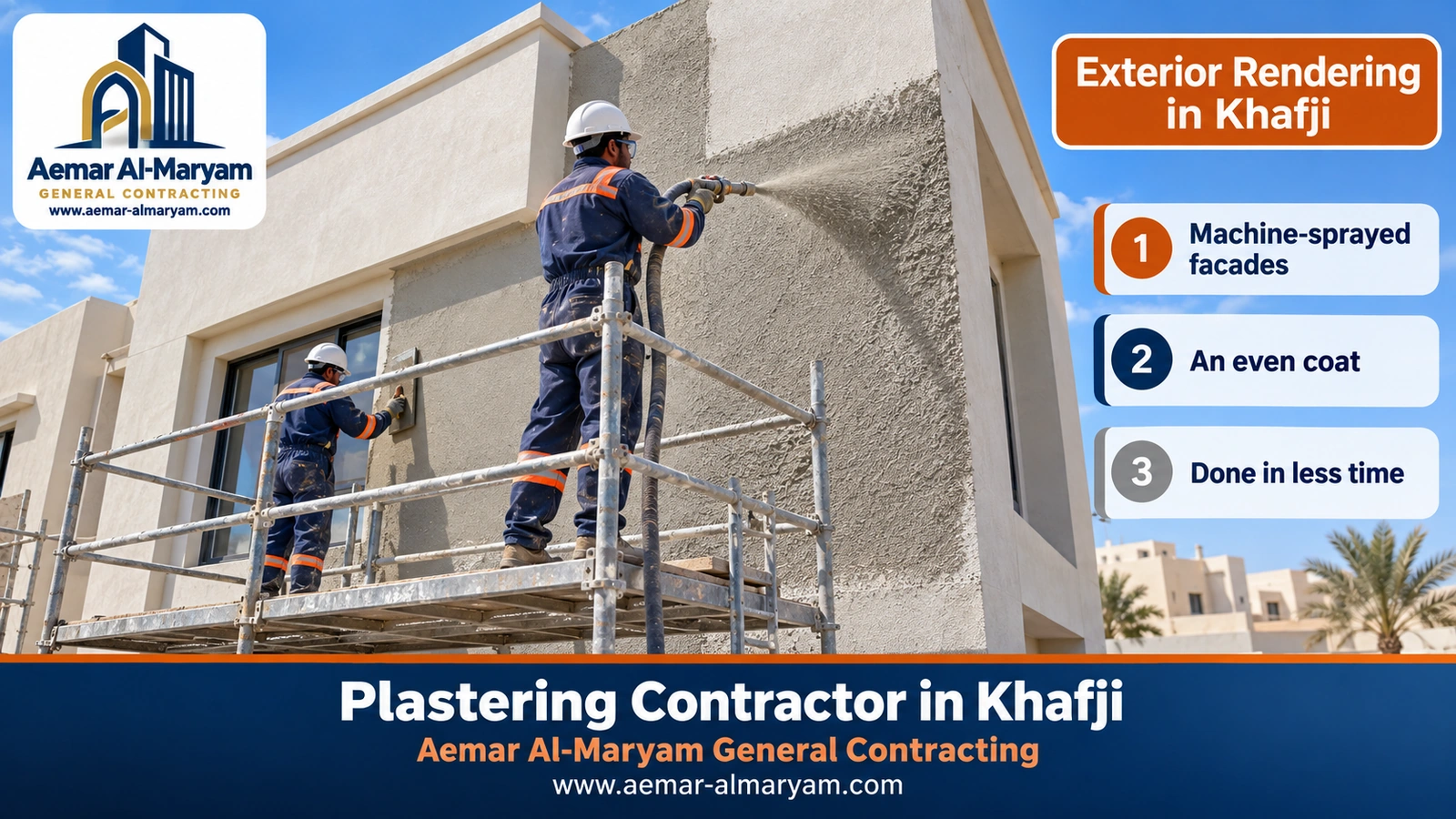
The machine does need uninterrupted work so the hose does not block, plus daily set-up and cleaning and a ready mix designed for spraying. That is why we do not suggest it for single rooms, lower-wall repairs or occupied homes, where hand work fits better. Whichever method is used, a true wall is the product of good screeds and a long rule rather than of the pump, and we cost spray work after seeing the site.
Rising damp in Khafji homes near the beach
Rising damp in Khafji shows in houses near the sea as a swollen band at the bottom of the wall, with flaking paint, crumbling plaster and white salt powder. Groundwater in much of the Eastern Province is saline and close to the surface; it climbs the blockwork by capillary action and evaporates from the plaster face, leaving its salt behind.
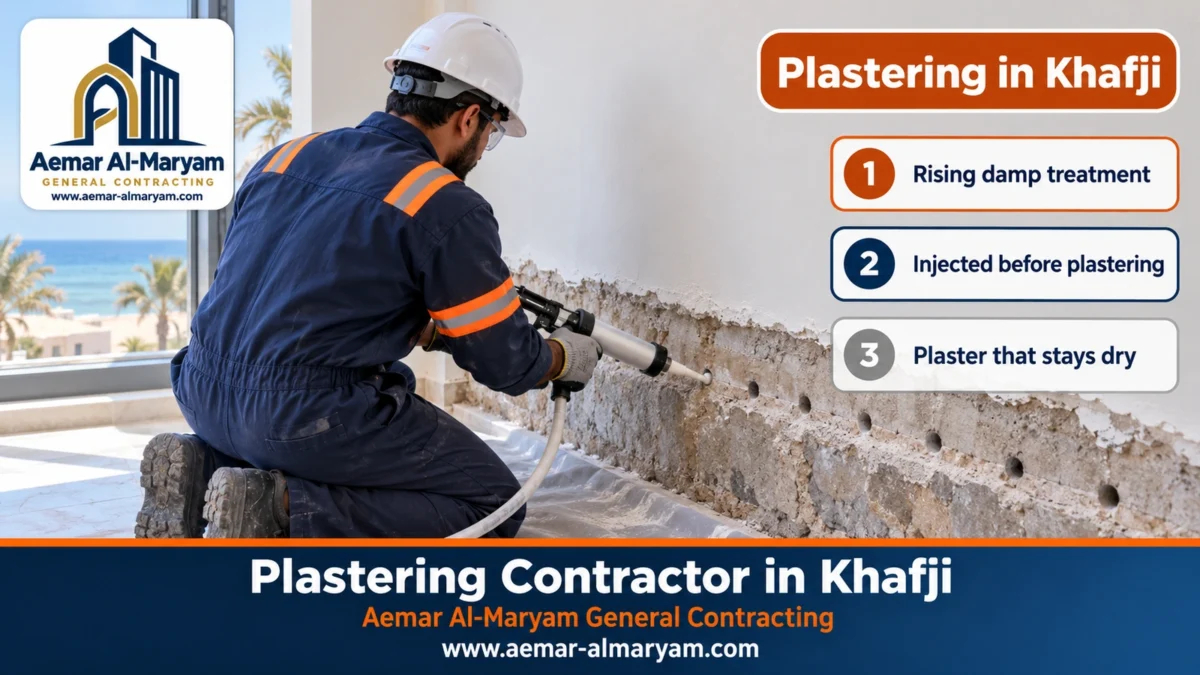
Treatment starts with the water, not the plaster. We establish whether the cause is a plumbing leak, garden water, outside ground higher than the floor, or damp rising from the soil. One recognised way of dealing with rising damp is to form a barrier at the base of the wall, for example by injecting a damp-proofing material into a row of holes drilled near floor level; the right method is chosen after investigation. This treatment is priced at inspection, and more detail is under renovation contractor in Khafji.
Re-plastering old walls in Khafji
With the water stopped, we strip the damaged plaster back to block and to a height comfortably above the last sign of salt, let the wall dry, dry-brush visible salts, spatter any concrete, set screeds and plaster with clean mortar. Our rate for taking off the old coat and putting on a new one opens at SAR 23 per square metre; removal by itself opens at SAR 7.5.
⚠ Damp-proof paint on its own will not do it
Painting the damaged band with “anti-damp” paint without stopping the water traps moisture behind it, and the coat blisters sooner than before. New plaster will also turn salty while water keeps rising. The right order is water first, then plaster, then a suitable paint once dry, as explained under painting contractor in Khafji.
Plaster fillets at the parapet before roof waterproofing in Khafji
A plaster fillet in Khafji is a smooth, sloped strip of cement mortar formed where the roof slab meets the parapet wall, so the waterproofing membrane can sweep up onto the wall without folding into a sharp corner. A right angle strains the membrane and cracks it in time, letting rain into the ceiling below, which is the last thing a coastal house already living with humidity needs.
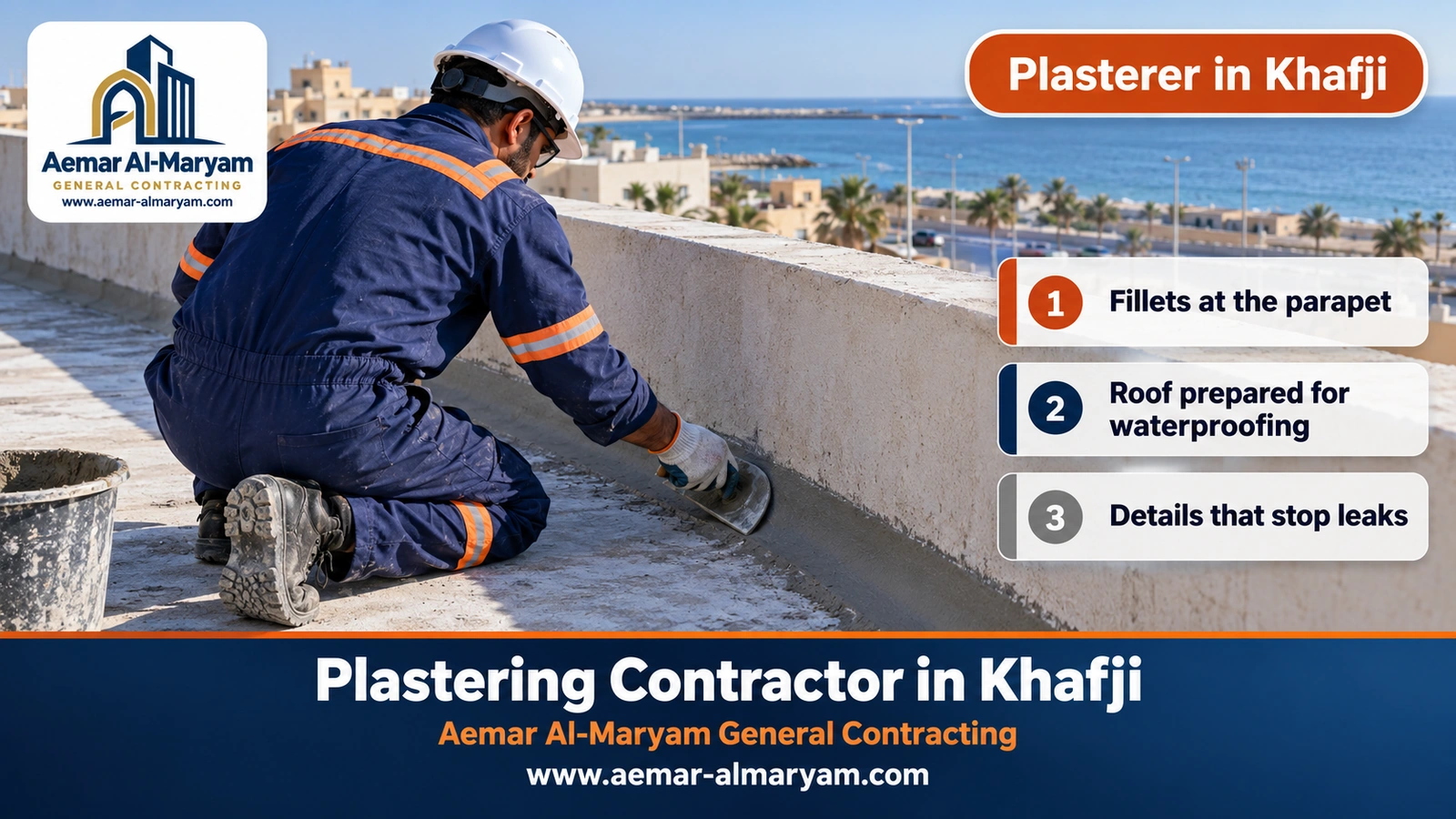
- The roof is cleaned and dampened, and smooth concrete along the junction is spattered.
- The fillet is shaped with a curved trowel or former, keeping equal width and height along the whole parapet.
- The inside face of the parapet is plastered to the height the membrane needs to turn up.
- The fillet is left to harden and is sprayed with water before the waterproofing crew starts.
Fillets are priced at inspection, since they depend on parapet length and roof condition. If the roof needs complete waterproofing, we carry it out under renovation and waterproofing on the same visit.
Photos give an estimate, the visit gives the price
Photos are enough to understand the job and give a first estimate, but three things never show in them: hollow plaster hiding under a sound-looking surface, how deep salts have travelled into the wall, and how far the wall is out of true, which decides plaster thickness. So the price is fixed after tapping and measuring on site, and we tell you from the outset what might change.
Plasterer or plastering contractor in Khafji?
For a modest job that you can oversee and stock with materials yourself, a Khafji plasterer will do. A whole facade, a house where several rooms are being re-plastered, or walls with rising damp are better handled by a contractor who measures, supplies materials and writes the method down: where the mesh goes, how many coats, and who does the curing.
| Comparison | Plasterer (tradesman) | Plastering contractor |
|---|---|---|
| Coastal facades | Depends on personal experience | Joint mesh or full mesh is a written item |
| Damp at the wall base | Often plastered over | Source identified before stripping |
| Materials | Bought by the owner | Supplied by us or by the owner |
| Continuity | May stop between other jobs | A continuous schedule to handover |
| Pricing | Daily wage or per metre | Square-metre rate per item and a clear travel line |
Plasterer in Khafji and how to reach us
A good plasterer in Khafji asks before pricing: how close is the facade to the sea? Is there damp at the bottom of the walls? Is the concrete smooth enough to need spatter? Our number is 0547879578 for calls and WhatsApp; once the photos arrive we share our reading of the problem and a rough number, and only then fix a visit.
Paying a plasterer by the day or by the metre in Khafji?
With the distance involved, square-metre pricing is clearer: you know each item’s cost before work starts, and travel is counted once. We only suggest day rates for scattered patching that cannot be measured, and even that is better combined with a larger job on the same trip.
Internal plastering in Khafji: rooms, bathrooms and ceilings
Internal plaster in Khafji is usually one cement coat of about 12–15 mm on even blockwork, set out with dots and screeds and ruled with a straightedge. In rooms facing the sea we look closely at the inside face of outer walls: if it shows damp patches or old hairlines, we inspect the facade behind it first, because water reaching the inside has generally come through a crack or a window edge outside.
In a humid climate, bathrooms and kitchens need cement plaster rather than gypsum, left keyed where tiles will be fixed; this starts at SAR 18 a square metre. Grooves cut for pipes and cables get packed with mortar and bridged with mesh tape ahead of the main coat, so no trace of them telegraphs through.
Plastering ceilings in Khafji
Concrete ceilings are smooth, so we spatter them, let that harden and apply a coat lighter than on the walls, since a heavy coat overhead sags and debonds. Ceiling plaster starts at SAR 14 a square metre. Bathroom ceilings in particular need good ventilation after finishing, as repeated steam weakens any finish that never dries.
Corner beads
Perforated metal beads go on exposed corners and around openings before plastering, giving the straightedge a true line and protecting the arris. In coastal homes we prefer rust-resistant beads outdoors and in wet rooms.
Scratch coat, dots and screeds in Khafji
Spatter, dots and screeds are what make plaster both bond and run true. Spatter here is a strong mortar, roughly a measure of cement for every two of sand, flicked hard at concrete columns, beams and soffits, left coarse and kept moist for a day or longer. Next we set dots with a line and level about 1.5 m apart and join them with vertical screeds for the straightedge to run on.
One Khafji-specific point: we never spatter or plaster a wall carrying a film of sea salt or stuck-on dust until it has been cleaned, because that thin film blocks adhesion however good the mix is.
Mix ratios and thickness for plastering in Khafji
Typical cement plaster proportions range from 1:4 to 1:6 by volume. Facade mixes lean richer than room mixes, and spatter is the richest. Unless the drawings set other values, these are our working figures:
- Spatter coat: near 1:2, left rough and damp for at least 24 hours.
- Rooms: 1:4 to 1:5, around 12–15 mm in a single coat.
- Facades: near 1:4 with a damp-resisting admixture if needed, in two coats totalling about 18–20 mm.
- Between coats: usually two days, or until the first coat has firmed.
- Cement: roughly one 50 kg bag for every 10 m² at about 2 cm.
- Strength order: the upper coat is never stronger than the one beneath, or it shrinks and pulls it away.
Reference values only. Where a project carries its own drawings or specification, those govern.
Gypsum plaster or cement plaster in Khafji?
Gypsum plaster in Khafji suits dry, air-conditioned internal rooms only. Its set takes roughly thirty minutes, it skips wet curing, it accepts paint after a few days, and our rate opens at SAR 41 per square metre supplied and fixed. Moisture is its weakness, so it has no place on facades, in bathrooms or kitchens, or on the inside of an outer wall that gets damp, and in a coastal town those cases are common. We therefore recommend cement plaster for most Khafji homes and keep gypsum for owners who want a quick finish in a dry inner room.
Curing plaster with water in the Khafji climate
Wet curing is still essential in Khafji despite the humid air, because sun and wind dry the outer coat quickly regardless. We give cement plaster a light spray for around seven days, morning and before sunset, and always with fresh water: curing with salty water adds exactly what we are trying to keep out of the wall.
- On very windy days we postpone rendering exposed facades or screen them with shade netting.
- Facades that take the afternoon sun need more frequent spraying.
- Closed rooms need only a light spray and some airflow; overdoing it just slows drying.
- No paint goes on until cement plaster has dried well, and it can keep hardening for up to 28 days.
Plaster defects in Khafji and their causes
In Khafji, plaster defects cluster on facades and at the foot of walls, and most trace back to water, salt or missing mesh:
| Defect | Usual place in Khafji | Cause | Remedy |
|---|---|---|---|
| Straight cracks | Around columns and beams on facades | Joints left without mesh | Open the crack, fit mesh and re-render |
| Branching hairlines | Facades exposed to sun and wind | Fast drying, rich mix or unclean sand | Fill or redo the top coat, and cure in the first days |
| White salts | Low on walls and beside gardens | Rising salty water or mortar mixed with unsuitable water | Cut off the water, let the wall dry and brush it, redo loose plaster |
| Drummy plaster | Ceilings, columns and wall bases | No spatter, salt behind the coat or excess thickness | Remove to a sound edge and rebuild in coats |
| Leak above the ceiling | Roof corner at the parapet | Sharp corner with no fillet cracked the membrane | Plaster fillet and new waterproofing |
| Widening diagonal crack | Running off the corner of an opening | The building is moving | Assessment before plastering, see crack repair in Khafji |
Sealing the hairline cracks in a single room ahead of painting opens at SAR 140; drummy plaster across larger areas is costed once we have sounded the walls.
Plastering price per square metre in Khafji
Khafji rates open at SAR 6.5 per square metre to plaster rooms using your materials or SAR 13 using ours; facade render opens at 14 for labour, 18 supplied and 20 with fibre mesh throughout. The list in full:
| Type of work | Unit | From (SAR) |
|---|---|---|
| Labour to plaster rooms with your materials, no screeds | square metre | 6.5 |
| Labour for screeded internal plaster with corner beads | square metre | 11 |
| Internal plaster where we supply cement and sand | square metre | 13 |
| Concrete soffit plaster | square metre | 14 |
| Labour to render a facade | square metre | 14 |
| Facade render with materials | square metre | 18 |
| Render reinforced with fibre mesh over the full wall | square metre | 20 |
| Fine finishing coat that takes filler directly | square metre | 17 |
| Bathroom and kitchen walls | square metre | 18 |
| Taking off old plaster only | square metre | 7.5 |
| Taking off old plaster and re-rendering | square metre | 23 |
| Fixing hairlines in a room before painting | room | 140 |
| Gypsum plaster for dry rooms with materials | square metre | 41 |
| Coloured render with materials | square metre | 32 |
| Spray-machine render | — | at inspection |
| Rising damp in homes near the sea | — | at inspection |
| Repairing drummy (hollow) plaster | — | at inspection |
| Plaster fillet at the parapet before waterproofing | — | at inspection |
These are opening estimates confirmed after inspection and agreement, and they depend on wall condition, the thickness needed, height, scaffolding, access and area. Travel to Khafji is added as a separate item set at inspection. Anything shown as “at inspection” gets a figure after your photos and measurements reach us on 0547879578.
Worked example: plastering a 3.5 × 4 m bedroom in Khafji
For illustration only, not a quotation: a bedroom of 4 × 3.5 m with a 3 m ceiling, a door of roughly 2 m² and a window of roughly 1.5 m².
- Wall area: 2 × (3.5 + 4) × 3 = 45 m²; take off 3.5 m² for door and window to leave 41.5 m².
- Ceiling: 3.5 × 4 = 14 m², bringing the total to 55.5 m².
- Labour only with your materials: 55.5 × 6.5 ≈ SAR 361.
- Screeded labour with beads: walls 41.5 × 11 ≈ SAR 457 and ceiling 14 × 14 = SAR 196, around SAR 653.
- With our materials: 55.5 × 13 ≈ SAR 722.
- Cement: about six bags at roughly 2 cm.
Facade example: a house with 160 m² of net facade
A facade of 160 m² after deducting openings: labour only starts at 160 × 14 = SAR 2,240, with materials at 160 × 18 = SAR 2,880, and with fibre mesh across every wall at 160 × 20 = SAR 3,200. Scaffolding and travel are added after inspection. Done on one trip, the bedroom above and this facade share a single travel cost.
How the plaster area is calculated
We multiply every wall’s run by its height and include the soffit when it is in scope. Openings above about two square metres usually come off the total and smaller ones stay in, since their reveals take extra work. We write this into the agreement and measure with you at handover.
Is painting straight onto block an option in Khafji?
In a dry inner room with very regular blockwork or smooth concrete, a skim or thin coat before painting can be enough. On Khafji facades, no: bare block absorbs sea moisture, and its joints and salts appear through the paint within months.
How we serve Khafji from Dammam: one well-planned trip
Each journey up to Khafji, some 298 km from Dammam, costs time, fuel and lodging. So we work there on a “complete trip” basis: we understand the job from your photos before travelling, pin down every item and quantity at inspection, then return with a crew and enough materials to finish as much as possible without a break.
■ Photos first
We assess what can be judged from pictures and flag what needs a visit, such as tapping and damp checks.
■ One thorough inspection
Facade, rooms and roof are measured together and written into one agreement.
■ Materials on board
Mortar, mesh, beads and scaffold come with us so work never stops for a missing item.
■ Smart sequencing
While the facade cures we work indoors; while a roof fillet sets we plaster another wall.
Jobs usually grouped into one trip
Facade render + re-plastering the bottom of internal walls + roof fillets before waterproofing + filling kitchen and bathroom chases. If a neighbour has similar work, book the same inspection day. Travel is set at inspection, never as a fixed fee, and is spread across every item.
As general contractors we can also handle what comes before and after plaster on the same trip: renovation and waterproofing, building work, painting and finishing. Building an annex or majlis? See annex and majlis building in Khafji. Examples are in our project gallery.
Plastering steps in Khafji
- 1Photos
You send pictures and sizes of the facade, rooms and roof on WhatsApp. - 2View and first figure
We tell you what we see, the likely items and their approximate cost. - 3Inspection
Tapping, measuring, damp and joint checks, and marking where mesh goes. - 4Agreement
Items, quantities, materials, travel, duration and who looks after curing. - 5Preparation
Water source treated, damaged plaster removed, salt and dust cleaned off. - 6Spatter, mesh, screeds
On concrete and joints, followed by dots, screeds and beads. - 7Plaster and fillets
One coat indoors, two on facades, then fillets at the parapet. - 8Curing and handover
About a week of fresh-water spraying, then a joint check and snag fixes.
At handover, check it yourself
- ✓Facade: no straight cracks by columns, and every ledge falls outward.
- ✓Line: lay a 2 m aluminium rule horizontally, vertically and diagonally and watch the gap.
- ✓Bond: knock gently along the wall; any dull, empty note marks plaster that has let go.
- ✓Roof: the fillet runs unbroken along the parapet.
- ✓Wall bases: no damp marks or salts once dry.
Recurring plastering mistakes in Khafji homes
■ Rendering over sea salt
Salt and dust on the wall stop the coat bonding.
■ Unsuitable water for mixing or curing
Salts built into new plaster.
■ Facade without mesh
Cracks at columns that let water in.
■ Sharp roof corner
Membrane cracking at the parapet.
■ Plaster over rising damp
A swollen band that returns after a season.
■ Gypsum in a bathroom
Plaster weakened by steam.
Khafji and beyond: where we work
Our crews cover the residential neighbourhoods of Khafji, from seafront houses to buildings further inland. Elsewhere in the province, our city guides include plastering contractor in Al-Ahsa, plastering contractor in Hafr Al-Batin and the main plastering contractor in Dammam guide.
What we bring to your Khafji home
■ Plaster suited to the sea
Clean materials, mesh, two coats and edges that shed water.
■ A complete trip
Planning from photos and continuous work that eases the distance cost.
■ Published prices
Each item’s starting rate is clear, and travel is a separate line.
■ Before and after plaster
Damp treatment, waterproofing and paint in one agreement.
How to order a plastering contractor in Khafji
Send the following to WhatsApp 0547879578; the fuller it is, the more accurate our estimate before the trip:
- ✓Facade photos: a full view of each elevation plus close-ups of cracks and edges.
- ✓Inside photos: damaged wall bases, bathrooms, and the roof along the parapet.
- ✓Dimensions: facade width and number of floors, and room sizes.
- ✓Distance from the sea: is the house on the seafront or inside the neighbourhoods?
- ✓Materials: will you supply them or shall we?
- ✓Other work: waterproofing, painting or repairs you want done on the same trip.
Plaster built for the Khafji climate
Photograph your facade and walls and send them over, or ring us. We will prepare the visit plan and its items before we set off, so your work is finished in one trip wherever possible.
More reading for Khafji homeowners
- ➤ How we plaster
- ➤ Home renovation
- ➤ Cracks and their treatment
- ➤ Painting once plaster is dry
- ➤ Interior finishing work
- ➤ New builds
- ➤ Renovation in Khafji
- ➤ Painting in Khafji
- ➤ Crack repair in Khafji
- ➤ Annexes and majlis rooms in Khafji
- ➤ The full plastering guide from Dammam
- ➤ Our services in Khafji
- ➤ Price list
- ➤ Book an inspection
Article tags