
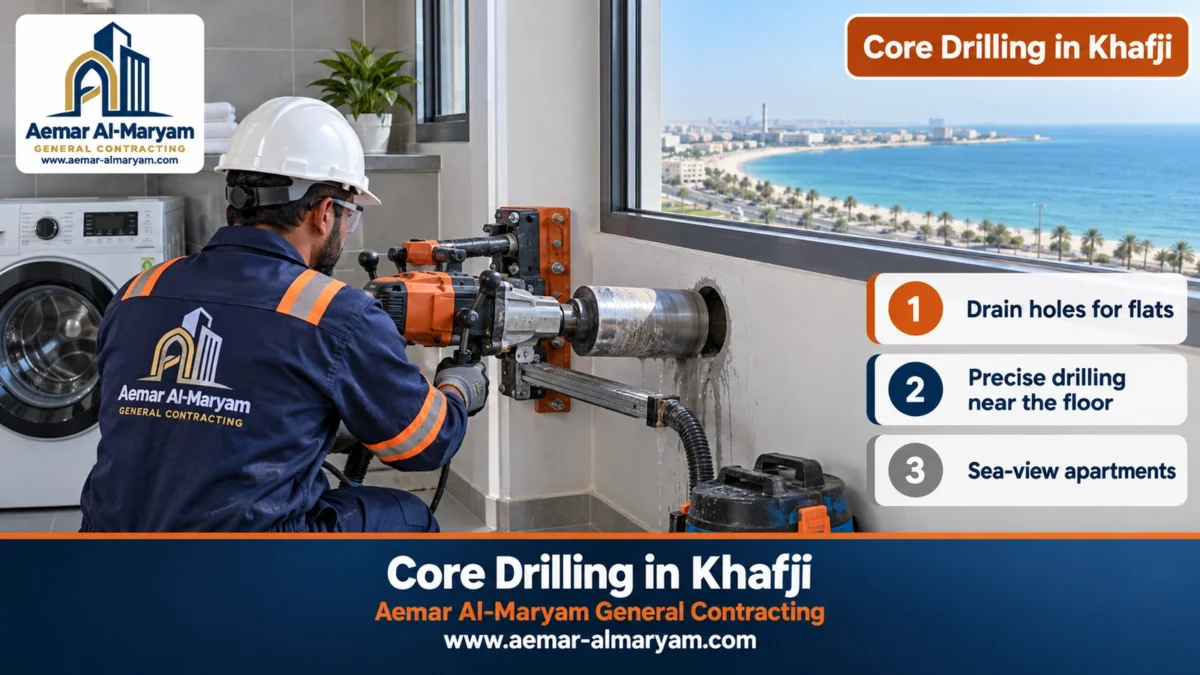
Core drilling in Khafji is how we cut a clean, round hole through a concrete wall or slab for a washing-machine drain, a rising water main in the stairwell or a set of AC pipes, using a diamond core bit instead of a hammer and chisel. Khafji lies on the northern coast, at the top of the Eastern Province, roughly 298 km from our base in Dammam, so every Khafji job starts with an assessment from your photos, and then we bundle all your holes (and your neighbours’, if they wish) into one planned visit. Pricing opens at SAR 90 for small and AC holes and at SAR 140 for the 5–6 inch band, with the final figure fixed after our inspection. Book on 0547879578 by phone or WhatsApp.
Most Khafji requests are small jobs with a big nuisance factor: a relocated washing machine with nowhere to drain, a new kitchen sink in a rented flat, a water pipe that must climb through the stair landings, a few supply-pipe holes in a villa wall. None can wait for months, and none justifies its own long trip, so we built a way of working just for Khafji.
In short: core drilling in Khafji
- What we do most: washing-machine and kitchen drain holes in flats, rising-main holes through stair landings, small holes for water pipes with a hand-held core drill, and AC holes.
- How booking works: you send photos and sizes first; we assess the job and estimate the cost, then add you to the next scheduled Khafji visit.
- Bundling lowers the cost: the more holes in one visit, yours or your neighbours’ in the same building, the more the travel cost is shared and the less each hole carries.
- Prices start from: small holes (to roughly 100 mm) from SAR 90; the 5–6 inch band from SAR 140; eight-inch from SAR 230; the 10–12 inch band from SAR 320. Travel is quoted at inspection.
- Built for sea air: properly sealed holes after the pipe goes in, protection for cut rebar ends, and an outward fall on holes in outside walls.
- Contact: call or WhatsApp 0547879578.
Core drilling in Khafji: why we start with your photos
Core drilling in Khafji starts with a photo, not a site visit, because a good set of pictures answers most of what we need to know before we drive north: what the wall is made of, which diameter fits, which tools to load and whether we need a scaffold or a rig anchored to a slab. The visit then arrives equipped for every hole, and we do not discover on site that the one bit size you needed is still sitting in Dammam.
Clear phone photos from the right angles are enough; in this order they often earn a same-day estimate:
Photos and details we need from you
Take the pictures in daylight and hold a tape measure or a pen next to the spot so we can judge the size:
- A close-up of the hole position with a pen mark or a piece of tape where you want the centre of the hole.
- A step-back photo of the entire wall or ceiling so we can see nearby columns, beams and windows.
- The other side what lies behind the wall or below the slab: a room, a staircase, the outside face or a false ceiling.
- Wall or slab thickness measured at a nearby door or window opening, or simply describe the construction.
- Pipe size or appliance for example a washing-machine drain, a 4-inch pipe, or a split AC of a given capacity.
- Floor and access which floor the flat is on, whether there is a lift, and whether the outside face can be reached from a balcony or roof.
The pictures tell us whether your mark can stay or should shift away from a beam or column, which diameter fits the pipe plus its sealing gap, and whether hand-held drilling will do. If a hole lands in a structural member, you hear before booking that an engineer must look at it.
One extra photo can save a trip
Customers often send a very close shot that hides everything around the mark. Always add a wide shot as well: a beam ten centimetres from the mark changes the whole plan.
Bundling several holes into one Khafji visit
Bundling means arranging every core hole you need in Khafji into a single working day, instead of booking one hole now and another next month. In a distant city most of the job’s cost is the travel and the hours on the road, and that part is almost the same whether we drill one hole or ten. So we suggest every Khafji customer walks around the home or building and lists every hole that might be needed over the coming months.
■ Inside your flat
the washing-machine hole, the kitchen drain, an extractor-fan hole and an AC hole for the room you plan to cool later.
■ Across the building
if your neighbours need the same holes, such as laundry drains on similar floors, drilling them on the same day lowers the cost for everyone.
■ Stairwell and roof
rising-main holes between landings and roof holes for tanks and pipes in the same visit.
■ Outside the building
small water-supply holes and cable holes in the boundary wall or the outer wall.
You send a list with a photo per hole; we group them by floor and by tool, hand-held work in one run and rig work in another, so the day flows from flat to flat and every hole is ready for the plumber or AC technician by the time we leave.
Can I share a visit with my neighbour?
Yes, and in Khafji it pays off. Each party pays its own holes from the table, the travel cost is split as agreed, and we merge your photos into one visit plan.
Kitchen and bathroom core holes in Khafji: washing-machine and sink drains
Kitchen and bathroom core holes in Khafji are mostly washing-machine drain holes in the laundry corner and sink drain holes when a kitchen sink moves. The holes are usually small, but their position is sensitive: close to the floor, often in an outside wall or a wall onto a light well, and they need the right fall so water runs away instead of back.
The washing-machine drain hole
In most domestic installations the washing-machine drain is a small pipe, around two inches in many flats, so its hole usually falls in the small-hole band that starts from SAR 90. We drill it low, near the floor, at the height the plumber sets from the machine position and the route of the drain outside the wall, leaving a modest gap around the pipe for sealing. We lay protection and an absorbent sheet below the drilling point, because laundry corners are usually tiled and right next to doors.
- Height: set by the drain route. If the outside pipe sits higher than the hole, the water will not flow. We confirm the height with the plumber before drilling.
- Fall: drains need to run downhill to the outside, so we tilt the bit slightly when the pipe exits straight through the wall.
- Behind the wall: in flats there is often a light well or service shaft behind the laundry corner, and we check it carries no other pipes or cables.
Kitchen drains and extractor-fan holes
When a kitchen sink moves to another wall it needs a hole for the drain and sometimes a second hole for the supply pipe. If you add an extractor that vents outside, kitchen hoods commonly take a 150 mm duct, so plan on a hole in the 6-inch band, whereas a bathroom fan usually runs on roughly 100 mm. The final word belongs to the fan or hood manual, so we ask for its photo or model name before choosing the bit.
In kitchens we cover the worktop, fix a catch tray under the hole and keep the wet vacuum running so slurry never creeps under the units; if the hole sits behind a fitted cabinet, we agree in advance which panel comes off.
Ask your plumber first
Have the plumber mark position and height on the wall and send us a photo of it, so we drill where he will work rather than where we guess.
Slab core drilling in Khafji: rising mains through stair landings
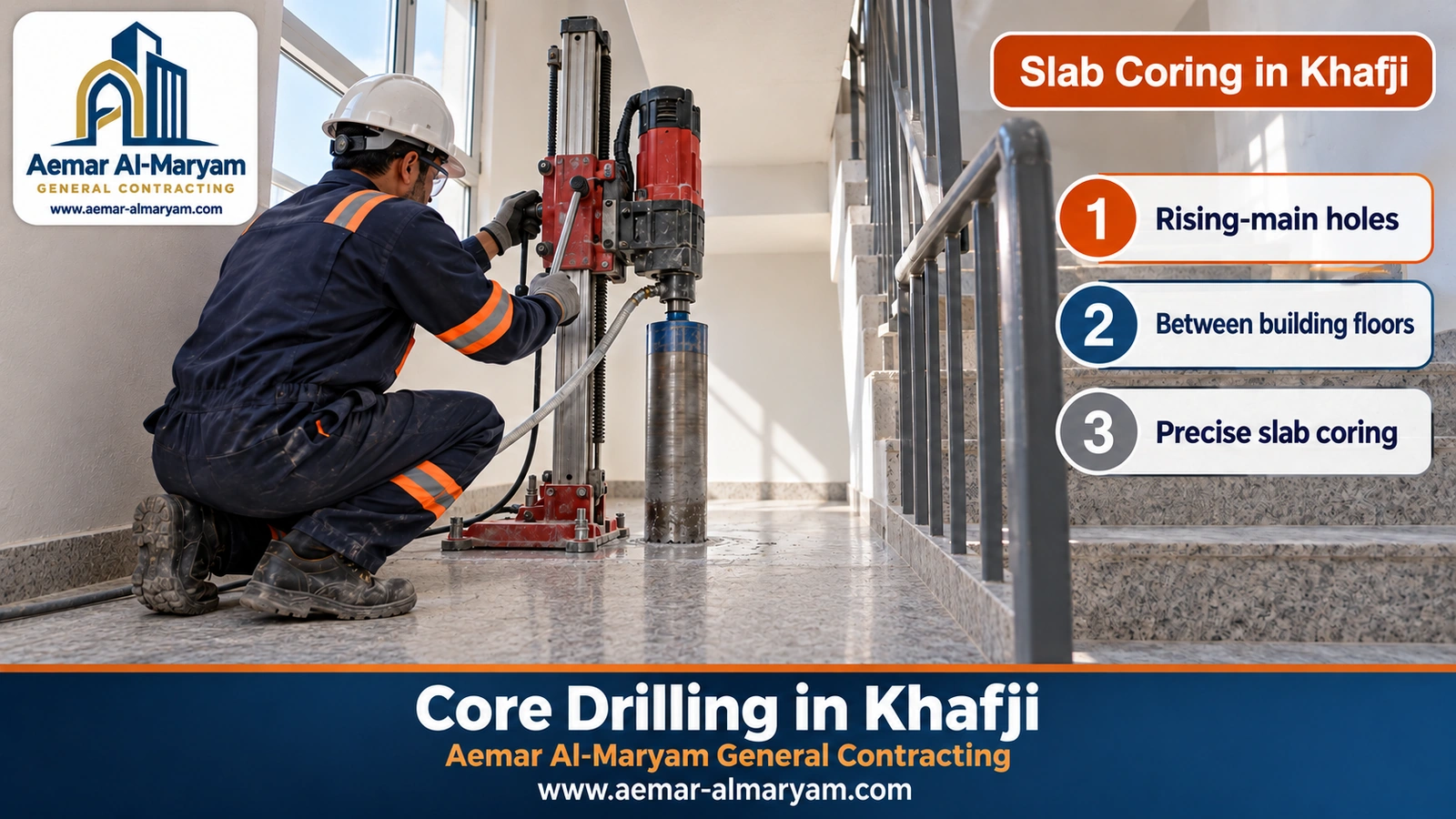
Slab core drilling in Khafji comes up again and again in apartment buildings when a water pipe has to rise from the tank or the meter to the upper floors through the stairwell. We drill a vertical hole through the landing slab next to the wall or handrail, then repeat it in the landing above on exactly the same axis, so the pipe runs straight from floor to floor.
Keeping holes aligned between floors
The hardest part of rising-main holes is not the drilling but the alignment. If the upper hole drifts a few centimetres from the lower one, the pipe needs extra bends or leans visibly. So we fix the axis from the first hole, transfer it to the landing above with a plumb line or a laser plumb tool, and anchor the rig on the new mark. The laser here is a measuring aid only; the drilling is still done with a diamond bit.
Protecting the stairs and the residents
A stairwell is a shared route that neighbours use all day. We tape off the work area, cover the steps below the hole and fix a catch under the slab to hold the concrete core when it breaks free, so it does not drop onto the flight below. Cooling water is collected from above by suction so it does not run down the steps and make them slippery. We usually ask for the building owner’s or the owners’ association’s approval in advance, because the landing is common property rather than part of any one flat.
Landing holes that call for a structural engineer
A small hole for a water pipe through an ordinary landing slab does not usually affect the structure once it has been scanned. But if the hole is large, very close to a beam or to the slab edge at the wall, repeated many times in one area, or in a post-tensioned slab, the decision belongs to a structural engineer. Beams are drilled only against an engineering office report, and columns are never cored.
⚠ Post-tensioned slabs
If the building is recent and its slabs are flat with no visible beams, they may be post-tensioned with steel tendons. Cutting a tendon endangers the slab and the people around it. We ask for the drawings and scan the slab before drilling anything.
Drilling holes in walls in Khafji: small holes with a hand-held core drill
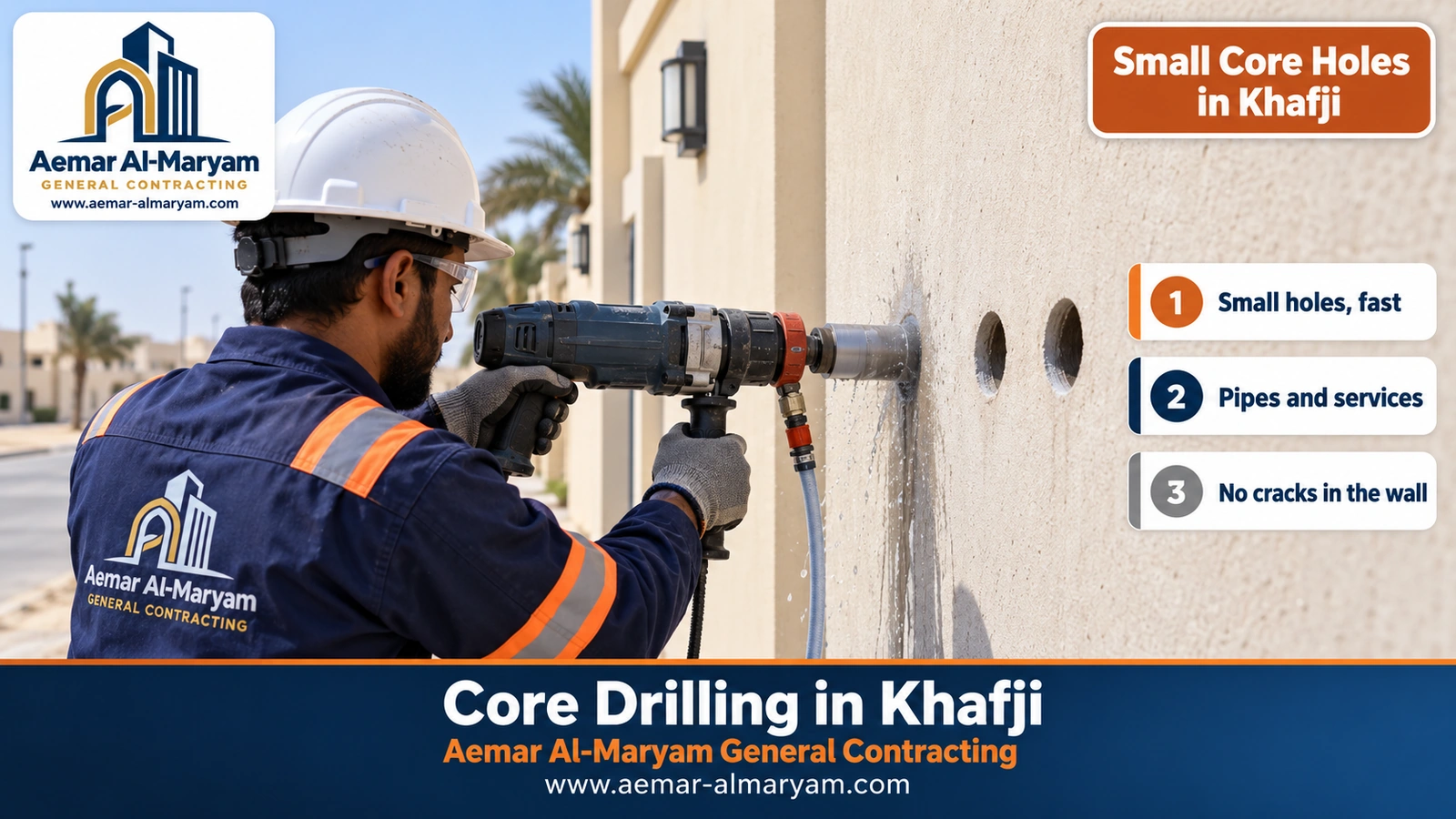
Drilling holes in walls in Khafji for small water-supply pipes is often done with a hand-held core drill: the technician holds the machine in both hands and cuts a clean round hole without anchoring a rig to the wall. That saves real time when the holes are small, numerous and spread across an outside wall or between a bathroom and a kitchen.
Hand-held or rig-mounted?
Some diamond core drills work both ways. Some manufacturers rate their hand-held units for concrete holes up to about 180 mm, used freehand or on a stand. But capacity on paper is not the same as accuracy on site. We drill by hand for small holes in walls with easy access, and we anchor a rig when the hole gets bigger, the wall is heavily reinforced concrete, an exact fall is needed, or we are drilling into a ceiling or slab.
| Situation | Right tool | Why |
|---|---|---|
| Several small, scattered holes for water pipes in a wall | Hand-held core drill | Moves quickly between holes without setting up a stand each time |
| AC hole in an outside concrete wall | Rig-mounted drill | Holds the outward fall steady and gives cleaner edges |
| Hole through a landing slab or ceiling | Rig-mounted drill | Vertical drilling needs anchoring and a precise axis |
| Holes of 5 inches and above | Rig-mounted drill | Torque and weight are too much to keep on line by hand |
| Light block wall | Usually hand-held, with light pressure | Hollow block cracks if pushed too hard |
Block or concrete walls in Khafji
We always drill reinforced concrete wet, since the water keeps the diamond rim cool through the steel and holds the fine dust down. Blockwork can be cored dry under a dust extractor where water would spoil paint or a timber floor nearby. With block, what matters is that the hole does not land on the joint between two blocks or right at the edge of a window, so the surrounding blocks stay sound.
Concrete coring in Khafji: how a diamond bit cuts through a wall
Concrete coring in Khafji means a hollow cylindrical bit with diamond segments on its rim turns around a fixed axis, cutting a thin ring through concrete and rebar together, and a solid concrete core comes out of the middle at the hole’s diameter. There is no hammering and no breaking, so the hole has smooth sides and the plaster or tiles on the far side usually come through intact.
Compare that with the old chisel-out method: the broken hole ends up far wider than the pipe and leaves gaps for damp and insects, whereas a cored hole leaves a narrow ring that is easy to seal, which counts for a lot in a coastal town.
- Wet coring: for reinforced concrete and slabs; water cools the bit and traps dust, and we remove it with a wet vacuum.
- Dry coring with extraction: for light block walls where water does not suit the room.
- Depth: standard rig bits reach about 450 mm of working depth, enough for a normal wall or slab in a single pass.
AC core holes in Khafji
AC core holes in Khafji start from SAR 90. Each one is angled gently downward to the outside, letting condensate escape and stopping rain or sea spray from tracking indoors. Diameter is taken from the installation manual; many wall-mounted split guides specifies 65 mm bored on a downward slope outward, and bigger units can call for 3 or 4 inches.
In sea-facing flats the outdoor unit often sits on a balcony or an exposed wall, so we watch two things: the hole should not sit directly above a neighbour’s window where condensate would drip onto it, and the outside seal has to be complete, because salty moisture gets in through any small gap. We prefer the AC technician to attend or mark the spot himself, since he is the one who will run the pipes in the end.
Rebar scanning before drilling in Khafji buildings
Rebar scanning before drilling is a step we take before every core hole in reinforced concrete in Khafji, so we know where the bars, buried pipes and cables run and can move the hole to a safer spot if needed. A diamond bit cuts steel easily, but cutting a main bar in a critical place is not a decision to take lightly.
- ✓Scan the area: with a rebar detector for ordinary holes, and with ground-penetrating radar when we suspect a post-tensioned slab or dense services.
- ✓Move the hole: a few centimetres is usually enough to miss a main bar or a buried pipe.
- ✓Keep clear of columns and beams: we leave a safe distance from column faces and beam soffits.
- ✓Record any cut steel: if the hole passes through secondary bars we tell you and protect the cut ends as described below.
Khafji adds a reason for care: Eastern Province building surveys rank reinforcement corrosion as the most common defect, with coastal salts and chlorides among the causes, so every exposed bar needs protecting.
Sealing core holes in Khafji’s coastal climate
Sealing is what decides how long a core hole in Khafji lasts after the pipe goes in, because sea air carries moisture and salt into any gap around a pipe. So we do not treat the job as finished when the core drops out; it is finished when the hole is ready for sealing, or sealed, if that is what we agreed.
- 1Clean and dry the hole
we remove slurry and drilling residue from the hole wall and let it dry before any sealing material goes in, because nothing bonds well to a muddy surface. - 2Protect the rebar ends
if cut bar ends show inside the hole, we coat them with an anti-corrosion layer before the hole is closed, so corrosion does not start there. - 3Fit a pipe sleeve
for water and drain pipes a sleeve (a slightly larger pipe) is preferable: it lets the pipe move and makes future replacement easier. - 4Fill the gap
with non-shrink mortar or grout around the sleeve in walls and slabs, and a flexible sealant on the outside face. - 5Outside face and roof
a slight fall or a collar around the pipe sheds water, and roof holes get a waterproofing layer that ties into the roof membrane.
⚠ Silicone alone is not enough
Packing the gap around a pipe with silicone or foam and painting over it is a temporary fix; with heat and humidity it cracks and lets go within a short time. The gap is filled with a suitable mortar, and the flexible sealant is only the final layer.
If the building already suffers from damp at the base of the walls or visible rusting steel, that is a wider repair than a single hole. You will find it on our renovation contractor in Khafji page, and our waterproofing work on the waterproofing and insulation page.
Core hole sizes: which diameter to ask for in Khafji
Core hole sizes follow whatever will pass through the hole, plus a small allowance for sealing. Here is an approximate guide to the holes most often requested in Khafji flats and villas; the final reference is the plumber, the AC technician or the appliance manual:
| Use | Approximate hole diameter | Price band |
|---|---|---|
| Electrical cable or small water-supply pipe | up to about 2 inches | from SAR 90 |
| Washing-machine or sink drain | usually 2–3 inches | from SAR 90 |
| Split AC pipes | about 65 mm for many units, up to 4 inches for larger ones | from SAR 90 |
| Bathroom fan duct of 100 mm | about 4 inches | from SAR 90 |
| 110 mm drain pipe (“4-inch”) | 5-inch class | from SAR 140 |
| Kitchen hood duct of 150 mm | 6-inch class | from SAR 140 |
| Rising main with a large sleeve, or a small duct | 8 inches | from SAR 230 |
| Ventilation duct or large flue | 10–12 inches | from SAR 320 |
Note: diameters are approximate, and prices are estimates until inspection and agreement.
Core drilling prices in Khafji
Core drilling prices in Khafji follow the same table we use across the Eastern Province, starting at SAR 90 for small holes and AC pipes. What differs in Khafji is travel, which we price at inspection in line with the job and confirm before anything is agreed.
| Item | Starts from |
|---|---|
| AC hole or small pipe hole, up to about 100 mm | SAR 90 |
| Five- to six-inch band | SAR 140 |
| Eight-inch hole | SAR 230 |
| Ten- to twelve-inch band | SAR 320 |
| Larger diameters, rows of large holes, or holes that need an engineer’s report | Priced once we inspect; WhatsApp us the photos and measurements for a first figure |
| Travel to Khafji | Set at inspection according to the number of holes and the size of the job |
Important: treat these as starting estimates. The figure you pay is settled after the site visit and depends on diameter, thickness, how much steel is inside, the floor, how easy the access is and how many holes there are.
How to keep the cost down
- ✓Bundle your holes: all of yours and your neighbours’ in one visit.
- ✓Send complete photos: so the right equipment arrives the first time.
- ✓Prepare the space: move furniture and empty the cupboard behind the hole before we arrive.
- ✓Fix the position with your tradesman: the plumber or AC technician marks the spot in advance, so no time is lost waiting.
Our full price list is on the prices page.
Coring plus sawing in Khafji: when a round hole is not enough
In Khafji, core drilling and concrete cutting meet whenever the opening has corners or real size: a rectangular duct, a small window, a doorway. The core rig only produces circles, so for a square shape we core each corner and saw between them, or take the entire panel out with a track-mounted diamond saw.
If your job is like that, read our concrete cutting in Khafji page, which covers door, shopfront and slab openings in the city, or the concrete cutting service page. We often combine both on one visit: cutting a doorway, for instance, plus a few plumbing core holes in the same flat.
Choosing a core drilling contractor in Khafji: checks before you book
Pick a core drilling contractor in Khafji by how they answer a few practical points, not by their slogans:
- ✓Do they scan for steel before drilling? And do they have a scanner, or do they rely on guesswork?
- ✓Do they drill wet and vacuum the water? Or will the slurry run over your tiles and stairs?
- ✓Do they ask what pipe goes through? A contractor who picks a diameter without asking will probably drill too big or too small.
- ✓Do they state the travel cost up front? In a distant city like Khafji this is a line you should know in advance.
- ✓Do they tell you when an engineer is needed? A contractor who drills anywhere without asking puts your building at risk.
- ✓What do you get at the end? Clean holes at the agreed diameters, a clean space, and sealing if agreed.
Mistakes that mean a core hole in Khafji has to be redone
■ No fall
a perfectly level AC or drain hole lets water run back inside and usually ends in a new hole.
■ Guessed diameter
too small for the pipe and sleeve means enlarging later; far too big leaves a gap that is hard to seal.
■ Misaligned landing holes
on rising mains, drift between landings adds bends and looks poor.
■ Silicone-only sealing
in sea air it cracks within a short time and lets damp in.
How to order core drilling in Khafji
- 1List your holes
each hole and its purpose: washing machine, kitchen, AC, rising main, cable. - 2Photograph every position
a marked close-up, a wide shot and a shot of the other side. - 3Send them on WhatsApp to 0547879578
plus the floor number, any thickness you know and your Khafji location pin. - 4Receive the assessment and estimate
we suggest a diameter and tool for each hole and give you the estimated price and travel cost. - 5Confirm your visit date
we add you to the next scheduled Khafji visit and remind you beforehand what to prepare. - 6Drilling and handover
scanning, drilling, vacuuming and cleaning, then you check every hole with us before we leave.
What Aemar Al-Maryam brings to Khafji core work
■ Assessment before the road
we read your photos and choose tools and diameters before we set off, so the visit is not wasted.
■ Bundled visits
we schedule your holes and your neighbours’ on one day so each hole costs less.
■ Tools for both cases
a hand-held drill for small scattered holes and a rig for slabs and larger holes.
■ Sealing that suits the sea
protected rebar ends, sleeves, non-shrink mortar and a flexible outer seal.
■ Open pricing
a printed starting-price table, and travel stated before you commit.
■ Eastern Province experience
we work from Dammam across the region; see examples on our projects page.
For the full technical guide to hole types and equipment, see our main article on core drilling in Dammam. The service summary is on the core drilling page, and pipe work after drilling is on the plumbing works page.
Coverage in Khafji
We work across all of Khafji: apartment buildings and villas in the residential districts, shops on the commercial streets and homes along the sea front. Our route north passes Jubail, so when your date lines up with other work on the way we can shorten your wait. All our services in the city are listed on the Khafji page.
Further inland, core drilling in Hafr Al-Batin runs on the same planned-visit model, and Dammam remains the base for every other Eastern Province town.
Need core holes in Khafji?
Photograph the positions and send your list on WhatsApp to 0547879578. We will send back an assessment and an estimate and reserve you a place on the next visit.
Useful links before you book
Article tags