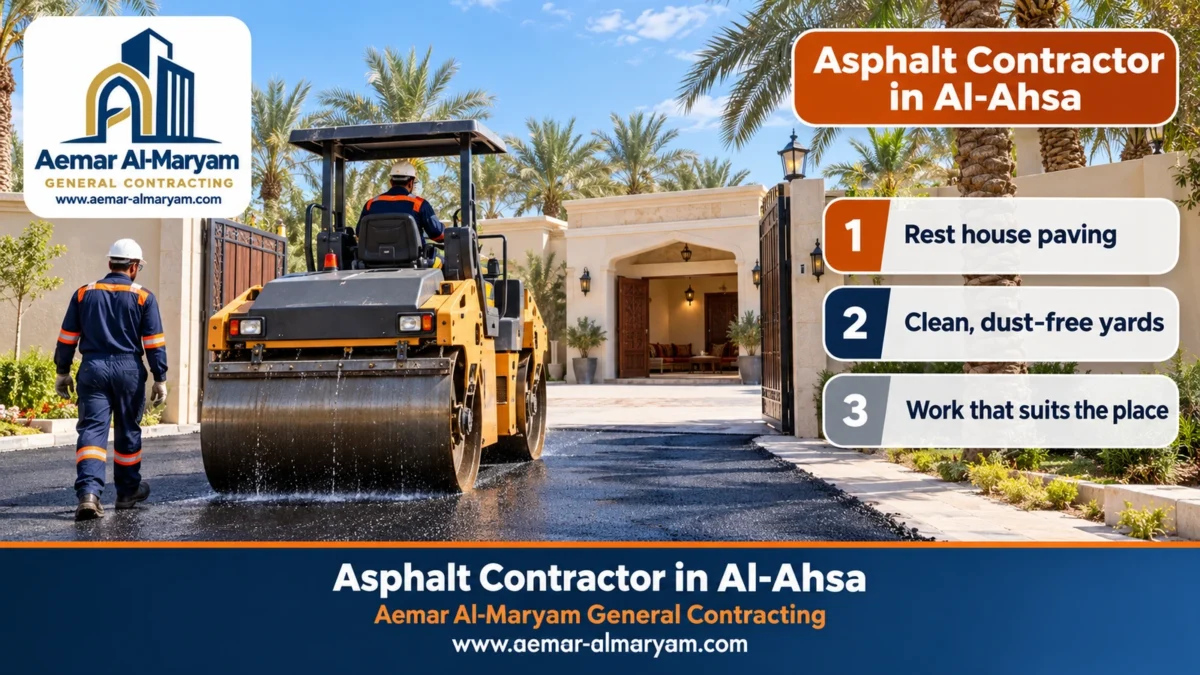
An asphalt contractor in Al-Ahsa readies the ground of a rest house, farm or shop car park, puts down a rolled layer of crushed stone, then spreads hot asphalt and compacts it into a firm surface that carries vehicles and sheds rainwater. At Aemar Al-Maryam General Contracting we pave rest-house (istiraha) yards and their gateways, farm roads between the palms, shop car parks in Hofuf and Mubarraz, and house yards, and we repair potholes, mill tired surfaces and paint parking bays. Our lowest rate is SAR 37 a square metre, for 5 cm over a sound base that already exists; a full build from bare ground starts at SAR 74. Treat every figure here as provisional until our visit and a written scope; the trip from Dammam is costed during that visit. Phone or message us on 0547879578.
Since our crews set out from Dammam, about 160 km of highway away, every job there is planned before the crew sets out. We look at your photos and measurements first, work out the equipment and quantities, then book the inspection day and group nearby jobs into one trip. What makes Al-Ahsa different from most cities we serve is where the work is: a large share of requests come from outside ordinary streets, such as a rest house ringed by palms, a farm whose owner wants a track that does not turn to mud after rain, or a row of shops whose owners want a car park that does the frontage justice.
Al-Ahsa paving at a glance
- What we do most: rest-house yards and gateways, farm roads, shop car parks in Hofuf and Mubarraz, and house yards and frontages.
- Farm roads: we put both options on the table honestly: compacted millings that cost less and look rougher, or new hot mix that is smoother and more stable.
- Layers: rolled natural ground, close to 15 cm of crushed stone for car yards, an MC prime spray, and 5–6 cm of asphalt measured after the roller.
- Starting prices: 5 cm over a sound base from SAR 37 per m², 7 cm from 41, 74 for a full build from bare ground, 55 for polymer-modified mix, 46 for temporary cold patching, 38 for milling and relaying. All estimates until inspection and agreement.
- Travel: around 160 km each way from Dammam; costed when we inspect, and the bigger the paved area, the less of it lands on each metre.
- To order: WhatsApp 0547879578 with photos, dimensions, vehicle types and a location pin.
Asphalt contractor in Al-Ahsa: what we pave in Hofuf, Mubarraz and around them
We pave privately owned sites in Al-Ahsa, from a small rest-house yard to a shop-row car park and a long farm road. We do not pave public streets or main roads; those belong to the Al-Ahsa Amana, its municipalities and their contractors. Each type of site below carries different loads and has different weak points, which is why a single price or thickness for all of them would mislead you:
■ Rest-house yards
The yard in front of the majlis, the gateway and the vehicle lane, with falls that carry water away from the seating areas.
■ Farm roads
Internal roads between palm rows and up to the store or house, in millings or new hot mix.
■ Shop car parks
Car parks in front of shop rows in Hofuf and Mubarraz, with edges compacted at the kerb and bays marked.
■ Homes in Hofuf and Mubarraz
The yard, the garage entrance, and the strip you own in front of the house up to the street line.
■ Warehouses and workshops
Loading yards and truck lanes with a thicker section and a heavier base.
■ Patching, milling, marking
Pothole, crack and settlement repairs, milling worn surfaces, and painting bay lines.
A short overview of the service sits on our asphalt paving service page. This page covers what is specific to Al-Ahsa: rest houses, farms, shop car parks, and how we price the trip from Dammam.
Asphalt company in Al-Ahsa or a lone paver? Three questions settle it
Plenty of yards in Al-Ahsa were paved in a hurry: mix spread straight onto loose sand, looking smart for a fortnight before ruts formed under the car wheels. Before you compare quotes, ask whoever will do the work three things. How many centimetres of base course will go down, and what will compact it? Is the stone base getting a prime spray, and how long do they leave it before the mix arrives? And what thickness remains once the roller has finished? A company that works to proper steps answers in numbers. Someone who avoids the questions is selling you a surface that will not last.
Asphalt, “zift” or “safalta”: different words, the same job
People in Al-Ahsa search for “zift”, “safalta” and “asphalt”, and they all mean one thing: a mix of graded stone, sand and bitumen, produced hot at a plant, then spread and compacted. What really changes from one site to the next is what lies underneath: dry sand, old fill, or damp farm soil. That is why our first question is about the ground, and only then about the area.
Rest-house (istiraha) yard paving in Al-Ahsa: the yard, the gate and the majlis lane
Paving a rest house in Al-Ahsa means turning the dusty yard in front of the majlis into a firm black surface that cars can enter without raising dust, with rainwater running to a planned outlet rather than toward the majlis door. A rest house differs from a house yard in practical ways: the yard is wider, the gate often takes a water tanker or a delivery truck, and the space is surrounded by palms, planting beds and irrigation lines.
So our visit starts by marking the asphalt boundary on the ground: where cars drive, where the tanker stops, where the outdoor seating and any pool sit. Then we set the falls. Expect a slope of somewhere between 1.5% and 3% across the yard, which means one edge of a 20 m wide yard ends up about 30 to 60 cm higher than the other, spread evenly across the width. That slope is built into the subgrade and the base, never “fixed” with extra asphalt at the end.
- ✓Gate and tanker path: we strengthen the base and thicken the asphalt where trucks run, so the yard does not break up at the entrance after a few months.
- ✓Around the palms: each trunk keeps an unpaved basin. Asphalt pressed against the trunk starves the roots of water, and the roots eventually crack it.
- ✓Irrigation and lighting lines: laid before the base course inside protective sleeves, with known crossing points.
- ✓Seating and pool: falls run away from them, and we finish clean edges between them and the yard.
- ✓A new annex or majlis: if you are building an annex or majlis in Al-Ahsa, leave the paving until the heavy plant has left the site.
Irrigation lines come first
The most common way a paved rest-house yard gets ruined is someone digging through it to run an irrigation pipe or cable that was forgotten. Plan the routes with your electrician and plumber before the base goes down, and we will leave empty ducts under the yard for future use. You can arrange this with a plumber or an electrician in Al-Ahsa.
Asphalt in front of houses in Al-Ahsa, and house yards
Asphalt in front of houses is a frequent request in the residential districts of Hofuf and Mubarraz. The aim is to raise the garage approach slightly above the water line and get rid of dust and mud. We do it inside your property only, with a fall that takes water away from the house wall and door threshold, and a clean edge at the kerb or the start of the pavement. If the yard is small or the entrance narrow, the mix goes down by hand and a small roller or plate does the compacting. The price per square metre on a small yard is higher than on large yards, because the cost of equipment and crew does not shrink with the area.
Farm roads in Al-Ahsa: asphalt millings or new hot mix?
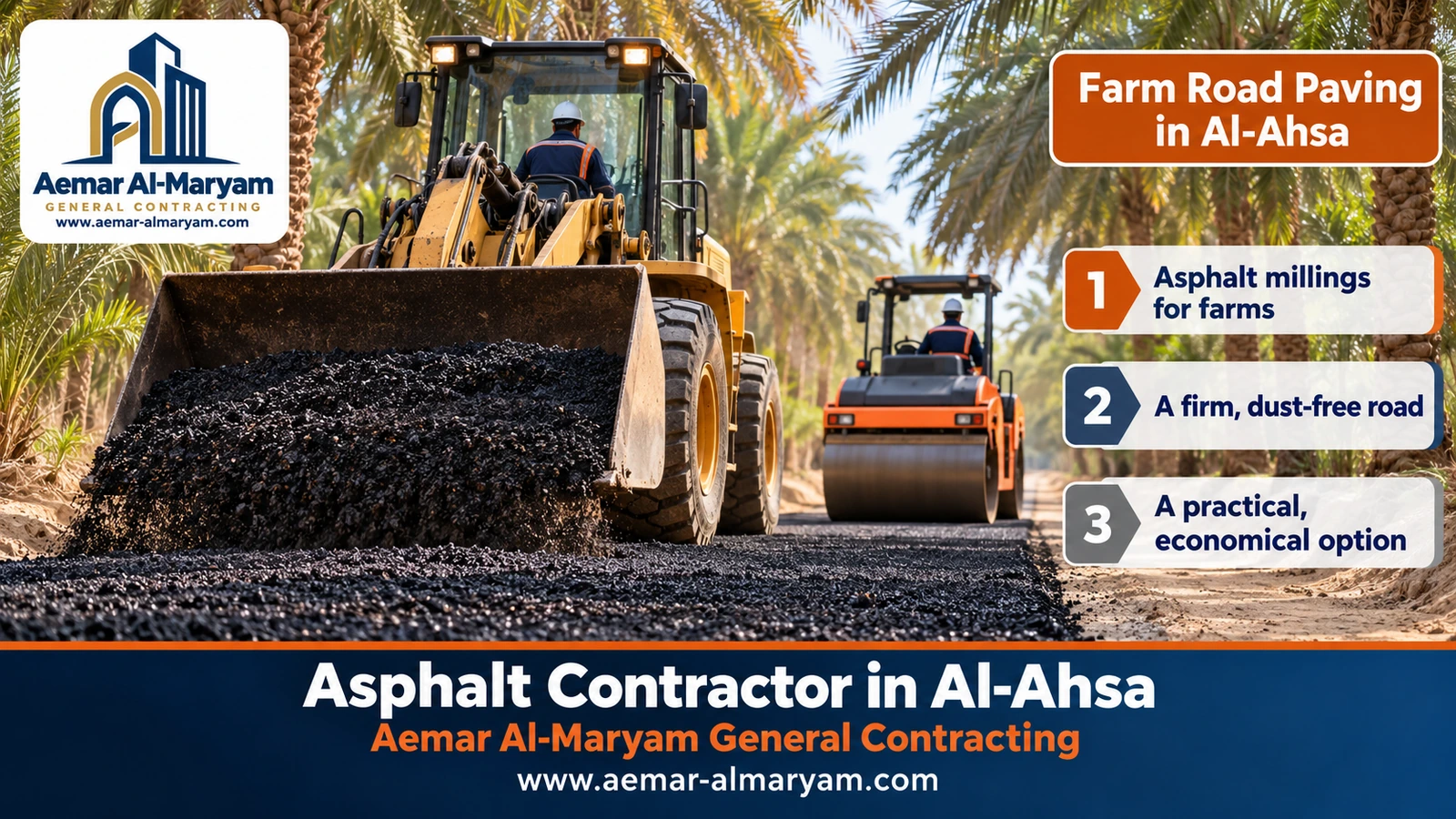
A farm road in Al-Ahsa has two genuine options. Asphalt millings, spread and compacted, give a firm track at a lower cost. New hot mix on a proper base gives a smoother, more stable and longer-lasting surface. The right choice depends on what drives on the road, where on the farm it runs, and how much the look matters to you.
Millings (locally “zift mabshour” or “maqshour”) are old asphalt ground up when roads are milled, and they still hold much of their bitumen. Spread on levelled ground and compacted well in two thinner lifts, to a total of roughly 8 to 10 cm, they make a serviceable road for farm cars, pickups and light machinery. They stay rough to the touch and uneven in colour, though, and under heavy loads standing for a long time in the midday heat they can soften and shift. With millings, compaction is everything.
| Point of comparison | Compacted millings | New hot mix on a base |
|---|---|---|
| Appearance | Rough, dark grey, patchy | Smooth, uniform black |
| Suitable loads | Farm cars and light machinery | Cars to trucks, depending on thickness |
| Summer heat | Can soften and move under long standing loads | More stable; polymer-modified even more so |
| Dust | Much reduced after good compaction | Gone |
| Upkeep | Re-compacting and topping up weak spots | Local hot-mix patching |
| Where we suggest it | Remote internal tracks, lanes between plantings, overflow yards | Main entrance, in front of the house or majlis, truck routes |
| Price | Set at inspection | From SAR 37 on a sound base; from SAR 74 starting from bare ground |
When are millings the sensible choice on a farm?
We recommend them without hesitation for the long road that serves the farm internally, where what matters is that a car gets through after rain without sinking, rather than how the surface looks. On many farms we suggest a mixed solution: hot mix for the first metres inside the gate and in front of the house or majlis, where people see it and cars turn, and compacted millings for the rest of the road. You get a tidy entrance and a practical road at a reasonable cost.
⚠ Millings are not the answer to everything
Where loaded trucks stand in one place for long periods, or the yard sits in front of a frontage you want to look clean, millings are the wrong material. They rut under the wheels in summer, scatter loose particles when vehicles turn, and send you back to repairs quickly.
Shop car park paving in Hofuf and Mubarraz
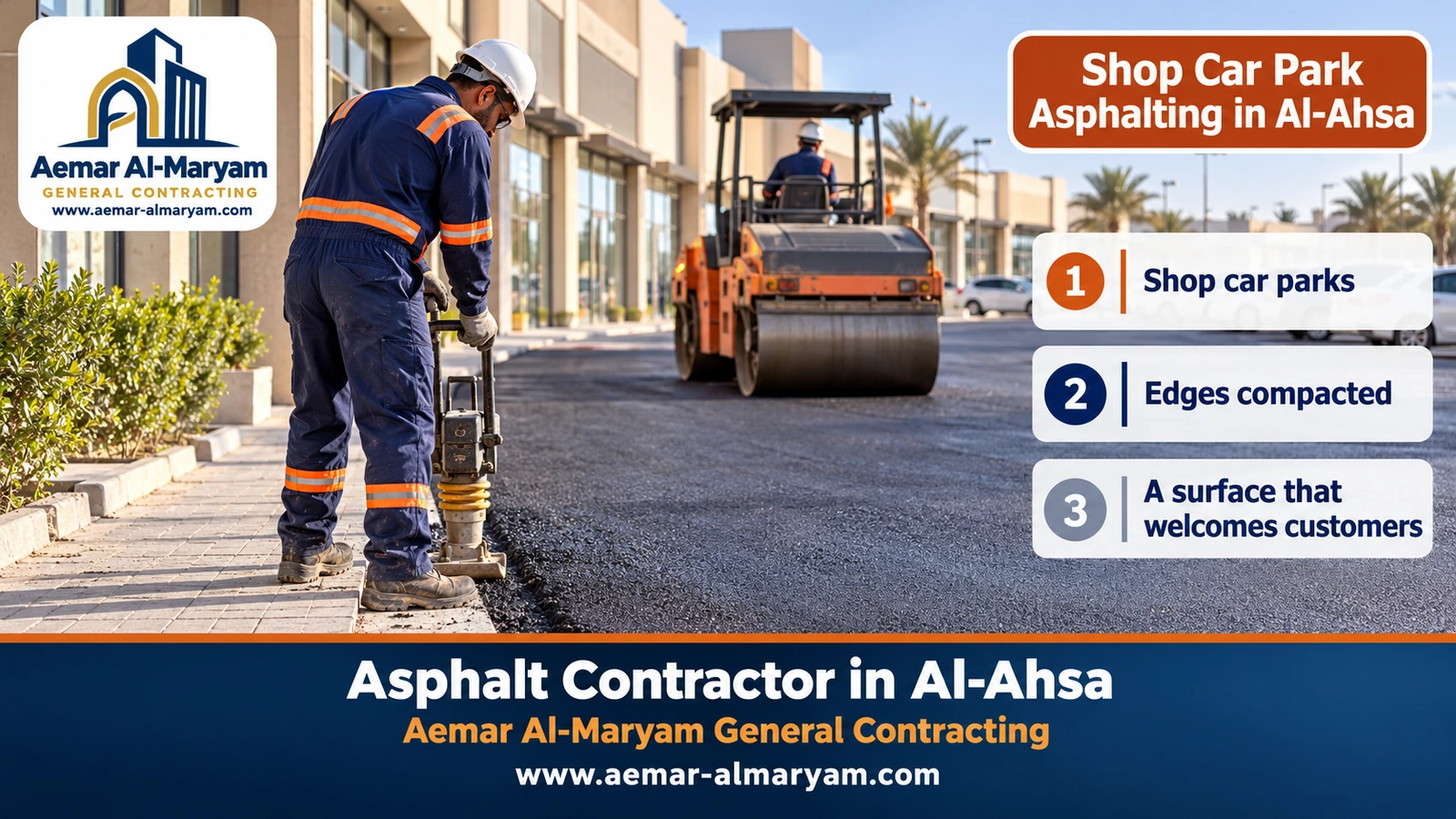
A shop car park in Al-Ahsa is judged on two things: water must not collect at the shop doors, and the asphalt edge against the kerb must not break up after a few months. The car park in front of a shop row in Hofuf or Mubarraz takes cars coming and going all day, wheels turning in the same spots, so it needs a well-compacted base, the right asphalt thickness and carefully compacted edges.
The strip along the kerb is the weakest part of any car park, because a large roller cannot reach right up to it. We compact it with a small hand tamper or vibratory plate while the roller works the open area, and we spray tack coat on the face of the kerb so the asphalt bonds to it and water cannot open a gap between them.
- ✓Falls: at least 1.5% across the car park, toward the street or a drain, never toward the shop doors.
- ✓Phased work: we split the car park into sections so part stays open to customers, or we work during quiet hours.
- ✓Kerbs: if they are broken or missing, we arrange them before the asphalt through our interlock and kerbs service.
- ✓Old concrete slabs: if broken concrete must come out before paving, our demolition team in Al-Ahsa handles it.
Car park line marking in Al-Ahsa
Once the asphalt has cooled we mark the car park to the building’s approved layout: bay lines, arrows, pedestrian routes, and accessible bays carrying the wheelchair symbol, kept to no more than 2% slope in either direction and backed by a raised sign. We explain the difference between cold road paint, which costs less, and hot-applied thermoplastic, which lasts longer in busy car parks. Marking is priced at inspection according to the number of bays and length of lines.
Pavement layers in Al-Ahsa, from sand to surface
The asphalt you see is the top of a four-layer system, and when one layer is skimped, the fault shows up in the surface. This is the order we build a rest-house yard or shop car park in Al-Ahsa:
- 1Natural ground
We strip clay, organic matter and old planting debris, roll the soil, slightly damp, until it reaches about 95% of the densest it can get when dry, and shape it to the planned falls. - 2Base course under the yard
Graded crushed stone, close to 15 cm thick for a car yard and close to 23 cm where trucks enter, placed in lifts of no more than 15 cm compacted, each rolled to its full maximum density (100%). - 3Prime coat (MC)
Liquid bitumen sprayed over the rolled stone at somewhere between 0.65 and 1.75 L per m², more where the stone is thirsty, followed by a full day or longer before the mix goes on. - 4Hot mix
Delivered hot from the plant; we check its temperature, spread it, start rolling while it is around 139 °C or more, and finish before it drops to about 90 °C.
Damp farm ground: when do we replace the soil before the base?
The ground inside farms and around irrigation basins is different from the sand of an open yard. It may stay damp most of the year, hide a soft clay layer, or show salt on the surface. Across the Eastern Province there are places where saline groundwater sits close to the surface, and salty soil loses part of its bearing capacity when it gets wet. So at the inspection we dig test holes at several points. Where we find a soft or wet layer, we remove it and replace it with suitable compacted fill, sometimes with a geotextile separating the soil from the base, or we raise the road slightly above the surrounding ground so irrigation water does not flood it. This treatment is priced at inspection because it varies from farm to farm, but ignoring it is the fastest route to a road that sinks after its first season.
MC prime or RC tack: which goes where?
Prime is sprayed once, on the new crushed-stone base, where it soaks in, locks the surface particles and prepares the layer for the asphalt. Tack is a thin film of no more than about a quarter of a litre per square metre, used where new asphalt meets an old surface, between a first and a second asphalt lift, or on a kerb face that the mix will touch. A crew that sprays tack on a fresh stone base instead of prime saves a little and loses the bond.
Asphalt thickness for a rest-house yard or a shop car park
A yard used by visitors’ cars over a sound base needs about 5 to 6 cm of compacted asphalt. A workshop or warehouse yard where trucks turn gets a total of 12 to 14 cm laid in two lifts, because a single lift should not exceed about 8 cm after rolling. Always agree the thickness after compaction: loose mix shrinks by roughly 20 to 25% under the roller, so “5 cm” measured before rolling is really less.
Asphalt mix types in Al-Ahsa: hot, cold and polymer-modified
We use three types of mix in Al-Ahsa, each with its place. Standard hot mix is the basis of every permanent job: rest-house yards, car parks, house yards and the main farm entrance. Cold mix comes ready and is laid without heating; we use it only for temporary patches, such as a pothole that must be closed quickly before an event at the rest house. Polymer-modified asphalt is hot mix with a polymer blended into the binder, which makes it stiffer against rutting in the heat; we suggest it for truck entrances and places where heavy vehicles stand.
| Mix | Where it fits on Al-Ahsa sites | Starting price |
|---|---|---|
| Hot mix, 5 cm | Rest-house yard, house yard, shop car park | SAR 37/m² on a sound base |
| Hot mix, 7 cm | Workshops and warehouses on a sound base | SAR 41/m² |
| Polymer-modified | Truck entrance and tanker standing area | SAR 55/m² |
| Cold mix | Closing a pothole before an event, or until a permanent repair | SAR 46/m² |
Mix from an asphalt plant: how it reaches your site hot
We do not mix asphalt on site. We order hot mix from a plant suited to the job location, time the truck for after the base is complete and the prime has cured, and check the temperature of the mix on arrival before it is spread. If it arrives too cold, it is not laid, because no number of roller passes will give it the density it needs. That is also why, for sites deep inside a farm, we want to know the distance from the gate to the paving area in advance.
Asphalt patching and crack sealing in Al-Ahsa
A patch that lasts starts with straight saw lines drawn around the pothole, far enough out to reach sound asphalt. We clear water and dirt from the hole, coat the sides with tack, fill with hot mix, compact from the middle outward and leave it slightly proud of the surrounding surface. Cold-mix patching is a stopgap for urgent cases. And if the pothole is the result of the base sinking, as often happens above a leaking irrigation line, patching the surface is pointless until the cause is fixed and the base is compacted again.
Longitudinal and transverse cracks are cleaned, blown out with compressed air and filled with hot rubberised sealant before water can seep beneath the asphalt. Interconnected “alligator” cracking is a sign that what lies under the surface has failed, and the cure is to cut out the damaged area and rebuild it. For straight cuts at tie-ins we use the equipment of our concrete cutting in Al-Ahsa team.
Milling old asphalt and relaying
When a rest-house yard or car park was paved years ago and its surface is worn but its base is still firm, the most economical answer is often to mill off the top 3 to 5 cm, spray tack coat and lay a fresh layer. That keeps the yard at the same level at gates and thresholds, instead of raising it as an overlay straight on top of the old asphalt would. Expect milling plus the new layer to start at around SAR 38 a square metre, as an estimate.
Asphalt price per square metre in Al-Ahsa
Al-Ahsa paving with us begins at SAR 37 a square metre, identical to our Dammam starting rates, with travel added after the site visit. Treat each number as provisional until the inspection and a signed scope; it moves up or down with the size of the yard, the layer thickness, the type of ground and what lies beneath it, and how easily the roller and the mix truck can reach the area:
| What you need in Al-Ahsa | Per m² from | When it fits |
|---|---|---|
| 5 cm hot mix over an existing compacted base | SAR 37 | Levelled rest-house yard, house yard, shop car park |
| 7 cm hot mix over an existing base | SAR 41 | Workshop or warehouse with trucks |
| Everything from bare ground: levelling and compaction, base course, prime, then 5 cm asphalt | SAR 74 | A sandy yard with nothing built on it yet |
| Polymer-modified mix | SAR 55 | Tanker entrance and truck standing areas in the heat |
| Cold-mix pothole filling (temporary) | SAR 46 | Before an event or until the permanent repair |
| Milling 3–5 cm, then a new layer | SAR 38 | Worn old surface with a sound base |
| Millings spread and compacted | At inspection | Internal farm roads |
| Permanent hot patch with cut edges | At inspection | Potholes and local settlement |
| Bay lines and accessible bays | At inspection | Shop and building car parks |
| Base course alone, or replacing wet or salty soil | At inspection | Farm land and areas around irrigation |
| Travel from Dammam | At inspection | All Al-Ahsa sites |
Travel to Al-Ahsa: how to bring its cost down
Travelling to Al-Ahsa means moving a roller, a paver or hand-laying tools, a water tanker and a crew, so there is no flat fee; it tracks the job size and the days on site. What we can say clearly is that the larger the area in a single visit, the smaller the share of travel in each square metre. If you have a rest-house yard and a farm road, or your neighbour in the market wants his car park done too, put them into one request.
Worked example: an 18 × 25 m rest-house yard
For illustration only: a sandy rest-house yard of 18 × 25 = 450 square metres, used by visitors’ cars, needing levelling, a base course, prime and 5 cm of asphalt. At our starting rates, the arithmetic looks like this:
| Item | Calculation | Approximate result |
|---|---|---|
| Area | 18 × 25 | 450 m² |
| Cost for the full build | 450 × 74 | SAR 33,300 |
| Hot mix tonnage (5 cm at roughly 2.3 t per m³) | 450 × 0.05 × 2.3 | Around 52 t |
| Crushed-stone base, 15 cm rolled | 450 × 0.15 | 67.5 m³ |
| Prime spray, taking 1 L for each m² | 450 × 1 | Around 450 L |
| Travel from Dammam | — | Set at inspection |
If the same yard were already levelled with a sound compacted base, the figure would drop to 450 × 37 = SAR 16,650. The final number comes after the inspection, which might show that the tanker path needs strengthening, or that part of the ground is damp and must be replaced.
After paving: when to use the yard and how to look after it
You can use the yard once the asphalt has cooled completely. Hot mix takes its strength from compaction while hot and needs no water curing like concrete. We tell you when, depending on how hot the day is and how thick the layer, and in early summer avoid leaving the tanker or a truck standing in one place for hours, and avoid turning the steering while the car is still.
- ✓Clear drains and water channels before the rainy season so water does not stand on the asphalt.
- ✓Seal cracks early; a crack that lets water in becomes a pothole.
- ✓Keep irrigation water off the asphalt edges; repeated wetting weakens the base beneath.
- ✓Watch for dips above irrigation and drainage lines and treat them before they spread.
- ✓Do not light fires or spill fuel on the asphalt in outdoor seating areas; both attack the binder.
Mistakes we keep seeing on rest houses and farms
- ✓Laying asphalt straight onto sand without a compacted base course.
- ✓Ignoring the path of the tanker and delivery trucks, so the yard breaks up at the gate first.
- ✓Paving right up to the palm trunks without leaving basins.
- ✓Forgetting irrigation and lighting lines, then digging through the new asphalt.
- ✓Falls that run toward the majlis or the seating instead of the outlet.
- ✓Using millings in front of the majlis or in truck yards.
- ✓Agreeing the thickness before compaction instead of after it.
Public streets in Al-Ahsa: who is responsible?
Paving within your own land, be it a rest house, a farm, a house yard or a shop car park you own, needs no excavation permit. Streets open to the public are paved and kept up by the Al-Ahsa Amana and its municipalities. Anything that cuts into a street or spills onto it has to pass through the municipality’s project coordination office, and digging to connect a utility is applied for by the utility company on Balady, not by the owner. If you see a pothole in the public street outside your home, report it on 940 or the Balady app; we pave up to your property line only.
How to order an asphalt contractor in Al-Ahsa
The quickest route is to send us the following on WhatsApp. We reply with a suggested build-up and an estimated cost before we fix the inspection day:
- ✓Site photos from the gate, from the middle of the yard, and from corners where water stands.
- ✓Rough dimensions of the yard, or the length and width of the road.
- ✓Vehicle types: cars only, or a tanker and delivery trucks too.
- ✓Current ground: sand, fill, old asphalt or tiles.
- ✓Gate width, and whether the mix truck can get through it.
- ✓A location pin in Hofuf, Mubarraz or on the farm.
- 1Share the site
Photos and sizes by WhatsApp, or a phone call, on 0547879578. - 2Initial estimate
We suggest layers and thickness and give an estimated cost from our starting rates. - 3Inspection in Al-Ahsa
We measure, check the ground, levels and truck access, and set the travel cost. - 4Agreement with clear items
Compacted thicknesses, layers, what the price includes and excludes, and the schedule. - 5Work and handover
We prepare, lay and roll, test the falls with water and the evenness with a straightedge, and leave the site clean.
Why Aemar Al-Maryam for paving in Al-Ahsa
■ Straight answers on options
We tell you where millings are enough and where you need new hot mix, and never push the dearest option without reason.
■ Figures in writing
The agreement states the base thickness, which spray we use and the asphalt thickness after rolling.
■ A planned trip
Equipment and quantities are worked out from your photos before we arrive, which saves days and money.
■ Beyond the asphalt
When you need it, we connect you with our renovation, demolition and cutting teams in Al-Ahsa.
You can see completed work on our projects page, and estimated prices for all our services in the price guide.
Areas we serve in Al-Ahsa
Our crews work across Hofuf and Mubarraz and out to the istirahas and palm farms beyond them. Districts include:
Coverage details are on our Al-Ahsa page. We also pave in the north of the province: read about our Khafji and Hafr Al-Batin work, or go back to the main asphalt contractor in Dammam guide.
Is your rest-house yard or farm road ready to pave?
Send photos, dimensions and vehicle types. We will suggest the layers and the right option with an estimated cost, then book the inspection day in Al-Ahsa.
Pages close to your request
Tags