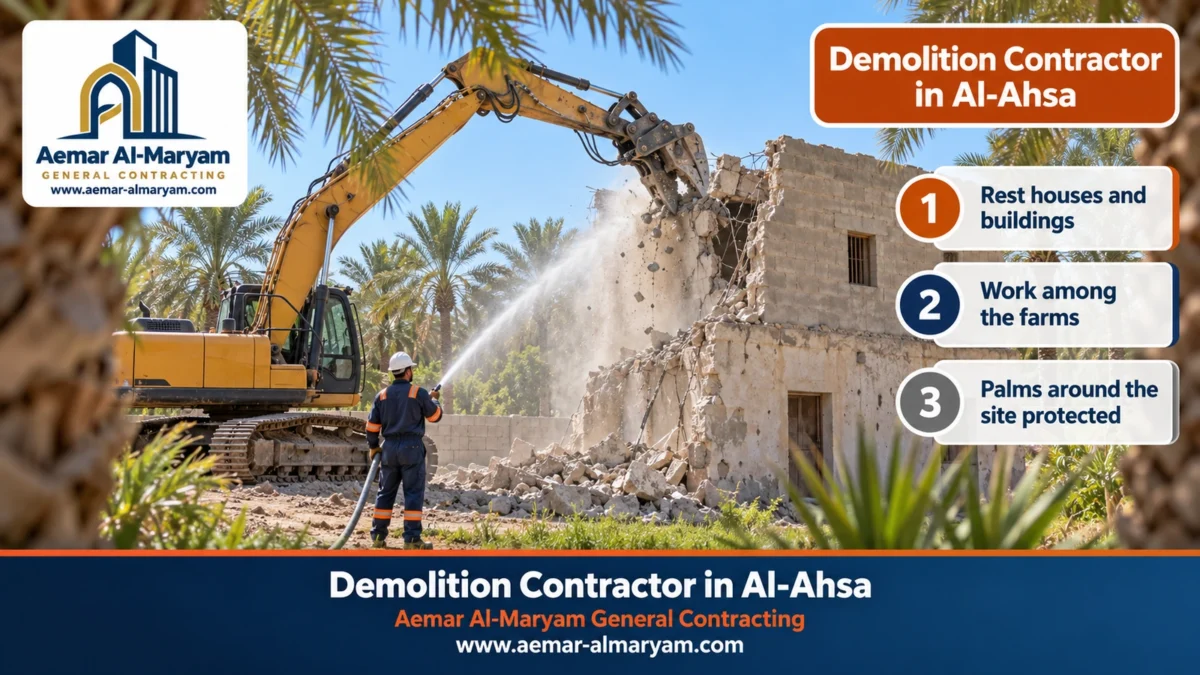
A demolition contractor in Al-Ahsa is the team that takes down an old rest house, a house or an annexe in Hofuf, Mubarraz and the farmland around them, breaks out walls, tiles and concrete farm basins, then hauls the rubble away and leaves the place clean. Aemar Al-Maryam General Contracting sends its crew from Dammam to Al-Ahsa with a work plan agreed in advance, and we work only on modern buildings made of concrete block and reinforced concrete. Our figures begin at SAR 7,400 to clear a small one-floor house, SAR 185 to take out a partition between two rooms and SAR 14 per square metre to strip old tiling, all of them estimates until we have inspected and agreed the job. Phone or WhatsApp: 0547879578.
The jobs we get from Al-Ahsa look different from those in Dammam or Khobar. Here we see many concrete-block rest houses (istirahat) on the edge of date farms, large halls tiled from floor to ceiling, and concrete water basins and irrigation channels that have cracked over the years and that the farm owner now wants to replace. At the same time the oasis holds mud-brick and traditional buildings that fall under a dedicated heritage authority, and we do not touch those. Below: what we demolish, where we stop, and how pricing works when the crew travels from Dammam.
Demolition and breaking in Al-Ahsa: the short version
- Where we work: Hofuf and Mubarraz and their districts, plus the rest houses and farms around both cities.
- What people ask us for most: demolishing block rest houses and annexes, breaking farm water basins and irrigation channels, removing wall tiles in rest-house halls, and pulling down old concrete houses.
- What we will not demolish: mud-brick and heritage buildings in the oasis; decisions on those belong to the Heritage Commission and the competent authorities.
- Where prices begin: a small house SAR 7,400; a two-floor home whose floors total roughly 300 m² SAR 13,900; bigger concrete buildings SAR 46 for each m² of floors; a partition SAR 185; tiles SAR 14 a m². All estimates, confirmed after the visit.
- Travelling from Dammam: the cost of moving the crew and machines is set after inspection, and grouping several jobs into one visit lowers it.
- How to reach us: WhatsApp 0547879578 with the location and photos of the property from every side.
Demolition contractor in Al-Ahsa: what we handle on rest houses, homes and farms
In Al-Ahsa our work falls into three kinds of job. The first is full demolition of a modern building whose useful life is over or is being replaced. The second is partial demolition of one element, such as an annexe, a canopy or a guard room. The third is breaking out finishes and non-structural items, like wall tiles, floor tiles, water basins and irrigation channels, without touching the frame. Each kind of job needs its own method and machines, which is why our first question on WhatsApp is always the same: what do you want gone, and what has to stay exactly as it is?
■ Block rest houses
Taking down the old hall, majlis or outdoor toilets, and breaking an old pool if you want it gone, while the boundary wall and gate stay.
■ Farm structures
Breaking concrete water basins, irrigation channels, pump bases and concrete shades without harming the palms around them.
■ Modern houses and villas
Demolishing old concrete houses in Hofuf and Mubarraz districts and handing back a plot ready for building.
■ Interior breaking
Stripping wall and floor tiles, removing the wall between two rooms and breaking bathroom floors before a refit.
■ Concrete breaking
Old footings, ground slabs, kerbs and thresholds, with hand-held or hydraulic breakers depending on size.
■ Debris removal
Loading the rubble and taking it with a licensed carrier to sites the municipality designates, then cleaning up.
You will find an overview on the demolition service page, while our Al-Ahsa page gathers everything we do in the governorate, including cutting, coring and renovation.
Building demolition in Al-Ahsa: Hofuf and Mubarraz
In practice, building demolition in Al-Ahsa happens mostly in its two main cities, Hofuf and Mubarraz, which have grown into one continuous urban area. Both have a mix of concrete houses built decades ago, newer villas and small apartment blocks. The plan for a demolition does not depend on which of the two cities the plot is in. It depends on what the building is made of, how wide the street is, how close the neighbour is, and whether there is an underground tank or an old septic pit under the yard.
Demolition in Hofuf
In the older parts of Hofuf we often find houses built tight against each other, and some share a single party wall with the house next door. On a plot like that we do not let the excavator work across the whole building. The machine takes down the part furthest from the neighbour, and a strip a metre or more wide along the shared wall is taken apart by hand with electric breakers, so the shaking stays on our side of the party wall.
Demolition in Mubarraz
Mubarraz has a similar mix of buildings, but many of its requests come from old family homes that the heirs want to demolish so they can sell or divide the land. In that case what matters most to the owner is that the plot is handed over completely clear, with no foundations and no rubble, so that a buyer values it as vacant land. We therefore agree at the start whether the ground beams and footings are removed or left in place, because the difference in time and in the number of truck loads is large.
Demolishing an old house in Al-Ahsa
Taking down an old house in Al-Ahsa starts with making sure it really is a modern block or concrete building and not a traditional mud house. Then we check the roofs. A slab whose steel has rusted and whose concrete has swollen and spalled is never walked on and never has a machine placed on it; it is brought down from outside with the excavator arm. After that we strip out the doors, windows, air conditioners and roof tanks, empty the ground tank, and start from the top slab downward. In parts of the oasis the groundwater sits close to the surface, which is a common reason why the bottoms of walls and the footings of older houses have deteriorated, and why their owners choose demolition over repair.
Villa demolition in Al-Ahsa
For a two-storey concrete villa in Al-Ahsa we bring an excavator carrying a pulveriser that chews through slabs and walls from the roof down, after which the steel is separated and collected for sale. What usually makes villa demolition longer here is everything around the house: a tall concrete boundary wall, car shades, an outdoor majlis and sometimes a pool in the yard. We price each of these as a separate line, so you can see what you are paying for each part and decide, for example, to keep the boundary wall and save part of the cost.
Demolishing concrete-block rest houses in Al-Ahsa
Rest-house demolition in Al-Ahsa has its own character. A typical rest house is a single-storey building in concrete block, with a light or concrete roof, surrounded by open ground, palms and water and power lines that serve the whole farm. Knocking the building down is not difficult in itself. The usual mistake is to demolish it and only then find out that the farm pump or the boundary lights were fed from its distribution board, or that the main irrigation pipe runs under its floor.
So on a rest house we start with a walk round the services together with the owner: where the power comes in, what outside the building draws from it, where the water and drain pipes run, and where the septic pit is. We separate what is coming down from what is staying, give the farm a temporary supply if it needs one, and only then begin. If it will be rebuilt, sound boundary walls, gates and paving are kept.
- ✓Hall and majlis: block walls under a concrete or light roof, taken down from the top once the air conditioners, lights and doors are out.
- ✓Outdoor toilets and kitchen: the water is cut off and the drain openings are plugged before breaking starts, so no rubble gets into them.
- ✓Old pool: drained, then its floor and walls are broken out or it is backfilled, depending on what will be built there; backfill that is not compacted settles later.
- ✓Shades and outdoor seating: the steel posts are unbolted and sold, and the concrete bases are broken down to ground level.
- ✓Boundary wall and gate: usually kept, and we protect them from machine knocks and from rubble piled against them.
The palms around the rest house
Before day one we agree the route the machines will take with the owner, so the excavator does not drive over palm roots or swing its arm into the fronds. If a palm stands right against a wall that is coming down, that wall is taken apart by hand and pushed away from the tree.
Breaking farm water basins and irrigation channels in Al-Ahsa
Farm owners in Al-Ahsa ask us to break out concrete basins and irrigation channels when they switch to modern irrigation networks, or when an old basin cracks and leaks so badly that repairing it is no longer worth it. A basin or channel is usually fairly thin concrete, sometimes reinforced with light mesh. The difficulty is not how hard it is but where it sits: among the palms, on damp ground, next to pipes that are still in use.
That is why most of this work is done by hand with medium electric breakers. The broken pieces go by wheelbarrow to a collection point the truck can reach, instead of heavy machines driving in between the palms. If a basin is large and well away from the trees, we can bring in a mini excavator with a hydraulic breaker to shorten the job. Once the breaking is done we level the area or backfill it with clean soil, and leave the old channel route ready for the new network to be laid.
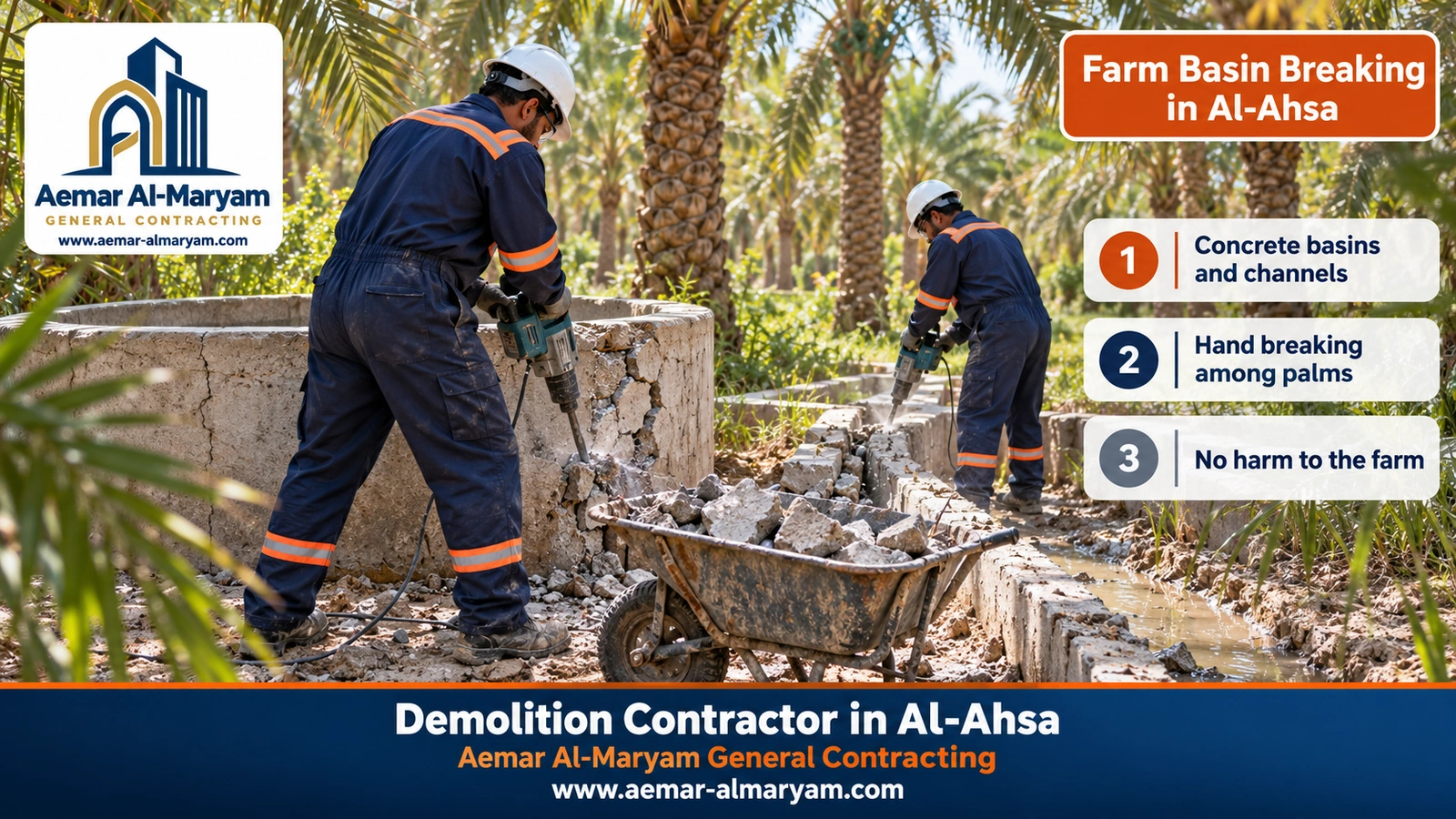
- Before breaking: the basin is fully drained, the valves feeding it are closed, and the route of any nearby pipe is marked.
- While breaking: we work from the edge inwards, and leave any basin wall that touches a palm until last, then take it apart by hand.
- The broken concrete: stacked outside the root zone and carried to the truck, never piled against the palm trunks.
- Afterwards: the area is levelled or backfilled and the channel route is handed over clean to whoever installs the new irrigation.
Owners often add an old pump base, a small equipment room or a concrete shade over the water source, and we group these jobs into the same visit. When a new pipe has to pass through standing concrete without breaking it, that is cutting and coring work, covered in concrete cutting in Al-Ahsa and core drilling in Al-Ahsa.
Mud-brick and heritage buildings in Al-Ahsa Oasis: why we do not demolish them
UNESCO lists Al-Ahsa Oasis as a World Heritage property, and within it stand mud-brick and traditional buildings, old markets and historic houses. What happens to this kind of building, whether it is restored or removed, is a matter for the Heritage Commission and the competent authorities, not for a residential demolition contractor. We therefore do not demolish a mud-brick house or a traditional building, and we do not accept requests to remove part of one.
⚠ If the property includes a mud-brick or traditional part
We stop before pricing and ask the owner to contact the heritage authority first. If a rest house or house is modern but has an old mud room attached, we demolish the modern part only, once the status of the other part is clear, and we separate the two with a saw cut so the older part is not affected.
Many Al-Ahsa houses only look old: built in cement block and concrete a few decades ago, they count as modern and can be demolished under a normal permit. If you are not sure what your building is made of, send a close-up photo of an exposed wall or of a ceiling from inside, and we will tell you what we see before any further step.
Breaking-out contractor in Al-Ahsa: tiles, walls and concrete
A breaking-out contractor in Al-Ahsa usually works inside a building that will stay in use, so the job is judged as much by what was not broken as by what was removed. We cover floors and doors, isolate the power to the wall, close the room off with plastic sheeting, bag the rubble and carry it out every day.
Removing wall tiles in rest-house halls
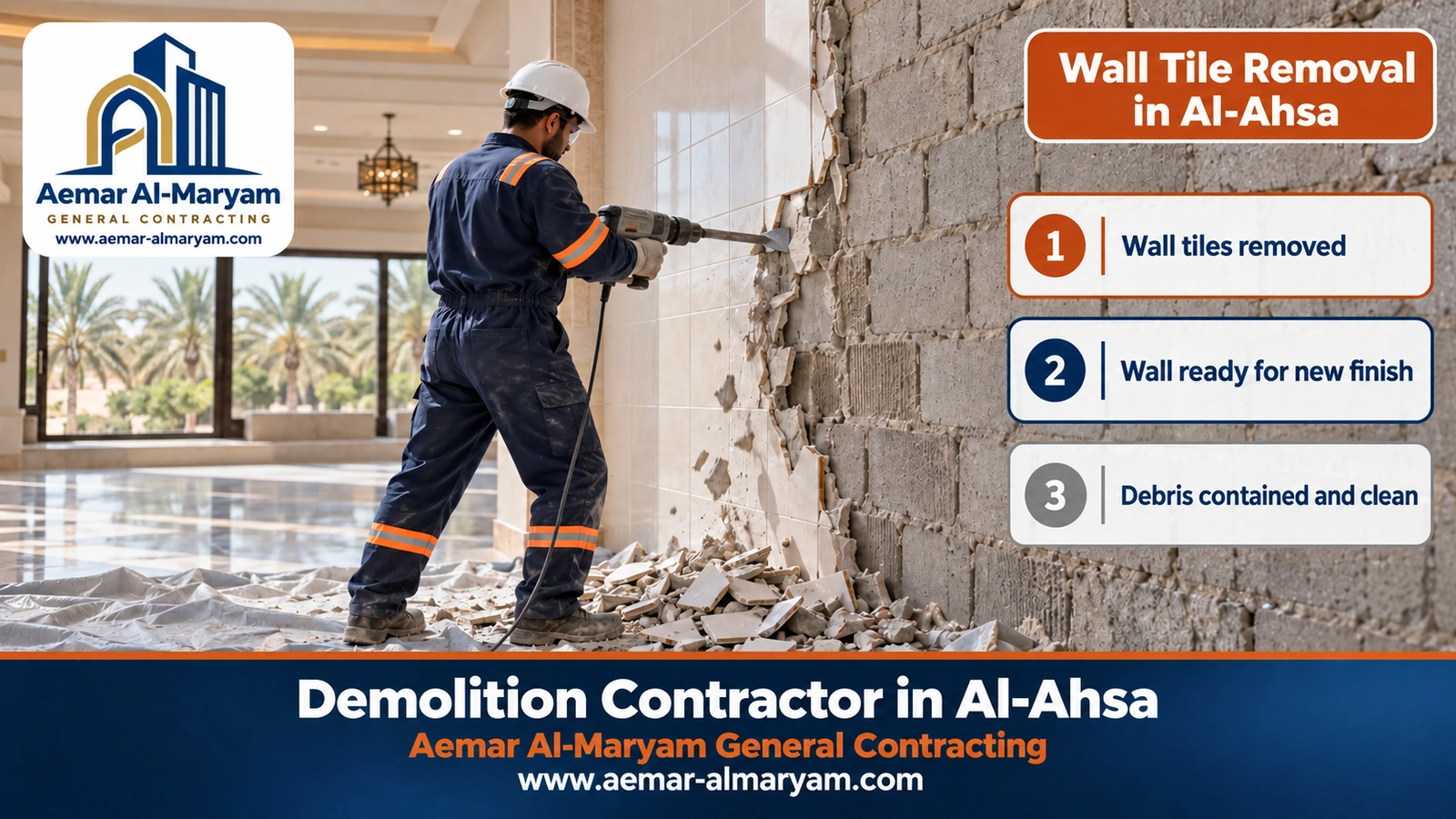
Wall tile removal is one of the most frequent requests from Al-Ahsa rest houses. Many older halls were tiled right up to the ceiling, and today their owners want plaster and paint or a modern cladding instead. What comes off is not just the tile but the bedding mortar behind it, all the way back to sound blockwork. Leaving old mortar under new plaster is what makes the plaster crack or come away after a while.
We use a light electric breaker with a wide chisel held at a shallow angle, so the tiles and mortar lift off without digging into the block or cutting the cables buried in the wall. We work from the top of the wall down, so pieces do not fall onto areas already cleared, and we lay a protection sheet along the foot of the wall. In a large hall we usually finish one or two walls a day, depending on how thick the mortar is.
Floor tile and floor breaking in Al-Ahsa
Breaking out floor tiles in Al-Ahsa normally comes before a new hall, bathroom or kitchen. We remove the tiles and the screed down to the concrete slab and stop at buried drain and supply pipes so the plumber can decide whether they are being replaced. Where a floor has lifted or sunk, we check underneath it, because the cause may be an old leak or poorly compacted fill that must be dealt with before the new tiles go down.
Breaking a wall and removing the wall between two rooms in Al-Ahsa
Removing the wall between two rooms in an Al-Ahsa home can be done in a working day if it is a block partition sitting under a visible concrete beam. First we confirm that it does not carry the roof and does not hide a column, and we move the sockets and switches on it. Then we break it from the top down and leave the beam as it is. If the wall is concrete, has no beam above it, or is thicker than about 20 cm, a civil engineer looks at it before anything is struck, and it may need temporary props and a new beam.
Concrete breaking in Al-Ahsa: what a concrete breaker crew actually does
Plenty of people in Al-Ahsa search for a “concrete breaking foreman” (mu’allim taksir kharasana) for a specific job: an old footing, a slab in a yard, a concrete staircase or a car stop. Reinforced concrete holds together around its bars instead of crumbling like block. We break it with a heavy electric breaker on small jobs, or with a hydraulic breaker on a mini excavator over larger areas, then cut the exposed bars to separate the pieces. The difference between hiring one foreman and hiring a contractor is that the contractor also carries the haulage, the clean-up and the protection of everything around the work, not just the breaking.
Cutting a wall with a hand-held “rocket” cutter in Al-Ahsa
The large hand-held cutter that people call a “rocket” (sarookh) is a disc saw, and the biggest hand-held power cutters reach a cutting depth of about 12.5 cm. That is enough to mark a straight line before breaking and to cut block or stone, but it will not get through a thick concrete wall from one side. We use it to set the edges of the work, finish with the breaker inside that line, and spray water while cutting, because dry cutting throws up a dense dust that is harmful to breathe.
Cutting without breaking in Al-Ahsa
If what you need is a door or window opening in a concrete wall, or to separate part of a slab without vibration, a diamond saw is a better choice than a breaker. The edges come out straight, water keeps the dust down and the rest of the wall is not disturbed. This work has its own guide, concrete cutting in Al-Ahsa, and on many projects we combine cutting and breaking.
Partial demolition in Al-Ahsa: annexes, guard rooms and canopies
Partial demolition in Al-Ahsa is about taking away one piece and leaving everything else working: an annexe in the yard, a guard room by the farm gate, a concrete canopy in front of the majlis or an external staircase. Steel bars run from that piece into the main structure, so if it is broken out roughly, cracks travel into the part that has to stay.
- 1We set the separation line
We mark the boundary between what goes and what stays, and cut along it with a diamond saw so the two parts are no longer joined. - 2We support what remains
Steel props go under any slab or beam that used to bear on the part being removed. - 3We take it apart gradually
The separated section is broken piece by piece by hand or with a mini excavator, without dropping large blocks. - 4We finish the edge
Exposed steel on the remaining building is treated and the edge prepared for plaster, or handed to the renovation team.
When a structural member is involved, it is the engineering office that chooses the permit route. If the remaining building needs repair afterwards, see renovation contractor in Al-Ahsa.
When is demolition the right answer in Al-Ahsa?
Pulling a building down makes sense when its frame is damaged throughout, rather than its finishes. Among the cases we meet in Al-Ahsa: wall bases and footings eaten away by damp and salts rising from the ground; slabs whose steel has rusted until the concrete cover falls off; buildings weakened by a fire or a long-running leak; or simply a building that no longer suits what the owner wants to do with the land.
| Situation | Usually closer to | Why |
|---|---|---|
| Cracks in the plaster and limited leaks | Renovation | The frame is sound and the problem is in the outer layers |
| Rusting steel in one or two slabs | Structural repair backed by an engineer’s report | Limited elements can be treated |
| Widespread decay in footings, columns and slabs | Demolish and rebuild | Repair costs approach those of a new building |
| An old rest house that no longer fits its use | Demolish and rebuild | The layout, not the damage, is the reason |
Remember: a civil engineer, not the contractor, makes the structural call after examining the building.
If renovation is the better fit for you, our renovation service explains what can be saved. If you decide to demolish and rebuild, have the new building planned before the old one comes down; we can carry the project on through construction.
Demolition permit in Al-Ahsa
No whole building in Al-Ahsa comes down without a demolition permit, applied for online on Balady as anywhere else in the Kingdom. After logging in with the national sign-on, the owner selects the property through its building permit or survey decision and appoints an engineering office, which fills in the data and draws up the plans. A declaration is signed that nobody, human or animal, will remain inside during the work. Balady lists the service as taking one to ten days, and its fee calculator shows what is due.
What you need before applying
- Title deed or survey decision: a survey decision is enough if there is no building permit.
- A contracted engineering office: it prepares the drawings, follows the request and later checks that the waste went with a licensed carrier.
- Fee payment: whatever the fee calculator shows once the request is submitted.
- Vacancy declaration: the owner’s statement that the building stays empty while it comes down.
Breaking out tiles or a non-load-bearing partition inside a house is normally treated as maintenance and does not need a demolition permit. For farm and rest-house structures such as outbuildings and basins, the engineering office decides whether a permit is needed and which one. We do not start a full demolition before the permit is issued, and our quote lists our own work apart from Balady fees and the engineering office’s bill.
Debris removal in Al-Ahsa
Debris removal in Al-Ahsa is the permit holder’s responsibility. Under the ministry’s rules on building and demolition waste, the holder must hire a haulier that the national waste-management centre has licensed, and the loads go the loads only to sites named by the municipality. The engineering office checks this and submits the waste-receipt certificate with the completion report. That is why haulage is part of our contract and not an optional extra.
On rest houses and farms the open space tempts some contractors to bury rubble at the edge of the land or leave it in a heap behind the wall. That damages farm soil, exposes the owner to penalties and becomes a problem when the land is sold or built on. Steel and other metals are sorted for sale, block and concrete leave in covered trucks, and you keep the disposal paperwork.
Can the rubble be used to fill the ground?
Filling holes with mixed rubble that contains timber, plastic and steel leads to settlement later. What works as fill is clean soil or recycled material from an approved source, and the engineer decides on that before building.
Demolition for scrap in Al-Ahsa: is there such a thing as free demolition?
Some adverts promise “free demolition” in return for the steel. On a big, heavily reinforced building that can almost work; on a small block rest house or a rusty old home it rarely does, because machines, labour, haulage and the drive to Al-Ahsa outweigh the scrap. We value anything saleable at the inspection, show it as a credit in the quote and still remove everything else.
Cost to demolish a house in Al-Ahsa: starting prices
House demolition in Al-Ahsa opens at SAR 7,400 for a modest one-floor building and SAR 13,900 for a two-floor house or villa of roughly 300 m² in total, and bigger buildings are worked out at SAR 46 for every square metre of their floors. Demolition contractors in Al-Ahsa do not publish prices, so we took the prices from the nearest city where they are published and set ours below them. The final figure is fixed after inspection.
| Job in Al-Ahsa | How it is charged | Starts from |
|---|---|---|
| Small rest house or old single-storey house | Fixed job price | SAR 7,400 |
| Two-storey house or villa, floors totalling about 300 m² | Fixed job price | SAR 13,900 |
| Larger concrete buildings | Per m² of floor area | SAR 46 |
| Block partition between two rooms | Per wall | SAR 185 |
| Wall or floor tiles with their mortar | Per m² | SAR 14 |
| Debris haul to a nearby site | Per load | SAR 90 |
| Breaking concrete water basins and irrigation channels | — | After inspection |
| Partial demolition: annexe, guard room, canopy, stairs | — | After inspection |
| Breaking reinforced concrete: footings and slabs | — | After inspection |
| Moving the crew and machines from Dammam | — | After inspection |
Before you compare: all of these are estimates pending inspection and agreement. Each goes up or down with the building material and size, how close the neighbour or the palms are, how easily the excavator can get in and how many debris loads there are. Lines marked “after inspection” are priced once we have seen them, so photograph the site and send the photos with rough sizes to WhatsApp 0547879578 for an approximate cost.
Old house demolition cost in Al-Ahsa
Here the floor is SAR 7,400. Take an old block house of around 150 m²: the metre rate gives about SAR 6,900, which is below that floor, so the minimum applies, since fencing, set-up and machines cost the same on a small job; loads and travel come on top. Expect more if there is a big ground tank, a pit to fill or a neighbour hard against the walls.
Two-storey house demolition cost in Al-Ahsa
A two-storey house starts at SAR 13,900 as long as both floors together come to no more than about 300 m². Above that the per-metre rate applies: a house with 180 m² on each floor has 360 m² of floor area, which works out at roughly SAR 16,560 before debris loads and before the value of the steel is deducted.
Villa demolition cost in Al-Ahsa
A villa with around 300 m² of floor area starts at SAR 13,900, and anything bigger is charged per metre. On top of that come the things around it: the pool, a tall concrete boundary wall, an outdoor majlis and car shades. Newer villas also carry more steel, which enlarges the scrap credit.
Wall demolition cost in Al-Ahsa
A block partition between two rooms starts at SAR 185, including bagging the rubble. A longer or taller wall, one with services that need rerouting, or one after which you want the floor and plaster patched, costs more. A load-bearing wall is not priced until an engineer has reported on it.
How is the trip from Dammam to Al-Ahsa charged?
Al-Ahsa is about 160 km by road from Dammam, so we add a line for moving the crew and machines after the inspection. We do not give it a fixed figure, because a job that needs an excavator and tipper trucks is very different from one where a crew with hand breakers is enough. The best way to bring it down is to group your work into one visit: the annexe demolition, the basin breaking and the hall tile removal in the same week, or to agree with a neighbour who has similar work so the trip is shared across more jobs.
How long do demolition and breaking take in Al-Ahsa?
Breaking out an interior wall or the tiles of one room is usually a day’s work. Allow several working days for a small rest house or one-floor house, and one to two weeks for a concrete villa on two floors. For a full demolition the permit time of one to ten days comes on top.
| Job | Usual time on site | What makes it longer |
|---|---|---|
| Stripping the wall tiles in a hall | One to two days | Thick mortar, tall walls, buried cables |
| Breaking a water basin and irrigation channel | A day to a few days | Nearby palms, damp ground, channel length |
| Rest house or single-storey house | A few days | Pool, underground tank, neighbour alongside |
| Two-storey concrete villa | Roughly one to two weeks | Removing foundations, boundary wall, number of loads |
Safety on demolition sites in Al-Ahsa
Before any full demolition the electricity meter is removed temporarily, at the owner’s request to the Saudi Electricity Company. The water is shut off, the drains plugged, the site fenced with mesh, the building taken down from the top, and water sprayed on the breaking and loading points. On farms, machines keep clear of wells, pumps and overhead lines.
⚠ Old sheets that may contain asbestos
Some old shades and equipment rooms on farms and rest houses are roofed with fibre-cement sheets. Saudi Cabinet decisions banned the use of asbestos and called for replacing it and disposing of it safely. Any sheet we are unsure of is left whole; we ask for a licensed specialist to remove it, and then we carry on. We do not offer asbestos removal ourselves.
How to request demolition or breaking in Al-Ahsa
A complete first message saves a round trip. Share these on WhatsApp (0547879578) and we will propose a method, a rough figure and a visit date:
- ✓Location: the district in Hofuf or Mubarraz, or the farm’s map pin, plus a photo of the road leading to it.
- ✓Photos of the job: the building from every side, or the basin and channel, or the tiled wall with a rough size.
- ✓The material: a close-up of an exposed wall or ceiling helps us tell whether it is block and concrete or mud.
- ✓What stays: the boundary wall, nearby palms, the services feeding the farm and the outdoor paving.
- ✓Permit: for full demolition, whether you have a survey decision or building permit and an engineering office.
- ✓Other work: any other breaking, cutting or repair that could be grouped into the same visit.
Demolition company in Al-Ahsa: why Aemar Al-Maryam?
■ We know where our work stops
Modern buildings only; we stop at mud brick, heritage buildings and asbestos.
■ We look after the farm
Machine routes kept away from the palms, and the farm services separated with care.
■ Prices you can see first
The table above shows where each job starts, and the final figure follows the visit.
■ One visit, many jobs
Demolition, breaking and cutting grouped into one trip to lower the travel cost.
■ Rubble handled properly
Licensed haulage to municipal sites, with paperwork you keep.
■ Work you can look at
Photos from our sites on the projects page.
Al-Ahsa districts we reach
We work in Hofuf and Mubarraz and their districts, and on the rest houses and farms around them. Districts we reach include:
We work the same way in the other Eastern Province cities, including demolition in Khafji and demolition in Hafr Al-Batin; the most complete guide is demolition contractor in Dammam.
Book a demolition or breaking visit in Al-Ahsa
Take a few pictures of the building, basin or wall, drop a map pin, and we will answer with a working method and a rough figure before arranging a single trip for all of it.
Useful links before and after demolition
Article tags