The first thing we see in a yard waiting to be paved in Abqaiq is not the soil but the sand: a loose layer carried in by the wind and piled against the wall and gate, with ground underneath that nobody has ever compacted. So our work there starts with scraping and compacting before any mix. As an asphalt contractor in Abqaiq, Aemar Al-Maryam General Contracting paves small yards and house fronts, car workshop and shop fronts, and private parking: we clear the loose sand, compact the ground, build a base course, spray the prime coat, lay hot mix and measure its thickness before and after rolling. On firm stone a yard surface starts at SAR 37/m², a workshop apron at SAR 41/m², and a sandy plot built from scratch at SAR 74/m²; the run out from Dammam is costed on the visit, and all of these are estimates until inspection and agreement. Call or message 0547879578.
Abqaiq is a governorate on the Dhahran road. Its houses are mostly single-storey with small or medium yards, and it has workshops and shops that need a frontage able to take cars and pickups. Our crews drive out from Dammam on set days, and we like to stack two or three Abqaiq jobs into one trip so the travel is shared. This guide explains how we prepare sand-covered ground, how we pave a yard a truck cannot enter, how we check thickness in front of a workshop, and what it all costs, with a worked example.
In short: asphalt contractor in Abqaiq
- Typical jobs: compact house yards, the strip outside the gate, garage aprons, shop fronts and private bays.
- Preparation: scraping wind-blown sand down to firm ground, then compaction and a base of about 15 cm.
- Thickness: 5–6 cm after compaction for yards, 7 cm at workshops used by light trucks, measured with a gauge before and after rolling.
- Starting figures: SAR 37/m² to surface a yard on firm stone; SAR 41 for a 7 cm workshop apron; SAR 74 to build a sandy plot from scratch; SAR 38 to mill and renew a tired apron; SAR 46 for a cold fill. Trip from Dammam priced on the visit.
- To order: photos of the site, its entrance and sizes on WhatsApp 0547879578.
Asphalt contractor in Abqaiq: what we pave in the town
An asphalt contractor in Abqaiq deals with sites that are smaller than industrial yards and more varied: a single-storey house whose owner wants to end the daily battle with sand, a garage entrance where wheels sink, a car-repair workshop front that has turned into potholes and oil stains, a shop that wants two or three clean bays outside its door. Each needs a different thickness and method, which is why we ask about the vehicles before we mention any price.
■ Small yards
House yards and garage entrances, even where the entrance is too narrow for a truck.
■ House fronts
Your strip between gate and garage, sloped so rain carries sand out rather than in.
■ Workshop fronts
The approach where cars and pickups enter repair workshops, at a greater thickness.
■ Shop fronts
A few parking bays and a clean frontage for customers.
■ Repairs
Holes filled and cracks sealed on aprons that are already paved.
■ Simple line marking
Bays and arrows in front of shops and small premises.
An asphalt company in Abqaiq or a quick spread?
An asphalt company in Abqaiq builds the layers before laying the mix; a quick spread puts a thin layer straight onto the sand as it is. In the first week the result looks the same: a smooth black surface. The difference shows months later, when asphalt laid on sand sinks along the wheel paths, its edges crumble and the potholes return. The general service description is on our asphalt service page, and local information is on the Abqaiq area page.
Clearing wind-blown sand before paving in Abqaiq
Clearing sand before paving in Abqaiq means scraping off the loose layer that the wind has built up until we reach firm ground, then compacting that ground at the right moisture to about 95% of its maximum dry density — and only then laying the base course. Loose sand will not lock together under a roller however many passes it gets, and if it stays under the asphalt it moves over time and the surface settles with it.
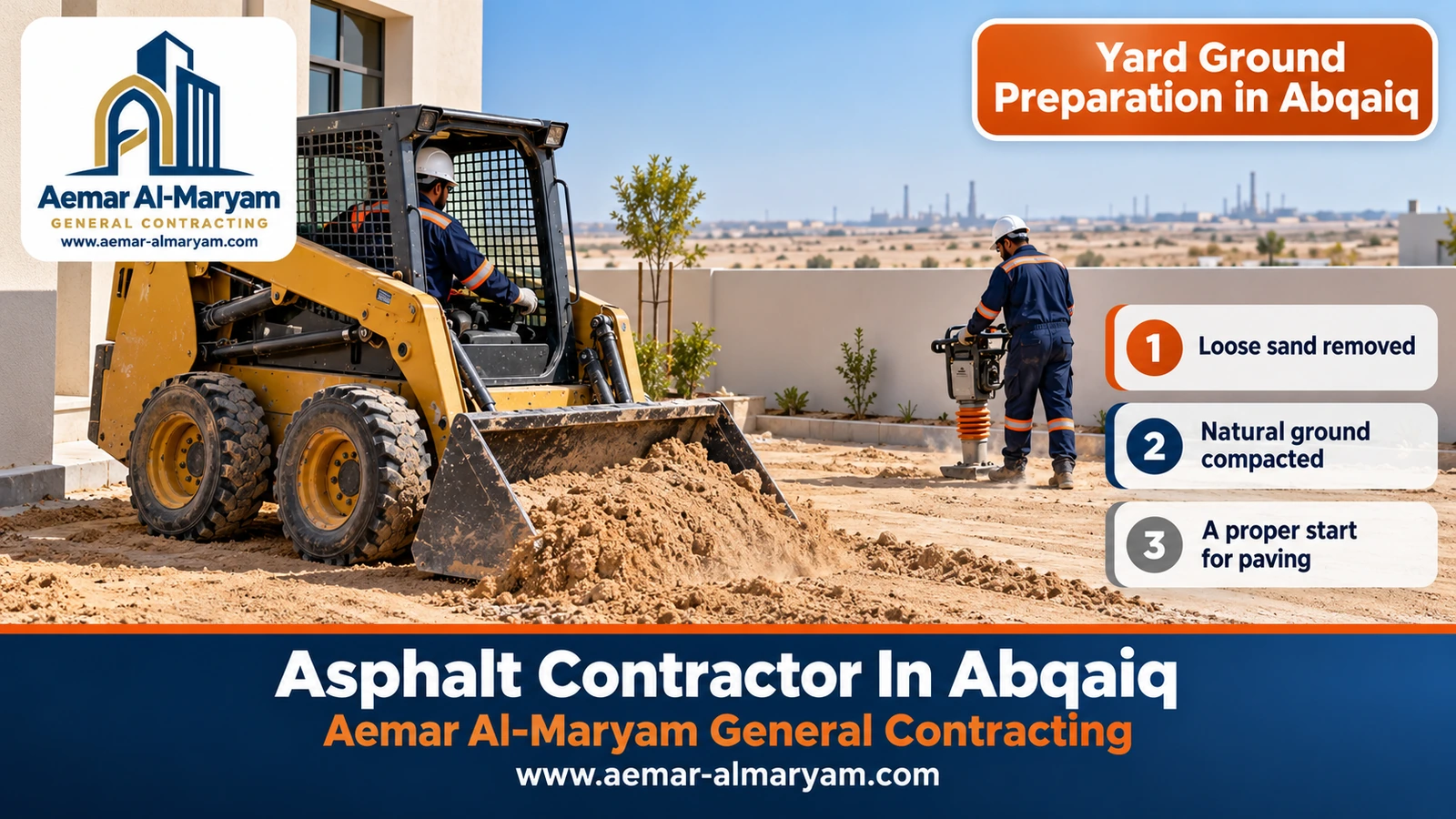
In the photo a small loader gathers the loose sand into a heap, while a worker compacts the ground exposed beneath it with a vibratory rammer near the wall, where the loader cannot reach. That heap is either carted off site or used as fill somewhere else if it is clean; it never goes back under the asphalt. After compaction we water the ground and lay the granular base.
Why we never lay the base straight onto sand
- ✓Loose sand does not carry load: its grains are separate and do not interlock, so they shift sideways under passing wheels.
- ✓It takes in water and loses it fast: so its volume changes slightly with every rain and dry spell.
- ✓It mixes into the base: weakening the granular base from underneath.
- ✓Compaction needs firm ground: a roller on loose sand sinks instead of compacting.
Protecting edges from drifting sand after paving
The wind will bring sand back after paving, and that does no harm to the asphalt if it is swept regularly. But an edge exposed to the wind wears faster, and sand piles up against it and blocks the drain openings. So on the exposed side we suggest a kerb or a concrete edge to support the asphalt and hold back the sand — see our interlock and kerbs page. We also set the yard’s fall towards a drain or the street, so rainwater washes the sand out with it instead of leaving it in the corners.
Paving small yards in Abqaiq: getting the mix into a narrow yard
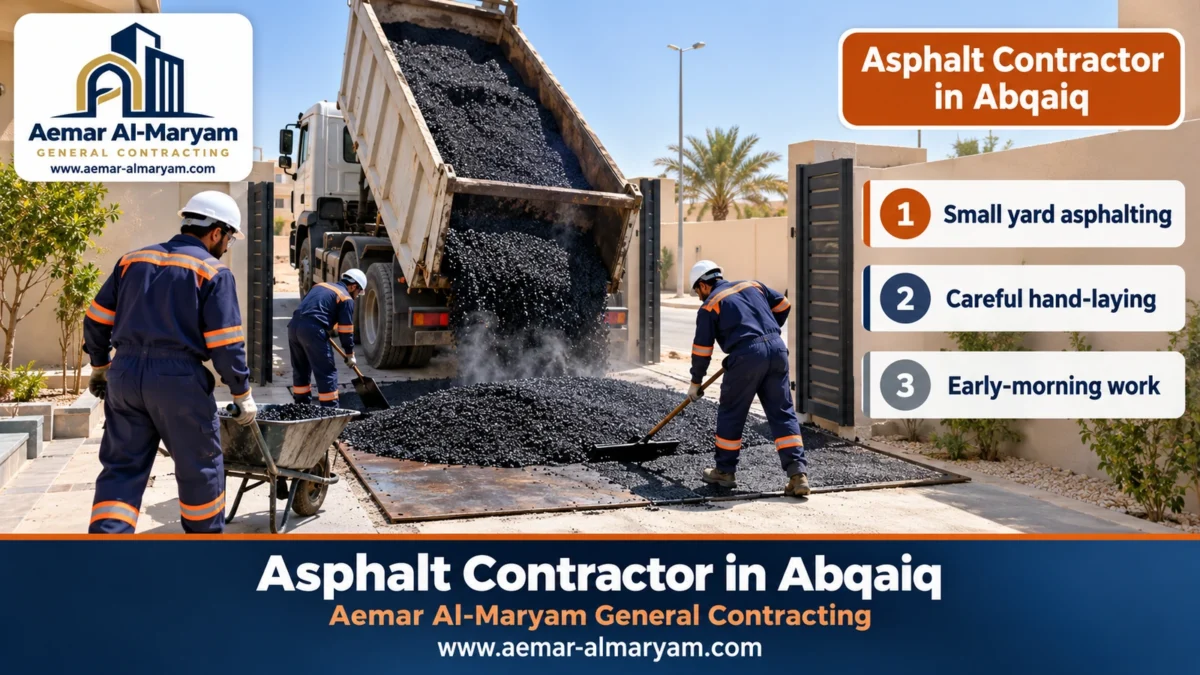
Small yards in Abqaiq are often paved without the truck ever entering: the tipper discharges the hot mix onto a steel plate at the entrance, the crew moves it into the yard with wheelbarrows and shovels, spreads it with lutes, and a small roller or rammer compacts it. That way the truck does not break the tiles or the kerb at the entrance, and we do not need a large paver that would not fit anyway.
Hand laying needs speed and organisation, because mix moved by wheelbarrow cools faster than a large load. So we bring a big enough crew, pave the yard in successive sections, roll each section while it is hot, and tack the edges of the earlier sections so the joints fuse. We check the mix temperature on arrival: anything tipped below roughly 139 °C is refused, and every barrow-load must be rolled before it slips towards 90 °C.
Why small yards in Abqaiq cost more per square metre
Because much of the cost does not change with the area: travel from Dammam, moving the roller and equipment, a mix truck that cannot be ordered in very small quantities, and a full day of the crew’s time. On a 40 m² yard those costs are spread over a small area, so the share per square metre rises, which is why small areas are priced after inspection. The practical answer in Abqaiq is for two or three neighbours to book the same day, or to add the garage entrance and the area in front of the house to the yard, so the fixed costs are spread over more square metres.
Ask your neighbours before you book
If someone on your street also wants their yard paved, send your requests together on WhatsApp 0547879578. We schedule both yards on one day, so each of you carries a smaller share of travel and equipment costs.
Asphalt in front of houses in Abqaiq
Asphalt in front of houses in Abqaiq is a four-step job on your own ground between the gate and the garage: clear the drift sand, roll the ground, lay roughly 15 cm of crushed stone, and finish with 5–6 cm of rolled hot mix sloped so rain and car-wash water leave by the gate or a gully.
In the single-storey houses common in Abqaiq, the yard level is often close to the street level — sometimes lower, after the street has been resurfaced or raised. That is the real problem: if we lay asphalt without raising the yard with the base course, street water will run into the yard instead of out of it. So we measure the level difference first and decide how much to raise the ground, keeping an eye on the door and majlis thresholds so the asphalt does not come too close to them.
- ✓The gate: we leave clearance underneath so it does not drag, and make the fall run outwards there.
- ✓Services: the water pipe from the meter and any lighting cable go in before the base, not after the asphalt.
- ✓Trees: we leave space around each tree so its roots do not lift the asphalt later.
- ✓Corners: laid by hand and compacted with a rammer where the roller cannot reach.
Asphalt or concrete in front of a house or workshop?
| Comparison | Asphalt | Concrete |
|---|---|---|
| Ready to use | Once cooled | After days of water curing |
| Cost per m² | Usually lower | Higher with reinforcement |
| Resistance to oil | Weaker, needs cleaning | Stronger |
| Repair | Local patch | Cut, break out and recast |
That is why many workshop owners combine the two: a concrete pad at the oil-change spot or under the lift, and asphalt for the rest of the frontage and the approach.
Workshop and shop front asphalt in Abqaiq
Workshop front asphalt in Abqaiq needs more thickness than a yard. We suggest 7 cm after compaction on a good base if the workshop takes loaded pickups and light trucks, and 5 to 6 cm if only cars come in. In front of a workshop the same movement repeats hundreds of times — a car comes in, turns, stops and leaves — so any lack of thickness shows up first as rutting, then as potholes.
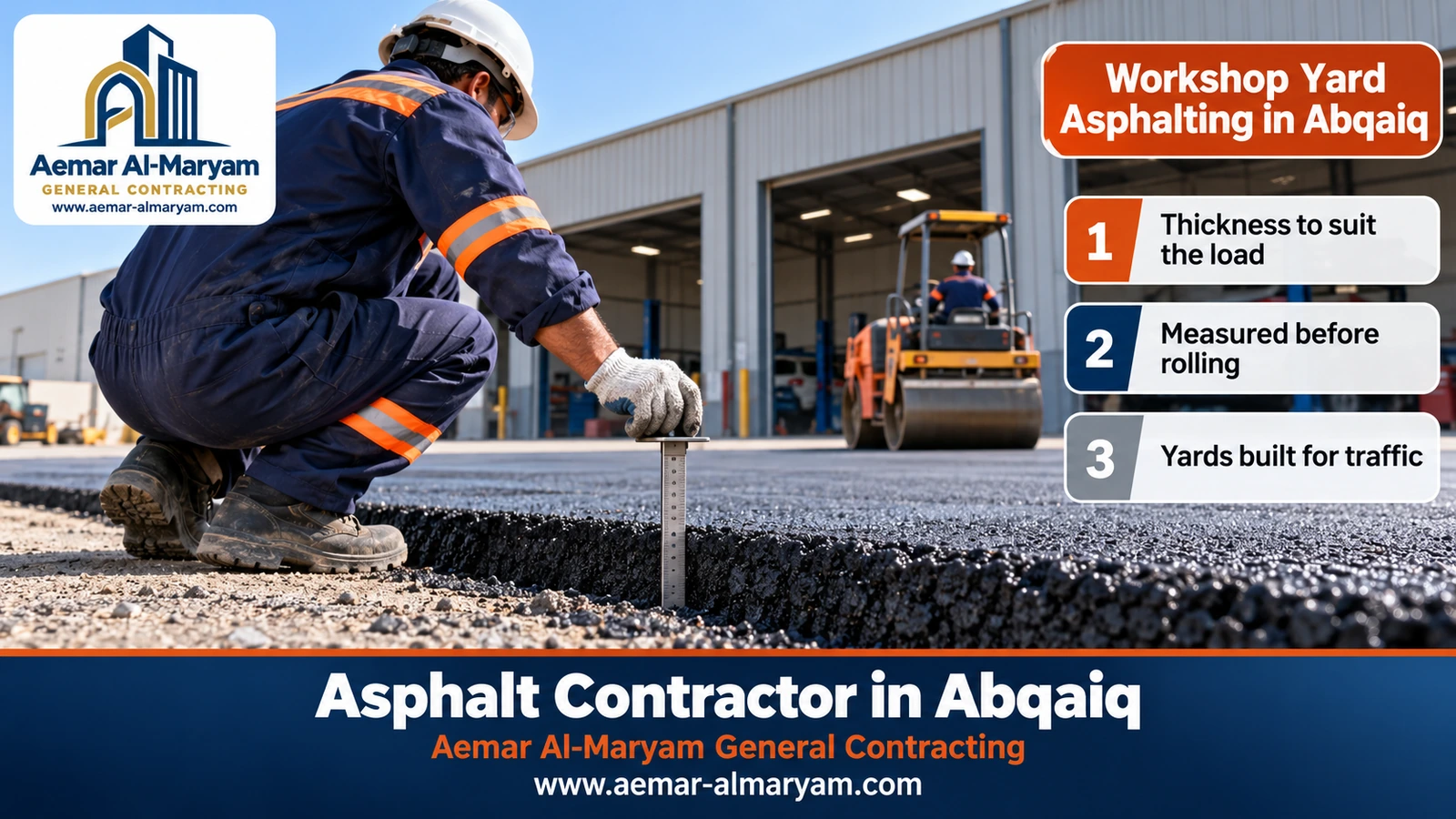
Checking thickness before and after rolling
In the photo the technician pushes a metal depth gauge into the hot layer before the roller passes over it. The reason is that loose mix compresses by about 20 to 25% under rolling, so for 7 cm after compaction the loose mat has to be roughly 8.5 to 9 cm. We measure at several points, especially at the edges and in corners where the mix tends to thin out. After rolling we show you the thickness at an exposed edge, because the thickness in the agreement is the compacted thickness, not the loose one.
| Required thickness after rolling | Approximate loose thickness before rolling | Where we use it |
|---|---|---|
| 5 cm | about 6 to 6.5 cm | Yards and house fronts |
| 6 cm | about 7.5 cm | Shop fronts and small car parks |
| 7 cm | about 8.5 to 9 cm | Workshop fronts used by light trucks |
Oil in front of the workshop
Oils and fuel dissolve bitumen over time, so the stones loosen and potholes appear where oil is changed. If the workshop has a fixed spot for oil changes or for lifting cars on a jack, we may suggest making that spot concrete and the rest asphalt. Either way, clean spills quickly and use a drip tray under the car. If an old concrete slab in front of the workshop needs cutting before paving, our concrete cutting team in Abqaiq handles it, and front lighting runs before paving can be arranged by our electrician in Abqaiq.
Shop front parking and line marking in Abqaiq
An Abqaiq shop front normally gets a rolled 5–6 cm surface over some 15 cm of crushed stone, with a fall of at least 1.5% towards the street or a drain point. Once the asphalt has cooled we can paint bays, arrows and an accessible bay near the door with a slope of no more than 2%, priced at inspection by line length. We also take care with the transition between asphalt and the pavement or the shop entrance tiles, so no lip forms for customers to trip on.
How thick should asphalt be in Abqaiq?
The right asphalt thickness in Abqaiq is about 5 to 6 cm after compaction for house yards and shop fronts on a base of about 15 cm, and about 7 cm in front of workshops used by light trucks. Heavier lorries and yards where they stand for long periods get two lifts adding up to 12–14 cm over roughly 23 cm of stone.
| Use | Asphalt after compaction | Base course | Layers |
|---|---|---|---|
| Home yard plus garage mouth | a rolled 5–6 cm | around 15 cm | One |
| Shop front or small car park | 5–6 cm | about 15 cm | One |
| Workshop front used by light trucks | 7 cm | about 15 cm or more | One |
| Lorry park for heavy vehicles | two lifts totalling 12–14 cm | roughly 23 cm | Two |
Asphalt layers in Abqaiq: base, prime and tack
After clearing the sand and compacting the ground, we lay a graded crushed-stone base, water it and compact it to 100% of its maximum dry density, in layers of no more than 15 cm each. Then we spray the prime coat (MC) at between 0.65 and 1.75 litres per m², depending on how porous the base is, and leave it at least 24 hours to soak in. In dusty weather we clean off any sand the wind has carried onto the base during those hours before we pave, because a thin film of dust between the prime and the asphalt weakens the bond.
The tack coat (RC) belongs on old asphalt or on a concrete face that the new asphalt meets, such as a workshop threshold. It is sprayed lightly — no more than about 0.25 litres per m² — and given a fresh coat if the surfacing slips by over three days. It must not stand in for prime on a new base.
⚠ Do not accept mix on a dusty base
If the wind blows after the prime is sprayed and sand settles on it, it has to be swept and blown off before paving. Asphalt laid on a thin film of sand separates from what is underneath and peels at the edges.
Asphalt in Abqaiq: which mix suits your site?
The asphalt we lay for yards and workshops in Abqaiq is hot mix ordered from an asphalt plant in the calculated quantity, with its arrival timed to when the site is ready. In a few cases we use other types:
| Type | When it fits | From |
|---|---|---|
| 5 cm plant mix | Yards, house strips, shop fronts | SAR 37 a metre if the stone is sound |
| 7 cm plant mix | Workshop aprons with pickups | SAR 41 a metre if the stone is sound |
| Polymer-modified | A spot where a lorry sits for hours in summer | SAR 55 a metre |
| Cold mix | Temporary patching only | SAR 46/m² |
| Millings | A back path or spare yard | At inspection |
Asphalt patching and crack sealing in Abqaiq
Permanent asphalt patching in Abqaiq starts with cutting the pothole edges straight down to sound asphalt, blowing out the sand and debris, tacking the sides, and filling with hot mix compacted to a slight crown. It is priced at inspection, while temporary cold-mix patching starts from SAR 46 per m².
If a workshop cannot close its frontage for a whole day, we may start with a temporary cold-mix patch that keeps traffic moving, then book the permanent repair for the workshop’s day off or the early morning hours before customers arrive. Where needed we split the frontage in two, working on one half while cars use the other.
Fine cracks in front of workshops and shops fill with sand quickly and disappear from view, but water gets into them with the first rain. So we blow them clean and seal them with hot rubberised sealant. If the old asphalt is tired all over but its base is sound, milling 3 to 5 cm and relaying it, from SAR 38 per m², may be cheaper than patching it spot after spot.
Asphalt price per square metre in Abqaiq
The asphalt price per square metre in Abqaiq turns on two questions: is there firm stone under the sand already, and what drives over it? Firm stone plus cars means a 5 cm surface from SAR 37; firm stone plus pickups means 7 cm from SAR 41; loose sand means building it all — scrape, roll, stone, prime, surface — from SAR 74. Abqaiq lies inland, beyond our Dammam–Al Khobar–Dhahran base, so the trip with roller and loader is costed at the visit, and heavy drift sand is priced by the truckload we haul away. In Abqaiq, as elsewhere, our figures stay estimates until inspection and agreement.
| Job in Abqaiq | What the rate includes | From (per m²) |
|---|---|---|
| House yard or shop front | Hot mix rolled to 5 cm over stone that is already firm | SAR 37 |
| Workshop apron | Hot mix rolled to 7 cm for pickups and light lorries | SAR 41 |
| Yard from sand and soil | Drift sand off, ground rolled, ~15 cm crushed stone, primed, then 5 cm on top | SAR 74 |
| Lorry standing spot | Polymer-modified binder that resists heat rutting | SAR 55 |
| Stop-gap fill | Cold bag-mix to keep a frontage usable | SAR 46 |
| Worn frontage | Top 3–5 cm milled away, tack, new surface | SAR 38 |
| Deep drift sand | Loading and hauling it off the plot | Set at the visit |
| Repairs and extras | Saw-cut hot patches, crack filling, kerbs, bay lines | Set at the visit |
| Getting to Abqaiq | Crew, roller and loader from Dammam | Set at the visit |
Whatever says “set at the visit” gets its number once we have seen how deep the sand runs; pictures and rough measurements on WhatsApp 0547879578 let us price the rest straight away. The rest of our rate card lives in the price guide.
What the price covers, and what is charged separately
At SAR 37 or 41 you get the hot mix at the rolled thickness we agreed, delivered, spread and compacted, with whatever tack or prime the existing stone calls for. Step up to SAR 74 and we also scrape off light drift sand, grade and roll the ground, lay roughly 15 cm of stone and prime it. Charged separately are: thick sand that has to be carted off site, breaking out old concrete or asphalt, kerbs and concrete edges, line marking, and travel from Dammam. We list each one as a separate line in the agreement.
Worked example: a 128 m² workshop front in Abqaiq
An illustration for a car-repair workshop front of 16 × 8 m = 128 m², used by pickups and light trucks, with an existing granular base that has been cleared of sand and re-compacted:
| Item | Calculation | Approximate result |
|---|---|---|
| Paving 7 cm on a ready base | 128 × 41 | from SAR 5,248 |
| Mix required (density about 2.3 t/m³) | 128 × 0.07 × 2.3 | about 20.6 tonnes |
| Loose thickness before rolling | 7 × 1.25 | about 8.75 cm |
| If for cars only (5 cm) | 128 × 37 | from SAR 4,736 |
The difference between the two options is SAR 512 — the price of the thickness that stops rutting in front of the workshop. Travel from Dammam, scraping off thick sand, and any kerb or concrete edge on the windward side come on top, all priced at inspection.
The example is for illustration only; the actual price depends on the ground, the amount of sand, the required thickness and equipment access.
Public streets in Abqaiq: the municipality’s responsibility
Abqaiq’s public streets are surfaced and repaired by the municipality; tell it about a hole via 940 or the Balady app. We work only within your property: the yard, the workshop or shop front within the plot boundary, and private parking. Where a workshop apron spills past the plot line into the road reserve, that strip waits for a municipal green light; and any trench across the street for a fresh water or power line is a permit the utility itself must hold.
When can new asphalt be used in Abqaiq?
Hot asphalt binds by being compacted while hot; it does not need days of water curing like concrete, so it can be used once it has fully cooled to air temperature. We do not give a fixed number of hours, because that varies with layer thickness and the heat of the day — a yard cools far faster on a winter morning than at a summer noon — and we tell you the time at handover.
A fresh mat stays slightly soft for its first few days, more so in July and August. So in front of workshops we ask that loaded trucks do not stand in one place for long, that steering is not turned while cars are stationary, and that jacks or sharp stands are not placed directly on the asphalt. In a yard, keep tent poles and sharp weights off the surface in the first week. These are small precautions that spare the surface from marks that never go away.
Looking after asphalt in a sandy town like Abqaiq
- ✓Sweep the sand regularly: especially after windy days, and before it blocks the drain openings.
- ✓Do not let sand pile up at the edges: it holds water and hides cracks.
- ✓Seal cracks early: today’s hairline crack is a pothole after a summer and a rainy spell.
- ✓Clean oil and fuel stains: especially in front of workshops.
- ✓Do not turn the steering on a stationary car: in the first days after paving and at summer noon.
- ✓Watch for settlement: a dip in the wheel path is a sign of weakness under the asphalt, so have it checked before it spreads.
If the house needs wider refurbishment, the paving can be scheduled at the end of the work by our renovation contractor in Abqaiq, and old concrete yard slabs can be removed by our demolition contractor in Abqaiq.
Common yard and workshop paving mistakes in Abqaiq
- ✓Laying on loose sand: the most common cause of settlement and potholes in the town.
- ✓A yard lower than the street: rainwater runs in instead of out; the level must be raised with the base before the asphalt.
- ✓5 cm in front of a workshop used by trucks: the asphalt ruts in the wheel path within months.
- ✓Accepting an unmeasured thickness: a thin mat looks just like a thick one until it is measured at the edge.
- ✓Paving on prime covered in dust: the asphalt separates and peels at the edges.
- ✓An unsupported edge on the windward side: it wears away, and sand piles against it and holds water.
Asphalt paving steps in Abqaiq
- 1A WhatsApp message
Photos of the site and entrance, dimensions and vehicle type to 0547879578. - 2Rough figure
Back comes a proposed thickness and a price built from our base rates. - 3Inspection
We measure, estimate the amount of sand, check the ground beneath, and set the falls and travel cost. - 4Sand clearing and compaction
Removing loose sand, compacting the ground and building the base course. - 5Prime coat
Spraying the prime and waiting at least 24 hours, sweeping off anything the wind brings. - 6Laying, measuring and rolling
Laying the hot mix, measuring thickness with the gauge, then rolling before it cools. - 7Handover
Hose test on the slopes, rolled depth shown at an edge, sand and offcuts cleared away.
Why book Aemar Al-Maryam for an Abqaiq yard?
■ We start below the sand
No laying on loose sand; we scrape it and compact the ground before the base.
■ Yards a truck cannot enter
Mix moved by wheelbarrow, hand laying and small-roller compaction.
■ Thickness measured in front of you
A gauge before rolling, and the compacted thickness at the edges.
■ Thickness to suit the vehicle
5–6 cm for yards, 7 cm in front of workshops used by light trucks.
■ Grouped visits
We put neighbours’ jobs on one day so travel costs less for everyone.
■ Published starting prices
From SAR 37 per m², with other items set out at inspection.
Abqaiq and the towns on our route
We serve houses, workshops and shops in Abqaiq on scheduled visits from Dammam. Nearby, we also pave in Jubail and Ras Tanura, and the full reference for the service is our guide to the asphalt contractor in Dammam.
Your Abqaiq yard deserves a base that stays put
Show us the yard, the gateway and what parks there, and we will say how much sand has to go, what thickness suits it and roughly what it costs.
Other pages useful in Abqaiq
Tags