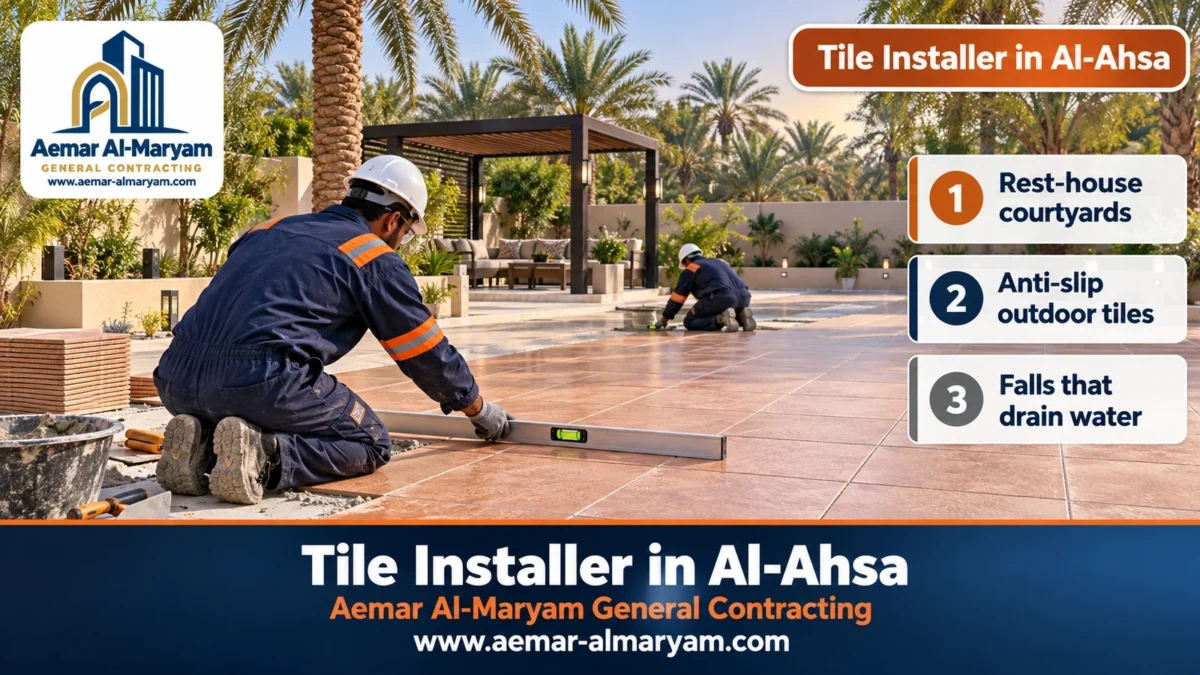
A tile installer in Al-Ahsa from Aemar Al-Maryam General Contracting tiles rest-house (istiraha) courtyards and halls, homes and villas in Hofuf and Mubarraz, and farmhouses around the oasis in ceramic, porcelain and marble. We lay courtyards to falls that carry washing and irrigation water to the drains, set decorative border bands that frame the centre of a hall, and deal with salt and damp at the base of farmhouse walls before anything is retiled. Our rate for a square metre of floor ceramic begins at SAR 23, a courtyard laid to its falls at SAR 37, porcelain to 60×60 at SAR 32 and marble or granite at SAR 92. Nothing is final until our visit, when we settle the scope together; at that point the cost of bringing the team out from Dammam is worked out on that same visit. Call or WhatsApp 0547879578.
Tiling in Al-Ahsa differs from tiling elsewhere in two ways: large open areas, and water close at hand. A rest house usually has a wide courtyard that is hosed down, sprinkled and used by the family in the evenings, a hall where guests gather, and often a pool and paths around a garden. A farmhouse sits in irrigated ground, and the region’s shallow, often brackish groundwater creeps up into ground-floor walls, where it dries out as a white crust that crumbles plaster and pushes skirting off. So on an Al-Ahsa job the first conversation is about water, and tile colour comes later. Where does it come from? Where will it go? And how do we stop it from getting back under the new tiles?
In short: tiling in Al-Ahsa with Aemar Al-Maryam
- What we tile: rest-house courtyards and paths, halls and majlis rooms, homes and villas in Hofuf and Mubarraz, farmhouses, bathrooms and kitchens, stairs and entrances, and skirting.
- What makes the work different here: courtyard falls of 1% to 2%, movement joints for sun-exposed tiles, decorative border bands set at even distances, and salt treatment before retiling.
- Rates per square metre: courtyards to falls and 60×120 porcelain from SAR 37; ceramic from 23 on floors and 27 on walls; porcelain to 60×60 from 32; marble and granite from 92; skirting from SAR 14 a running metre. All figures firm up after the site visit.
- The drive out: roughly 160 km separates Al-Ahsa from Dammam, so we cost the trip during the inspection, and the more work you bundle into that visit, the less of it falls on each item.
- Getting started: message 0547879578 on WhatsApp with pictures of the yard or hall, rough dimensions, your chosen tile and where the rest house is.
Tile installer in Al-Ahsa for rest houses, homes and farms: what we do
Our tile installers in Al-Ahsa work on three kinds of building, and each one has its own method. A rest house is mostly outdoor tiling, large areas and open halls. A house in Hofuf or Mubarraz is mostly renewal of rooms, bathrooms, kitchens and stairs. A farmhouse is mostly a ground floor sitting directly on damp soil. We inspect first, check the floor with a straightedge and a level, ask about every source of water around the building, and only then propose a tile, a fixing method and an order of work.
■ Rest-house courtyards
Matt or anti-slip outdoor tiles laid to falls towards the drains, with movement joints that stop tiles lifting in summer.
■ Halls and majlis rooms
Large porcelain or marble with a decorative border band framing the centre, and matching skirting around the walls.
■ Farmhouses
Removal of salt-damaged tiles, treatment of the lower walls and floor, then retiling.
■ Bathrooms and kitchens
Wall and floor ceramics laid to falls, with wet areas waterproofed and water-tested before tiling.
■ Stairs and entrances
Marble or granite treads and entrances, with the added thickness calculated so every step stays equal.
■ Polishing and repairs
Marble and tile polishing, and replacement of broken or hollow tiles without breaking out the whole floor.
Tiler in Al-Ahsa or a contracting company?
A tiler in Al-Ahsa lays the tiles in front of him. A contractor answers for everything around that moment, before and after. On rest houses in particular, what comes before the tiles matters most: levelling the courtyard, setting the direction of the falls and the position of the drains, coordinating with the plumber when irrigation or drainage lines run beneath the yard, and treating salt in the boundary walls and ground-floor rooms. When one party holds that whole chain, nobody can blame someone else when water stands in the yard or the salt comes back.
One question that tells you about a tiler
Ask him: “Where will the washing water in this courtyard go?” If he answers with a fall percentage, a direction and a drain position, he is thinking about what lies under the tiles, not only about the tiles.
Tiling rest-house courtyards in Al-Ahsa with falls and movement joints
Tiling a rest-house courtyard in Al-Ahsa rests on three things: an outdoor tile whose face will not turn slippery, a solid concrete bed that slopes 1% to 2% down to the drains, and flexible joints spaced somewhere between 2.4 and 3.6 m, since the yard bakes from morning to sunset. Those numbers are the difference between a courtyard that dries within minutes of being washed and one where water stands and leaves stains and salt along the joints.
A 1% fall means one centimetre per metre. If the furthest corner of the yard is 8 metres from the drain, it sits about 8 cm higher at a 1% fall and about 16 cm higher at 2%. So we never set the fall by eye. We mark it with a laser or a water level on the base before tiling and test it with water before the first tile goes down. If the courtyard is very large we divide it into zones, each with its own drain or channel, so that the height difference between one side and the other never becomes large enough to bother people walking or setting out seating.
Movement joints in a courtyard are not a cosmetic detail. Tiles expand in the midday heat and contract at night, and if they have no flexible gap to move into they push against each other until they lift into a ridge across the middle of the yard or come away from their base. So we leave a perimeter joint at boundary walls, house walls, columns and planters, add field joints inside the courtyard, and fill them with a flexible sealant instead of rigid cement grout.
- ✓Tile type: exterior-grade porcelain or granite with a honed or gripping surface; a polished face plus water plus sand is a slip waiting to happen.
- ✓Colour: clay and pale beige shades stay cooler underfoot than dark tiles and hide the dust better.
- ✓Base: sound concrete with no settlement; tiles laid over loose, uncompacted sand crack and sound hollow over time.
- ✓Adhesive: an improved cement-based exterior grade that wets out 95% or more of every tile back; any air pocket under an outdoor tile ends up as a water pocket.
- ✓Drains and channels: their levels are fixed before tiling, and the tiling works up from them.
If your courtyard also needs kerbs or interlocking paver paths, we handle those under our interlock and kerbs service. Tiles around a swimming pool belong to our pools and fountains service.
Do not retile over a sinking base
If the old courtyard shows continuous cracks or patches where the tiles have dropped, the problem is in the base. Retiling it without repairing the base brings the same fault back within a season or two.
Choosing courtyard tiles that cope with sand and sun
Rest-house yards in Al-Ahsa collect fine sand, especially after windy days, and are often swept and hosed down together. Sand acts like sandpaper on a polished surface, so a glossy outdoor tile soon looks dull and patchy. A matt or lightly textured porcelain hides wear far better, is safer when wet, and does not glare in the afternoon sun. We also advise against very dark tiles on exposed yards: they become uncomfortable to walk on barefoot and they move more with heat, which puts extra demand on the movement joints.
Tiling rest-house halls in Al-Ahsa: borders and decorative bands
A rest-house hall in Al-Ahsa is usually spacious, with seating along the sides and the centre left open, so many owners like a border band in a darker colour or a different pattern to frame the middle of the room. That band is the first thing your eye lands on when you walk in, and any error shows instantly: a larger gap to the wall on one side than the other, a corner that is not square, or a small cut piece in the middle of one side.
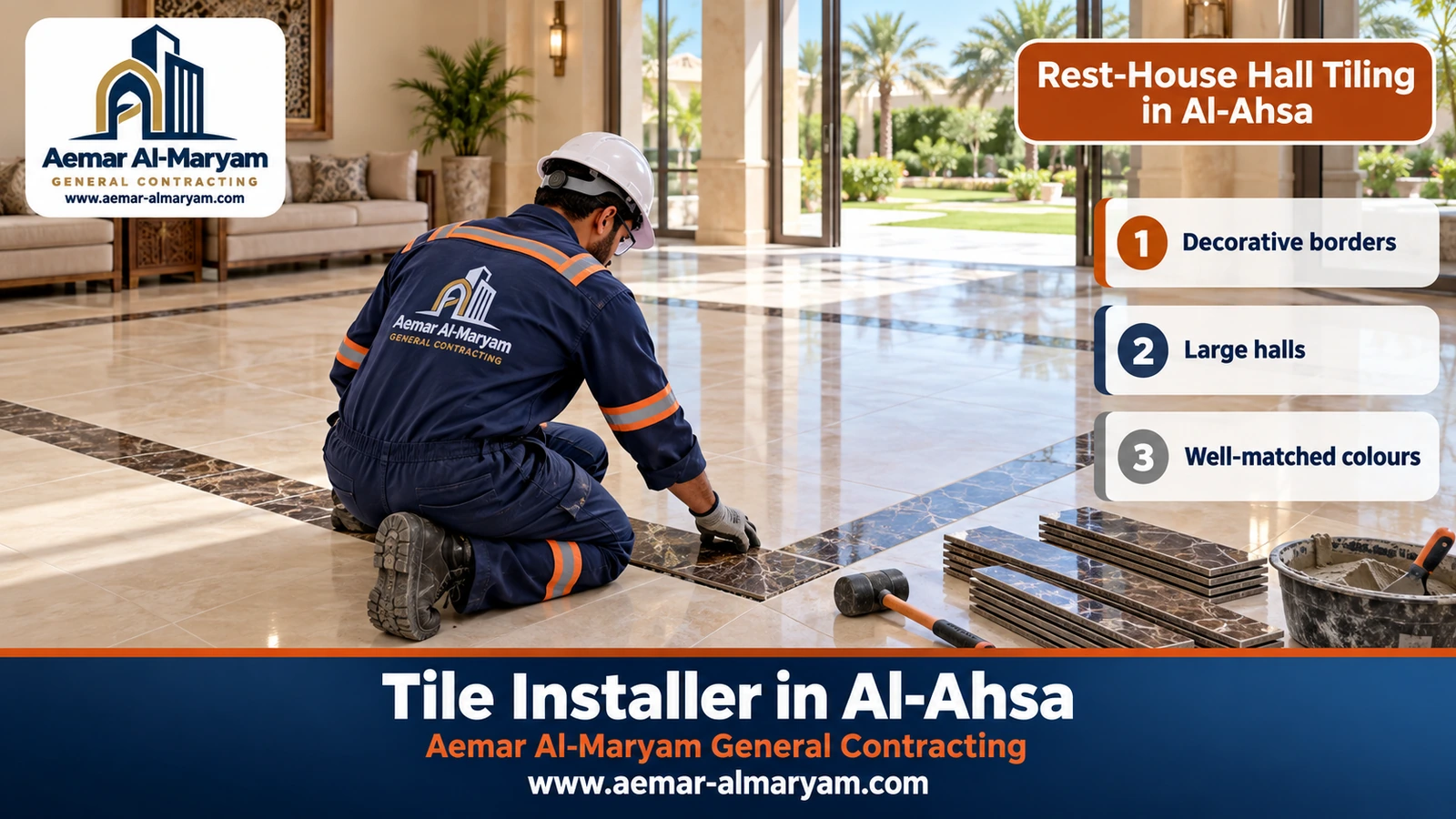
We start a hall by marking two perpendicular axes through its centre with a laser, then measuring the distance from the border to each wall so that it is equal, or deliberately proportioned to the seating, the TV wall and the entrance. Next we lay the border pieces out on the floor in order before any adhesive is mixed, so we know where the corners fall and where we will cut. If a cut is needed in the middle of a side we make it with two equal pieces, not one sliver at one end. If the hall walls themselves are not square, which is common, we lose the difference in the field tiles outside the border, where the seating covers it, not in the band the eye follows.
In large halls we also insist on two more things. Big porcelain only goes onto a floor where a 3 m straightedge shows no gap above 3 mm. And a hall longer than about 7.6 m needs a movement joint within the field, which we hide on the border line itself or on a joint line between tiles so it is not noticed. In halls where the sun pours in through wide glass doors that spacing should be shorter, because sun-struck tiles heat up more than the rest of the floor.
Skirting around the hall
Skirting completes the border and hides the movement gap at the wall. We cut it from the same tile or a matching one, set it at a single height all round the hall, and leave the perimeter joint beneath it open rather than packing it with cement. We charge skirting by the running metre, from SAR 14.
Salt and damp at farmhouse wall bases before retiling
If you see white patches at the bottom of the walls in an Al-Ahsa farmhouse, skirting that has come away from the wall, or tiles near the wall that sound hollow underfoot, the cause is usually salt-laden water rising from the soil or arriving from nearby irrigation, evaporating out of the plaster and leaving its salt behind. Retiling over that situation solves nothing: the salt returns within months and lifts the new skirting.
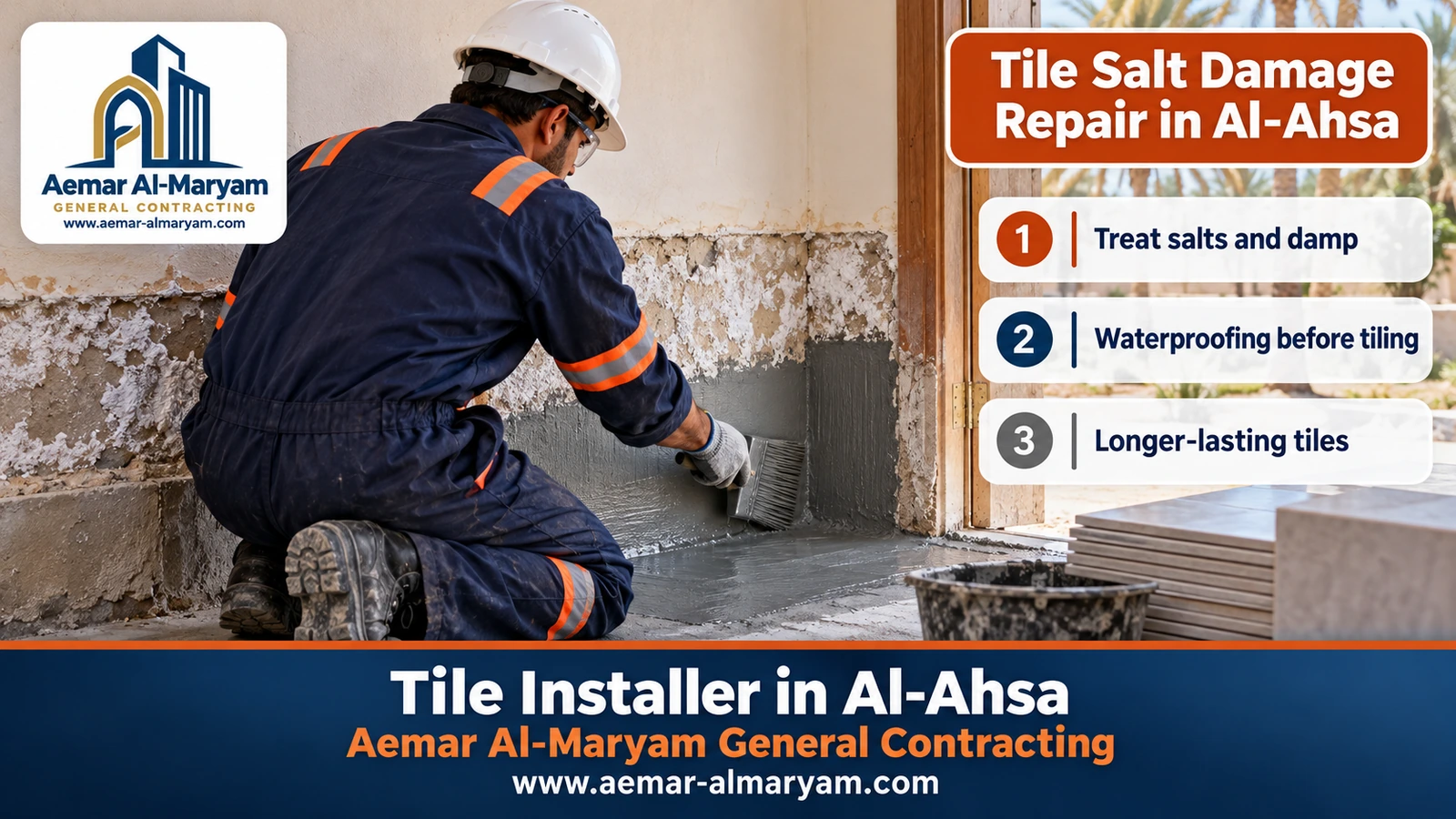
So in farmhouses we work in a clear order. We lift the skirting and the first row of tiles against the wall to see how far the damage goes. We trace the source of the water: irrigation next to the wall, a leak from a tank or pipe, or damp rising from the ground. We treat the source in the way that fits it, whether that means moving irrigation away from the wall, repairing the leak, or forming an external fall that carries water away from the foundations. Then we remove the salt-damaged plaster, brush off the salts, let the wall dry, apply a flexible cementitious waterproofing coat to the lower wall and the floor beside it, and only then replaster, tile and fit skirting.
- 1Lift skirting and damaged tiles
We remove only what has come loose or turned salty, so we can see the extent of the problem without breaking out the whole room. - 2Find the water source
Irrigation, a leak or rising damp from the soil, and each needs a different fix. - 3Treat the source
We move irrigation away from the wall, repair the leak with our plumber in Al-Ahsa, or form an external fall. - 4Remove salty plaster
We brush the salts off dry and let the wall dry out before any new coat. - 5Cementitious waterproofing coat
We coat the lower wall and the adjoining floor with a flexible cementitious membrane, taken up the wall above skirting height. - 6Replaster and retile
New plaster with clean materials, then tiles in an improved adhesive, then skirting with the perimeter joint left open.
If the damage has reached the plaster higher up the wall, the method for redoing it is in our guide for a plastering contractor in Al-Ahsa. If the walls themselves have cracked, see crack repair in Al-Ahsa.
Can ceramic tiles go on a damp wall?
No. Ceramic tiles should not be fixed to a damp or salty wall. Adhesive does not bond properly to a wet or salt-coated surface, and moisture trapped behind the tiles looks for a way out, through the joints or by pushing the tile off. Tiles go on once the source of the damp has been stopped, the wall has dried and the waterproofing coat is in place.
Traditional mud buildings
We do not work on Al-Ahsa’s traditional mud-brick heritage buildings; they have their own specialist authorities and restoration methods. Our work is in homes, villas, rest houses and farmhouses built in block and concrete.
Ceramic or porcelain installation in Al-Ahsa: which should you choose?
Ceramic suits walls, bedrooms and lightly used majlis rooms in Al-Ahsa. Porcelain suits courtyards, bathrooms, kitchens and corridors because it soaks up 0.5% of water or less. Marble is a beautiful natural stone for halls and stairs but reacts with acids, while granite is harder and works for outdoor entrances and kitchen worktops.
| Comparison | Standard ceramic | Porcelain | Natural marble | Granite |
|---|---|---|---|---|
| Water it takes up | More than porcelain | 0.5% or less | Porous; varies with the stone | Little, for most types |
| In a rest house | Bathroom and kitchen walls | Courtyards, halls, corridors | Halls and indoor stairs | Entrances and outdoor steps |
| With salt and water | Suffers if what lies beneath is not protected | Copes better | Stains and needs protection | Good |
| Ease of cutting | Easy | Needs diamond tools | Needs care | Hard, needs machines |
| Fixing rate per m² | SAR 23 floors / 27 walls | SAR 32 to 60×60 | SAR 92 | SAR 92 |
Fixing only, confirmed after the site visit.
Large-format porcelain in Al-Ahsa halls
Sizes of 60×120 and 120×120 give a large hall a calm look with few joints, but they ask more of the floor beneath them: it must sit within 3 mm across a 3 m rule, the adhesive goes on both the floor and the back of each slab, and a clip-and-wedge system that stops neighbouring edges sitting at different heights. A square metre of 60×120 costs from SAR 37 to fix; the 100×100 and 120×120 slabs from SAR 46.
Tile adhesive or sand-cement mortar?
An improved cementitious adhesive (class C2, often with T for no slip on walls and E for extended open time) is the right choice for porcelain, large sizes, bathrooms and courtyards, provided the floor is flat. Sand-and-cement mortar still has a job as the levelling bed, or under ordinary ceramic where the floor must be raised. Coverage matters: no less than 80% of each tile back in dry rooms, and 95% in bathrooms and open yards.
Joints, grout and floor levelling in Al-Ahsa homes
Before tiling we check the floor with a 3 m straightedge in several directions. Where it is further out than your tile size allows, a levelling screed goes down first at SAR 14 a square metre and up; deep ground-floor fills are costed on site. Sand beneath ground-floor tiles has to be clean, free of clay and salts, and compacted; otherwise it settles and the tiles above it sound hollow.
The joint between tiles is never dropped, even with rectified porcelain. Its width has to be at least triple the real difference in size between tiles in the batch; in practice roughly 3 mm suits rectified tiles and roughly 5 mm suits pressed ones. In halls we match the grout to the tile, a slightly darker grout in courtyards because it hides dust, and a water-resistant grout in bathrooms.
Bathroom retiling and kitchen tiling in Al-Ahsa
Replacing bathroom tiles in Al-Ahsa starts with removing the old tiles and bedding down to the concrete and repairing any leak in the pipework. A screed follows, dropping 2% to the shower drain and less elsewhere, then a waterproof layer across the floor and lapped up the walls, then a day or two with the room flooded to prove it holds, and only after that the tiles and grout. Fixing a bathroom’s floor and walls costs from SAR 36 a square metre; stripping and redoing a small bathroom completely, membrane and economy tiles included, from SAR 2,300.
In rest-house bathrooms that see heavy use at weekends we recommend matt porcelain on the floor, a water-resistant grout and a drain sized for the area. In kitchens we tile the floor and the walls behind the sink and cooker once the plumber and electrician have finished, so nobody has to hack out a fresh tile later to reach a pipe or socket. Waterproofing and flood testing are covered in roof and wet-area waterproofing in Al-Ahsa, and anyone who needs kitchen sockets moved before tiling will find the details under electrician in Al-Ahsa.
Marble, granite and marble stairs in Al-Ahsa
Marble installation in Al-Ahsa suits halls, entrances and indoor stairs. Pale marble goes down on a white bed, because grey adhesive ghosts through the stone, and certain white and green marbles bow or discolour when they draw water from the adhesive, so those get a fast-setting or resin-based product. Granite is harder and less absorbent, so we prefer it for rest-house outdoor entrances, exposed entrance steps and the edges of planters and basins.
Cladding an existing staircase lifts each tread by the stone plus its bed, so we work that figure out first. Skip that step and the bottom or top riser ends up odd, when risers in one flight should differ by no more than about 9.5 mm. Stair cladding is priced per square metre of tread and riser, from SAR 46, with the marble chosen and supplied to your taste.
Marble and tile polishing in Al-Ahsa
Polishing begins with rough diamond pads that grind away uneven edges and scratches, moves through progressively smoother grades until the gloss comes back, and finishes with a protective coat. Dull marks left on marble by lemon or acidic cleaners do not come off with cleaning; they come off with honing and polishing. Polishing is from SAR 14 a square metre, or SAR 9 a metre for jobs of 200 m² and upwards, which some rest-house halls do when their corridors are counted in.
Repairing hollow and broken tiles in rest houses and homes
Tap a tile and hear a drum? It has lost its bond, usually through patchy adhesive, sand that has sunk, or a floor built with no movement joints. We map the drummy area by tapping, ease those tiles out without chipping the ones next door, scrape the bed clean and set them back on a full bed. Re-bedding a few tiles starts at SAR 92, and that is the reason we tell every client to keep some boxes of the original tile.
Tile over tile in Al-Ahsa: is it possible?
It can be done when every old tile is still stuck fast, the face is cleaned and keyed, and the bed is an improved adhesive. Expect the floor to rise as a result, so doors, thresholds and drains need altering, and it never works over tiles being lifted by salt or over a bathroom whose waterproofing has failed. We see that often in farmhouses, and there removal is the correct answer. Taking up old tiles with their bed costs from SAR 14 a square metre; for heavier breaking-out see our demolition contractor in Al-Ahsa.
Tile installation prices in Al-Ahsa
We do not charge Al-Ahsa clients more per square metre than Dammam clients; what changes is the journey out, priced during the inspection according to how big the job is and how long it runs. Each rate below is a starting point that moves with the tile, the state of the floor, the quantity and the access.
| Work at your rest house or home | Starting price | Charged per | Al-Ahsa note |
|---|---|---|---|
| Rest-house yard, courtyard or garden path laid to falls | SAR 37 | m² | Drains fixed before tiling |
| Hall or majlis, porcelain no larger than 60×60 | SAR 32 | m² | Tiles supplied by the owner |
| Hall laid in 60×120 porcelain | SAR 37 | m² | Floor checked with a 3 m straightedge |
| 100×100 or 120×120 slabs | SAR 46 | m² | Bigger slabs estimated on site |
| Rooms in standard ceramic | SAR 23 | m² | Suits bedrooms |
| Kitchen or wash-area wall ceramics | SAR 27 | m² | After services are finished |
| Rest-house bathroom, floor and walls | SAR 36 | m² | Waterproofing and test come first |
| Small bathroom stripped and redone with membrane and economy tiles | SAR 2,300 | per bathroom | Economy tiles included |
| Economy tiles supplied, fixed and bedded | SAR 37 | m² | Materials included |
| Marble or granite floor | SAR 92 | m² | Stone to your choice |
| Marble or tile steps | SAR 46 | m² of stair surface | Thickness worked out in advance |
| Skirting around halls and rooms | SAR 14 | linear metre | Over the perimeter gap |
| Levelling before tiling | SAR 14 | m² | Deep sand fills estimated on site |
| Old tiles and bedding broken out | SAR 14 | m² | Haulage to distant tips is extra |
| Resetting drummy or cracked tiles | SAR 92 | small job | By tile count |
| Marble or tile polishing, normal areas | SAR 14 | m² | Pads and compounds included |
| Polishing a hall and corridors of 200 m² or more | SAR 9 | m² | Polishing materials included |
| Salt treatment at wall bases | On inspection | — | Depends on the water source |
| Team travel from Dammam to Al-Ahsa | On inspection | — | Shared across the visit’s jobs |
All rates here are starting points, fixed only after the visit. For lines marked “on inspection”, WhatsApp your photos and measurements to 0547879578 for a first figure.
Tiler price per square metre in Al-Ahsa
Expect a fixing rate from SAR 37 a square metre for yards laid to falls and for 60×120 porcelain, from SAR 32 for porcelain to 60×60, from SAR 23 and 27 for floor and wall ceramic, and from SAR 92 for marble or granite; the tiles themselves are not in these figures.
Are the tiles included in the Al-Ahsa rate?
They are not, unless you take the supply-and-fix economy option (tiles plus adhesive) from SAR 37 per metre. Everything else (tiles, adhesive, grout, screeding, removal) is added as agreed and written out line by line before day one.
Worked example: a rest-house courtyard and hall
An illustrative example for a rest house with a 12 × 9 m courtyard and an 8 × 6 m hall to be tiled in 60×120 porcelain with skirting:
- ✓Courtyard: 12 × 9 = 108 m² × SAR 37 = SAR 3,996 labour including falls.
- ✓Hall: 8 × 6 = 48 m² × SAR 37 = SAR 1,776.
- ✓Skirting: hall perimeter (8 + 6) × 2 = 28 m, minus two doorways of 1.5 m each = 25 m × SAR 14 = SAR 350.
- ✓Estimated labour total: 3,996 + 1,776 + 350 = SAR 6,122, before travel and materials, and before any base repair or salt treatment if it turns out to be needed.
Adding other work to the same visit, such as tiling the rest-house bathroom or polishing the marble at the entrance, spreads the travel over a bigger job and reduces the share each item carries. Our full rate list lives on the prices page.
Tile installation in Al-Ahsa step by step, from first message to handover
- 1Pictures first
You share pictures of the yard, hall or bathroom with approximate measurements and the tile you like, and we come back with a first figure. - 2Site visit
We walk the site, test the base, look for salt, measure the falls and fix both the work list and the trip cost. - 3Agreement
We write down the items, the prices, what is and is not included, and the expected duration. - 4Preparation
Removal of old tiles where needed, salt treatment, levelling, fixing the drains, and waterproofing wet areas. - 5Tiling
Laser reference lines, adhesive at the required coverage, even joints, and movement joints where they belong. - 6Grout and clean
Once the adhesive has had its stated curing time, we grout, clean and cover the floor. - 7Walk-through
Before leaving we go over the floor with you, straightedge in hand, tapping and pouring water.
Receiving your tiles: what to check yourself
- ✓Run a long straightedge in several directions: you should not feel any edge sitting higher than its neighbour.
- ✓Knock gently with a wooden handle all over: one even note everywhere, no drummy patches.
- ✓Pour water in the courtyard and the bathroom: it should run to the drain and not sit in corners.
- ✓Look at the joints: straight, even and completely filled.
- ✓Check that the perimeter gap at the walls is left under the skirting and that courtyard movement joints are filled with a flexible sealant.
- ✓Ask for the spare boxes of the same tile for future repairs.
How to book a tile installer in Al-Ahsa
Send on WhatsApp 0547879578 photos of the area from more than one angle, the sizes of the courtyard, hall or rooms, your tile and its size if already picked, whether the old tiles are to be removed, whether there is visible salt or damp at the base of the walls, and the location of the rest house or the name of your district in Hofuf or Mubarraz. That is enough for a first figure and a visit date, and where we can group it with other jobs for clients in Al-Ahsa so that your share of the travel is lower. Prefer a form? Use the inspection request form.
What sets our Al-Ahsa tiling apart
■ We start with water
We ask about damp, salt and the path of washing water before choosing a tile.
■ Courtyards by numbers
Falls of 1% to 2% set with a laser, movement joints for the sun, and drains fixed before tiling.
■ Balanced halls
Decorative borders at even distances, with cuts placed where the eye does not go.
■ One general contractor
Removal, levelling, waterproofing, plumbing, electrics, tiling and polishing under one responsibility.
■ Itemised prices
What is in, what is out and what the trip costs, all on paper before the first day.
Photos of finished jobs sit in our projects gallery; the marble and tiles service page gives the short version.
Hofuf, Mubarraz and the oasis: where we tile in Al-Ahsa
Our teams reach both cities and their outskirts, including Al-Kut, Al-Na’athil, Al-Salhiyah, Mahasin Aramco, Al-Rawdah, Al-Shu’bah, Al-Mazrou’iyah, Al-Fadhiliyah, Al-Muhammadiyah, Al-Khalidiyah and Al-Rashidiyah, plus the rest houses and farms dotted around the oasis. Not on the list? Ask us. The Al-Ahsa area page lists our other local work.
Beyond the oasis, the long-form guide is our tile installer in Dammam page, and the northern cities have their own: tile installer in Khafji and tile installer in Hafr Al-Batin.
Need a tile installer in Al-Ahsa? Send photos of the courtyard or hall
Snap the yard or hall, note the measurements and the tile, and send it over WhatsApp to 0547879578; a phone call works just as well.
Other work around your Al-Ahsa tiles
Article tags