A tile installer in Dammam prepares the floor or wall first, then lays ceramic, porcelain or marble on it at a controlled level, with even joints and, where water is involved, falls that carry it to the drain. At Aemar Al-Maryam General Contracting we tile halls, majlis rooms and bedrooms, fit wall ceramics in bathrooms and kitchens, install large-format porcelain, lay courtyard (hosh) tiles, fit skirting, install marble and granite floors and stairs, polish marble and repair hollow or broken tiles, in Dammam and across the Eastern Province. Labour for ceramic floors starts from SAR 23 per square metre, walls from SAR 27, porcelain up to 60×60 from SAR 32, 60×120 porcelain from SAR 37, and marble or granite from SAR 92. Each figure becomes firm only after our visit, when the work list is settled between us. Phone and WhatsApp: 0547879578.
Tiles are the finish your eyes see and your feet touch most in a home, so their faults show quickly: a tile that sounds hollow when you walk on it, an edge that sits higher than its neighbour and catches your toe, water that sits in a corner of the bathroom instead of running to the drain, or a grey shadow that appears in white marble a few weeks after it was laid. Most of these problems are not caused by the tile itself but by what lies beneath it: a floor that is out of level, adhesive that never reached the back of the tile, a movement joint that was forgotten at the wall, or a fall judged by eye. This guide explains what a tiler actually does for each material and each room, the numbers that separate careful work from rushed work, how the cost is built up, and what you can check yourself on handover day.
Quick answers: tiling and marble work in Dammam
- What we install: ceramic floor and wall tiles, porcelain from 60×60 up to 120×120, outdoor courtyard and walkway tiles, skirting, marble and granite floors and stairs, plus stone facade cladding after inspection.
- Before tiling: floor levelling, flatness checks with a 3 m straightedge, calculated falls in bathrooms, kitchens and courtyards, and waterproofing of wet areas with a water test.
- Prices start from: SAR 23/m² ceramic floors, 27 walls, 32 porcelain up to 60×60, 37 for 60×120, 46 for 100×100 and 120×120, 36 for bathroom floor-and-wall tiling, 37 including and economy tiles and adhesive, 92 for marble and granite, SAR 14 per linear metre of skirting. Estimates until inspection and agreement.
- Related work: removal of old tiles from SAR 14/m², levelling from 14, marble and tile polishing from SAR 14/m² (from 9 for areas of 200 m² or more), repair of a few broken or hollow tiles from SAR 92 per job.
- Where: every district of Dammam, plus Eastern Province cities from Saihat and Qatif to Jubail, Al-Ahsa, Dhahran and Al Khobar.
- To book: phone and WhatsApp 0547879578 with photos of the floor or wall, the area, and the tile type and size.
Tile installer in Dammam: what we install in homes, villas and buildings
Our tilers do not start by opening boxes of tiles. They start by reading the room. Is the floor flat enough for the size of tile you have chosen? Is it a ground floor laid over a sand fill, or a concrete slab on an upper floor? Is there a bathroom that needs falls and waterproofing? Are the doors already hung, or will they be fitted after tiling? The answers decide the fixing method, the materials and the number of days, and only then does the work begin.
We work in flats, villas, apartment buildings, annexes and shops, whether the building is a new shell or an occupied home whose tiles are being renewed. In occupied homes we work room by room and protect furniture and doors from dust and cutting slurry.
■ Floor tiling
Halls, majlis rooms, bedrooms and corridors in ceramic, porcelain or marble, finished with skirting around the room.
■ Wall ceramics
Bathrooms, kitchens and wash areas with true horizontal and vertical lines and clean cuts around outlets and switches.
■ Large-format porcelain
60×120, 100×100 and 120×120 with an improved adhesive, full coverage and a levelling clip system for the edges.
■ Courtyard tiles
Matt or anti-slip outdoor tiles with falls to the drains and movement joints for the sun.
■ Marble and granite
Floors, entrances and stairs, with the right setting material for light and moisture-sensitive marble.
■ Polishing and repairs
Marble and tile polishing, replacement of broken or hollow tiles, and regrouting.
A short summary of the service sits on the marble and tiles service page. This guide goes into each job in detail, with the numbers behind it.
Tiler in Dammam or tiling contractor: what is the difference?
A tiler in Dammam is a skilled individual; a contractor or tiling company takes responsibility for the job from start to finish. The difference is not visible in the tile itself but in everything around it. Who decides that the floor needs levelling? Who works out the quantity of tiles including wastage? Who waterproofs the bathroom and tests it before the tiles go down? Who coordinates with the plumber so that the floor drain sits in the right place at the right height? And who comes back if a hollow tile shows up after handover?
When you work with a general contractor you get that whole chain: an inspection, quantities, materials if you want us to supply them, a tiler and a helper for cutting and mixing, coordination with plumbing, electrical and waterproofing, and a clear handover check at the end. If you have already bought your tiles, that is fine too. We install them for labour only, and we tell you before we start if the quantity, size or condition of the tiles needs attention.
How to choose a tiler
Ask three questions before you agree: how will you check the floor is flat, which adhesive will you use with my tile size, and where will you leave movement joints? Clear answers to those three tell you more than any photo gallery.
Tile installation in Dammam for floors and walls
Tile installation in Dammam means preparing the surface, setting out a starting line, spreading adhesive or mortar, fixing the tiles with even joints, and then grouting and cleaning. The approach differs between floors and walls. A floor carries weight, foot traffic and water, so it needs full adhesive coverage, close flatness and falls where water collects. A wall needs true vertical and horizontal lines and a fixing that stops tiles sliding before the adhesive has set.
Every room starts with a layout on the floor. Where will the cut tiles fall? Nobody wants a thin sliver of tile at the doorway or against the wall you see first as you walk in. So we set the tiles out from the centre line or from a calculated line, so that the edge cuts are equal on both sides and sit in less visible places, such as behind furniture or under cabinets.
In large halls we stretch a string line and mark square reference lines, because a one-millimetre error in the first row becomes centimetres by the far wall, and we carry joint lines through from room to corridor or finish them at a deliberate threshold.
Ceramic tile installation in Dammam for walls and kitchens
Ceramic wall tiling in Dammam starts with plaster that is flat and dry, because tiles do not correct a leaning wall; they expose it. We check the wall with a straightedge and a spirit level. If the plaster is cracked or hollow we repair or replace it before tiling; you can read how in our guide to plastering in Dammam.
On walls we fix a level batten under the second row and work upwards from it, then fit the bottom row last once the finished floor level is known. That way the line stays straight whatever the floor is doing. We cut around water and electrical outlets with diamond hole saws rather than by snapping tiles, and we leave enough space around mixers for the metal cover plate to sit tightly over the hole.
In kitchens we plan the positions of wall and base cabinets before tiling. Will the whole wall be tiled, or only the band between the upper and lower cabinets? Where will the sink, the gas point and the hood sit? If the kitchen needs changes to its pipework, the plumber should finish before the tiler starts, so we coordinate with our plumber in Dammam team; otherwise new tiles may have to be broken out later to reach a pipe.
Ceramic vs porcelain vs marble vs granite
The key difference between ceramic and porcelain is density and water absorption. Porcelain is a denser ceramic tile whose water absorption does not exceed 0.5% under the American tile standard’s definition, which makes it suitable for bathrooms, courtyards and busy corridors. Ordinary ceramic is lighter and easier to cut, and is perfectly adequate for walls and bedrooms. Marble is a beautiful natural stone but reacts with acids, while granite is a harder stone that suits entrances and kitchen worktops.
| Feature | Ceramic | Porcelain | Marble | Granite |
|---|---|---|---|---|
| Water absorption | Higher than porcelain | Not more than 0.5% | Varies by type; porous | Low in most types |
| Best places | Walls, bedrooms, low-traffic majlis rooms | Bathrooms, kitchens, courtyards, corridors, shops | Halls, entrances, indoor stairs | Entrances, stairs, kitchen worktops, outdoors |
| Cutting and fixing | Easier and faster | Harder; needs diamond tools and an improved adhesive | Heavy; needs a setting material suited to its colour and type | Heavy; harder to cut |
| Acids and cleaners | Glazed face usually unaffected | Usually unaffected | Dulls and loses its shine (etching) | Unaffected by weak acids |
| Installation labour from | SAR 23/m² floors | SAR 32/m² up to 60×60 | SAR 92/m² | SAR 92/m² |
| NOTE: These are general properties and vary between products. Ask your supplier for the data sheet of the tile you are buying, especially water absorption and slip resistance. |
That does not make ceramic a poor choice. In a bedroom or a quiet majlis a good ceramic tile performs well for many years at a lower cost. But in a bathroom, a courtyard or a corridor that collects sand from the street every day, porcelain or granite usually works out cheaper over the life of the floor. For wet floors, choose a matt or anti-slip surface: the American standard asks for a dynamic coefficient of friction of at least 0.42 for level interior floors that get wet, and you can ask your supplier for that figure.
Before buying, open a full box in daylight and check that the batch number is the same across the whole quantity; a different batch can mean a different shade or a size that shows up in the joints.
Porcelain installation in Dammam
Porcelain installation in Dammam is unforgiving in three ways. It needs a flatter floor than usual. It needs an improved cementitious adhesive, because porcelain absorbs so little water that it does not grip the old-style mortar the way ceramic does. And it needs full coverage on the back of the tile, with no voids. Because porcelain is so hard, we cut it with wet diamond saws and blades so the edges come out clean without chipping.
Laying porcelain the old way, on dabs of mortar at the centre and corners, is a mistake that shows up later. The tile looks solid on the day, but the voids underneath make it sound hollow and its edges crack the first time a heavy load or a dropped piece of furniture hits them. So we comb the adhesive onto the floor with a notched trowel matched to the tile size, back-butter the tile itself with a thin coat where needed, then press it down and slide it slightly so the adhesive ridges collapse into a solid bed.
Large-format porcelain 60×120 and 120×120 in Dammam
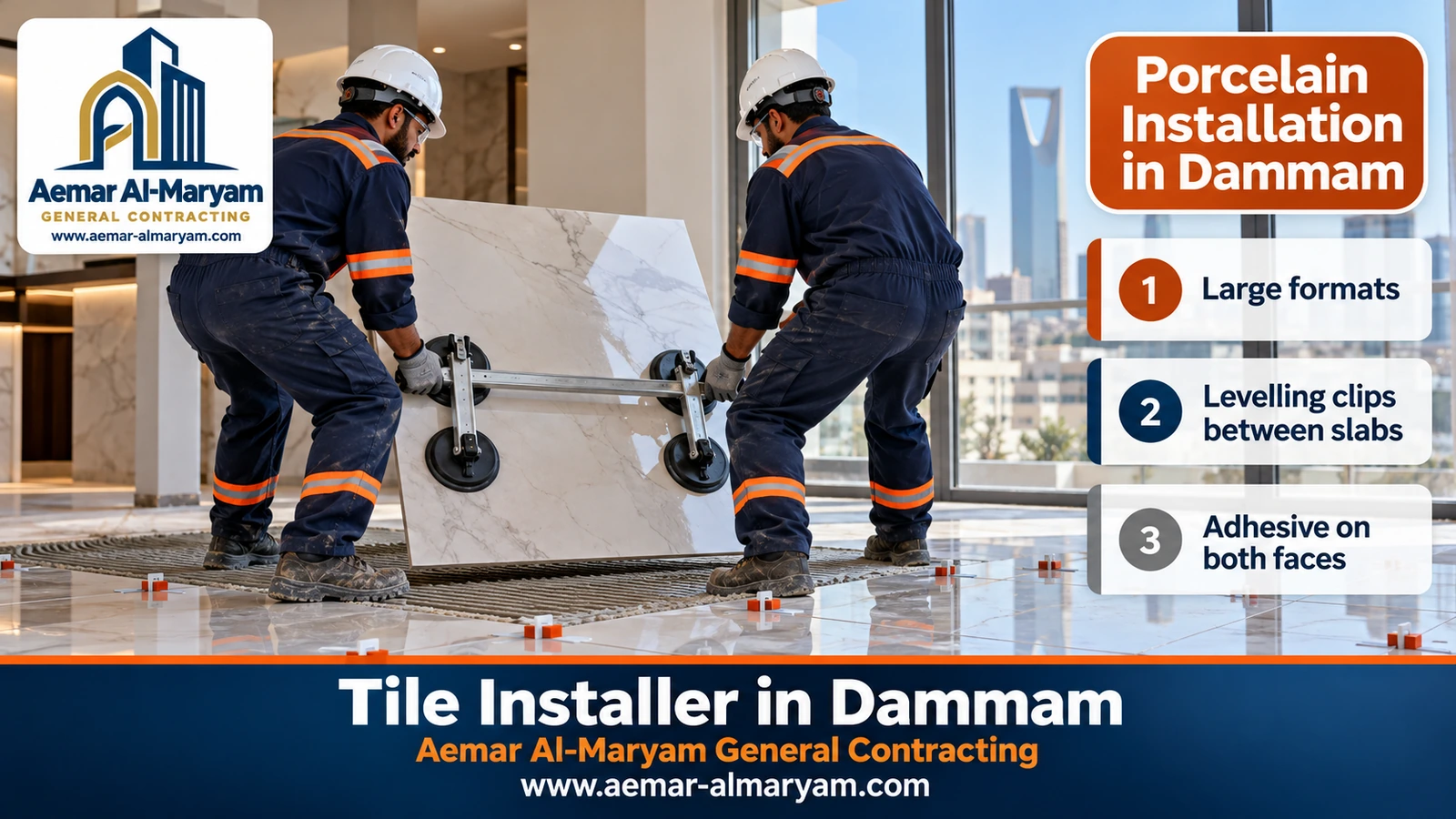
Large-format porcelain in Dammam needs a floor that deviates by no more than 3 mm under a 3-metre straightedge. That is what the American installation standard asks for once any edge of the tile reaches about 38 cm, while it allows roughly double that for smaller tiles. The reason is simple: the longer the tile, the more any wave in the floor becomes a visible step between its edge and the next one.
So with large formats we start by checking the floor with a straightedge in several directions. If it is outside the limit, we level it first with a suitable screed or levelling compound. Then we use a clip-and-wedge levelling system between the slabs to hold the edges in one plane while the adhesive sets, and we leave a calculated joint no narrower than three times the actual size variation of the tiles. For 120×120 slabs we use a lifting frame with suction cups, because carrying such a slab by hand can bend or crack it.
Labour for 60×120 porcelain starts from SAR 37 per square metre, and for 100×100 and 120×120 from SAR 46. Slabs larger than 120 cm are priced after inspection, because they need extra hands and equipment. We also check that big slabs will fit in the lift and up the stairs before you buy.
Do not start large tiles on an unchecked floor
Large porcelain on a wavy floor gives edges at different heights and tiles that sound hollow in the middle, and the only cure is to lift them and start again. Levelling costs far less than redoing the floor.
Tile adhesive or sand-cement mortar in Dammam?
The short answer: for porcelain, large formats, bathrooms and courtyards we use an improved cementitious adhesive on a flat floor, while traditional sand-cement mortar stays for the levelling screed or for ordinary ceramic on a floor that needs building up. Adhesive is a thin bed that barely raises the floor level, but it cannot correct an uneven floor. Mortar can correct the level, but it takes skill to avoid leaving voids under the tile.
We see homes in Dammam where porcelain was laid in old-style mortar, the way ceramic used to be, and the tiles started sounding hollow within months. The fault is not in mortar as such but in using it with a low-absorption tile and with the dab method that leaves gaps beneath. So we choose the method after measuring the floor and seeing the tile, not out of habit.
What do C2TE and S1 on the adhesive bag mean?
The codes printed on a bag of tile adhesive come from the European and international classification for tile adhesives, and they tell you the bond strength and how the adhesive behaves. Read them before you buy:
| Code | Meaning | When it matters |
|---|---|---|
| C | Cementitious adhesive | General floor and wall use |
| C1 | Bond strength of at least 0.5 N/mm² | Ordinary ceramic in dry areas |
| C2 | Improved adhesive, bond of at least 1 N/mm² | Porcelain, large formats, bathrooms and courtyards |
| T | Slip of no more than 0.5 mm | Wall tiles, so they do not slide before setting |
| E | Extended open time of at least 30 minutes | Large areas and hot conditions |
| F | Fast setting | When the area must reopen early, or with sensitive marble |
| S1 / S2 | Deformable adhesive (S2 more flexible) | Courtyards, sun-exposed areas and large tiles |
| D / R | Dispersion (paste) / reaction resin | Special cases; resin for some sensitive marbles |
So if the bag says C2TE, you have an improved cementitious adhesive that will not slip on a wall and has an extended open time. Add S1 and it is also flexible enough to absorb small movements. There is no need for the most expensive adhesive everywhere: a bedroom with small ceramic tiles does not need what a sun-baked courtyard with large porcelain needs.
How much of the tile back must the adhesive cover?
The American installation standard asks for at least 80% contact on the back of the tile in dry interior areas, and at least 95% in wet and exterior areas, with corners and edges fully supported. A good tiler checks this by lifting a freshly laid tile at the start of the job and looking at its back. If the adhesive has transferred over most of it as flattened ridges rather than separate blobs, the coverage is right.
In Dammam’s heat the surface of the adhesive dries quickly and forms a skin that no longer bonds to the tile. So we spread small areas at a time and touch the adhesive before placing the tile; if it does not stick to a fingertip, we scrape it off and spread fresh.
Floor levelling before tiling in Dammam
Floor levelling before tiling in Dammam is a step nobody sees after handover, but it decides how the whole floor looks. We check the floor with a 3-metre aluminium straightedge in different directions, set the finished level with a laser or a water level, and mark the high and low spots. If the deviation is within the limit for the chosen tile, we start straight away; if not, we level.
There are two ways to level. One is a sand-cement screed of suitable thickness, laid between screed rails and left to dry. The other is a self-levelling compound for small differences on indoor floors. We choose between them according to the size of the difference, the type of floor and the time available. Levelling starts from SAR 14 per square metre; thick build-ups are priced after inspection.
Before tiling, the floor must be free of dust, gypsum, paint splashes and oil, because all of these stop adhesion however good the adhesive is. And if an old floor has live cracks, tiling straight over them will not help; the crack will travel into the tiles. Crack treatment is covered in our guide to crack repair in Dammam.
Sand fill under ground-floor tiles
On ground floors and in courtyards there is usually a sand fill under the tiles. Saudi engineering inspection firms advise that this sand be washed, coarse and free of clay and salts, around 5 to 10 cm thick, and well compacted. A thick, poorly compacted fill settles over time, and the tiles above it crack or start to sound hollow.
Dammam has a particular issue here. Over large parts of the Eastern Province the water table is high and salty, and moisture rises by capillary action, carrying salts up into ground-floor slabs and courtyards. So in older homes we look for the source of damp before retiling, and we pay attention to damp-proofing and falls. Otherwise white salts appear along the grout lines a few months after the new floor goes down.
Joints, grout and movement joints in Dammam tiling
The joint between tiles is not a flaw to hide; it is part of the installation. Its width should be no less than three times the actual size variation of the tiles you have, as the American standard puts it. As a general guide that means about 3 mm for rectified tiles and about 5 mm for ordinary pressed tiles. We set plastic spacers of the right size and remove them before grouting.
Grout fills the joints. We choose its colour with the homeowner before we start: a very light grout in a corridor gets dirty quickly, and a very dark grout on light tiles makes the grid stand out. We pack each joint to its full depth, wipe the surface with a damp sponge before it hardens, and clean off the remaining haze the next day. In bathrooms and kitchens a stain-resistant or epoxy grout can be chosen depending on use.
Can tiles be laid without joints?
No. Tiles cannot be laid without joints at all; even rectified tiles need a small one. No two tiles are exactly the same size, and floors expand and contract with temperature, so the joint absorbs those differences. Tiles butted edge to edge move as one rigid sheet, and when that sheet expands in the heat the tiles push against each other and lift or chip at the edges. What we can do is narrow the joint to the minimum the tile allows and choose a grout colour close to the tile, so the surface looks almost continuous.
Movement joints: why do tiles suddenly lift?
Movement joints are soft joints filled with a flexible sealant instead of cement grout. They go around the perimeter of a room, where the tiles meet walls and columns, and across large areas. The American tile council’s guidance places them about every 7.6 m in interiors, about every 3.6 m in interiors exposed to direct sun or moisture, and every 2.4 to 3.6 m outdoors.
Missing movement joints are the best-known cause of tiles suddenly lifting into a tent shape in large halls and courtyards, especially under Dammam’s strong sun and the gap between daytime and night-time temperatures. So we leave the perimeter joint under the skirting, where it cannot be seen, and line up the field joints with the ordinary grout lines so they do not spoil the look.
Tile falls in bathrooms, kitchens and courtyards in Dammam
Tile falls in Dammam are calculated, not judged by eye. A shower floor falls about 2% (2 cm per metre) towards the drain and no more than 4%. The rest of a bathroom or kitchen floor has a gentle fall of 0.5% to 1%, and a courtyard 1% to 2%. That is the practice in the codes on which the Saudi plumbing code is based, and it matches what engineering inspection firms in the Kingdom recommend.
| Area | Usual fall | If the fall is too small | If the fall is too steep |
|---|---|---|---|
| Shower floor | About 2% (2 cm/m), up to 4% | Water stands and seeps into the joints | Unsteady footing; shower chairs rock |
| Rest of the bathroom floor | 0.5% to 1% | Permanent puddles around the basin | The slope becomes visible and uncomfortable |
| Kitchen floor | 0.5% to 1% towards a drain if there is one | Mopping water sits under the cabinets | Cabinets and appliances are hard to level |
| Courtyards and outdoor walkways | 1% to 2% towards the drains | Pools after rain and washing | Tiring to walk on and slippery when wet |
| NOTE: Indicative values from code practice and inspection guidance; the reference on each project is the drawing and the actual level of the drains. |
We check the fall on the screed itself before tiling, and again after tiling by pouring water and watching where it goes. Building a fall by piling extra adhesive under the tiles does not work; it creates uneven bed thicknesses and voids. A correct fall starts at the drain: its level dictates everything around it, which is why we review it with the plumber before the screed is laid.
Bathroom tile replacement in Dammam
Replacing bathroom tiles in Dammam is more than pulling off old tiles and sticking on new ones. A bathroom is a wet room, and what lies under the tiles matters more than the tiles themselves. The correct sequence is: remove the tiles and bedding down to the concrete, check the pipework and fix any leaks, lay a screed with falls, waterproof the floor and carry the membrane up the walls, carry out a flood test, and only then tile. Labour for bathroom floor-and-wall tiling starts from SAR 36 per square metre, removal of old tiles from SAR 14, and a complete small-bathroom retile (removal, waterproofing and economy tiles) from SAR 2,300.
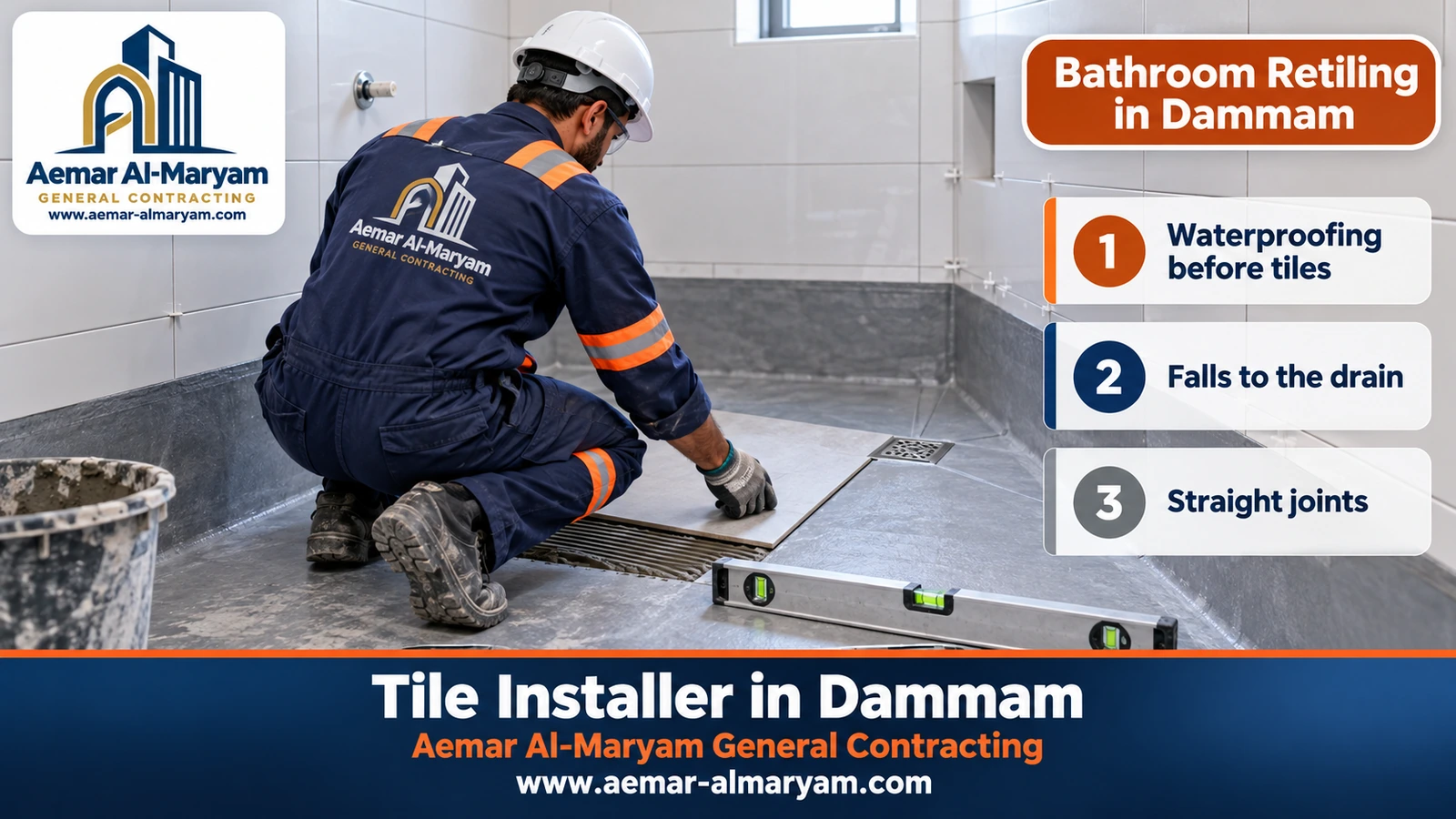
Many people ask us to “just change the ceramics” because the bathroom looks dated, and then, when the old tiles come off, we find long-standing damp under them from a weeping mixer or a cracked floor drain. Tile over that and the leak returns to the ceiling of the floor below. So we arrange for our plumber in Dammam to check the pipework after removal and before screeding, and to replace what is needed while everything is exposed, rather than breaking out new tiles a few months later.
How to replace bathroom ceramic tiles, step by step
- 1Isolate the water and protect the area
We close the valves, remove the WC, basin and accessories, and cover the doorway and corridor against dust. - 2Remove old tiles and bedding
Wall and floor tiles come off together with their mortar down to the concrete or blockwork, and the debris goes out as we work. - 3Check the pipework
We inspect supply pipes, waste pipes and the floor drain, and fix leaks or replace old pipes while they are exposed. - 4Screed the floor to falls
A levelling screed falling towards the drain, plus re-plastering of damaged walls so they are flat before tiling. - 5Waterproofing
A flexible membrane across the entire floor, rising up the walls, with reinforcing tape in corners and around the drain and pipes. - 6Flood test
The floor is kept flooded for 24 to 48 hours as we monitor the ceiling below and the adjoining walls before anything is covered. - 7Tiling
A C2 improved adhesive with full coverage, walls from a level line, and the floor following the same falls. - 8Grout and seal
A grout suited to wet areas, and flexible silicone where the floor meets the walls and around the bath and basin. - 9Refit and test
We refit the sanitary ware, then pour water on the floor and watch it reach the drain before handover.
Bathroom waterproofing and flood testing are covered in more depth in our guide to roof and wet-area waterproofing in Dammam, while a full bathroom makeover with new fittings and layout belongs to our bathroom and kitchen renovation service. For timber or plasterboard walls, or around new built-in baths, we may use cement board as a tile backer instead of ordinary gypsum board, which does not suit wet conditions.
Can bathroom tiles be replaced without breaking out the old ones?
New ceramic can go over old tiles on bathroom walls only if every old tile is firmly bonded with no hollow spots, the wall is dry with no leak, and the space can take the extra thickness at the door frame, mixers and mirrors. On a bathroom floor we rarely recommend it: the new layer raises the level at the doorway, covers old waterproofing without testing it, and reduces the fall to the drain. If the reason is to avoid dust and time, we explain the difference in cost and result and let you decide.
Courtyard tiles in Dammam
Courtyard tiles in Dammam face conditions no indoor tile does: direct sun that heats them through the day, washing water and occasional heavy rain, sand dragged in on shoes, and sometimes a parked car. So we choose outdoor porcelain, stone or granite with a matt or textured anti-slip surface and low absorption, and lay it on a sound concrete base with falls of 1% to 2% towards the drains, movement joints every 2.4 to 3.6 m, and a flexible improved adhesive. Labour for courtyards and outdoor walkways, falls included, starts from SAR 37 per square metre.
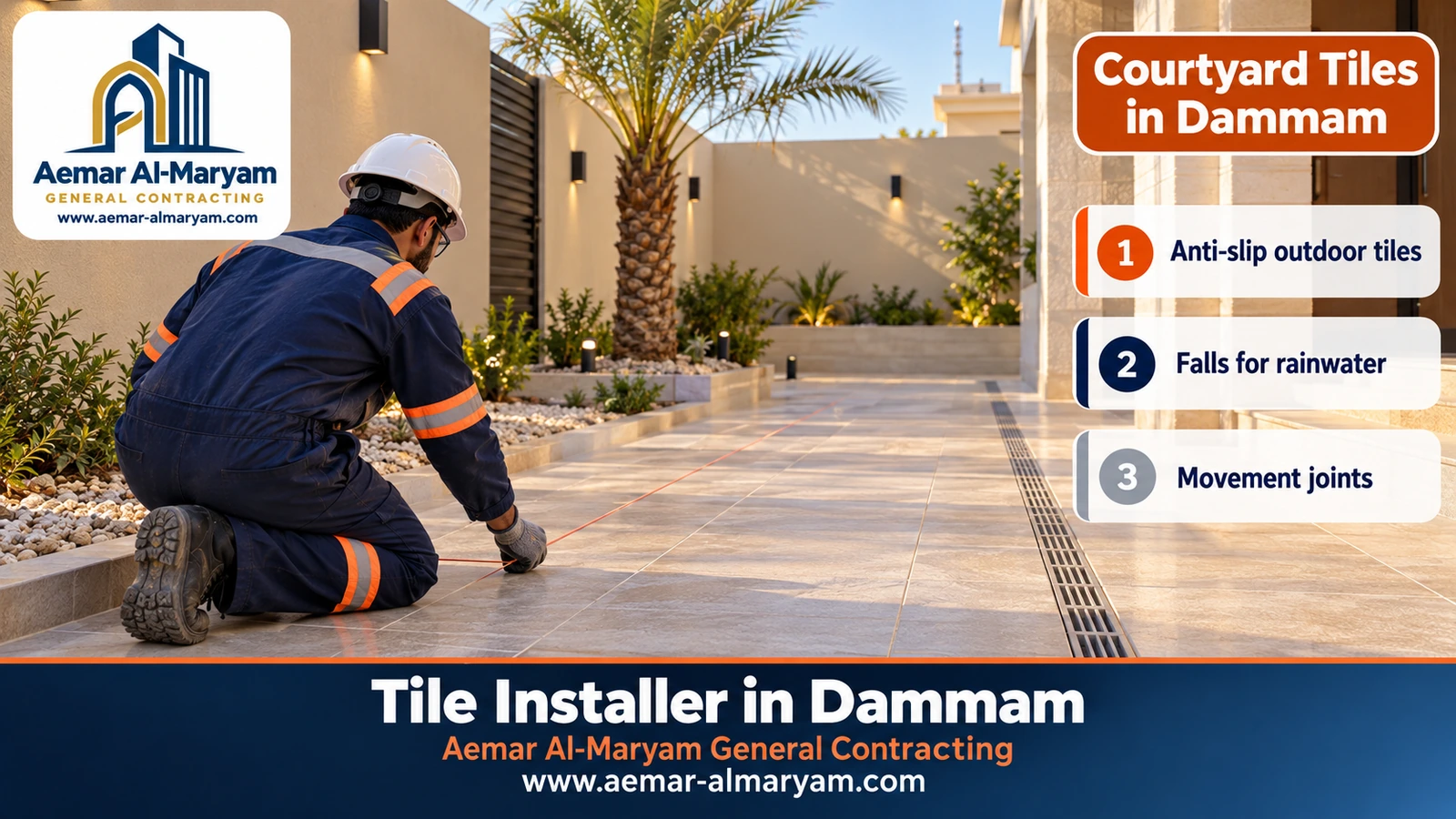
Where cars park in the courtyard we check the thickness of the concrete base before choosing the tile; the tile does not carry the car, the base does. If you want a surface that takes vehicles and is easy to maintain, interlocking pavers may suit part of the courtyard better; see our interlock and kerbs service. Many villas combine the two: interlock for the parking bay and outdoor porcelain for the seating area and paths.
Replacing and repairing courtyard tiles in Dammam
Repairing courtyard tiles in Dammam starts with finding the cause. Did the tiles crack because the fill beneath them settled? Did they lift because there are no movement joints? Are white salts coming out of the joints because of moisture rising from the ground? Where only a handful of tiles are damaged, we replace them with matching pieces where available. If the cause is in the base or the falls, the answer is to lift the damaged section, repair what is underneath and retile.
Our advice when replacing an old courtyard floor completely: think about the drains first. Many older courtyards hold water because there are too few drains or they are in the wrong place, and retiling is the one chance to add a linear drain or correct the falls without breaking out new tiles years later. Breaking out old tiles and removing the debris is handled by our demolition contractor in Dammam team, scheduled as part of the same job.
Skirting installation in Dammam
Skirting is a strip of tile or marble about 8 to 12 cm high fitted along the bottom of the wall around a room. It protects the wall from mops and washing water and hides the movement joint between the floor tiles and the wall. Skirting labour starts from SAR 14 per linear metre, and it is usually cut from the floor tiles themselves or bought ready-made with a finished top edge.
Some tilers set the skirting straight onto the floor tiles and fill the gap between them with cement, which closes the movement joint, and the skirting line cracks over time. The correct way is to fit the skirting above the floor with a small gap filled with a flexible sealant, to keep its top edge in one straight line, and to mitre internal and external corners at 45 degrees rather than butting one piece over another.
Marble installation in Dammam
Marble installation in Dammam differs from tiling in three ways. Marble is a natural stone whose pieces vary in veining and shade, so they are arranged before fixing. It is heavy and needs a solid base and full coverage. And some types react to water and to the colour of the setting material. Labour for marble or granite floors starts from SAR 92 per square metre, while the supply of marble is priced on the type and thickness you choose.
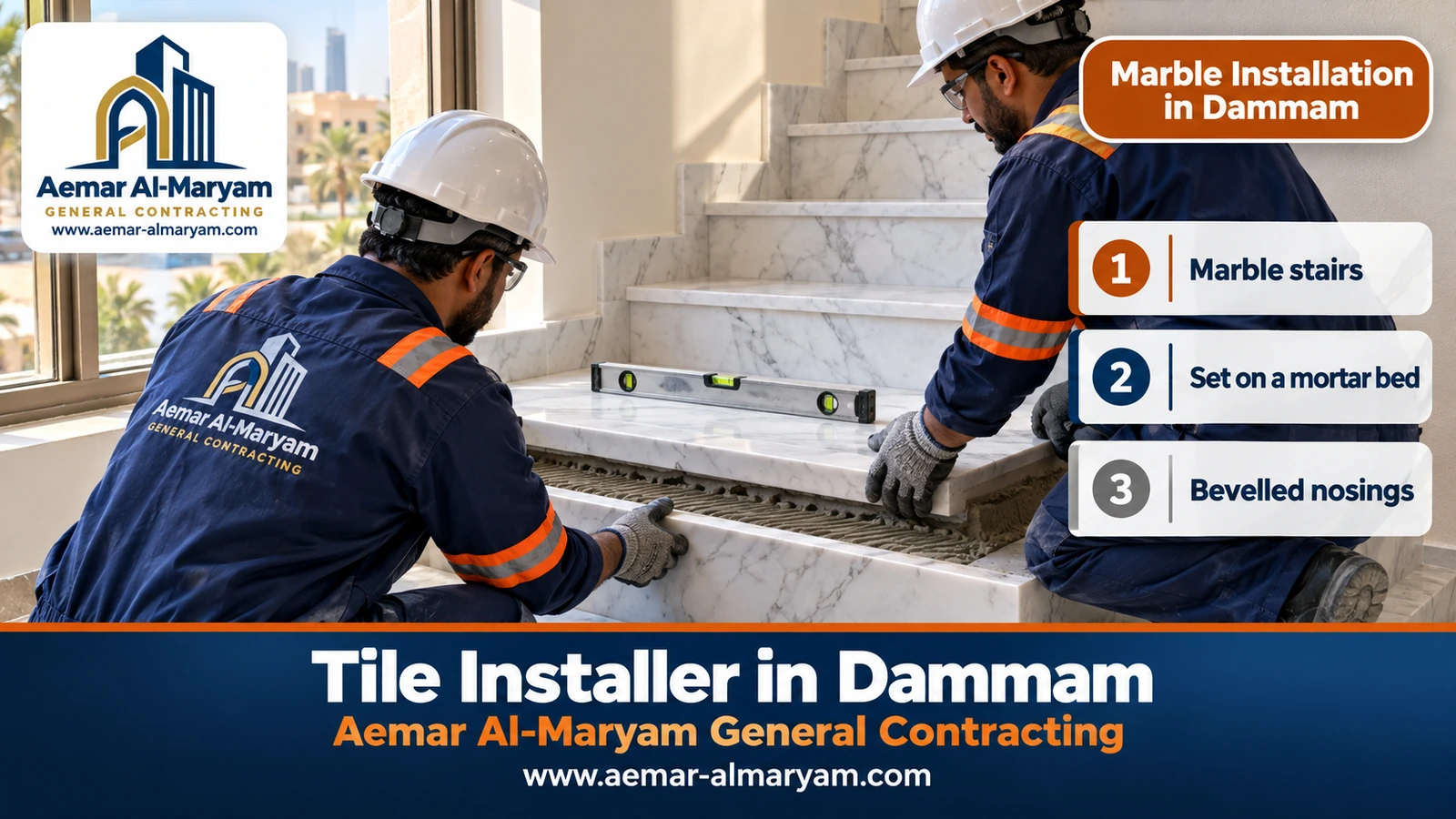
Before fixing, we lay the marble out on the floor and arrange the pieces with the homeowner. Where should the most heavily veined pieces go? How should the veins flow from piece to piece in the entrance or the main hall? Then we number the pieces and fix them in that order.
Remember that marble reacts with acids. Lemon juice, vinegar and some cleaning products leave dull marks on it, known as etching, and a sealer reduces staining but does not stop etching. That is why we do not recommend marble for kitchen floors or worktops, and prefer it for halls, entrances and indoor stairs.
Granite installation in Dammam
Granite installation in Dammam suits external entrances, exposed stairs, door thresholds and busy courtyards, because granite is harder than marble and does not dissolve in weak acids. Outdoors, where it gets wet, granite needs a textured or matt finish, because polished granite becomes very slippery with water. We cut it with dedicated diamond blades and fix it with an improved adhesive or a mortar bed, depending on its thickness and location.
White marble and moisture-sensitive marble
White and light marble is set in a white adhesive, never grey, because slightly translucent marble lets the colour of the bed show through as grey patches. Some green marbles and some white marbles are moisture-sensitive: their edges curl or they stain when set in slow-drying, water-based materials, so they need a rapid-setting cementitious adhesive or a reaction-resin adhesive. We ask the supplier about the stone’s sensitivity before purchase, and if the information is not available we test a piece before fixing the whole area.
Granite kitchen worktops
Granite kitchen worktops are more a matter of templating and workshop cutting than tiling, and they are tied to the cabinets, sink and hob, so we price them after measuring on site. A full kitchen makeover, from cabinets and services to worktops, is covered by our bathroom and kitchen renovation service, and any relocation of the kitchen sink or change to its pipework is coordinated by our plumber in Dammam before the worktop is fixed.
Marble stairs in Dammam
Marble stairs in Dammam consist of treads (the part you stand on) and risers (the vertical part), fixed onto a concrete staircase with a mortar bed or an improved adhesive, with a bevelled or rounded nosing at the front. Labour for tiling or marble-cladding stairs begins at SAR 46 per m² of stair surface, and the stair marble itself is priced on the type and thickness you choose.
The most important thing on a staircase is that the steps stay equal. Marble and its bed add thickness to every step, and if that thickness is not allowed for from the start, the first step ends up taller than the rest and the top step shorter, and people trip. Summaries of the Saudi Building Code for residential buildings give a riser of no more than 20 cm, a tread of at least 25 cm, and a variation between steps in one flight of no more than about 9.5 mm. So we measure the whole staircase before cutting and spread any difference across it.
We usually choose tread marble 2 to 3 cm thick, thicker for heavily used stairs, with a slightly projecting nosing. For external stairs we recommend granite with a textured finish, or anti-slip grooves near the nosing.
Marble and stone facade cladding in Dammam
Marble and stone facade cladding in Dammam is done in one of two ways: wet fixing with mortar or adhesive for small, light pieces at low height, or dry mechanical fixing with stainless steel brackets and anchors and an air gap behind the stone for large, heavy pieces and greater heights. We price cladding after inspection, because it depends on the stone, its thickness, the height of the facade and the scaffolding needed.
Mechanical fixing is the safer choice for large pieces. Stone held only by mortar at height can come away if the bond weakens with heat and moisture, and the moisture in the mortar can also stain light stone. Board facades are explained on our page for cement board installation in Dammam, and the full renovation of old facades, from plaster and paint to cladding, in our Dammam renovation guide.
Marble polishing and tile polishing in Dammam
Marble polishing in Dammam means grinding the surface with wet diamond pads from coarse to fine. The coarse pads remove lippage between pieces and deep scratches, the medium pads remove the marks of the coarse ones, and the fine pads bring back the shine, followed by a protective treatment. Marble or tile polishing starts from SAR 14 per square metre for normal areas, and from SAR 9 for areas of 200 m² or more.
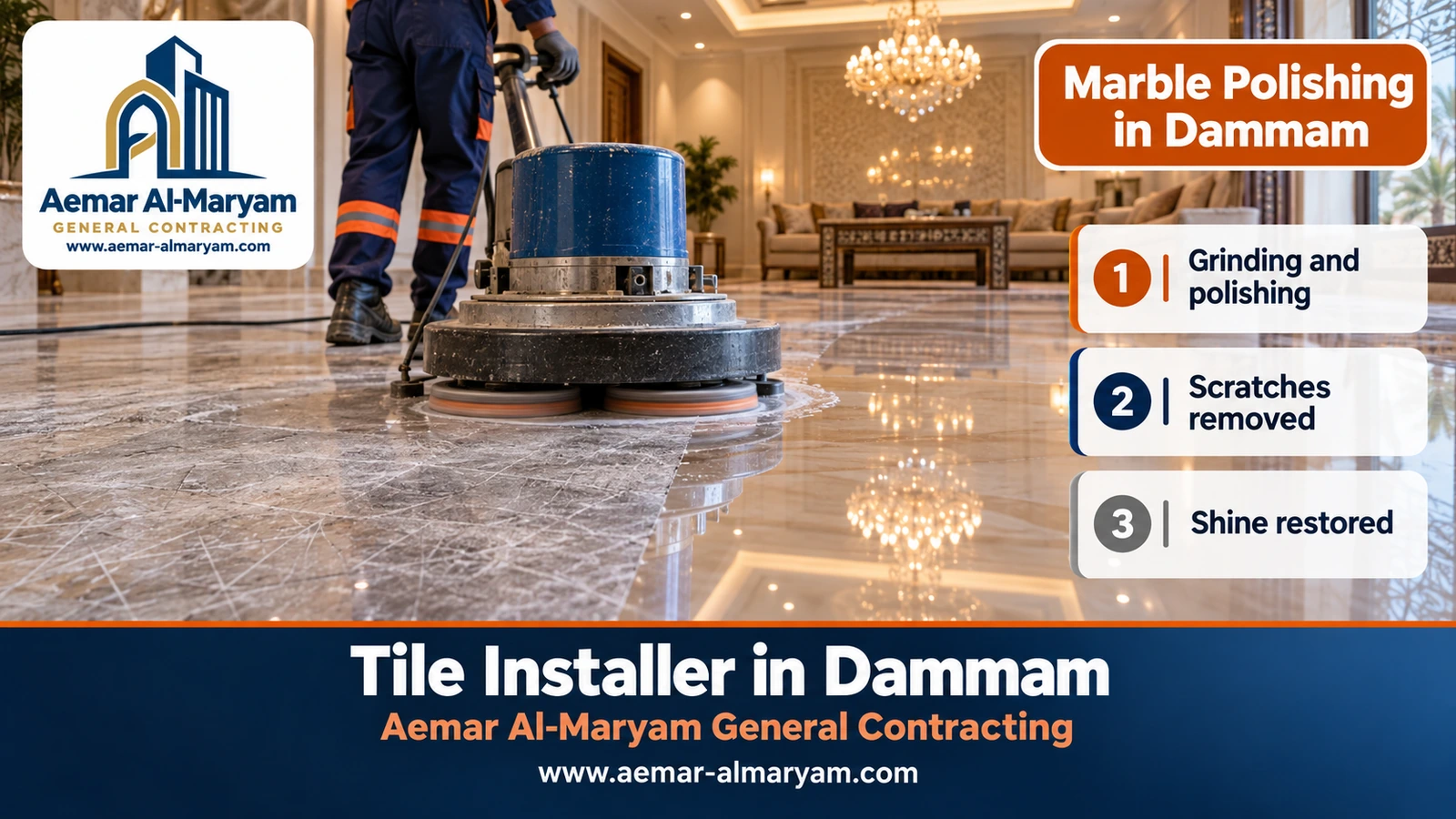
The usual sequence runs from coarse pads between 50 and 200 grit, through medium pads between 400 and 800, to fine pads between 1500 and 3000, with each pad removing the scratches of the one before. Skipping grits leaves swirl marks. On newly laid floors we fill pores and hairline joints with a filler matched to the marble before the fine stage.
Polishing tiles and porcelain is a different job from polishing marble. Factory-polished porcelain is not normally ground; it is cleaned by machine with suitable products, whereas marble can be reground many times over its life.
Grinding vs crystallisation: what is the difference?
Grinding removes a thin layer of the surface with diamond pads, whereas the “crystallisation” offered by polishing firms is a final shine treatment applied to marble after grinding, not a substitute for it. Crystallise a scratched or uneven marble floor and you get a shine on top of the scratches. So we grind until the surface is even, then agree the level of shine with the homeowner: a high polish for majlis rooms, or a honed, semi-matt finish for corridors and entrances, because it shows scratches less and is less slippery. Dull acid marks on marble are treated by grinding, not by cleaning products.
Repairing broken and hollow tiles in Dammam
Repairing hollow tiles in Dammam means lifting the tiles that sound hollow, cleaning the floor and the back of each tile, and refixing them, or fitting replacements, with full adhesive coverage. Repair of a limited number of broken or hollow tiles starts from SAR 92 per job, and larger areas are priced per square metre after inspection.
Hollow tiles do not happen by accident. The usual causes are tiles set on dabs of mortar instead of full coverage, adhesive that skinned over before the tile went down, dust on the back of the tile or on the floor, an uncompacted sand fill under ground-floor tiles, or missing movement joints. We tap every tile and mark the areas that sound hollow. If they are scattered we repair them piece by piece; if they cover a large part of the room, retiling that whole section is usually the more economical choice.
The hardest part of any repair is finding a matching tile. That is why we always advise keeping a box or two of tiles after any new installation; if a tile breaks years later, the same range may no longer be on the market. If no match is available, we can sometimes take tiles from a hidden area such as under the kitchen units and replace those with a close match.
Laying new tiles over old tiles in Dammam
Laying new tiles over old ones is possible only if every old tile is firmly bonded with no hollow spots, clean, and roughened or treated with a primer, and a suitable improved adhesive is used. It raises the floor by a centimetre or more, so doors need trimming, thresholds adjusting, and floor drains and air-conditioning floor grilles raising. We do not recommend it in bathrooms over waterproofing of unknown condition, or over broken or hollow tiles, because the defect simply transfers to the new floor.
Tiling defects and their causes
Most tiling defects come down to one of five causes: a floor that is not flat, incomplete adhesive coverage, wrong joints, falls that were never calculated, or a setting material unsuited to the tile. This table helps you read what you are seeing at home:
| Defect | Usual cause | Remedy |
|---|---|---|
| Hollow sound when tapped | Dab fixing, adhesive skinned over, dust, uncompacted fill | Lift, clean and refix with full coverage |
| Tiles lifting in a tent shape | No movement joints at walls or across the area; sun heat | Cut in movement joints and relay the lifted tiles |
| Uneven edges between tiles (lippage) | Floor out of flat, bowed large tiles, joints too tight | Level before tiling; edge-levelling system; correct joint width |
| Cracked tiles | Voids underneath, settled fill, crack in the slab | Replace tiles and repair the base or the crack |
| Water standing in a bathroom or courtyard | Wrong falls, drain set too high or blocked | Re-screed to the correct fall and adjust the drain level |
| White salts on the grout | Rising damp carrying salts | Stop the water source, damp-proof, then clean |
| Grey patches or curling in light marble | Grey adhesive or slow water-based bed with sensitive marble | Lift and refix with a white rapid-set or resin adhesive |
| Dull marks on marble | Acid etching from lemon, vinegar or cleaners | Spot grinding and repolishing |
Several of these faults only surface months later, which is why the layers under the tile get most of our attention.
Tile installation prices in Dammam
Tile installation prices in Dammam start from SAR 23 per square metre of labour for ceramic floors, and rise with the size and type of tile, the condition of the floor and the location. The figures below are estimates that we confirm after inspection. They vary with the tile type and size, the floor condition, the quantity, the floor level and ease of access, and each line states whether materials are included:
| Service | Unit | From | Materials included? |
|---|---|---|---|
| Ceramic floor tiling | m² | SAR 23 | Labour only |
| Ceramic wall tiling | m² | SAR 27 | Labour only |
| Porcelain up to 60×60 | m² | SAR 32 | Labour only |
| Porcelain 60×120 | m² | SAR 37 | Labour only |
| Porcelain 100×100 or 120×120 | m² | SAR 46 | Labour only (larger slabs on inspection) |
| Bathroom floor and wall tiling | m² | SAR 36 | Labour only |
| Ceramic or porcelain including economy tiles and adhesive | m² | SAR 37 | Includes economy tiles and adhesive |
| Courtyard and outdoor walkway tiling with falls | m² | SAR 37 | Labour only |
| Marble or granite floors | m² | SAR 92 | Labour only |
| Stair tiling or marble | m² of stair surface | SAR 46 | Labour only; marble as you choose |
| Skirting | linear metre | SAR 14 | Labour only |
| Floor levelling before tiling | m² | SAR 14 | Thick build-ups on inspection |
| Removal of old tiles with bedding | m² | SAR 14 | Excludes long-distance debris haulage |
| Repair of broken or hollow tiles | limited job | SAR 92 | Depends on the number of tiles |
| Marble or tile polishing | m² | SAR 14 | Includes polishing materials |
| Polishing for areas of 200 m² or more | m² | SAR 9 | Includes polishing materials |
| Complete small-bathroom retile | bathroom | SAR 2,300 | Removal, waterproofing and economy tiles |
| Marble or stone facade cladding | — | On inspection | Depends on stone and fixing method |
| Granite kitchen worktops | — | On inspection | Depends on sizes and stone |
| NOTE: Pool tiling is not in this table; see the pools and fountains service. For any line without a price, send photos, sizes and the tile type on WhatsApp 0547879578 for an estimate. |
How much does a tiler charge per square metre in Dammam?
A tiler in Dammam charges from SAR 23 per square metre for ceramic floors and SAR 27 for walls, and from SAR 32 for porcelain up to 60×60. The rate rises with large formats, because a big slab needs two people to carry it, a flatter floor, a levelling system and more time to cut. It also rises with diagonal laying and complex patterns, because cutting and wastage increase; with upper floors that have no lift; and with small areas where cutting takes up a large share of the work relative to the area.
Does the per-metre price include the tiles?
No, not usually. The per-metre price tilers quote is normally labour only and does not include tiles, adhesive, grout, levelling or removal of the old floor. That is why our table has a clear column for what each line includes, and a separate line from SAR 37 that includes economy tiles and adhesive for anyone who wants the complete job. If you buy the tiles yourself, we give you the quantity needed, with wastage, before you buy, so you neither overbuy nor run short halfway through.
How is the tiling area measured?
Floors are measured as length × width for each room; walls as the room perimeter × tiling height, less doors and large windows; and skirting by the linear metre around the room, less door widths. When buying tiles, add an allowance for wastage and cuts: roughly 5% to 10% for straight laying, more for diagonal laying and small rooms with many corners. That allowance is approximate and depends on tile size and room shape, so we calculate it precisely after measuring.
Worked example: a 5 × 6 m hall in 60×120 porcelain
Suppose a hall 6 m long and 5 m wide, where the owner wants 60×120 porcelain with skirting, and the floor is ready:
- ✓Floor area: 5 × 6 = 30 m².
- ✓Porcelain labour: 30 m² × SAR 37 = SAR 1,110.
- ✓Skirting: perimeter 2 × (5 + 6) = 22 m, less a 1 m door = 21 m × SAR 14 = SAR 294.
- ✓Estimated labour total: 1,110 + 294 = SAR 1,404, excluding tiles, adhesive and grout.
- ✓If the floor needs levelling because it fails the 3 mm under a 3 m straightedge check: 30 × 14 = SAR 420 more, bringing the total to SAR 1,824.
This is an illustration of how the cost is worked out, not a final price; the actual price is confirmed after inspection and agreement.
Tile installation steps in Dammam
Our tile installation in Dammam follows this order, and we do not move to the next step until the previous one has been checked:
- 1Inspection and measurement
We measure the areas, check the flatness of floors and walls and any sources of damp, and look at the chosen tile and its size. - 2Quantities and materials
We calculate tiles with wastage, adhesive, grout and skirting, and confirm that all the tiles come from one batch. - 3Preparation
Removal of the old floor if any, cleaning, levelling, and waterproofing of wet areas with a water test. - 4Setting out
We fix starting lines, finished levels and falls, and place cut tiles where they are least visible. - 5Fixing
The right adhesive with full coverage, spacers of the right size, a levelling system for large formats, and straightedge checks row by row. - 6Movement joints
A joint around the perimeter and at columns, plus field joints in large and outdoor areas. - 7Grouting and cleaning
After the time stated by the adhesive maker, we fill the joints, wipe the surface and remove the haze. - 8Skirting and sealant
Skirting fitted and flexible joints sealed around sanitary ware and basins. - 9Protection and handover
We protect the tiles until other trades have finished, then hand over with you using the checklist.
Tile handover: the checklist
You do not need an engineer to accept a tiled floor. These are checks you can make yourself on handover day, and we will go through them with you:
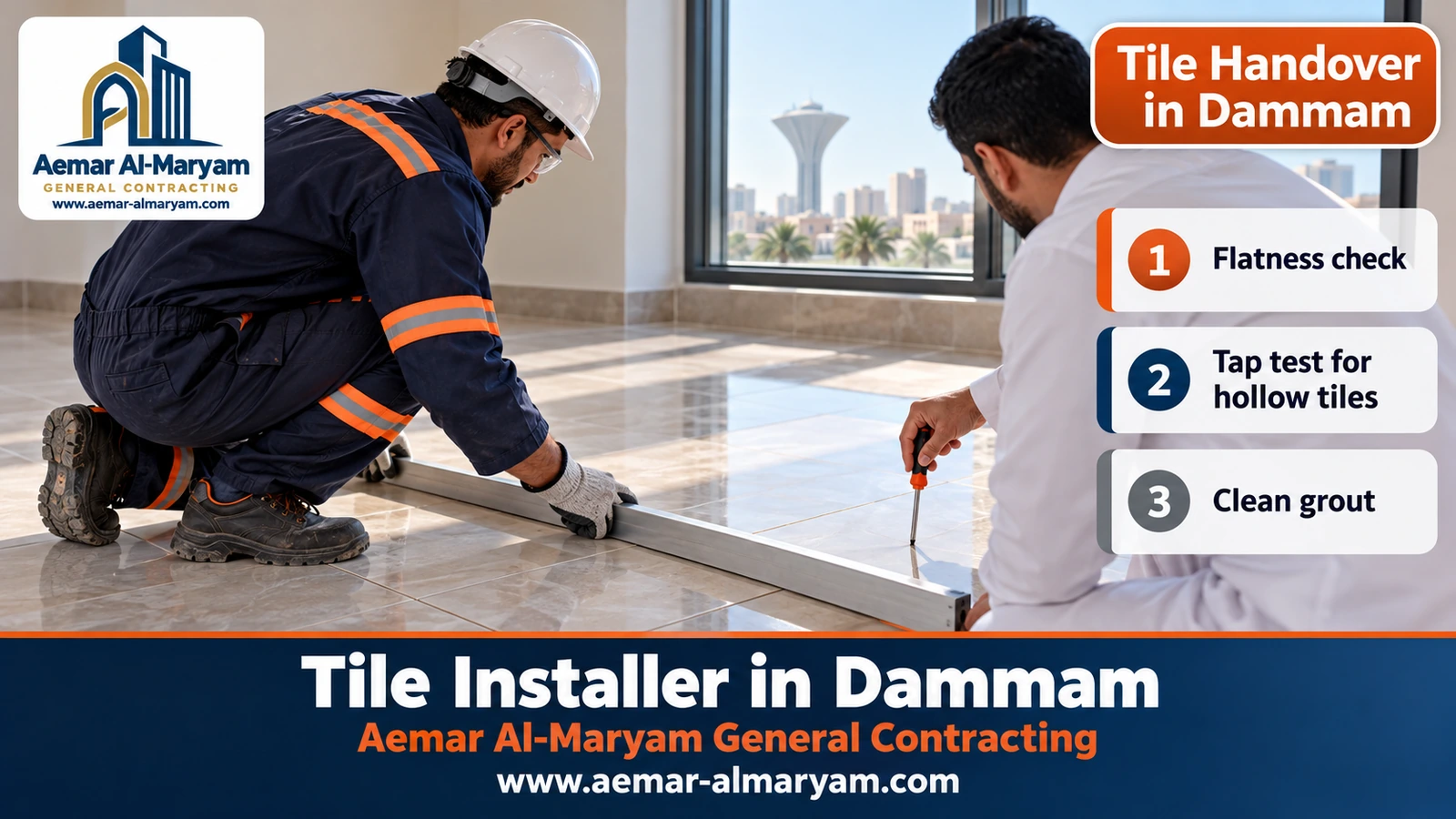
- ✓Flatness: lay a long straightedge on the tiles in several directions; there should be no obvious gaps under it, and you should not feel an edge sitting higher than its neighbour when you run your hand across.
- ✓Sound: tap the tiles with a screwdriver handle; the sound should be about the same across the floor, and any areas that ring hollow need attention.
- ✓Joints: straight, even in width, filled with grout to the surface, with no cracks or residue.
- ✓Water: in bathrooms, kitchens and courtyards, pour water and watch it reach the drain without collecting in corners.
- ✓Perimeter: a joint left at the wall under the skirting, and flexible sealant around sanitary ware and basins.
- ✓Cuts: clean at doors, corners and around outlets, with no chipped edges.
- ✓Marble: no grey patches or curling, and the veining arranged as agreed.
- ✓Spare tiles: a box or more of the same tiles left with you for future repairs.
How long does tiling take, and when can you walk on it?
A small room with a ready floor is usually tiled in one working day, large halls in two to three days, and a full bathroom with removal, waterproofing and flood testing takes several more days because of drying and testing time. We confirm the duration after inspection, not before. As for walking on the tiles, grouting and washing, follow what the adhesive maker states on the bag: a standard adhesive needs longer than a rapid-set one, and we do not load or wash the floor before the stated time.
Tiling within renovation and finishing in Dammam
Tiling is often part of a bigger project: renovating an older home, finishing a new annex, or refreshing a bathroom and kitchen. In those cases the tiles go in after the services, plaster and waterproofing, and before the final paint and the doors, and getting that order right saves you from breaking out new tiles later. That is why we include tiling within:
- ✓Full renovation: replacing tiles, ceramics and porcelain as part of a whole-house renovation, in our Dammam renovation guide.
- ✓Finishing: tiling new annexes and majlis rooms after plaster and services, on the finishing service page and on our page for annex and majlis construction in Dammam.
- ✓Bathrooms and kitchens: on the bathroom and kitchen renovation service page.
- ✓Opening doors or passages in a concrete wall before tiling: covered under concrete cutting in Dammam, and openings for pipes and air conditioning in core drilling in Dammam.
- ✓After tiling: gypsum ceilings on the gypsum board service page, and the final paint in our guide to painting in Dammam.
Tiling across Al Khobar, Dhahran, Qatif and the Eastern Province
From our base in Al Rawdah district in Dammam we serve every district of the city, among them Uhud, Badr, Taibah, Al Noor, Al Nada, Al Anud, Al Manar, Al Hamra, Al Shati, Al Dabab, Al Athir, Al Rawdah, Al Fursan, Al Rayyan, Al Khaleej, Al Shulah, Al Badiyah, Al Firdaws, Al Jamiyin, Ghirnatah, Al Itisalat, Al Qadisiyah, Al Mazruiyah, Al Jalawiyah, Al Faisaliyah, Ibn Khaldun and King Fahd Suburb.
Beyond Dammam we tile in nearby Saihat, Al Khobar, Qatif and Dhahran; to the north in Jubail, Ras Tanura, Khafji and Hafr Al-Batin; and inland to Abqaiq and Al-Ahsa. For cities further from Dammam, travel is priced after inspection, and its share of the cost per square metre falls as the area grows or when tiling is combined with other work in a single visit. In Al Khobar in particular, where courtyards and terraces sit close to the coast, we pay close attention to falls, movement joints and salt control; see our Al Khobar renovation guide. The Dammam area page lists all our services in the city.
How to book a tile installer in Dammam
Booking a tile installer in Dammam takes one WhatsApp message to 0547879578. Include these details and we come back with either an estimate or a visit time:
- ✓Photos: the floor or wall from more than one angle, plus close-ups of any cracks, hollow tiles or damp.
- ✓Sizes: room length and width, or the approximate area, and the tiling height on walls.
- ✓Current condition: old tiles to be removed, a bare concrete floor, or plaster ready for tiling?
- ✓Chosen tile: the type (ceramic, porcelain, marble, granite) and size, and whether you have bought it or want us to supply it.
- ✓Location and access: district and city, floor level, whether there is a lift, and the working hours allowed in the building.
- ✓Timing: your preferred start date, and whether the family will be living in the home while we tile.
To see previous work, visit our projects page; our prices page brings together our estimated prices for every service. Prefer a form? Use our inspection request form.
Why Aemar Al-Maryam for tiling in Dammam?
As a general contractor, not a single tiling crew, we take care of what comes before and after the tiles: removal and breaking out, levelling, waterproofing and its test, coordination with plumbing and electrics, and then the tiles, skirting and polishing. Before we start, we list in writing the items covered by the price and those outside it, and we explain how we will lay your tiles and why. We work with straightedges, levels and lasers rather than by eye, we leave movement joints where they belong, and we hand the floor over only after checking it with you item by item.
Need a tile installer in Dammam? Send the photos now
Photograph the floor or wall, note the area and the tile type and size, and send them on WhatsApp to 0547879578, or ring us to fix a convenient visit.
Related pages
- ➤ Request an inspection
- ➤ Price list for all services
- ➤ Marble and tiles service
- ➤ Bathroom and kitchen renovation service
- ➤ Waterproofing and insulation service
- ➤ Interlock and kerbs service
- ➤ Renovation service
- ➤ Plumber in Dammam for bathroom and kitchen pipework
- ➤ Roof and wet-area waterproofing in Dammam
- ➤ Demolition contractor in Dammam
- ➤ Plastering contractor in Dammam
- ➤ Renovation contractor in Dammam
Article tags