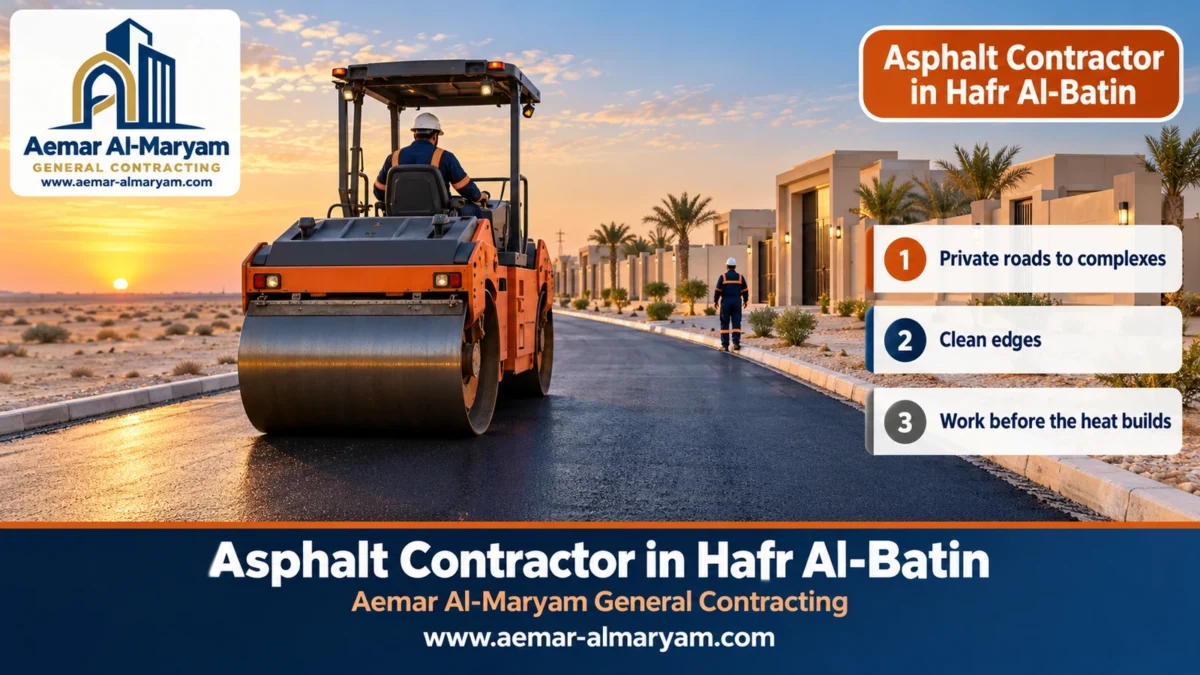
An asphalt contractor in Hafr Al-Batin turns the dirt track leading to a private villa compound, or a busy depot yard full of turning lorries, into an asphalt surface built on a firm, compacted base, with a thickness that matches what will run over it and a mix that copes with summer heat. Aemar Al-Maryam General Contracting builds private roads to residential compounds and the streets inside them in Hafr Al-Batin, lay warehouse yards in two layers with a tack coat between them, build speed humps on private streets, and pave and patch yards and car parks. Rates open at SAR 37/m² where a base is already in place and only 5 cm is needed, rise to SAR 74/m² for a road built up from raw desert, and SAR 55 for polymer-modified mix. Nothing is final until we have walked the site and signed off a scope, and the cost of getting crew and plant up to Hafr Al-Batin is worked out then. Contact: 0547879578.
Out in the northern desert of the province, Hafr Al-Batin keeps spreading, and many of its new projects sit on its edges: a villa compound that needs a road linking it to the street, a commercial warehouse that needs a yard able to take trucks, a private scheme whose owners want quiet internal streets with humps to keep speeds down. These jobs are longer and heavier than paving a house yard, so we plan them from photos and drawings before moving any equipment from Dammam.
What to know before paving your site in Hafr Al-Batin
- Our work here: private roads to villa compounds and their internal streets, warehouse yards, speed humps, and house yards, car parks and patching.
- Truck yards: two asphalt layers totalling about 12–14 cm, with an RC tack spray between them, over a base of about 23 cm.
- Heat: polymer-modified mix where trucks stand or crawl; standard mix is enough for residents’ roads.
- First prices: per square metre, 5 cm on a prepared base from SAR 37, 7 cm from 41, a full road from bare ground from 74, polymer-modified from 55, a cold patch from 46, milling and relaying from 38; all provisional until we inspect and agree.
- Travel: costed at the inspection; on large projects its share per square metre becomes small.
- Start with: site photos, dimensions and vehicle types on WhatsApp 0547879578.
Private road paving to villa compounds in Hafr Al-Batin
Paving a private road to a villa compound in Hafr Al-Batin means building a complete road, not just spreading a black layer. We set out its route and levels on the ground, level and compact the soil, build a crushed-stone base course, spray prime, then lay and roll hot asphalt and finish the edges so they do not crumble. A road running through open ground has its own issues compared with a walled yard: wind carries sand onto its edges, rain is rare but heavy when it comes, and unsupported edges break up under the wheels.
- ✓Cross-falls: about 1.5% to 3%, from the crown or from one side to the other, so rainwater leaves the road at once instead of soaking into its base.
- ✓Shoulders and edges: the base is laid a little wider than the asphalt, and the prime extends past the edge; we suggest kerbs at the compound entrance and at bends.
- ✓Construction traffic: if the villas are still being built, we suggest delaying the wearing course or strengthening the base, because concrete and block trucks are far heavier than residents’ cars.
- ✓Junction with the public street: we stop at the property line; any connection on the public street goes through the municipality.
- ✓Services under the road: water, power and drainage lines go in before the base, and we leave empty crossing ducts at each villa entrance.
Ask for crossing ducts before the base
The cheapest moment to place an empty duct under the road is before the base course; the dearest is after paving, when cutting and patching the asphalt becomes unavoidable. Coordinate early with an electrician and a plumber to fix the crossing points.
Road edges on open ground
On private roads outside built-up areas, the edge fails long before the middle does. A car pulling over to let another pass drops a wheel onto the asphalt edge, and if there is no wider base beneath it, the edge snaps and erodes inward. So we extend the base course well beyond the asphalt line, compact the earth shoulder beside it to roughly surface level, and suggest concrete kerbs at the entrance, the bends and in front of the compound gate where vehicles manoeuvre most. We also warn owners about wind-blown sand: left to build up on the edge, it holds water and hides cracks, so clearing it regularly is part of looking after the road.
Internal compound streets: one width or lanes?
Internal streets in Hafr Al-Batin’s private compounds are usually narrower than the access road and serve residents, visitors and sometimes service trucks. We pave them to the same thickness as for residents’ cars and strengthen the spots where trucks turn, at street ends and outside service rooms. Where streets run straight past villa entrances, we match their levels to the entrances so water does not run from the street into a villa yard.
Warehouse yards in Hafr Al-Batin: two layers with a tack coat between them
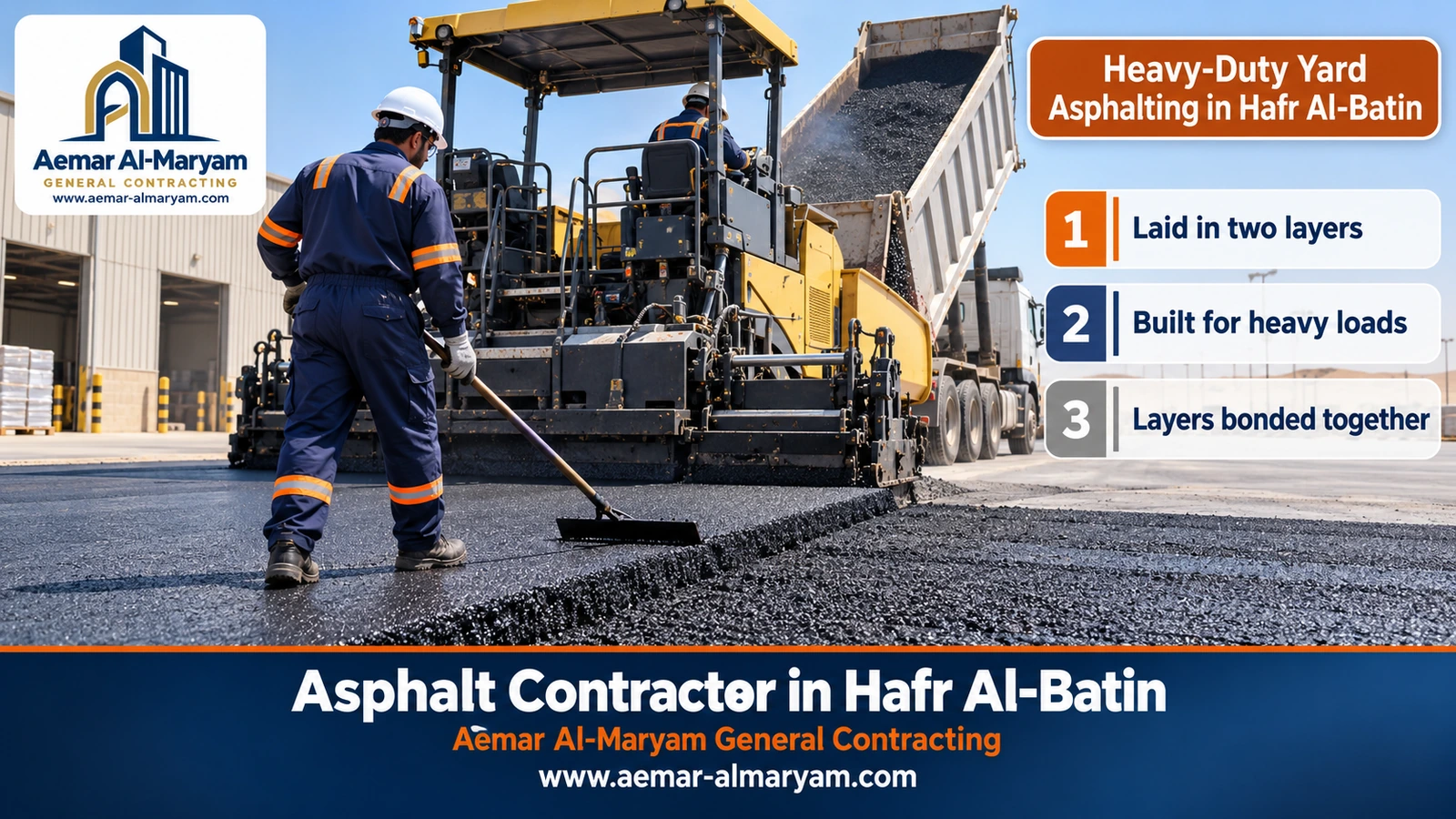
A warehouse yard in Hafr Al-Batin takes loads no house yard or car park sees: loaded trucks driving in and standing at loading docks, forklifts turning on the same spot, trailers parked for hours. One thin asphalt layer is not enough. It needs roughly 23 cm of rolled crushed stone underneath, and on top of that around 12 to 14 cm of asphalt laid in two layers.
Why not lay 12 cm in one go?
Because a roller can only compact an asphalt layer properly up to a certain thickness, and the paving specs we work to cap each lift at roughly 8 cm compacted. A thicker layer ends up less dense at depth than at its surface, and over time it ruts under heavy wheels. So we first lay the lower binder course, roll it until it is tight, then lay the wearing course that takes the wheels directly on top.
RC tack between the layers: why it matters
Between the two layers we spray a rapid-curing bitumen tack coat, very lightly, no heavier than roughly 0.25 L/m². Its job is to make the two layers work as one body. Without it, the top layer can slide over the lower one when a loaded truck brakes or turns, leaving crescent-shaped cracks pointing in the direction of travel. Should the top course wait over three days, or dust settle on the binder course, we clean it and re-spray the tack before paving.
⚠ Do not confuse prime with tack
Prime (MC) is sprayed once, on the crushed-stone base, and needs at least a day to cure. Between two asphalt layers, what is needed is tack (RC), not prime. Spraying prime between asphalt layers leaves an oily film that can weaken the bond instead of strengthening it.
We divide large yards into sections so the warehouse can keep working, spray tack on the vertical edge of each finished section before laying the next one, and offset the joints of the top layer from those of the bottom layer so they never line up into a single seam that lets water in.
Loading docks and forklifts: asphalt or concrete?
We will say it plainly: not every part of a warehouse yard belongs in asphalt. The strip along the loading docks, where a trailer stands for hours and its steel landing legs press into the surface, and where forklifts spin on small solid wheels in one spot, may be better served by a reinforced concrete slab, with asphalt for the rest of the yard and the lanes. Even polymer-modified asphalt is a flexible material, and a concentrated, static load in the heat will dent it whatever its thickness. We raise this option at the inspection if we think your yard needs it; details of slab work are on our concrete pouring page.
Hafr Al-Batin heat and polymer-modified asphalt
Asphalt softens with heat, and at midday in summer a black surface gets far hotter than the air. On a road where cars pass quickly this barely shows, but where a loaded truck stands for a long time, or crawls up to a loading dock, ordinary asphalt starts to rut: grooves in the wheel paths that deepen every summer.
The answer in those places is polymer-modified asphalt, a hot mix with a polymer blended into its bitumen that raises its heat tolerance and rutting resistance. This is not marketing talk: Dhahran-based university researchers who looked at Gulf paving binders found that asphalt in the east of the Kingdom needs polymer modification to reach the required performance, and that conventional bitumen suits only a small part of the region. Our polymer-modified mix starts at SAR 55 per m².
| Area of your project | Mix we suggest | Why |
|---|---|---|
| Compound road and internal streets | Standard hot mix | Moving cars, light loads |
| Villa yards and garage approaches | Standard hot mix | Light vehicles parking |
| Truck lanes in the warehouse yard | Standard or modified, depending on loads | Heavy traffic |
| Loading docks and trailer parking | Polymer-modified | Long standing of heavy loads in heat |
| Ramps up to the docks | Polymer-modified | Slow, loaded climbing and braking |
Heat also works in our favour: the mix cools slowly in summer, which widens the compaction window. Even so, we start early in the morning and check the temperature of every load on arrival; the mix must be around 139 °C or more when spread, and rolling ends before it drops to about 90 °C.
Speed humps on private streets in Hafr Al-Batin
A speed hump on a private compound street in Hafr Al-Batin protects children and pedestrians from speeding inside the compound, and we shape it from the same asphalt, during paving or afterwards. With the compound management we agree each hump’s position, height, width and curve, based on the speed you want and the vehicles that come in, because a hump that suits residents’ cars can be harsh on a service truck.
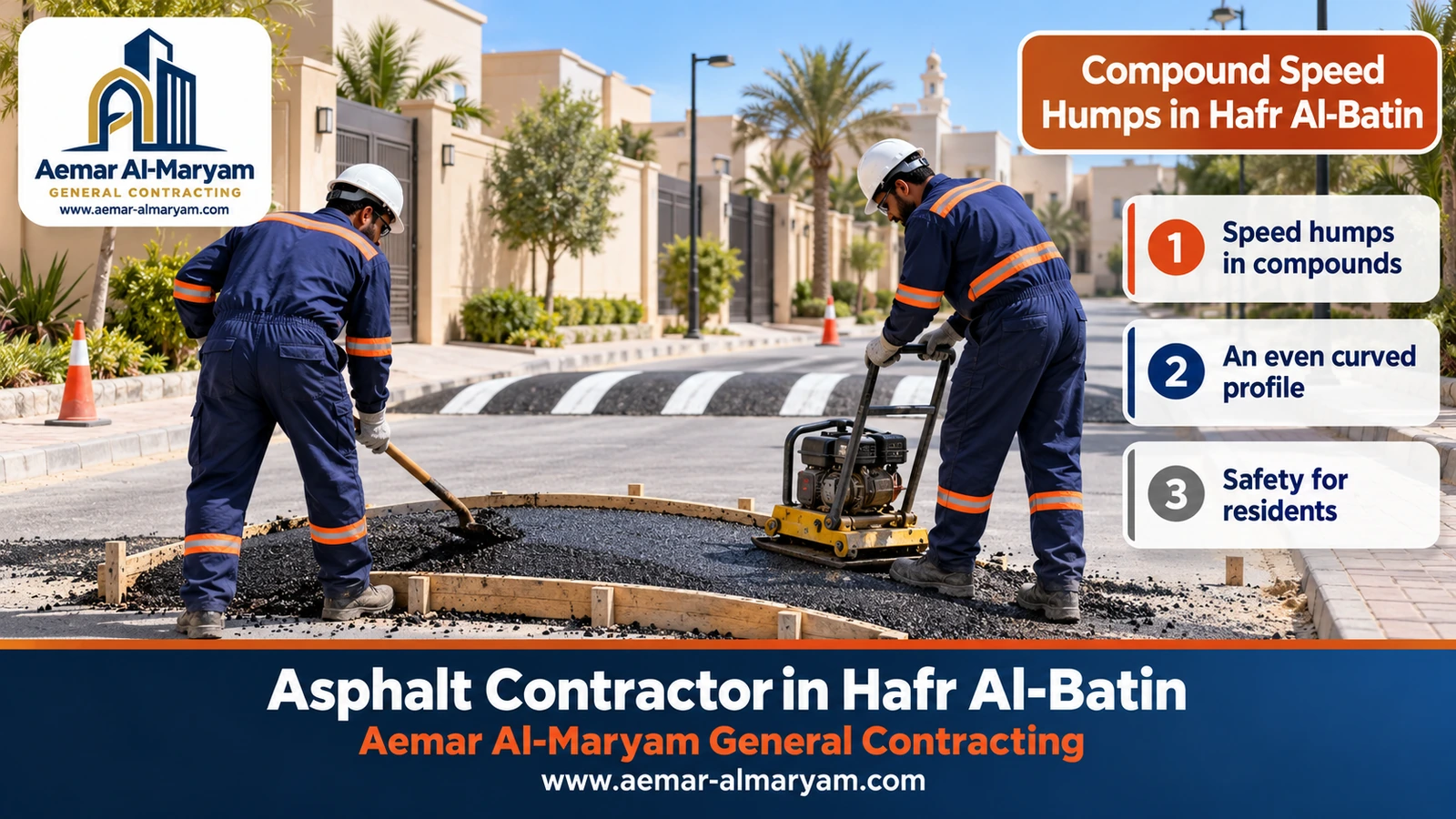
- 1Choose the spot
Away from the bend itself and from villa entrances, where a driver can see it from far enough back. - 2Prepare the surface
Clean the hump area and spray tack so it bonds to the asphalt beneath. - 3Shape it
Lay hot mix inside a template that sets the curve, and level it with lutes. - 4Compact
Compact with a vibratory plate until it is firm and holds its profile. - 5Water channel
Leave a gap at the edge, or work with the falls, so the hump does not trap rainwater. - 6Markings
White reflective stripes on the hump, and we suggest a warning sign before it.
How many humps a street needs depends on its length and its danger points: outside a children’s play area or internal garden, before sharp bends, and at pedestrian crossings between villas. One hump on a long street is not enough, because drivers speed up again after it, while too many closely spaced humps annoy residents and punish cars. So we propose the layout on the plan with the compound management before building, and build the humps straight after the wearing course, or as part of it, so each hump fuses with the asphalt beneath and does not lift off after a few months.
Humps on public streets are not our work; placing them there is the municipality’s decision. Inside compounds and on private roads we build them as part of the paving job, and each hump is priced at inspection according to its size.
Asphalt in front of houses in Hafr Al-Batin, plus yards and driveways
Asphalt in front of houses in Hafr Al-Batin covers the strip the owner holds up to the street line, plus the yard and garage approach. The goal is a clean surface that does not raise dust with every car, an entrance slightly above rainwater, and a fall that sends water away from the wall and threshold. Small yards are hand-laid and finished with a compact roller, and they cost more per metre than big roads or yards since the plant and crew cost the same however few metres there are, which is why it pays to combine your yard with a neighbour’s, or with other work, in the same visit.
Shop car parks and line marking in Hafr Al-Batin
Shop and office car parks get a fall of no less than 1.5% toward a drain or the street, and compact the edges at the kerbs with a small tamper. Once the asphalt has cooled we mark bays, arrows and accessible bays to the approved plan; marking is priced at inspection. Broken kerbs are replaced before paving, with details on our kerbs and interlock page.
Asphalt in Hafr Al-Batin: the layers from desert ground to surface
Whether it is a road, a yard or a house front, we build in Hafr Al-Batin in the same order; only the thicknesses change with the loads:
| Layer | Compound road and yards | Warehouse yard |
|---|---|---|
| Natural ground | Shaped, then rolled to ~95% of the soil’s peak dry density | As for roads, with soft pockets dug out |
| Base course | About 15 cm after compaction | About 23 cm after compaction, in two lifts |
| Spray on the base | MC prime, cured for at least a day | MC prime, cured for at least a day |
| Asphalt | About 5–6 cm after compaction | Binder course then wearing course, about 12–14 cm in total |
| Between asphalt layers | — | Light RC tack |
A base on desert ground: what we check
Dry sandy ground in Hafr Al-Batin looks hard, but loose sand will not carry asphalt unless it is compacted at the right moisture. So we dampen the soil from the tanker and roll it until it reaches roughly 95% of the densest state it can reach dry, hunting as we go for soft spots: old fill, a dry wadi channel filled with fine material, or buried building rubble. Anything weak comes out and is replaced. Then the stone base is built up in rolled lifts of up to 15 cm, every lift brought to full density before the next goes on.
Asphalt patching and milling in Hafr Al-Batin
On existing roads and yards we repair potholes with a permanent patch: a straight cut around the hole back to sound asphalt, cleaning, tack on the sides and base, then hot mix compacted from the middle outwards. Cold mix is for urgent cases only and starts at SAR 46 per m². Rutting in truck yards is treated by planing off the rutted 3–5 cm, tacking and relaying, from SAR 38 per m², and we may suggest that the new layer be polymer-modified where trucks stand. Straight saw cuts at joints are handled by our concrete cutting in Hafr Al-Batin crew.
Asphalt price per square metre in Hafr Al-Batin
The asphalt price per square metre in Hafr Al-Batin opens at SAR 37 where the base is ready, matching our Dammam starting rates, and travel is added after the visit. Read every figure as provisional; it moves with the road length or yard area, the number of asphalt layers, the mix type, the ground condition and the number of humps:
| Work in Hafr Al-Batin | Per m² from | Suits |
|---|---|---|
| 5 cm hot mix on an existing compacted base | SAR 37 | Yards and compound streets with a base in place |
| 7 cm hot mix on an existing base | SAR 41 | Light truck lanes |
| Complete road from bare ground: levelling and compaction, base, prime, 5 cm | SAR 74 | New compound roads |
| Polymer-modified mix | SAR 55 | Loading docks and trailer parking |
| Emergency cold patch | SAR 46 | A pothole that cannot wait |
| Planing off 3–5 cm, then relaying | SAR 38 | Rutted yards with a sound base |
| Two-layer truck yard with tack between and a 23 cm base | At inspection | Warehouses and heavy yards |
| Speed humps with reflective stripes | At inspection | Private compound streets |
| Bay and arrow marking | At inspection | Shop and compound car parks |
| Permanent hot patch | At inspection | Potholes in existing roads and yards |
| Travel from Dammam | At inspection | All Hafr Al-Batin sites |
Travel to Hafr Al-Batin
We move whatever the project calls for to Hafr Al-Batin: a grader or loader, a vibratory roller, a steel-drum roller, a paver, a water tanker, a sprayer and a crew that may stay several days. The cost of that varies widely between a small yard and a compound road or warehouse yard, so we work it out at the inspection once the days and equipment are known. Since most Hafr Al-Batin requests are big roads and yards, travel ends up a minor slice of each metre.
Worked example: a 250 × 6 m private road to a villa compound
For illustration: a private dirt road 250 m long and 6 m wide linking a villa compound to the public street, used by residents’ cars and needing a full build from the ground:
| Item | Calculation | Approximate result |
|---|---|---|
| Area | 250 × 6 | 1,500 m² |
| Cost for a full build | 1,500 × 74 | SAR 111,000 |
| Asphalt mix (5 cm, about 2.3 t/m³) | 1,500 × 0.05 × 2.3 | About 173 t |
| Base course after compaction (15 cm) | 1,500 × 0.15 | 225 m³ |
| Prime (roughly 1 L per m²) | 1,500 × 1 | About 1,500 L |
| Speed humps, marking and travel | — | At inspection |
Had the road already been graded with a firm rolled base, the sum would be 1,500 × 37 = about SAR 55,500. And if it turns out that construction trucks will use the road for months before the villas are finished, we may suggest strengthening the base along their path or holding back part of the asphalt, and we price that at inspection.
How long does a compound road or warehouse yard take?
A compound road a few hundred metres long goes through stages that should not be squeezed: levelling and compacting the soil, laying the base in two or more lifts and compacting each, spraying prime and waiting at least a day for it to cure, paving and rolling, then humps and marking. The paving itself on such a road may be done in a day or two, depending on the length and how many mix trucks are available, but the stages before it take most of the time. Warehouse yards need extra days because the asphalt goes down in two layers, and we may lay the binder course on one part of the yard while the base on the next part is being prepared. After the inspection you get a written day-by-day schedule so you can plan warehouse traffic or residents’ access.
What should a quote for a road or yard include?
Before comparing two quotes in Hafr Al-Batin, check that each one states these items explicitly; a difference in price is very often a difference in what lies under the asphalt:
- ✓Measured area in square metres, not a rough guess.
- ✓Base course thickness after compaction, its material, and the number of lifts.
- ✓Sprays: prime on the base, and tack between layers in yards.
- ✓Asphalt thickness after compaction, number of layers, and mix type: standard or modified, and where.
- ✓Extras: humps, marking, kerbs and crossing ducts, each as its own line.
- ✓Exclusions: such as removing old structures or replacing weak soil if found.
- ✓Travel, schedule and payment terms.
Mistakes we see on compound roads and warehouse yards
- ✓Laying 12 cm of asphalt in a single layer, leaving its depth under-compacted so it ruts.
- ✓Laying the top layer without tack on the lower one, or after days of dust have settled on it.
- ✓Standard mix at loading docks where trucks stand in the heat.
- ✓Road edges with no support, crumbling under wheels and buried in sand.
- ✓Humps that trap rainwater, or have no reflective stripes visible at night.
- ✓Paving the road before the heavy construction work in the compound is finished.
- ✓Forgetting service crossing ducts and then cutting the new road.
Public streets in Hafr Al-Batin: where our work ends
Our work stays inside your boundary: the private road, the compound streets, the yard and the house front. Public streets are paved and maintained by the Hafr Al-Batin Governorate Amana and its municipalities; nobody cuts into or widens them without going through its project coordination office, and excavation for utility connections is requested by the utility provider on the Balady platform. For a pothole in the public approach street, ring 940 or post it on Balady.
After paving: use and upkeep
Traffic returns when the mat is cold all through; rolled hot mix gains strength from compaction, not from water, and we set the time by the weather and the depth laid. After that, clear wind-blown sand from the edges as it collects, seal cracks before water gets into them, watch the loading docks through the first summer, and renew the reflective stripes on humps when they fade. In warehouse yards, ask drivers not to rest trailer legs directly on the asphalt without boards to spread the load, and not to idle a stationary truck over an oil or fuel spill, because petroleum products dissolve the binder and leave a soft hole. If rutting appears at a loading dock in the first summer, tell us early; treating it while it is shallow is far easier than after it deepens.
How to order an asphalt contractor in Hafr Al-Batin
Send these details on WhatsApp 0547879578, ideally with a site plan if you have one:
- ✓Photos of the road or yard from its start and its end.
- ✓Rough length and width, or the dimensioned plan.
- ✓Vehicle types: residents’ cars, or trucks, trailers and forklifts.
- ✓How many speed humps you want and roughly where.
- ✓Current ground: sand, fill or old asphalt.
- ✓A location pin in Hafr Al-Batin.
- 1Send the details
WhatsApp or a call to 0547879578. - 2First proposal
Suggested layers, thicknesses and mix, with an estimated cost. - 3Inspection in Hafr Al-Batin
We check the ground, levels and truck routes and work out the travel. - 4Detailed agreement
Compacted thicknesses, number of layers, mix type in each area, humps and schedule. - 5Work and handover
We build, lay and roll, test the falls and evenness, and leave the site swept.
What sets our Hafr Al-Batin work apart
■ Built for the load
Base thickness and the number of asphalt layers follow what will drive on the road, not the price per metre.
■ The right mix in each place
Standard where it is enough, modified where trucks stand in the heat.
■ Two-layer details
Tack between layers, staggered joints, and re-spraying if paving is delayed.
■ Well-planned humps
The right position and height, a channel for water, and reflective stripes.
Browse finished jobs in the projects gallery and indicative rates on our prices page. If the site needs old concrete or structures removed before paving, we have a demolition team in Hafr Al-Batin.
Where we pave in Hafr Al-Batin
We pave inside the city’s districts and on its edges where the new compounds and warehouses are, including:
The Hafr Al-Batin page has more detail. We also pave in Khafji on the Gulf coast and in the Al-Ahsa oasis, and our most complete reference is the asphalt contractor in Dammam page.
A compound road or warehouse yard in Hafr Al-Batin?
Send photos or the plan with dimensions and vehicle types; we will propose the layers, mix and humps with an estimated cost, then fix the inspection.
Useful links for your Hafr Al-Batin project
Tags