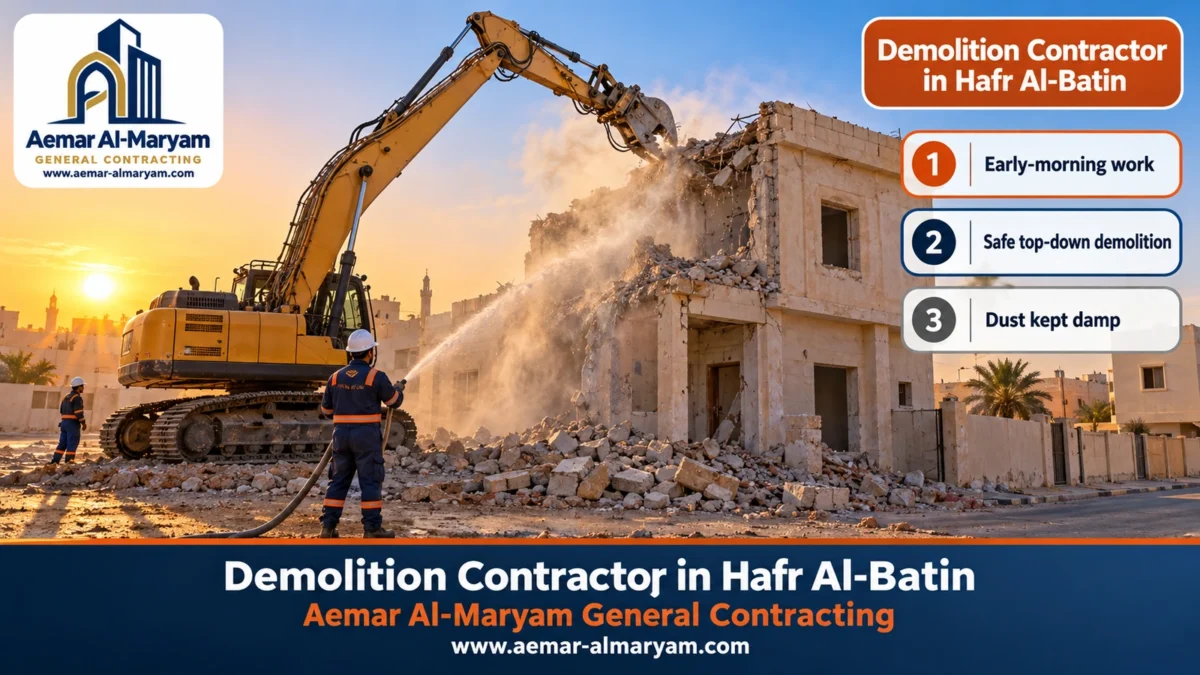
A demolition contractor in Hafr Al-Batin clears a house, a villa or part of one, breaks out walls, tiles and the concrete water tanks buried under courtyards, removes the rubble and hands you a level, compacted plot that is ready for the surveyor and the builder. At Aemar Al-Maryam General Contracting our Hafr Al-Batin jobs run on a timetable that starts at sunrise, so the heaviest work is done before the heat builds, and in summer we keep to the ban on outdoor work under the midday sun. Prices in the city begin at SAR 7,400 to remove a small house, SAR 13,900 for a two-storey home and SAR 185 to break out a partition wall, all of them estimates that become firm only after inspection and agreement. Call or message 0547879578.
Three things come up again and again in the demolition requests we get from Hafr Al-Batin. There is a long, hot summer that changes working hours. There are concrete water tanks under the courtyards of older houses that must be broken out and backfilled properly before anything new is built. And there are owners who want to receive a genuinely level plot, not just ground with the visible rubble taken away. This page is built around those three points, alongside prices, the permit and breaking methods.
Demolition in Hafr Al-Batin at a glance
- Our hours: we start at first light and stop exposed work from 12 noon to 3 pm between 15 June and 15 September.
- Underground tanks: drained, roof and walls broken out, then backfilled with clean sand in compacted layers.
- Handover: a levelled, compacted plot, a clean edge along the neighbour’s wall, levels checked with a laser and after-photos.
- Opening prices: partition wall SAR 185, tiles SAR 14 a m², small house SAR 7,400, two floors near 300 m² SAR 13,900, larger buildings SAR 46 per m² of floors; all confirmed after the visit.
- Getting there: moving the crew and machines from Dammam is priced after inspection.
- Booking: drop a map pin plus building and courtyard pictures on WhatsApp 0547879578.
Demolition contractor in Hafr Al-Batin: from first light to a level plot
A demolition job in Hafr Al-Batin is judged by how it ends. Did you get a clean, level plot the surveyor can start on, or ground with tank pits filled with rubble and old footings hidden under a layer of sand? That is why we plan backwards from the handover: we agree with you what has to come out below ground, the level you need and what stays, such as a boundary wall or the neighbour’s wall, and then arrange the demolition, breaking and haulage to get there.
■ Houses and villas
Taking down an old house or a one- or two-storey villa from the top with an excavator and crusher jaw.
■ Tanks and septic pits
Draining the underground tank, breaking its roof and walls and filling the old pit, using clean sand and compaction.
■ Partial demolition
Courtyard annexes, rooftop rooms, concrete canopies and outside stairs, with the remaining building protected.
■ Interior breaking
The wall between two rooms, floor tiles and bathroom or kitchen floors before a refit.
■ Foundations
Breaking out and lifting footings and ground beams when we agree on a fully clear plot.
■ Plot handover
Levelling, compaction and a level check, a clean street, photos and a signed handover note.
The general service is on our demolition service page, and everything we do in the city is gathered on our Hafr Al-Batin page.
Summer demolition in Hafr Al-Batin: the case for a dawn start
We begin demolition in Hafr Al-Batin at sunrise because the first hours of the day are the coolest and usually the calmest. Crews and machines work at their best, and the water we spray on the rubble stays there longer before it evaporates. As the temperature climbs we move to lighter tasks or to work in the shade. During the summer months we observe the labour ministry’s annual decision barring work in direct sunlight between 12 noon and 3 pm, running from 15 June to 15 September.
| Time of day | What we do | Why |
|---|---|---|
| Sunrise to mid-morning | Excavator demolition from the top, breaking slabs and outer walls | The coolest hours, and moisture holds the dust down |
| Mid-morning to noon | Sorting, loading, covering trucks and indoor breaking in shade | Lighter tasks, under a roof or a shade |
| 12 noon to 3 pm in summer | No exposed work under the sun | Keeping to the midday ban, 15 June to 15 September |
| Late afternoon | Cleaning the site and street, locking up and preparing the next day | Lower heat, and a secure site overnight |
Outside summer: the working day is longer and uses the full daylight, but we still start early because the district is quieter and the street is clearer for trucks.
Heat affects demolition in ways that go beyond the crew. The water used to keep dust down evaporates fast at midday, so more of it is needed; hydraulic machines run close to their limits; and broken concrete heats up until it is unpleasant to handle by hand. We therefore keep a large water tank on site, schedule regular breaks in the shade and make sure drinking water is available all day.
What this means for you
A summer schedule can look shorter in hours, but it gets more done with fewer accidents. We build that into the duration we give you at the start, so a job in July does not surprise you by running an extra day.
Building demolition in Hafr Al-Batin: old houses, villas and annexes
Every Hafr Al-Batin demolition we run obeys the same order: roof first, fittings before frame, far side before the party wall. Between houses, what shifts is the material, how many storeys there are, what is buried beneath the yard and how much room the street leaves for trucks.
Demolishing an old house in Hafr Al-Batin
Taking down an old house in Hafr Al-Batin starts with removing what can be removed: doors, windows, air conditioners, roof tanks and wiring, with the saleable items set aside. Then an excavator fitted with a crusher jaw works on the top slab from above, biting it away piece by piece under a water spray, before moving down to the walls and the ground floor. In older districts where houses stand close together, the strip along the neighbour’s wall is left for hand work, keeping shocks and debris on our side.
Villa demolition in Hafr Al-Batin
Expect a bigger machine and longer programme for a reinforced-concrete villa on two floors, since columns, beams and slabs are locked together by steel. We bring it down from the top with the crusher jaw, cut and collect the steel for sale, then deal with what surrounds it: the concrete boundary wall, shades, an outdoor annexe and a pool if there is one. Anything that is to stay is agreed in writing before we start, so we can shield it from the excavator arm and from piled rubble.
Partial demolition in Hafr Al-Batin
Most partial demolition requests in Hafr Al-Batin are for a courtyard annexe, a rooftop room, a cast canopy or an outside staircase. The first step is a straight diamond-saw cut that isolates the part from the rest of the building; props then go under whatever beam or slab leaned on it, and the piece is taken apart in small bites, never toppled. Where structure is involved the engineering office settles the permit route, and the edge of the remaining building will need treatment afterwards, which is covered in renovation contractor in Hafr Al-Batin.
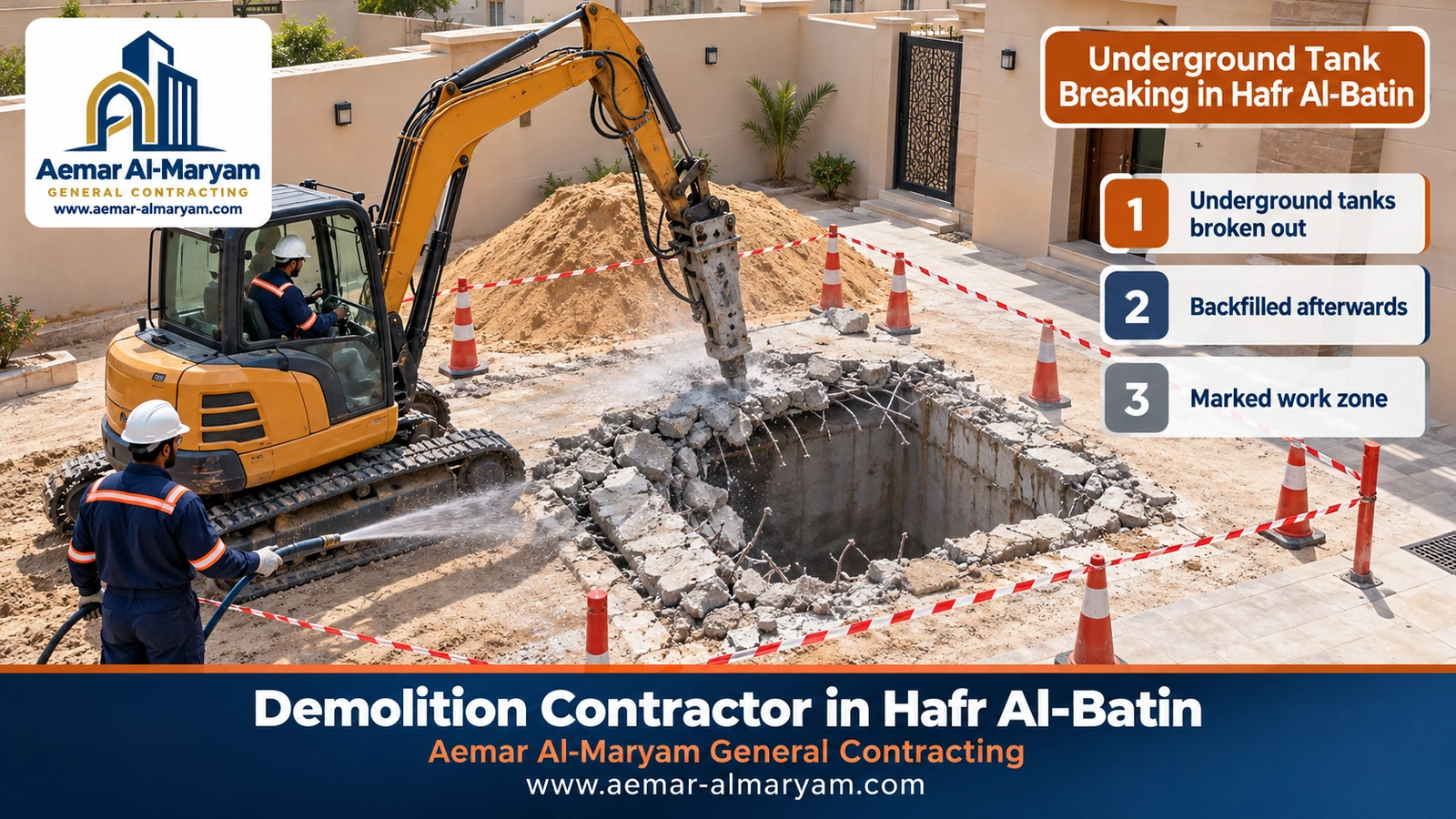
Breaking out and backfilling courtyard water tanks in Hafr Al-Batin
Many older houses in Hafr Al-Batin have a concrete water tank under the courtyard, and sometimes an old septic pit as well. When the house comes down, it is not enough to cover the tank with rubble and forget it. A void under the ground, or fill that was never compacted, settles over time, and that settlement can end up under a wall or column of the new house. So we treat the tank as a separate stage in the demolition plan.
Finding the tank and its size before demolition
In old houses the owner may not remember exactly where the tank is, especially if the courtyard has been retiled over it more than once. Look for a small steel or concrete cover in the courtyard or near the entrance, or a supply pipe dropping into the ground beside an old pump, or ask whoever lived in the house before you. If you still have the original drawings, the tank and pit usually appear on them with their sizes. Knowing the position and depth beforehand stops a heavy machine from rolling over a tank roof nobody knew about, and makes the estimate of backfill sand much more accurate.
Before breaking: drain, fence off and never go in
The tank is isolated from the supply and drained completely, then its opening and the area around it are closed off with barriers and warning tape. A closed tank is a confined space where foul air can collect, so nobody climbs inside; the breaking is done from above with the machine. If there is an old septic pit, its contents are pumped out by a tanker before any breaking or filling.
Breaking the roof and walls
A compact excavator with a hammer attachment punches through the tank roof and either drop the pieces inside or lift them out, as agreed. Then we break the upper walls down to a depth set by what will be built above. If the spot will sit under a building, the better approach is to break the walls and remove the concrete, or break the floor so any water can drain. If it will stay open courtyard, dropping the roof and breaking the upper walls before backfilling may be enough. The decision belongs to the engineer designing the new house.
Backfilling with clean sand in compacted layers
Proper backfill is not mixed rubble full of timber, plastic and steel. It is clean sand or a suitable fill material, spread in layers, wetted and compacted one layer at a time. That is what prevents settlement later. After the last layer the surface is trimmed to match the rest of the plot.
- If you want to keep the tank: when it is sound and fits the new layout it can stay; we protect its roof from machines and mark its position clearly.
- A tank under a new building: is never left hollow; the engineer decides whether it is removed or filled in a specified way.
- An old septic pit: pumped out, its opening broken and the pit filled and compacted just like the tank.
- Records: we photograph the tank before breaking and after filling, so the photos stay in the plot’s file.
Breaking-out contractor in Hafr Al-Batin: walls, tiles and concrete
Interior breaking in Hafr Al-Batin usually happens in a home the family will move back into within days, so what surrounds the work matters as much as the work. We cover floors and furniture, close the room off with sheeting, seal nearby air-conditioning vents so dust does not get in, and bag the rubble out every day.
Breaking a wall and opening two rooms into one
Opening two rooms into one usually takes no more than a working day when the dividing wall is block with a clear concrete beam running over it. We check it holds nothing up and conceals no column, relocate its switches and sockets, and knock it out course by course from the beam downward, the beam itself staying as it is. If the wall turns out to be cast concrete, thicker than about 20 cm, or has no beam above it, a civil engineer has the say, and temporary props and a new beam may be needed. After removal we agree with you on patching the floor and plaster along the old wall line.
Floor tile breaking in Hafr Al-Batin
We lift old tiles and their bedding down to the concrete and stop at buried pipes so the plumber can decide whether to replace them. Where floors have sunk, we open up what lies beneath, because the cause may be old fill that was never compacted or a leaking pipe, and fixing it before the new tiles go down saves doing the job twice.
Concrete breaking in Hafr Al-Batin
Concrete breaking covers footings, ground beams, slabs, boundary walls and stairs. Rebar keeps reinforced concrete in one piece, so courtyards and open plots get a compact excavator with a hammer, tight corners get heavy handheld breakers, and the protruding bars are sheared off afterwards. We do not break concrete that still supports a remaining part of the building without an engineer’s plan.
Rocket cutter wall cutting in Hafr Al-Batin
The tool locals call the “rocket” is a portable disc saw whose biggest blades bite only about 12.5 cm deep. Fine for outlining the work and slicing blockwork; useless alone against a thick cast wall. We cut with water, because dry cutting dust is dense, then finish with a breaker inside the line, and we keep it well away from beams and columns.
Cutting without breaking in Hafr Al-Batin
When what you want is a new doorway or window in a cast wall, with sharp straight edges and no vibration, a diamond saw beats a breaker. That work is explained in concrete cutting in Hafr Al-Batin, and small pipe holes in core drilling in Hafr Al-Batin.
Demolition permit in Hafr Al-Batin
Demolishing a whole building in Hafr Al-Batin requires a demolition permit applied for online through Balady. An engineering office is engaged to finish the file and drawings, the plot is linked through its building permit or survey decision, the owner confirms no person or animal will be inside while work goes on, and the platform’s calculated fee is paid. Balady states that issue takes between one and ten days. By contrast, removing tiles or an internal partition that carries no load is usually counted as maintenance, and for removing a structural element the engineering office chooses the right permit.
Permit fees and the engineering office
No flat fee is published on Balady; each case is calculated, and the engineering office bills separately. Our quote shows only the price of our own work and keeps those items separate so you can compare offers clearly.
Debris removal from demolition sites in Hafr Al-Batin
Rubble neither stays on the plot nor goes into the tank pits. Municipal ministry rules on construction waste require the permit holder to use a haulier carrying a National Center for Waste Management licence and to tip only at municipally designated sites, while the engineering office checks the receipt form and attaches the final certificate to the completion report.
- Sorting: steel and aluminium for sale, concrete and block together, timber and plastic to one side.
- Loading: with a loader in the early morning, with water sprayed on the heap.
- Transport: sheeted loads, keeping grit off the highway.
- What you receive: proof that the waste was disposed of at the approved site.
We bring the trucks in early, before the street gets busy and the heat builds, and leave the site entrance clean at the end of each day. Rubble left on the asphalt is carried by passing cars all over the district, and it is the first thing neighbours complain about.
Handing over a level plot after demolition in Hafr Al-Batin
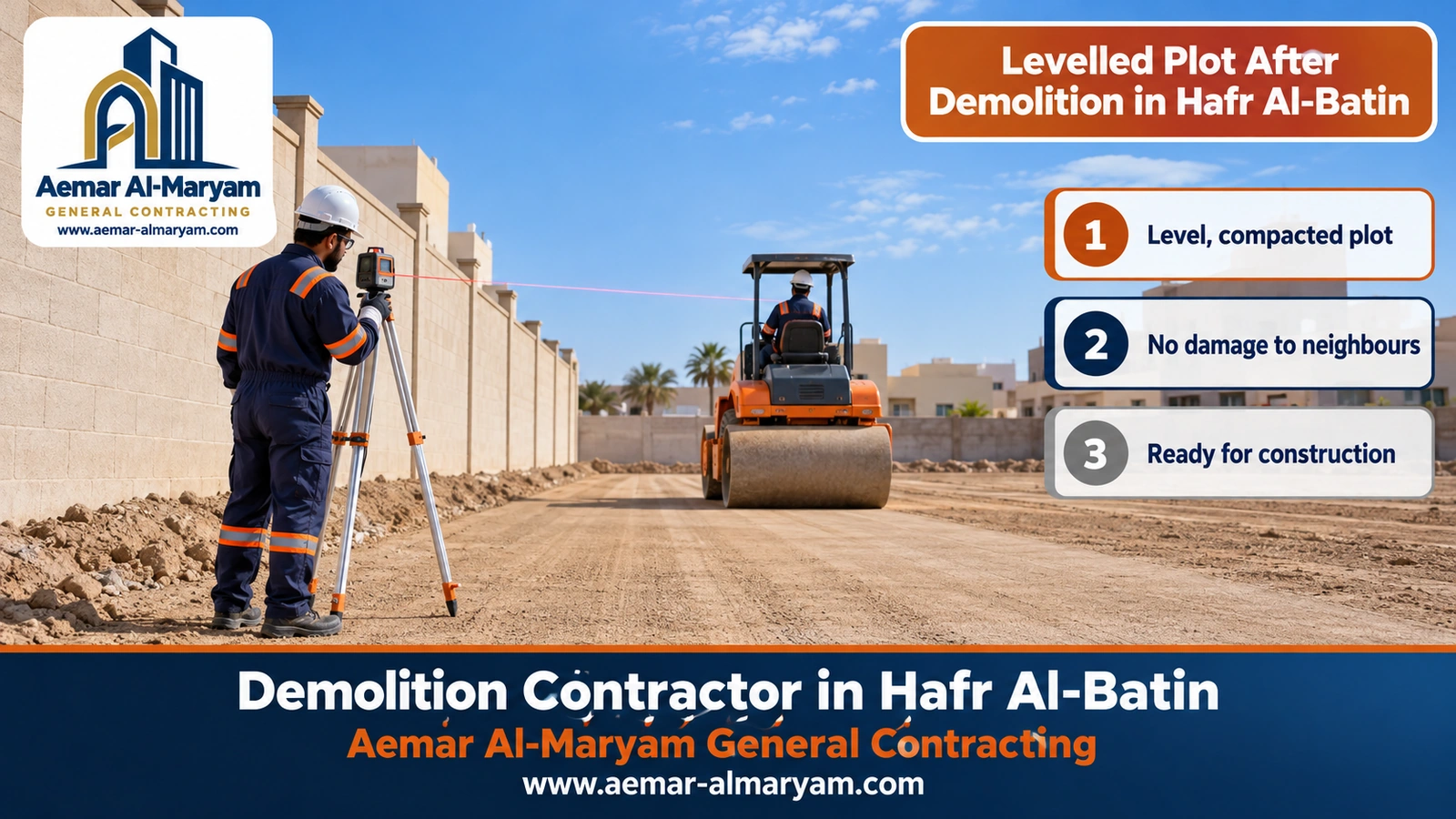
The level plot we hand over in Hafr Al-Batin is not just ground cleared of visible rubble. It is ground whose levels have been checked, that has been compacted, and whose edges have been left clean. We define “ready” with you at the outset, because someone building straight away needs something different from someone putting the land up for sale.
- ✓Foundations: are all footings and ground beams removed, broken down to a set level, or kept if the engineer decides to reuse them?
- ✓Pits: tanks and septic pits filled with clean sand and compacted in layers.
- ✓Level: the plot levelled and compacted with a small roller and checked with a tripod laser, so no hollows are left where water could gather.
- ✓Neighbour’s edge: a straight, clean line along the neighbour’s wall, with the wall intact and no rubble piled against it.
- ✓Street and pavement: cleared of rubble and truck marks.
- ✓Records: after-photos from several angles and a handover note signed by both sides.
If you will build right after demolition, we can carry the project on through our construction service. If you are torn between demolishing and repairing, our renovation service explains when fixing a building costs less than removing it.
Safety and the neighbours on Hafr Al-Batin demolition sites
Ahead of a full demolition, the owner asks the power company to take the meter away for a while, the supply water is closed, drains are stopped up, and we fence the plot with steel panels carrying mesh and warning signs. We photograph the neighbouring houses before starting, demolish from the top down, work by hand at the shared wall and spray water where we break and load. The crew wears helmets, glasses, gloves and safety boots, with drinking water and shade available all day.
⚠ Old sheets that may contain asbestos
If we find old fibre-cement sheets on annexes or shades that we suspect, we leave them whole, without breaking or cutting, and call in a licensed specialist to remove them before we return to that part. Cabinet decisions in the Kingdom prohibit the material and require its replacement and safe disposal. Asbestos removal is not one of our services.
Demolition methods and crews in Hafr Al-Batin
We choose the method in Hafr Al-Batin after seeing the plot, the street and the neighbours, and a single project usually combines three. Selective strip-out comes first, taking out doors, windows, aluminium, air conditioners, roof tanks and cables so there is less mixed rubble. Machine demolition follows, with with the excavator working downward a storey at a time. Hand work with electric breakers finishes the job at the wall shared with a neighbour and anywhere the excavator cannot reach. Explosives and the wrecking ball have no place in residential districts, and “laser demolition” does not exist in contracting work.
Our Hafr Al-Batin team pairs a machine operator who understands sequencing and slab condition with hand-breaking technicians and a supervisor who manages water, fencing, loading and heat breaks, and who messages you daily photos. Leaving a roof slab or bearing wall to unsupervised casual labour is something we steer owners away from.
Contract clauses that protect the handover of your plot
Most disputes in demolition happen at handover, not during the work, because the owner and the contractor never wrote down what “finished” means. We spell out these clauses in our quote and contract, and we suggest you look for them in any offer you compare:
- ✓What is below ground: the tank, the septic pit and the foundations; what is broken out, what is filled and what stays.
- ✓Fill material: clean sand or a suitable fill in compacted layers, never mixed rubble.
- ✓Final level: the ground level at handover relative to the street or a point set by the surveyor.
- ✓Protecting the neighbour: the neighbour’s wall documented before starting and a clean edge along it at the end.
- ✓Rubble and scrap: who hauls it, where to, who keeps the steel and how much is deducted for it.
- ✓Hours: daily working hours, including the summer midday ban, and the overall duration.
- ✓Payments: linked to completed stages, with the last one after the handover note and photos.
House demolition cost in Hafr Al-Batin
In Hafr Al-Batin a compact one-storey house is cleared from SAR 7,400; a two-floor house or villa of roughly 300 m² overall from SAR 13,900; above that, SAR 46 per square metre of floor. Local contractors publish no rates, so we benchmarked against the closest city that does and priced beneath it.
| What you need | Basis | From |
|---|---|---|
| Small single-floor house | Lump sum | SAR 7,400 |
| House or villa on two floors, about 300 m² in all | Lump sum | SAR 13,900 |
| Bigger concrete structures | Each m² of floor space | SAR 46 |
| Non-load-bearing block wall between two rooms | Each wall | SAR 185 |
| Old tiles with their bedding | Per m² | SAR 14 |
| Short-haul rubble load | Each load | SAR 90 |
| Breaking out and backfilling an underground tank | — | After inspection |
| Partial demolition and reinforced concrete breaking | — | After inspection |
| Mobilising people and plant from Dammam | — | After inspection |
Read before comparing: nothing here is final before we inspect and agree; material, floor area, a close neighbour, a narrow street, truck count and buried tanks all move the number. Items without a figure are priced after the visit, so send photos and rough sizes of the building and courtyard on WhatsApp 0547879578 for a ballpark figure.
Old house demolition cost in Hafr Al-Batin
A small house opens at SAR 7,400. Picture a one-storey home of some 155 m²: multiplied out it gives about SAR 7,130, under the minimum, so SAR 7,400 stands, plus any tank work, the truck loads and mobilisation. The wider the courtyard and the street, the shorter the job and the lower the price.
Two-storey house demolition cost in Hafr Al-Batin
Up to roughly 300 m² across both levels the opening figure is SAR 13,900; extra area is billed by the metre. A house with 190 m² on each floor totals 380 m², giving an illustrative figure of around SAR 17,480, with loads, the tank and travel added and saleable steel deducted.
Villa demolition cost in Hafr Al-Batin
A villa whose floors add up to about 300 m² begins at SAR 13,900, with anything larger charged per metre. The boundary wall, annexe, shades and pool are separate items, and so is removing the foundations completely, because it can sometimes double the number of loads.
Wall demolition cost in Hafr Al-Batin
Taking out a block partition starts at SAR 185, with its rubble bagged. Longer or taller walls, embedded cables or pipes, and making good the floor and plaster raise it, while a load-bearing wall is priced only after an engineer’s report.
Demolition for scrap in Hafr Al-Batin
Saleable steel, aluminium and good doors are valued on inspection and shown as a credit. “Free demolition” offers, however, rarely include breaking and backfilling the tank or levelling the plot, and they often end with pits filled with rubble. Always ask who hauls the concrete, who fills the tank and at what level the plot is handed over.
How long does demolition take in Hafr Al-Batin?
Allow hours for an inside wall, a day or two for a room’s flooring, several working days for a modest house and around a fortnight at most for a two-floor concrete villa, plus whatever Balady takes to issue the permit. In summer the daily working hours are shorter because of the heat and the midday ban, and we include that in the schedule from the start.
| Job | Time on site | What affects it |
|---|---|---|
| Wall between two rooms | Hours to a day | Services inside the wall and patching afterwards |
| Underground tank: break out and backfill | A day to a few days | Tank size and depth, amount of sand |
| Small house with plot levelling | A few days | Neighbour alongside, foundations, loads |
| Two-storey villa with a level plot handover | About one to two weeks | Foundation removal, summer hours, number of trucks |
How to request demolition or breaking in Hafr Al-Batin
Send the following to WhatsApp 0547879578:
- ✓Location and district: map link, district name and a shot of the road outside.
- ✓Building photos: every façade and the roof, and the walls next to the neighbours.
- ✓Courtyard photos: where the tank opening and septic-pit cover are, and a rough tank size if you know it.
- ✓The building: how many storeys and roughly how big each one is.
- ✓Handover you want: a plot for immediate building or for sale, and whether the foundations come out.
- ✓Permit: whether you have an engineering office and a survey decision or building permit.
Demolition company in Hafr Al-Batin: why Aemar Al-Maryam?
■ Hours that suit the weather
We start at sunrise and keep to the summer midday ban.
■ What is underground is dealt with
Tanks and septic pits are broken out, filled and compacted, not buried under rubble.
■ A plot that is really level
Compaction, a level check, a clean edge at the neighbour and a photo handover note.
■ Published starting prices
The price table shows where each item begins before you call.
■ Regulated haulage
Licensed trucks, municipal tipping, receipts in your hands.
■ Completed work
Past sites are pictured on our projects page.
Hafr Al-Batin districts we work in
We reach older and newer districts across Hafr Al-Batin, including:
Sister pages cover Al-Ahsa demolition and Khafji demolition, while the demolition contractor in Dammam guide brings all the details together.
Book a sunrise demolition in Hafr Al-Batin
Share pictures of the house, yard and road along with a pin. Expect a proposed method, a heat-aware timetable and an opening estimate, followed by a clear agreement on the finished plot.
Related services and articles
Article tags