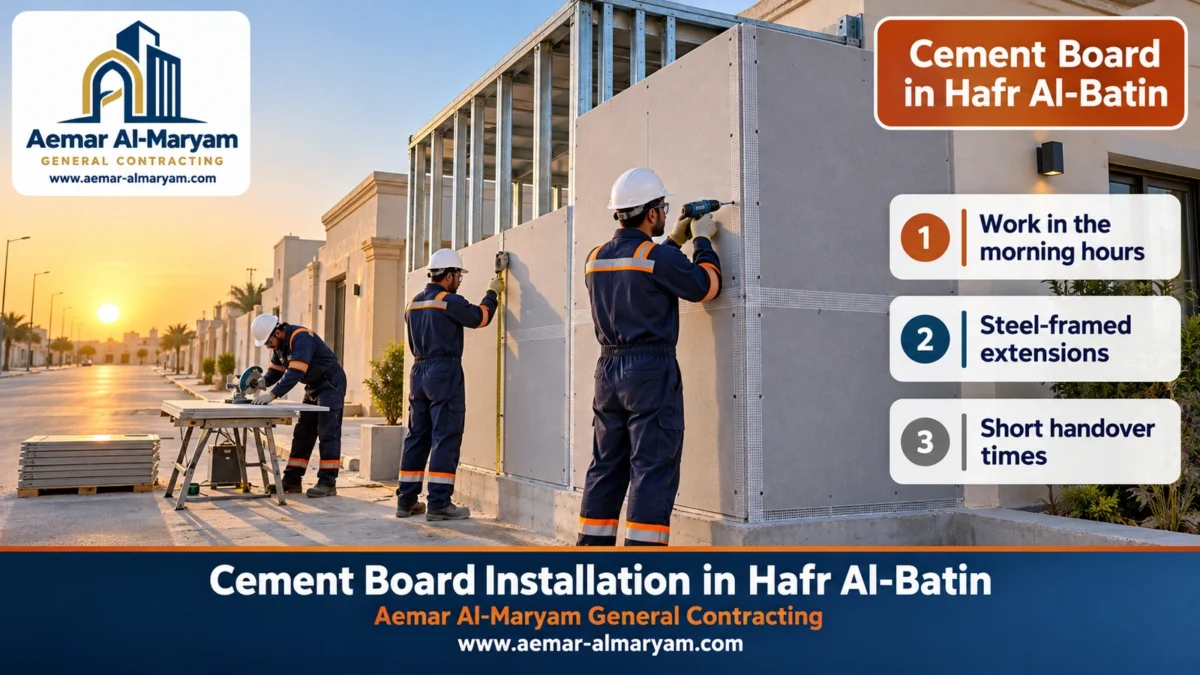
In Hafr Al-Batin every wall is judged by one question: what will the room feel like on a July afternoon? That is why, when we carry out cement board installation in Hafr Al-Batin, we do not stop at a board and some rock wool. We add a layer of reflective aluminium foil with an air gap in front of it, so a large share of the radiant heat bounces back before it reaches the room. We start work at sunrise and stop during the banned midday hours in summer. Alongside annexes and courtyard rooms, we build the cement board partitions that divide new shop units on the city’s broad commercial streets. That, in short, is the service Aemar Al-Maryam General Contracting brings to Hafr Al-Batin, with insulated walls starting at SAR 185 a square metre, materials and fixing included, an estimate confirmed after inspection. Call or WhatsApp 0547879578.
We travel to Hafr Al-Batin from our base in Dammam, so we rely on photos for the first estimate, inspect once, and then move the crew with every material on board. This guide starts with what sets the city apart, the heat, the insulation and the timing of work, then moves on to shop partitions, annexes and rooms, and finally prices, steps and common mistakes.
Cement board in Hafr Al-Batin at a glance
- Insulation: rock wool between the studs, reflective foil with an air gap, a sandwich-panel roof and a light exterior colour.
- Timing: outdoor work begins at sunrise and pauses in the banned midday hours throughout the period from mid-June to mid-September.
- Shops: partitions that split a unit in two, back-store walls and suspended ceilings.
- Homes: side extensions beside houses on wide streets, courtyard and driver rooms, and recladding old walls.
- Starting prices: insulated walls and double-faced partitions from SAR 185 a square metre, cladding from 148, fixing-only labour from 46.
Cement Board in the Hafr Al-Batin Heat: What Changes?
Cement board copes well with the Hafr Al-Batin climate because it does not soften or warp in the sun the way gypsum board does; gypsum makers specify that their boards should not be exposed for long to temperatures above roughly 52 °C, and an exposed wall surface in the city’s summer goes well past that. Yet the board itself is not a thermal insulator; it is a hard skin protecting what lies behind it. Heat reaches the room in two ways: by conduction through the wall materials, and by radiation from the hot surface to whatever faces it. Rock wool slows the first, reflective foil with an air gap deals with the second, and combining the two is what makes a cement board room comfortable in this city.
■ Board movement
The swing between a summer noon and the night moves the boards, so we leave 3–5 mm gaps between them and treat the joints with mesh.
■ Facade colour
Dark colours absorb the sun and heat the board; light ones reflect part of it, so we recommend white or a pale sand tone.
■ Dust
Dust-laden wind gets in through any open joint, so we seal joints around windows, doors and pipes.
■ Exterior finish
A flexible paint that tolerates movement over base coat and mesh, not a rigid paint that cracks after the first summer.
Two-Layer Heat Insulation: Reflective Foil and Rock Wool
We build the heat insulation of a Hafr Al-Batin cement board wall from outside in like this: the 12 mm outer board, then a water and air barrier, then rock wool filling the space between the studs, then the reflective foil with its shiny aluminium face, then a small air gap, then the inner board. The condition many people miss is that reflective foil does not work if a board is pressed against it on both sides. It reflects radiant heat across air; without an air space in front of it, it becomes just a thin layer that conducts heat like any metal. So we fix small battens over it before the inner board goes on, holding that gap at a steady width.
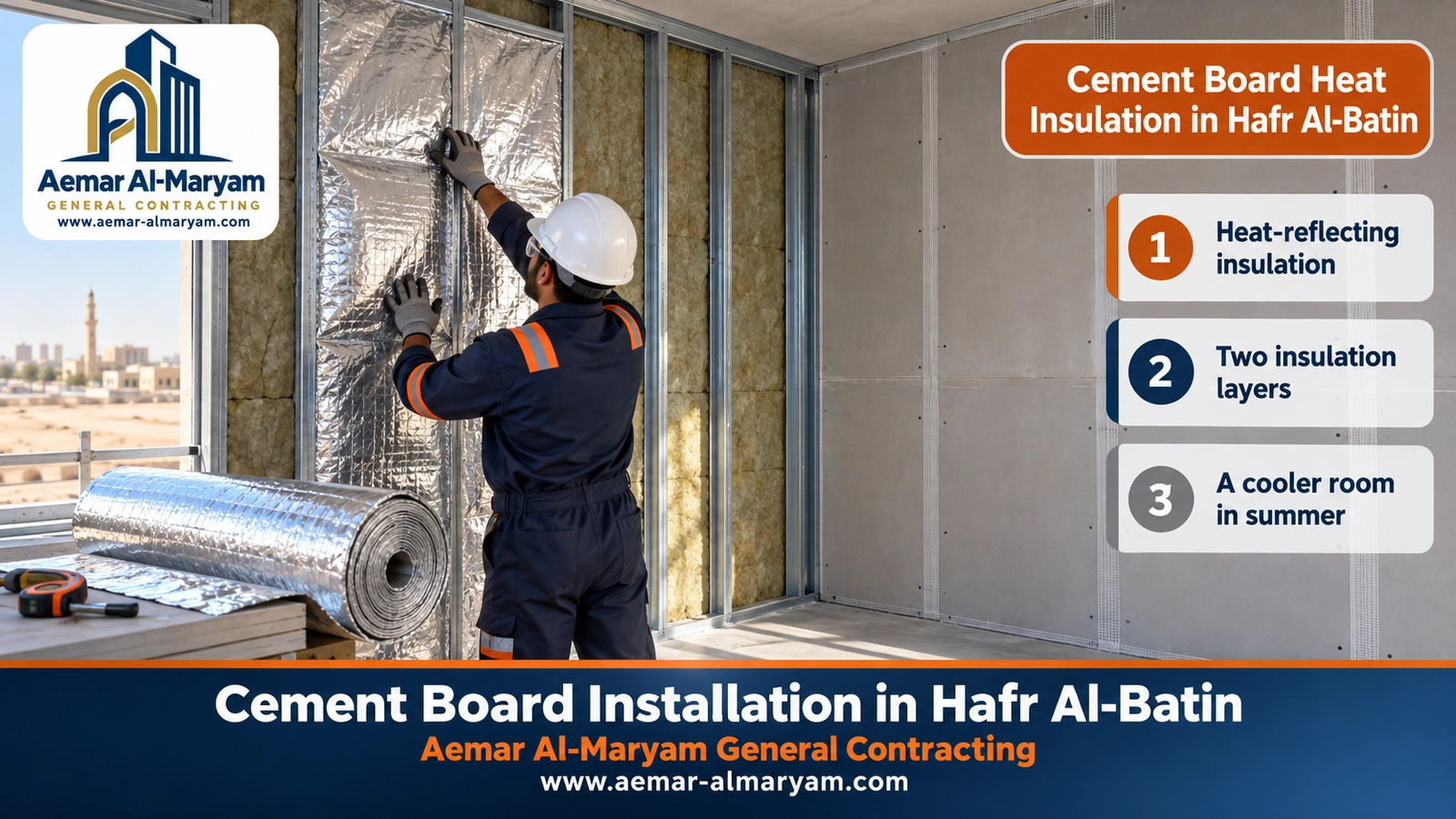
- ●Overlapping the rolls: we lap the rolls and tape their seams with aluminium tape so hot air cannot slip between them.
- ●Around openings: we wrap the foil around window and door frames and close its edges, because heat finds its way through the smallest gap.
- ●Pipes and cables: electrics run in conduit through the cavity without tearing the foil, and any hole is taped shut.
- ●Rock wool, fully filled: batts are cut exactly to the cavity, leaving no empty corners and never squashed so tight that they lose part of their performance.
The Roof First: Sandwich Panel and a Light Colour
The roof is the surface of a room that takes the most sun, so we use a factory-insulated 5 cm sandwich panel with a polyurethane or rock-wool core, laid to a fall that sheds the rain, which is rare but sometimes heavy. We prefer a light-coloured outer face. If the room has an existing concrete roof, its waterproofing and heat insulation are done through our insulation service. Reflective foil has no fixed line in our price table because its type and quantity vary from room to room, so we price it at inspection.
Sunrise Starts and the Summer Midday Work Ban
Each summer a decision of the Saudi Ministry of Human Resources and Social Development, issued with the National Council for Occupational Safety and Health, forbids open-air work in direct sun between 12:00 and 15:00 for the period 15 June to 15 September. We follow it on all our sites, and in Hafr Al-Batin we build the summer working day around it:
- 1At first light: outdoor work starts early: standing the studs, fixing the outer boards and cutting boards in the open air.
- 2Before noon: we finish everything on exposed facades and move boards and materials into the shade.
- 3The ban hours: no work exposed to the sun at all; the time is used only for roofed, shaded indoor work if there is any.
- 4After the afternoon heat breaks: we continue indoor tasks such as insulation, services and inner boards as the temperature drops.
The timing has a technical benefit too: base coat on the joints dries far too fast under the midday sun and cracks, and boards stored in the sun heat up and expand, then shrink after fixing. So we keep the boards in shade or under a light-coloured cover, apply base coat in the morning or late afternoon, and use sealants only within the temperatures their data sheets allow.
Sealing a Cement Board Room Against Hafr Al-Batin Dust
Dust storms are part of life in the city, and a light room that has not been sealed properly lets dust in from places its owner never expects: the gap between the bottom track and the slab, around the AC box, where the wall meets the roof, and through outdoor electrical openings. So we lay a sealing strip under the bottom track before fixing it, fill the wall-to-roof junction with flexible sealant inside and out, and close the AC pipe opening once the pipe is through. We choose windows with tight-closing frames and fit them with a sealing tape around the opening before the frame goes in. None of these details show in photos after painting, but they make the difference between a room that needs sweeping every day and one that stays clean after a storm.
Hafr Al-Batin Winters: Does Cement Board Stay Warm?
Some owners ask: if a light room is designed for the heat, what is it like on cold winter nights? The answer is that insulation works both ways; the rock wool that slows summer heat coming in also slows the warmth of a heater or AC escaping in winter. What needs attention in winter is condensation: when the inside is warm and humid from breathing and cooking and the outside is cold, vapour can condense inside the wall if nothing stops it. So we place the vapour barrier on the warm side of the wall, seal its laps, and recommend airing the room a little every day. The room then stays comfortable in both seasons without hidden damp behind the boards.
Cement Board in Hafr Al-Batin: The Board and Its Sizes
In Hafr Al-Batin, as elsewhere, cement board means fibre-reinforced cement and silica sheets screwed onto light galvanised framing, serving exterior walls, partitions, ceilings and bathrooms. The most common size is 1220 × 2440 mm, and thickness is chosen by position:
| Position | Thickness | Why |
|---|---|---|
| Exterior wall of an annex or room | 12 mm | Stiff enough for wind and knocks |
| Partition in a shop or house | 9–12 mm | 12 mm if the partition is tall or will carry shelving |
| Suspended ceiling in a shop or arcade | 6–8 mm | Light on the hangers |
| Impact zones and light floors | 15–18 mm | Takes knocks and point loads |
We do not accept a board whose supplier cannot provide a certificate of conformity with the GSO specification for fibre-cement sheets, together with the data sheet showing its fire classification.
Cement Board Installation in Hafr Al-Batin: Our Work
Our cement board installation in Hafr Al-Batin is split between homes and shops. At homes we build side extensions added beside the house on the street, courtyard and driver rooms, and we reclad old walls. In shops we divide space and build back-store walls and suspended ceilings.
■ Side extension beside the house
One or two rooms with double insulation, built on a slab next to the house.
■ Shop partitions
A partition that splits the unit in two, or separates the store from the showroom.
■ Courtyard and driver rooms
A room with a small bathroom and heat insulation suited to the summer.
■ Suspended ceilings
Cement board ceilings in shops and arcades that tolerate humidity and dust.
■ Recladding existing walls
12 mm boards over an old wall, then a light paint, instead of demolition.
■ Small bathrooms and kitchens
Cement backer behind tiles with waterproofing.
Installation Is Our Job; Selling Sheets Is Not
Boards reach our clients only fitted to a wall, not by the sheet. Owners who bought their own boards get them checked first and pay for fixing only, from SAR 46 per square metre.
Cement Board Partitions for New Shops on Hafr Al-Batin’s Wide Streets
Cement board partitions are in demand in Hafr Al-Batin because many new rows of shops are handed over as open shells, and the tenant then decides how to divide them: a barber wants a back room, a services office wants two offices, a clothing shop wants a fitting room and a store. A light partition goes up in a day or two depending on its length, puts little weight on the slab and can be taken down later if the business changes, a real advantage for a tenant who does not own the unit.
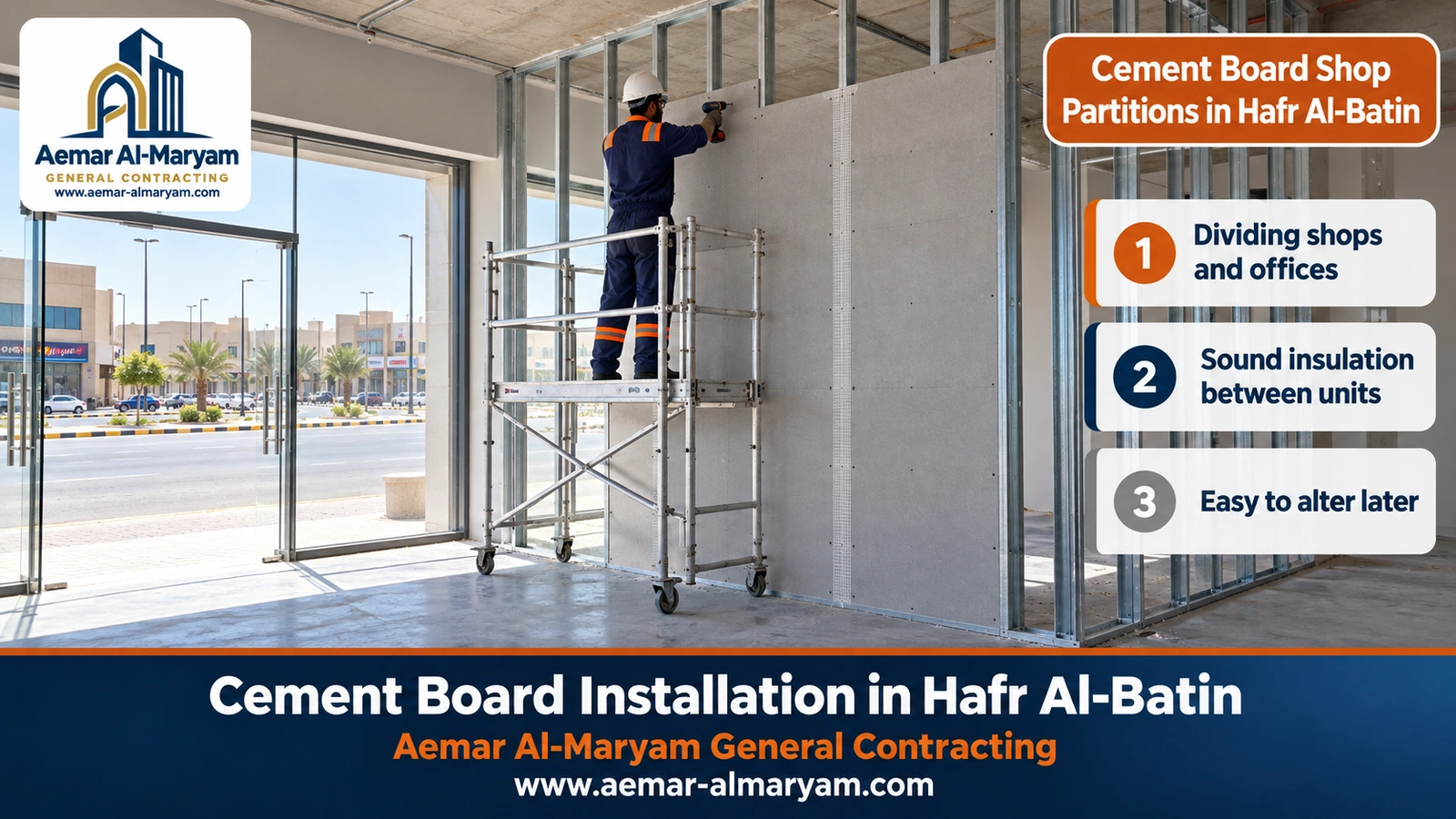
There is a difference between a partition inside one shop and a wall separating two units let to different tenants. An internal partition is there to organise space, so moderate insulation and an internal door are enough. A wall between two shops must reach the concrete soffit with no gaps, be completely filled with rock wool to cut the passage of sound and smells, and have every opening sealed, because the noise of a workshop or the smells of a restaurant should not reach the neighbour. We agree with the landlord from the outset which of the two is required, because the difference in materials and price is clear.
Partition Height and Fixing
New shops often have high ceilings, so the partition either runs up to the concrete soffit, which is best for sound and keeping dust out, or stops at a suspended ceiling. Either way we fix the bottom track to the slab and the top track to the soffit or to an independent suspended frame, use stronger or closer studs for tall partitions, and leave a detail where the partition meets the soffit that lets the concrete move without cracking the partition.
What Hangs on the Partition: Shelving, Screens and Signs
A shop wall carries more than a house wall: stock shelving, screens, advertising panels and AC units. So before we build we ask about everything that will hang on it, place backing studs or treated timber inside the frame behind each item, and mark their positions for you so whoever fits the shelves knows where to fix. On a partition separating showroom from store we use 12 mm board on the store side, because that face takes knocks from cartons and trolleys.
The Suspended Ceiling Inside the Shop
Many tenants ask for a suspended ceiling along with the partition, to hide services and lower the shop height so there is less air to cool. In the showroom a gypsum ceiling with concealed lighting may be enough, but in the back store, a small kitchen and the toilet we use thin cement boards because humidity and steam do not affect them. We hang the ceiling frame from the concrete soffit on galvanised hangers at regular spacing, and leave access panels near AC units and electrical boards so the ceiling is not broken open at the first fault. A suspended cement board ceiling starts from SAR 120 per square metre.
Licensing and Safety Requirements
Before dividing a shop, the tenant confirms with the landlord and under the business licence that the division is allowed, and we recommend checking the safety requirements for the activity with the competent authority. For our part, we choose a board whose data sheet shows its fire classification, fill the cavity with rock wool that does not burn easily, and leave access for AC, electrics and lighting boards at positions agreed with the technician.
Working in a shop without closing it
If the shop is trading, we start early before opening hours, screen off the work area with plastic sheeting and cut the boards outside with a saw fitted with extraction, so dust stays away from stock and customers.
Exterior Cement Board in Hafr Al-Batin for Side Extensions
We use exterior cement board in Hafr Al-Batin for the extensions built beside houses on wide streets, where the facade is exposed to sun and wind from many directions. The layers of that wall from outside are: a light flexible paint; base coat with alkali-resistant mesh along joints and corners, extended across the entire west-facing elevation; a 12 mm board held by rust-proof screws at spacings between 20 and 30 cm; a water and air barrier; the galvanised frame with studs at 40–60 cm and its double insulation; and the inner board.
Boards are laid in a staggered bond with no point where four corners meet, and keep joints away from window and door corners, where stress concentrates and cracks begin. Around every opening we fit a sealing tape and fill the gap around the frame with a flexible, sun-resistant sealant. The facade can be finished with cornices or a light profile render priced at inspection, and the rest of our finishing services are listed under finishing.
The Side Extension: Tying It to the House Without Leaks
An extension built against the wall of an existing house needs care along the line where they meet, because a concrete house and a light extension move differently with heat. We do not fix the extension boards straight onto the house wall; we leave a small movement joint filled with flexible sealant and cover the junction of the two roofs with a metal flashing that throws water away. If you want a door cut from the house into the extension, cutting the concrete wall is separate work done with a diamond saw once an engineer has cleared the wall as non-structural, or after it has been propped and strengthened. Before building, the engineering office checks the extension’s position against the plot boundaries and setbacks under the applicable requirements.
Cement Board Rooms in Hafr Al-Batin: The Cost of a 4×4 Room
A cement board room in Hafr Al-Batin is one of the most common courtyard requests: a driver room, a guest room, or a side room for a home activity. To work out its cost, take an illustrative 4 × 4 m room 3 m high: its four walls cover 48 square metres, which at the starting price of SAR 185 comes to about SAR 8,880, and the 16 square metres of panel roof, at SAR 125 each, add SAR 2,000. The total is around SAR 10,880 for a rock-wool insulated envelope, with the reflective foil, door, window, electrics, floor and paint added after inspection.
| Example | Walls or partition | Roof | Estimate |
|---|---|---|---|
| Courtyard room 4 × 4, 3 m high | 48 m² at 185 | 16 m² at 125 | About SAR 10,880 |
| Side extension 4 × 5, 3 m high | 54 m² at 185 | 20 m² at 125 | About SAR 12,490 |
| Shop partition 6 m long, 4 m high | 24 m² at 185 | — | About SAR 4,440 |
| Store partition 4 m long, 3 m high | 12 m² at 185 | — | About SAR 2,220 |
Illustrative examples from the starting prices, using full area without deducting doors, before reflective foil and finishes.
After the First Summer: What to Check
Once a room or extension has been through its first full summer, we recommend a quick look: search for hairlines over joints or around window corners, make sure the sealant around frames is still bonded and flexible, and look at the paint on the west facade in particular, because it takes the most sun. Any small issue is fixed in an hour; leaving it until water and dust get in turns it into a bigger repair.
Cement Board Annexes in Hafr Al-Batin
A light cement board annex suits Hafr Al-Batin owners who want one or two rooms with a bathroom quickly and with less weight. The large shaded majlis, the block-and-concrete annex (shell from SAR 830 for every square metre it occupies, standard finish from SAR 1,200), and the building permit amendment on Balady all sit in the Hafr Al-Batin annex and majlis article and on our annexes and majlis page.
Which Suits Hafr Al-Batin: Cement Board, Block or Gypsum Board?
| Comparison | Cement board, double insulated | Block | Gypsum board |
|---|---|---|---|
| In the summer heat | Handles the sun; insulation protects the interior | Its mass stores heat and releases it at night unless insulated | Not for exterior use |
| Partition inside a shop | Fast and removable | Heavy; needs breaking out to change | Suits dry offices |
| Build time | Days | Weeks | Days, interior only |
| Hanging loads | Good with backing inside the frame | Excellent | Needs backing |
| Best fit in Hafr Al-Batin | Side extensions, courtyard rooms, shop partitions | Large permanent buildings | Ceilings and office partitions |
In admin offices inside shops, gypsum board is sometimes enough for light partitions and ceilings with concealed lighting; see how we fit it in the Dammam gypsum board article or on our gypsum service page.
Cement Board Price With Installation in Hafr Al-Batin
We found no one in Hafr Al-Batin publishing cement board installation prices, so we apply our own starting prices from Dammam, the nearest city with published prices. Travel for the crew is added after the site visit, scaled to the work, and weighs less on each metre when several jobs are combined.
| Item | From | Measured per |
|---|---|---|
| Annex or room wall insulated with rock wool, 12 mm outer board and inner board on galvanised studs | SAR 185 | m² of wall face |
| Shop or house partition, two faces with insulation | SAR 185 | m² |
| Recladding an old wall: 12 mm sheets plus meshed base coat, paint not included | SAR 148 | m² |
| Suspended ceiling in 6–8 mm boards | SAR 120 | m² |
| 5 cm sandwich-panel roof | SAR 125 | m² |
| Labour only for the client’s materials | SAR 46 | m² |
| Reflective foil layer with air gap | At inspection | — |
| Final exterior paint | At inspection | — |
Estimates until inspection and agreement. They rise for tall partitions, heavy backing for shelving or a higher finish. Prices page.
What Pushes the Cost Up or Down in Hafr Al-Batin?
- ●Height: a partition running up to a tall shop soffit needs stronger studs and scaffolding, which raises its rate per metre.
- ●Backing: every spot for heavy shelving or a large screen adds studs and boards inside the frame.
- ●The reflective layer: it adds material and labour but cuts AC consumption all summer long.
- ●Grouping jobs: two partitions in neighbouring shops, or an extension and a courtyard room at one house, share the travel cost and lower each square metre’s share.
- ●Site readiness: a level slab and clear truck access save the crew time; if there is no slab yet, we can pour one as part of our construction work.
Cement Board Sheet Price
Buying loose sheets, you will see Saudi listings near SAR 85–110 for 12 mm, about SAR 55–75 for the 9–10 mm range and SAR 130–170 or so for 15–18 mm, for 1.22 × 2.44 m and depending on the source. That is not the price of an installed square metre, which includes studs, insulation, screws, mesh, base coat, labour and waste. Loose sheets are not something we sell.
How Many Days Cement Board Work Takes in Hafr Al-Batin
Splitting a shop with one partition is normally a one- or two-day job for frame and boarding, before the joints are treated and painted. A room or side extension needs a few days for the frame, double insulation and boards once the slab is ready, then the joints and paint. In summer the effective working day is shorter because of the ban hours, and our programme counts those lost hours up front instead of promising a timeline that forgets them. You receive the staged schedule after inspection.
Cement Board Installation Steps in Hafr Al-Batin
- 1Photos and sizes: photos of the house or shop, the lengths and heights, and what you want built.
- 2Inspection: we measure, check the slab and soffit, and agree door and hanging positions.
- 3Slab and tracks: a slab for an extension, or the bottom track fixed to the shop floor for a partition.
- 4Frame: galvanised studs at their spacing, with openings and shelving or screen positions stiffened.
- 5Services: electrical and AC conduit before closing.
- 6Outer boarding: 12 mm boards with staggered joints, fixed in the morning during the summer months.
- 7Double insulation: rock wool, then lapped reflective foil, then battens that hold the air gap.
- 8Inner board and roof: closing the inside face, then a sandwich-panel or suspended ceiling.
- 9Joints: mesh and base coat during moderate hours.
- 10Paint and handover: a light colour, then a joint inspection under raking light.
We cut boards in the open air away from passers-by, scoring and snapping where we can and otherwise sawing under a hooded extractor, wear masks because the dust contains silica, and clean up with a vacuum.
Common Cement Board Mistakes in Hafr Al-Batin
■ Foil pressed against the board
With no air gap it loses most of its benefit and becomes a layer that conducts heat.
■ Working at midday
It breaches the summer ban, and base coat dries too fast and cracks.
■ Boards stored in the sun
They heat up and expand, then shrink after fixing and open the joints.
■ A dark facade colour
It soaks up the sun and raises the temperature of the wall and the room.
■ Shelving without backing
Shop walls carry a lot, and hanging on the board alone loosens the screws.
■ Partition jammed against the soffit
Movement of the concrete above cracks the top of the partition.
If you have an older light annex whose joints have opened or whose paint has flaked in the heat, read how we repair it on the Hafr Al-Batin renovation page.
Hafr Al-Batin Districts We Serve
Our crew reaches the city’s residential districts and commercial streets, including:
For more about our services in the city see the Hafr Al-Batin area page. Cement board jobs in Al-Ahsa and Khafji have their own pages, and the whole system is explained in our complete Dammam cement board guide.
How to Order Cement Board Installation in Hafr Al-Batin
- 1Send on WhatsApp 0547879578: photos of the site, the dimensions, and whether it is a house or a shop.
- 2For shops: a photo of the soffit and floor, the shop height, and what will hang on the partition.
- 3For extensions: a photo of the spot beside the house, the facade direction, and whether a slab exists.
- 4Estimate: a first cost figure comes back to you, and the site visit is booked.
- 5Build: we confirm price and schedule after inspection and arrive with all the materials.
Why Home and Shop Owners in Hafr Al-Batin Choose Us
- ✓Considered double insulation: rock wool and reflective foil with a proper air gap.
- ✓We respect the midday work ban and build it into the schedule from day one.
- ✓Experience with shop partitions: height, backing and working without closing the shop.
- ✓Published starting rates and costed examples, so the numbers are clear up front.
- ✓One inspection visit and a complete delivery from Dammam.
- ✓Completed jobs to look through on our projects page.
An extension or a shop partition in Hafr Al-Batin?
Share photos and measurements; a cost estimate and a visit slot will follow.
Linked pages
Tags