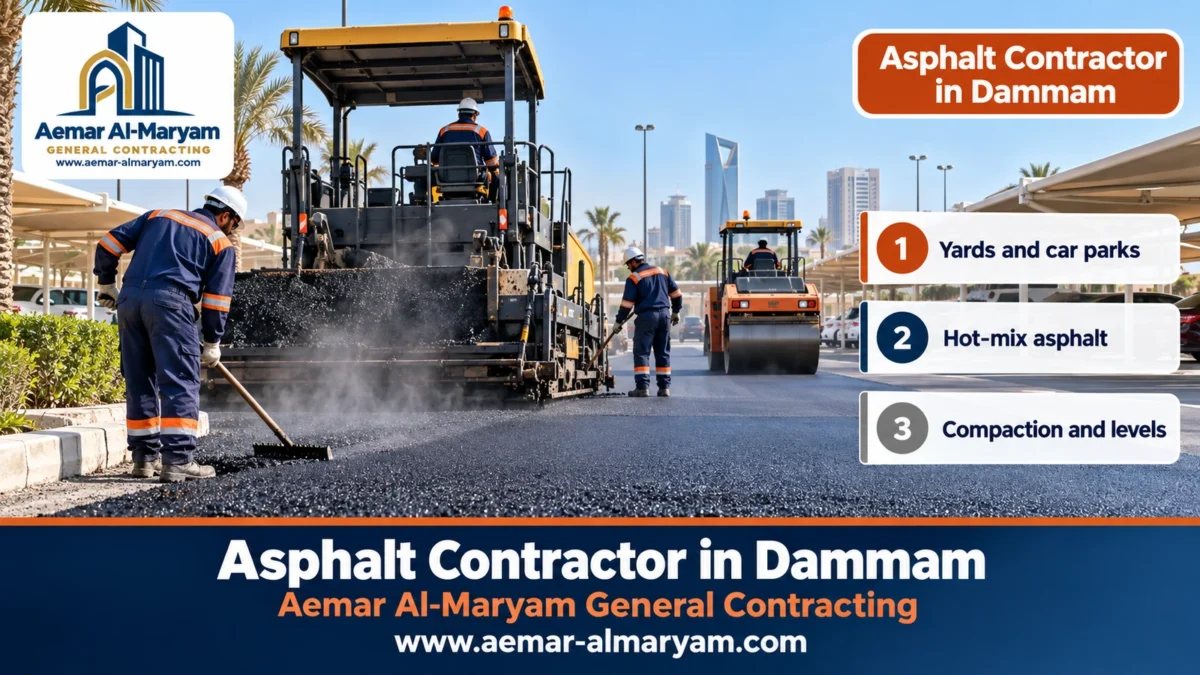
An asphalt contractor in Dammam prepares the ground, builds a compacted base course over it, then lays hot asphalt mix and rolls it, so the owner ends up with a firm surface for cars or trucks that sheds water and does not sink a few months later. At Aemar Al-Maryam General Contracting we asphalt house yards and house fronts, car parks for shops, apartment buildings and companies, internal roads for warehouses, factories and compounds, and we patch and mill old asphalt and mark out car parks, in Dammam and across the Eastern Province. Prices start from SAR 37 per square metre for 5 cm of hot mix on a ready base, from SAR 41 for 7 cm for trucks, and from SAR 74 for the full system including the base course. Every figure here is an estimate until we inspect the site and agree the scope. To order or ask a question, call 0547879578 or message the same number on WhatsApp.
Let us be clear from the start: the public streets of Dammam are paved and maintained by the municipalities under the Eastern Province Amana, and that is not our work. What we do is the paving that people and businesses own: a villa yard you want to drive into without dust, a house entrance where rainwater pools, a parking area in front of a shop full of potholes, a warehouse yard where trucks turn all day, an internal road in a residential compound or a plant. This guide explains what we pave, the pavement layers and their thicknesses, the difference between prime coat and tack coat, the types of mix, patching, milling and line marking, prices with a worked example, and what to check before you accept the job.
In short: your asphalt contractor in Dammam, Aemar Al-Maryam
- What we pave: villa yards and house fronts, car parks for shops, buildings and companies, internal roads for warehouses, factories and compounds, and farm and rest-house tracks.
- Layers: subgrade levelled and compacted, then a crushed-stone base course of about 15 cm for cars and 23 cm for trucks, then a prime coat (MC), then the hot mix.
- Thickness: about 5–6 cm compacted for family cars and light car parks; about 12–14 cm in two layers for trucks and industrial yards.
- Prices start from: SAR 37/m² for 5 cm on a ready base, 41 for 7 cm, 74 for the full system with base course, 55 for polymer-modified, 46 for temporary cold-mix patching, 38 for milling and re-laying. Estimates until inspection and agreement.
- Repairs: permanent hot-mix patches after the edges are cut, crack sealing, and milling off a worn surface before laying a new one.
- Cities: Dammam and its industrial cities, plus Al Khobar, Dhahran, Saihat, Qatif, Jubail, Al-Ahsa and other Eastern Province towns.
- To order: call or WhatsApp 0547879578 and attach site photos, rough measurements and the vehicles that will use it.
Asphalt contractor in Dammam: what we pave and for whom
The asphalt contractor you need in Dammam is one who deals with your private site from the ground up: reads the soil, sets the levels and the direction water will run, builds the base that carries the asphalt, then lays and rolls the mix and hands over a level surface. That is the work we do, on the kinds of sites people in Dammam actually ask about, not on highways and public roundabouts, which are the business of government bodies and their contractors.
Most requests that reach us fall into three groups. A home owner who is tired of dust and mud wants the yard or the area in front of the house paved. A shop or building owner wants a tidy car park for customers or residents. A company or factory wants a yard and internal roads that can take trucks and forklifts. Each group needs a different thickness, different layers and a different cost, which is why one price for everyone makes no sense.
■ Yards and house fronts
Villa yards, garage entrances and the owned area in front of the house, with falls that keep water away from the walls.
■ Car parks
Parking for shops, apartment buildings, compounds and offices, with line marking, arrows and accessible bays.
■ Warehouses and factories
Loading and unloading yards and truck lanes with thicker asphalt and a heavier base.
■ Internal roads
Roads inside residential compounds, private schools and clinics, farms and rest houses.
■ Patching and maintenance
Pothole repair, crack sealing, settlement repairs, and milling off a worn surface before re-laying.
■ Line marking and kerbs
Car park marking and painting, and kerbs around the asphalt coordinated with the interlock crew.
A short description of the service sits on the asphalt paving service page. This guide goes into the details that decide whether your asphalt lasts for years or cracks in its first summer.
Asphalt company in Dammam or a single paver: what changes in the result?
An asphalt company in Dammam works with a crew, equipment and written steps: a level survey, base preparation, a prime coat, mix ordered from a plant, laying, rolling and checks. A single tradesman working alone may lay a neat mat, but he often starts straight with the mix and spreads it on uncompacted soil or a thin base. The surface looks good in the first week and then sinks under the car wheels.
The difference is invisible on handover day and appears later. So ask any contractor three things before you ask about price. How thick is the base course and how will it be compacted? Will a prime coat be sprayed on the base, and how long before the asphalt goes down? And how thick will the asphalt be after rolling, not before? If the answers come back as clear numbers, you are dealing with someone who knows the job.
Asphalting, paving or “zeft” in Dammam: different words, one job
People search for asphalting, paving, tarmac and blacktop, and in Arabic they type «سفلتة», «اسفلت» and the Gulf word «زفلت». They all mean the same thing: a mix of graded aggregate and bitumen produced hot, spread and compacted. The name matters far less than the specification: the type of mix, its thickness after compaction, and what lies beneath it.
Asphalt in front of houses and yard paving in Dammam
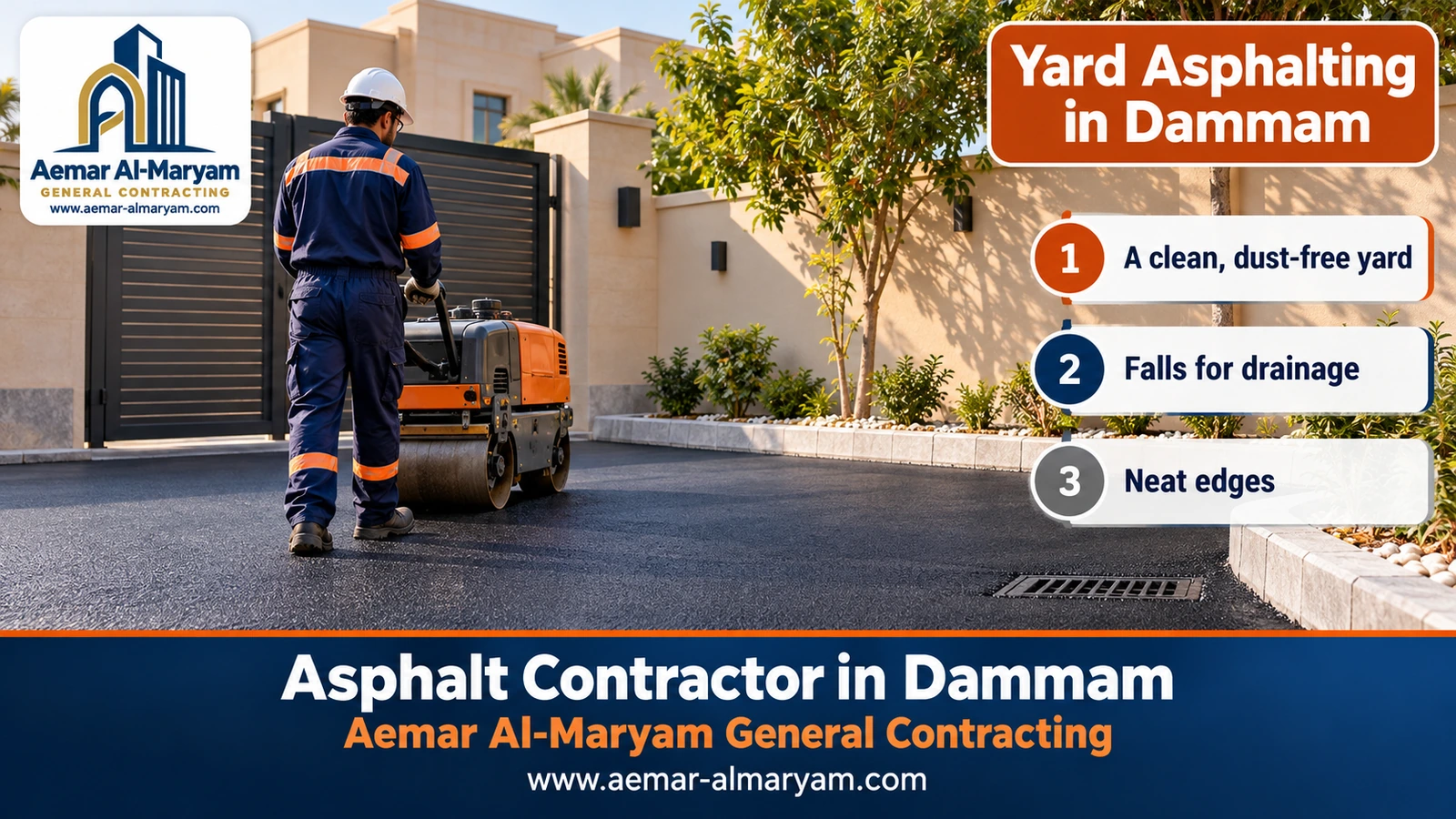
Asphalt in front of a house in Dammam means paving the part you own inside the boundary wall or the area set aside for the garage entrance, with a compacted base and about 5 to 6 cm of hot mix after rolling, laid to a fall that carries rain and wash-down water away from the house. It is one of the most common requests we get, because an earth yard fills the house with dust, turns to mud after rain and lets the car wheels sink.
In older Dammam houses we often find the yard covered in cracked concrete, in tiles that broke under the car, or in a thin skin of asphalt laid straight on soil. In these cases laying a new layer over the old one is not enough. We break out and remove what has failed first, sometimes with our demolition team in Dammam lifting old concrete and carting away the debris, and then we rebuild the layers from scratch.
Five things that decide whether a driveway works
- ✓Where the water goes: the fall runs toward the street, a gully or a channel, and never toward the house wall, the majlis door or the garage.
- ✓Door and threshold levels: we leave a sensible step below the door sill and the gate so water stays out and the gate does not scrape the asphalt.
- ✓Services under the yard: water and drain pipes, power and lighting cables are laid before the base, because cutting new asphalt later leaves a permanent scar.
- ✓Edges: a free asphalt edge needs support from a kerb, a wall or a concrete strip, or it crumbles over time.
- ✓Trees: roots from large nearby trees lift and crack asphalt, so we leave space or a barrier around them.
If you are building an annex or outdoor majlis in the yard, it is better to asphalt the area around it after construction, once the trucks and cranes have gone, not before; heavy equipment breaks the edges of new asphalt and leaves marks in it. Paving can also be folded into a wider renovation project in Dammam if you are refreshing the whole house.
Before you decide: measure and photograph
Take the length and width of the yard in metres and photograph the entrance, the gate and the corners where water collects, then send them on WhatsApp. We work out the area and suggest falls and thickness before the visit, so you know the estimated cost early.
Asphalt or interlock for a yard in Dammam?
Asphalt is the quickest and cheapest per square metre and its surface is seamless, which suits driveways and large areas. Interlock gives you colours and patterns, and if you ever need to reach a pipe underneath you lift the blocks and relay them, but it needs kerbs to lock it in place and takes longer to lay. Many villas combine both: asphalt for the driveway and interlock for paths and seating areas. Interlock and kerbs have their own page: interlock and kerb installation.
| Comparison | Asphalt | Interlock | Concrete |
|---|---|---|---|
| Speed | Fastest once the base is ready | Slower: laid block by block | Slowest: pour, then water curing |
| Look | Uniform black, no joints | Many colours and patterns | Grey with movement joints |
| Repairs | Local patch | Lift and relay the damaged blocks | Cut, break out and re-pour |
| Carries trucks | Yes, with the right thickness and base | Yes, with thick blocks | Yes, with the right reinforcement and depth |
| Needs edge restraint | Preferable | Essential (kerbs) | Usually not |
Car park asphalt in Dammam
Car park asphalt in Dammam means preparing an area that can take cars driving in, out and turning every day, with a base course of about 15 cm and about 5 to 6 cm of asphalt after rolling for cars, a fall of at least 1.5 percent toward the drainage points, and line marking at the end. A car park differs from a yard in two ways: traffic is far heavier, and repeated turning on the same spot pushes and ruts the asphalt if it is too thin.
In Dammam, car park paving is in demand in front of shops along commercial streets, at new apartment buildings that need parking for residents, and at offices, clinics and private schools. Each of these needs a clear plan for entry and exit, the number of bays, accessible bays close to the entrance, and the drainage points.
Shop fronts, apartment buildings and compounds
A customer sees the parking in front of a shop before seeing the shopfront, and potholes and standing water send people elsewhere. Yet the area in front of many shops meets the public pavement or the street, and here we need to know where your property ends. Whatever lies inside the plot we pave; whatever lies in the street reserve needs the municipality, as explained in the public-street section below. In buildings and compounds we pay particular attention to sloping car park ramps and to the joint between the asphalt and the entrance tiles, so no lip forms that jolts cars.
Accessible parking bays
They go close to the entrance, the bay and its access aisle are kept to a slope of 2 percent or less in both directions, the access symbol is painted on the surface, and a sign is mounted no lower than 2.1 metres. We build this into the paving and marking.
Asphalt and car park line marking in Dammam
Line marking in Dammam means painting bay lines, direction arrows, pedestrian walkways and accessible bays on the asphalt once it has fully cooled and dried, following the approved site plan. We set out the lines with string and chalk first, then push a line-marking machine that leaves a straight line of constant width, and paint arrows and symbols with stencils.
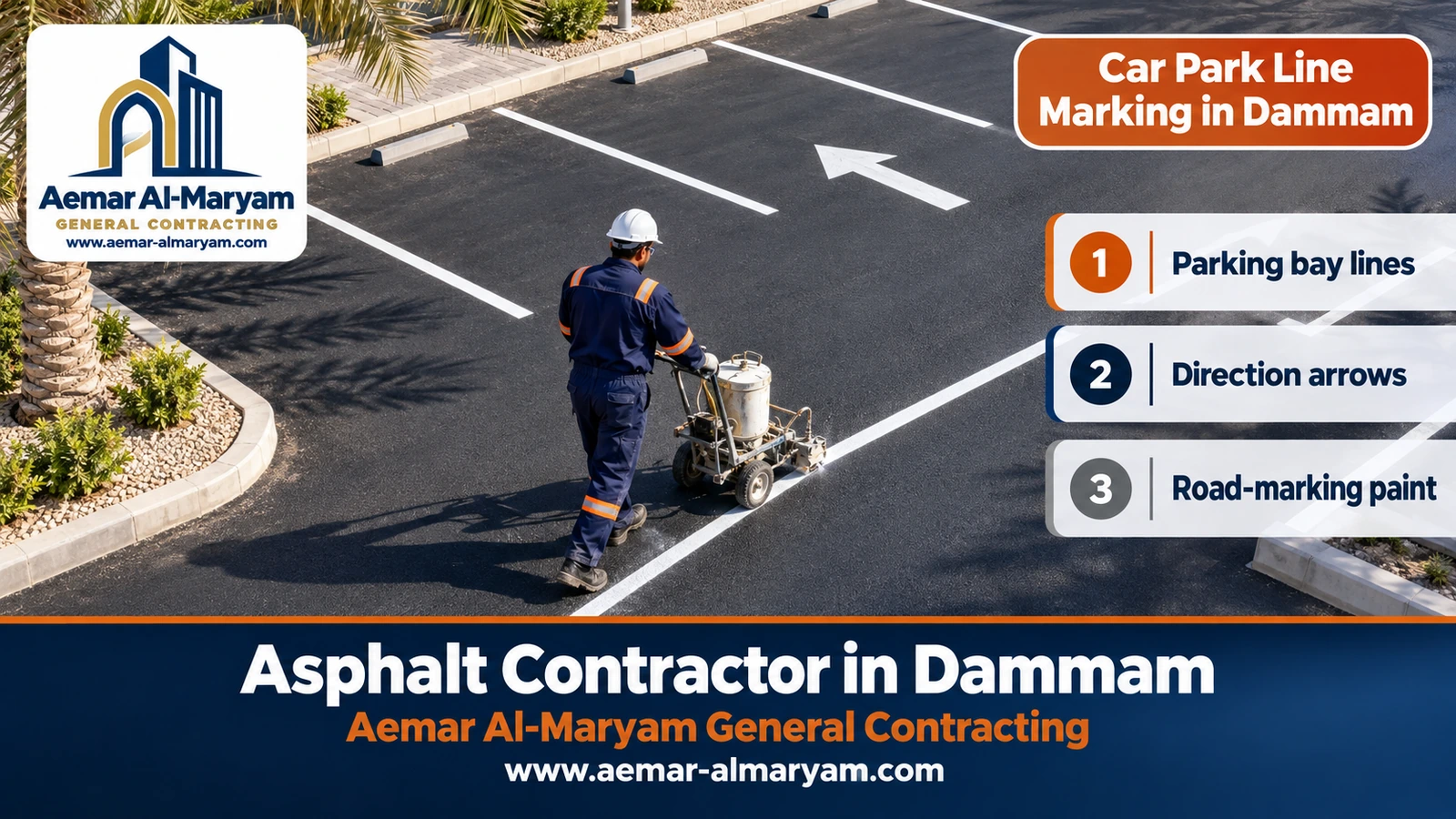
The paint follows the use. Hot-applied thermoplastic lasts longer on busy car parks, while cold road paint is quicker and cheaper but needs renewing sooner. We do not print fixed bay dimensions here, because bay sizes come from the approved parking design guide and from your site plan, and we follow the plan. Line marking is quoted after we see the site, since the cost turns on line length, the number of arrows and symbols and the paint type; send us the plan or a photo of the car park on WhatsApp 0547879578.
Plan the layout before you pave
If you have a parking layout, send it before paving, because drain positions and falls are built around it. Turning the bays the other way after the asphalt is down can leave a gully in the middle of a parking space.
Asphalt for factories, warehouses and internal roads in Dammam
Asphalt for factories and warehouses in Dammam needs a heavier design than a yard: a base course of about 23 cm and a total asphalt thickness of about 12 to 14 cm laid in two layers, because a loaded truck or a container handler presses on the surface many times harder than a family car. Dammam has three industrial cities, the First, the Second and the Third, with many plants, warehouses and workshops that need yards and internal roads able to take that load.
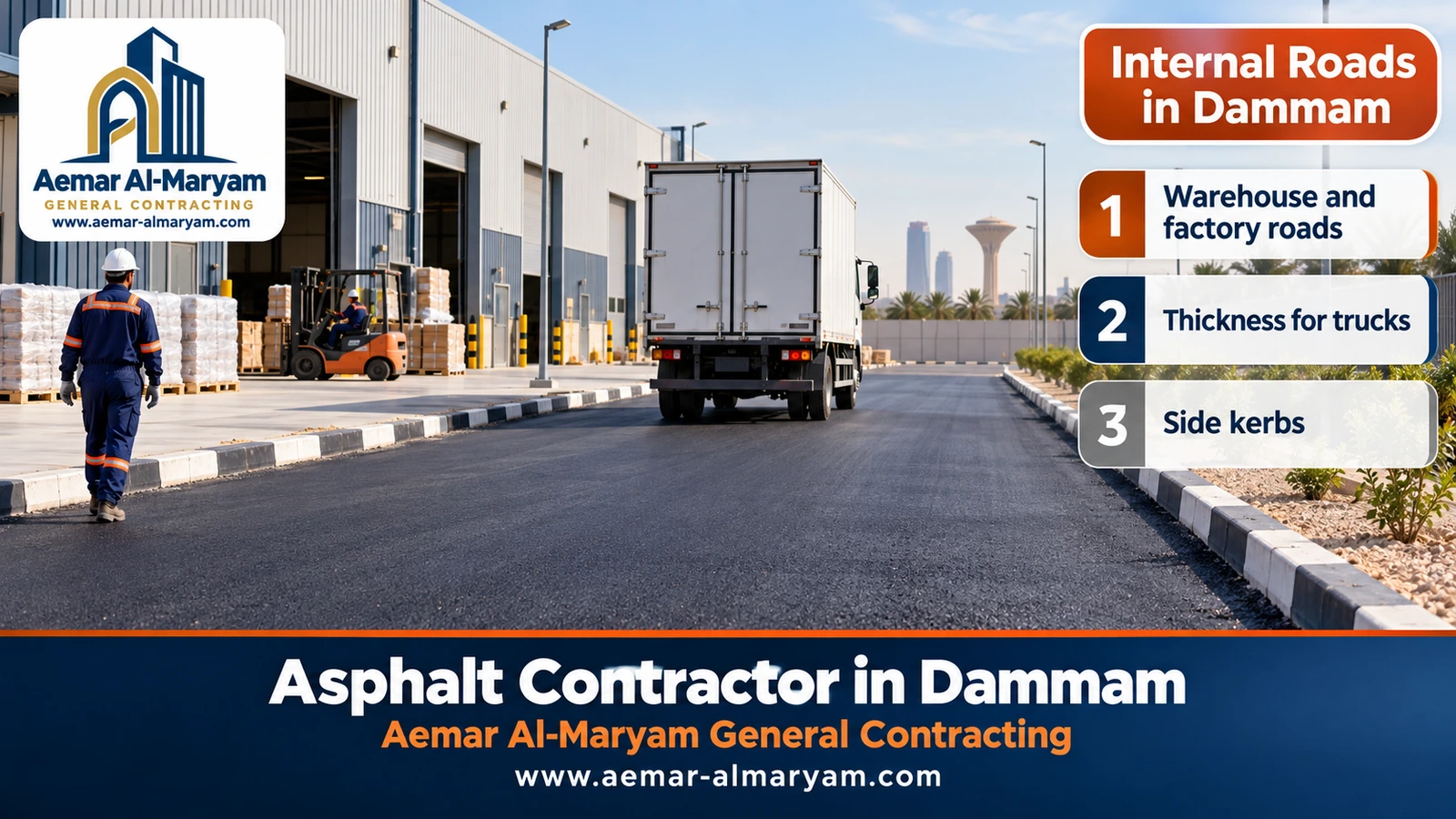
On these sites we do not start with the price; we start with questions. What is the heaviest vehicle that comes in? Do trucks stand in one place for long while loading? Where do they turn? Are there containers or crane outriggers that press on small points? Will the site keep working while we pave? The answers set the thickness and the mix, and may lead us to suggest polymer-modified asphalt in the standing and turning areas, or concrete at a specific point such as container feet.
- ✓Loading and unloading bays: the area most prone to rutting, so we raise the thickness there and suggest a modified mix.
- ✓Truck lanes: enough width to turn, and edges held by kerbs so they do not crumble under the wheels.
- ✓Compound roads: falls toward side drains, coordinated with speed humps.
- ✓Farm and rest-house tracks: millings or a thinner layer may be enough, depending on use.
- ✓Working sites: we phase the job so a gate or a lane stays open for traffic.
Two typical cases: a company moves its warehouse to the Second Industrial City and needs a yard in front of it, or an old plant has a gate area where the asphalt has broken up because trucks have stood there for years. In the second case we mill out the failed area and rebuild it thicker, rather than patching it every few months. If the site also needs a concrete floor cut or a trench opened for a cable before paving, our concrete cutting team in Dammam handles it.
Asphalt layers in Dammam: from subgrade to surface
The asphalt you see is only the top of a full system, and most failures start in the layers below it. If the surface dips under the wheels or shows cracks that look like crocodile skin, the cause is usually soil that was never compacted, a base that is too thin, or water that got under the asphalt. This is the order we build in, from the bottom up:
- 1Subgrade (natural ground)
Soft, clayey and organic material is removed and replaced, then the ground is compacted at its optimum moisture to about 95% of maximum dry density and shaped to the required falls. - 2Base course
Graded crushed stone laid in layers no thicker than 15 cm after compaction, each rolled to 100% of maximum dry density. - 3Prime coat (MC)
Liquid bitumen sprayed on the dry, compacted base so it soaks in, seals the surface and bonds it to the asphalt; it is left at least 24 hours. - 4Binder course (for heavy loads)
A first, coarser asphalt layer on heavy sites, with a light tack coat on top before the second layer. - 5Wearing course
A finer hot mix laid and rolled while hot; this is what the tyres run on.
In an ordinary yard the wearing course alone may be enough over the base. On heavy yards the full thickness is never laid in one go: the maximum compacted thickness of a single layer is about 8 cm, and anything more is laid in two layers so each can be compacted properly from top to bottom.
Base course in Dammam: the layer you never see
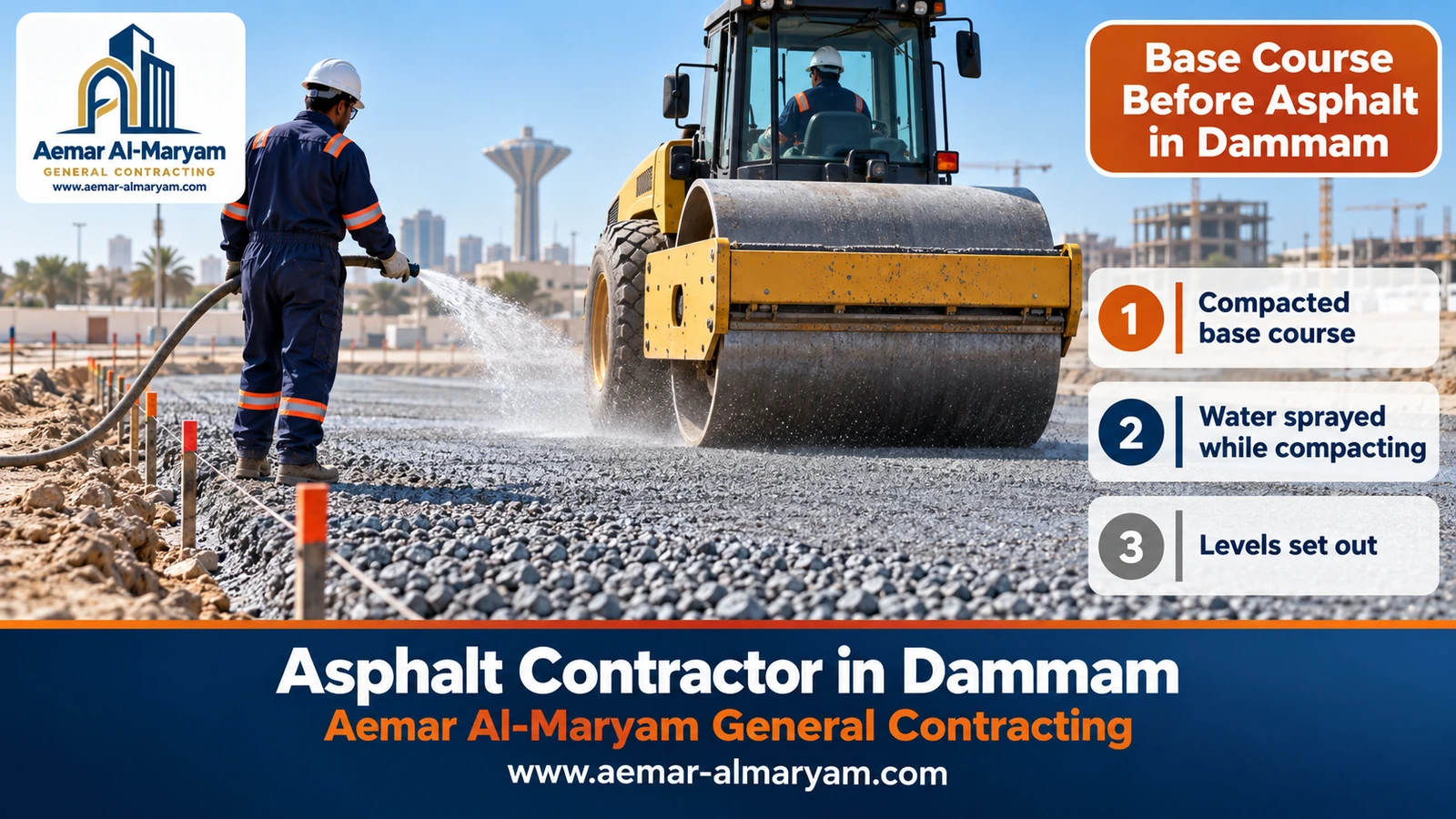
The base course, which crews in Dammam also call “base” or «سبيس», is crushed stone in graded sizes, spread, watered and compacted with a vibratory roller until it locks together into one mass. It carries the weight of the vehicle and spreads it onto the soil; the asphalt above it is a wearing skin that resists friction and water.
| Use | Approximate base course thickness | Note |
|---|---|---|
| House yard and garage entrance | About 15 cm | On sound, compacted ground |
| Car parks for cars and access roads | About 15 cm | Compacted in one or two layers |
| Truck parking and industrial yards | About 23 cm | Laid in at least two layers |
| Wet or saline ground near the coast | Set at inspection | May need removal and replacement or geotextile |
We water the base while compacting it because dry stone will not pack and over-wet stone softens. When it is finished we run a long straightedge across it, because any dip in the base reappears in the asphalt as a hollow where water stands.
⚠ Do not accept asphalt on bare soil
Asphalt laid straight on uncompacted soil looks fine for a few days, then sinks under the wheels and cracks in the first summer or the first rain. Always ask: how thick is the base, and how will it be compacted?
Prime coat (MC) and tack coat (RC): the difference many people mix up
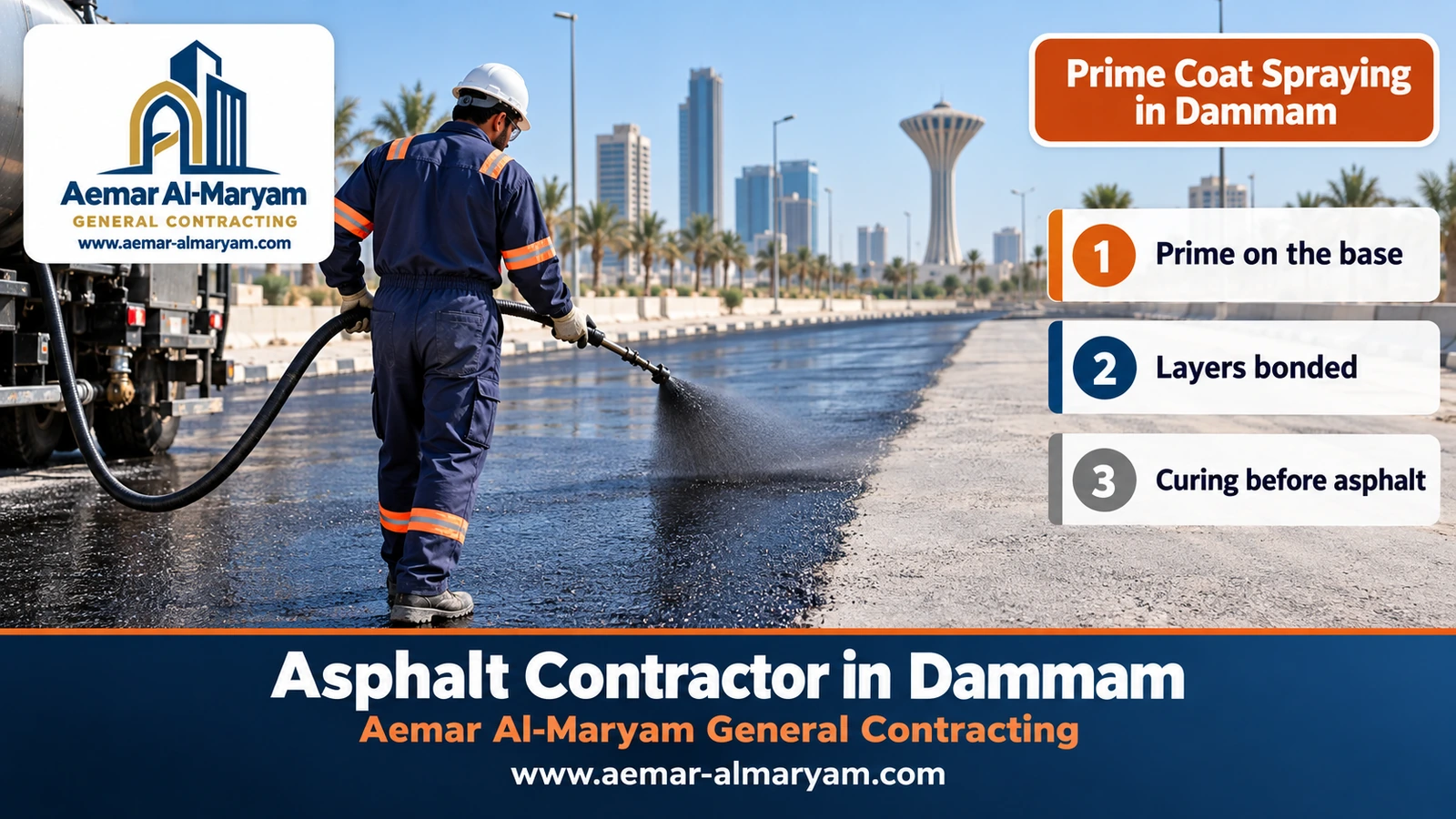
These are two different sprays, and many crews and even some published pages confuse them. The prime coat, written MC and sold in the local market as “MC1”, is a medium-curing cut-back bitumen sprayed on a new aggregate base course. It soaks in, seals the surface, binds the loose top particles and prepares the base to bond with the asphalt. The tack coat, written RC and sold as “RC2”, is a rapid-curing cut-back sprayed very lightly on old asphalt, between two asphalt layers, or on concrete edges that the new asphalt will butt against.
| Item | Prime coat (MC) | Tack coat (RC) |
|---|---|---|
| Where it goes | On a new aggregate base course | On old asphalt, between asphalt layers, on concrete edges |
| What it does | Soaks into the base, seals it and bonds it to the asphalt | Glues the new layer to what is underneath |
| Typical rate | 0.65 to 1.75 litres/m² depending on base porosity | Light spray, no more than about 0.25 litres/m² |
| Wait before paving | At least 24 hours, until it has soaked in | Paved after it breaks; re-sprayed if paving is delayed beyond 3 days |
| Common mistake | A light tack spray used instead on a new base | Too much, so the new layer slides on it |
Before priming, the base must be nearly dry and free of dust; if it is very dry we dampen it lightly so the prime does not sit in beads on the surface without soaking in. We take the spray slightly beyond the edges of the future asphalt and keep traffic off it until it cures, so wheels do not pick it up. Those twenty-four hours are the correct place for waiting in asphalt work, not after the mat is laid.
How thick should asphalt be in Dammam?
For family cars and light car parks on a good base, about 5 to 6 cm of asphalt after rolling is enough; for trucks and industrial yards the total rises to about 12 to 14 cm in two layers, and the final thickness is set after inspection according to the load. The key words are “after rolling”. Loose mix compresses by roughly 20 to 25 percent under the roller, so 6 cm of loose mix may end up at about 5 cm compacted.
| Use | Asphalt thickness after rolling (approx.) | Base course (approx.) | Asphalt layers |
|---|---|---|---|
| House yard and garage entrance | 5–6 cm | 15 cm | One |
| Car parks for shops and buildings | 5–6 cm | 15 cm | One |
| Internal roads with moderate traffic | 6–7 cm | 15 cm or more | One or two |
| Truck yards, warehouses and factories | 12–14 cm | 23 cm | Two |
| Footpaths only | Less, set at inspection | Depends on the soil | One |
You may be offered a low price for 3 cm of asphalt in front of the house. That thickness suits people on foot; a car that drives in, out and turns every day needs more. This is why we write the compacted thickness into the agreement, measure it at the edges after paving, and on large commercial jobs can take cores on request.
How to compare two quotes
SAR 37 for 5 cm is not dearer than SAR 30 for 3 cm; the first contains about two thirds more mix. Compare thickness after rolling, whether the base is included, and whether a prime coat is listed.
Hot, cold and polymer-modified asphalt in Dammam
Hot mix asphalt is produced at an asphalt plant, reaches the site hot and is laid and rolled before it cools; it is the choice for all permanent paving. Cold mix is a ready-made material for temporary and emergency patching. Polymer-modified asphalt is a hot mix whose bitumen contains a polymer that raises its resistance to heat and to rutting under heavy loads.
| Type | When we use it | Life and performance | Starts from |
|---|---|---|---|
| Standard hot mix | Yards, car parks, internal roads | Longest life when the base is sound and drainage works | SAR 37/m² (5 cm on a ready base) |
| Hot mix 7 cm | Truck yards on a ready base | Takes higher loads | SAR 41/m² |
| Polymer-modified | Heavy loads and long standing in heat | Higher rutting resistance | SAR 55/m² |
| Cold mix | Temporary and emergency patching | Short-lived repair | SAR 46/m² |
In the Eastern Province heat carries real weight. Studies at KFUPM (King Fahd University of Petroleum and Minerals) concluded that polymer modification of the bitumen is necessary to meet performance requirements in the east of the Kingdom, and that ordinary local bitumen is adequate for only a limited part of the Gulf area. That does not mean every yard needs a modified mix; a family car does not stand on the asphalt with the weight of a truck, and a standard mix usually serves it well. We use the modified mix where it earns its cost: loading bays, warehouse entrances and turning areas.
Mix from asphalt plants: what “asphalt plant Dammam” and “asphalt supply” mean for you
Many people search for an asphalt plant in Dammam or for asphalt supply, and some want to buy the mix on its own. We do not sell mix separately. For each project we order hot mix from asphalt plants in the region in the calculated quantity, then haul, lay and roll it as part of the job. The advantage to you is that the right type of mix is ordered and arrives when the ground is ready and the equipment is on site, so it does not cool in the truck while it waits.
Mix temperature: why we check it on arrival
Hot asphalt binds by being rolled while hot, not by drying. If the mix arrives cold or waits too long, it will not compact however many passes the roller makes; it stays porous, lets water in and loses stones. So we check the temperature of each load on arrival. Reference specifications require at least about 139 °C at spreading and require rolling to finish before the mat drops below about 90 °C. A truck that arrives with cold mix is sent back.
Compaction, falls and drainage for asphalt in Dammam
Compaction turns loose mix into a dense layer, and the falls protect that layer from water. After the paver lays the mix, a steel-drum roller goes over it first to set it, then a pneumatic or vibratory roller to densify it, then a finishing roller to remove marks; reference specifications call for density of at least 96% of the Marshall density of the mix. In corners and tight spots we use a plate compactor, because a roller cannot reach them.
Falls are built into the subgrade and the base course before the asphalt, not by piling extra mix into low spots. A paved surface needs a cross-fall of roughly 1.5 to 3 percent, and car parks at least 1.5 percent, which is about 1.5 cm of drop for every metre. Rain in Dammam may be rare, but a single storm can dump a lot of water at once, and water left on the asphalt seeps through any crack into the base, softens it, and the potholes begin.
- ✓Direction of fall: toward the street, a gully or a side channel, as far as possible from the building walls and doors.
- ✓Drains: placed at the lowest point and set flush with the asphalt, so they are not higher than it and do not trap water around them.
- ✓Evenness: after rolling we run a long straightedge; reference specifications allow only a few millimetres of gap beneath it.
- ✓Water test: before handover we spray water and watch where it goes; any spot where it stands is corrected before acceptance.
Asphalt contractor equipment in Dammam
Equipment varies with the size of the site, but a complete project usually calls for this list. On small yards we replace the paver with hand laying and the large roller with a small roller or a plate compactor:
■ Preparation
A grader or loader for levelling and shaping, and a water tanker to bring the soil and base to the right moisture.
■ Compaction
A vibratory roller for the base, steel-drum and pneumatic rollers for the asphalt, and a plate compactor for corners.
■ Spraying
A bitumen sprayer to spread prime coat and tack coat evenly at the right rate.
■ Laying
An asphalt paver for large areas and hand-laying tools for small ones.
■ Repairs
A milling machine, and a floor saw for straight cuts at edges and patches.
■ Checks
A thermometer for the mix, a long straightedge for evenness, and tools for measuring thickness.
Asphalt patching, pothole and crack repair in Dammam
Asphalt patching in Dammam comes in two kinds: a permanent patch in hot mix after the edges of the pothole are cut straight and tack is sprayed, and a temporary patch in cold mix for emergencies until the permanent repair can be done. More important than the patch itself is knowing why the pothole appeared. If water reached the base or the soil settled, the hole will come back in the same place unless the cause is dealt with.
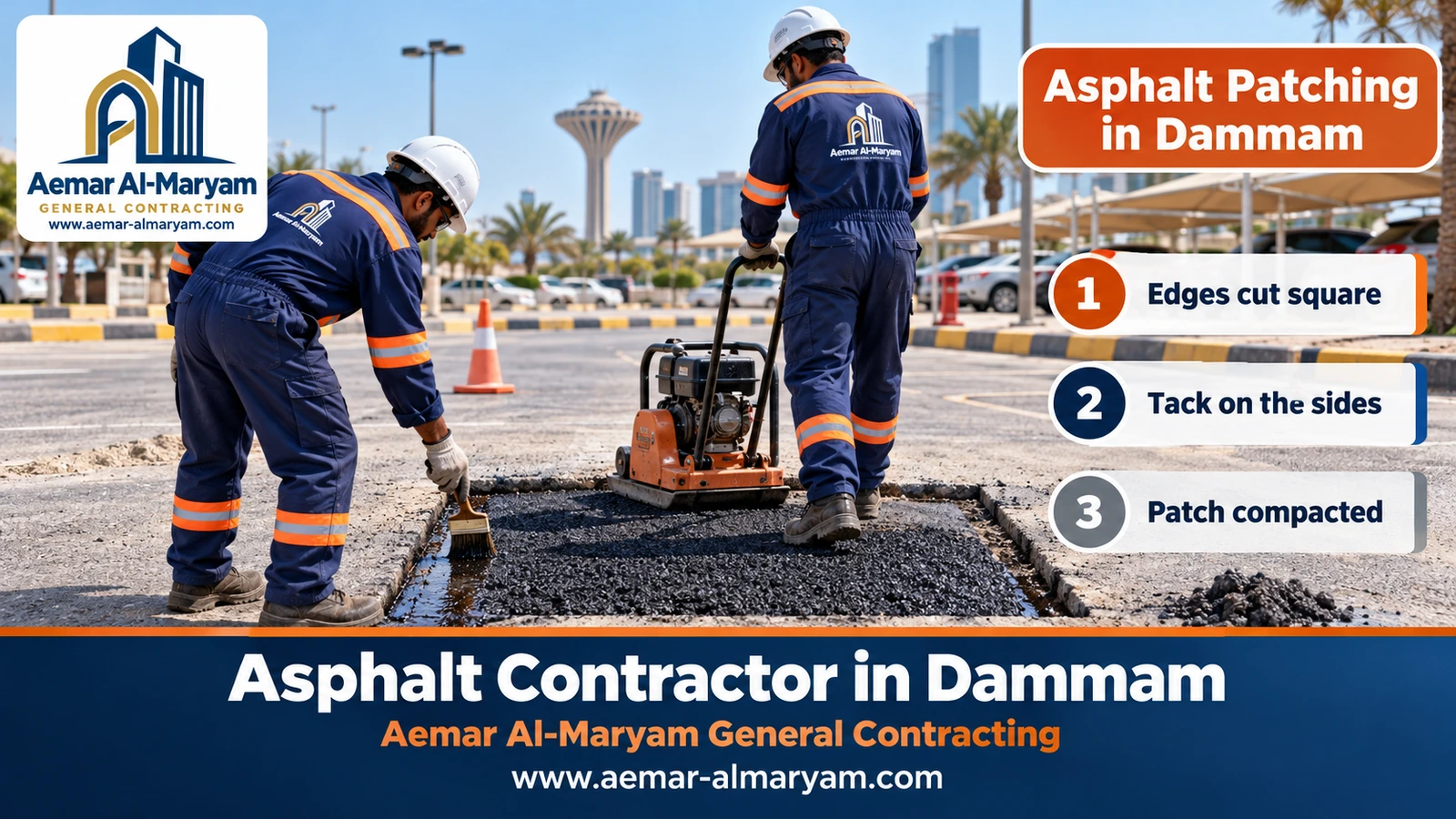
Steps for a permanent patch
- 1Clean out
We remove water, dust and loose pieces from the hole. - 2Cut the edges
We cut a rectangle around the hole with vertical sides back to sound asphalt, using a floor saw or a milling machine. - 3Check the bottom
If the base under the hole is soft or wet, we dig it out, rebuild and compact it before any asphalt goes in. - 4Tack
We spray tack coat on the sides and bottom so the new mix bonds to the old. - 5Fill and compact
We fill with hot mix, in layers if the hole is deep, and compact from the centre outwards, leaving a slight crown that settles to level under traffic. - 6Seal the joints
We make sure the edges of the patch sit flush with the surrounding asphalt with no gap for water to enter.
Potholes caused by failure of the full pavement depth need a full-depth repair, not a surface patch. We see this often at warehouse gates where trucks stand, and around manholes where the backfill has settled. Where asphalt or concrete edges need a precise cut near a structure or at a joint between old and new, our concrete cutting crew in Dammam can take it on.
Asphalt crack sealing
A thin longitudinal or transverse crack should be dealt with early, before it becomes a pothole. We blow it clean with compressed air, sometimes widen it slightly, and fill it with a hot rubberised sealant that stays flexible as the asphalt expands and contracts. Interconnected cracks that look like crocodile skin are a sign of a weak base or overloading, and sealing them is not enough; the area has to be cut out and rebuilt. Crack sealing is priced after inspection because it is measured by crack length, not by area.
Asphalt milling and resurfacing in Dammam
Milling, also called cold planing, removes the worn top layer of asphalt with a milling machine, usually to a depth of about 3 to 5 cm, before tack coat is sprayed and a new layer is laid. We use it when the base is sound but the surface is tired: rutting, widespread surface cracking, or a level that has crept up until it sits above door sills and drains. Its advantage over overlaying is that it keeps the level where it is instead of raising the surface each time. Milling and re-laying starts from SAR 38 per square metre as an estimate.
If the job is to remove the entire pavement or break up old concrete slabs in the yard before paving, that is demolition and debris removal, which we arrange with our demolition contractor team, then rebuild the layers.
Asphalt millings or new asphalt in Dammam?
Millings, known locally as «زفلت مبشور» or «مقشور», are old asphalt ground up by milling machines and then spread and compacted in place of new mix. They are much cheaper and keep part of their bitumen, which helps them bind after rolling, so they suit farm tracks, rest-house access, spare yards and overflow parking. But they look rough, can soften in extreme heat, and their success depends entirely on good compaction.
| Item | Millings | New hot mix |
|---|---|---|
| Look | Rough and uneven | Smooth, uniform black |
| Loads | Light to medium | Light to heavy, depending on thickness |
| In heat | Can soften and move | More stable, especially modified mix |
| Suits | Farms, rest houses, spare yards | Yards, car parks, warehouses, internal roads |
| Price | After inspection | From SAR 37/m² |
We know many people search for millings for sale. We do not sell millings as a product, but if you want them spread and compacted on a farm track or a side yard we will do it and price it after inspection, and we will tell you plainly if your site really needs new mix.
Kerbs around the asphalt
A free asphalt edge crumbles under wheels over time; a kerb supports it, defines where vehicles go and separates the asphalt from the garden or the footpath. So kerbs go in before paving, tack is sprayed on the face that will meet the asphalt, and the mix is then laid and rolled against them. Kerb and interlock installation is handled by our interlock crew (see the interlock and kerbs service), and on a shared project we coordinate so kerb, asphalt and drain levels all match. Kerbs are priced after inspection.
Sabkha and heat: what makes paving in Dammam and the Eastern Province different
Paving in Dammam and the Eastern Province has two local conditions a contractor must plan for: saline or wet ground near the coast, and summer heat. Coastal sabkha flats stretch along the Gulf shore; their salts hold the surface firm while it is dry, but once wetted and the salts dissolve they lose much of their bearing strength. A King Fahd University study recorded a drop of about 30% in bearing capacity at a coastal site after the salts were leached out. Groundwater in many parts of the province is also shallow and saline.
So we do not give a final price for ground near the shore, or ground where we see damp and salt, before inspecting it. An improved base may be enough; or we may need to remove a layer of soil and replace it, or lay a geotextile between the soil and the base. All of this is decided on site and priced after inspection. As for heat, we covered it under modified mix: for truck yards and long standing loads we suggest the stronger mix, and for house yards a standard mix usually does the job.
What we look at during the site visit
The colour and feel of the soil, white salt patches, moisture when we dig a little, the site level compared with the street, where water collected after the last rain, and cracks in any existing asphalt or concrete.
Asphalt price per square metre in Dammam
The asphalt price per square metre in Dammam starts from SAR 37 for 5 cm of hot mix on ground or a base course that is already sound, and from SAR 74 for the full system of levelling, compaction, base course, prime coat and asphalt. The figure moves up or down with the area, the thickness, the ground condition, the base course and how easily equipment can get in. Prices are estimates until inspection and agreement.
| Service | Unit | Starts from |
|---|---|---|
| 5 cm hot mix on ground or a ready base (yards, house fronts, light car parks) | m² | SAR 37 |
| 7 cm for trucks, warehouses and industrial yards (on a ready base) | m² | SAR 41 |
| Full system: levelling and compaction + base course + prime coat + 5 cm asphalt | m² | SAR 74 |
| Polymer-modified asphalt (heavy loads and heat) | m² | SAR 55 |
| Pothole patching in cold mix (temporary repair) | m² | SAR 46 |
| Milling old asphalt (3–5 cm) and re-laying | m² | SAR 38 |
| Permanent hot-mix patch with cut edges and tack coat | — | After inspection |
| Sabkha or wet ground treatment (removal and replacement, geotextile) | — | After inspection |
| Base course only (supply and compaction) | — | After inspection |
| Car park line marking, arrows and accessible bays | — | After inspection |
| Kerbs around the asphalt | — | After inspection |
| Crack sealing with hot rubberised sealant | — | After inspection |
| Spreading and compacting millings (farm tracks and yards) | — | After inspection |
| Saw-cutting asphalt edges at tie-ins | — | After inspection |
Lines marked “after inspection” get a figure only after our visit, but photos, rough sizes and the vehicle type sent to 0547879578 on WhatsApp are usually enough for a first estimate. Starting prices for the rest of our work sit in the estimated price guide.
What sits inside the starting price, and what sits outside it
The SAR 37 rate covers hot mix at 5 cm after rolling, delivered, laid and compacted, with the tack or prime that a ready surface needs. It does not cover building a base course where the ground is bare soil, breaking out old concrete or asphalt and removing the debris, or kerbs, drains and line marking. The SAR 74 rate adds levelling, compaction of the subgrade, a base course of about 15 cm and the prime coat. We list every item in the agreement, line by line, so nothing turns up that you had not budgeted for.
Why small areas cost more per square metre
Much of the cost stays the same regardless of the area: moving the paver and the roller, a truckload of mix that cannot be ordered in tiny quantities, and a crew that spends its day on your site. On 600 square metres those costs spread over a large area; on 40 square metres they spread over very little, so the share per metre goes up. That is why small areas, below roughly 100 m², carry a higher rate that is set after inspection. If your neighbour also wants a yard paved, paving both sites in one visit cuts the bill for each of you.
Worked example: a 120 m² yard and a 600 m² warehouse yard
Example one (yard or house front): an area of 10 × 12 m = 120 square metres. If the ground already has a sound, compacted base: 120 × 37 = SAR 4,440 as a starting estimate. If it is bare soil that needs levelling, a 15 cm base, prime coat and 5 cm of asphalt: 120 × 74 = SAR 8,880 as a starting estimate.
| Quantity in the yard example | Calculation | Approximate result |
|---|---|---|
| Asphalt mix (density about 2.3 t/m³) | 120 × 0.05 × 2.3 | About 14 tonnes |
| Base course after compaction | 120 × 0.15 | 18 m³ |
| Prime coat (about 1 litre per m²) | 120 × 1 | About 120 litres |
| Cost on a ready base | 120 × 37 | SAR 4,440 |
| Cost with the full system | 120 × 74 | SAR 8,880 |
Example two (warehouse yard): 600 square metres for trucks at 7 cm on an existing base: 600 × 41 = SAR 24,600 as a starting estimate. If the yard needs the full heavy section, with a 23 cm base and asphalt in two layers, it is priced after inspection.
The same arithmetic shows why very low prices deserve caution. One tonne of mix covers only about 8 to 9 square metres at 5 cm, so the mix alone takes a large share of the price per metre before haulage, equipment and labour. A price far below that usually means less thickness, or no base at all.
These examples are for illustration only. The actual price changes with the ground condition, the required thickness, removal of old paving, kerbs and drains, and access for equipment.
Questions to ask any contractor before you sign
| Your question | The answer you want to hear |
|---|---|
| How thick is the asphalt? | A figure after rolling, not before, written into the agreement. |
| Does the price include the base course? | A clear yes or no, with the base thickness if it is included. |
| What will you spray on the base? | Prime coat (MC) and at least 24 hours before paving, not just a light tack spray. |
| Where does the mix come from? | From an asphalt plant, with its temperature checked on arrival. |
| Where will the water go? | A stated fall toward the street or a drain, not “it will find its way”. |
| What is not included? | A list: breaking out old paving, debris, kerbs, drains, line marking. |
Asphalt paving steps in Dammam
Asphalt paving in Dammam runs through eight linked stages, and none starts before the previous one is finished, because any error in level or compaction gets buried under the asphalt and only shows months later:
- 1Site visit and measuring
We measure the area and the levels, check the soil and any old asphalt, and agree the thickness and the direction of water. - 2Removal and preparation
We remove failed asphalt or concrete and debris, and wait for water and power lines under the site to be finished. - 3Subgrade levelling and compaction
We shape the falls, bring the soil to the right moisture and compact it, replacing any soft material. - 4Base course
We lay the base course in layers, water and compact it, and check it with a straightedge. - 5Prime coat
We spray prime coat (MC) on the dry base, leave it at least 24 hours, and keep traffic off it. - 6Laying
We receive the mix, check its temperature, and lay it with the paver or by hand to the agreed thickness. - 7Rolling
We roll with the steel-drum roller, then the pneumatic roller, then the finishing roller before it cools, with a plate compactor in corners. - 8Checks and handover
We check evenness, the water path and the edges, clean the site, and tell you when it can be used.
Accepting the asphalt: a checklist before the final payment
- ✓Thickness: measure at the edges, or ask for a core on large jobs, and compare it with the agreed compacted thickness.
- ✓Water: hose the surface and watch; water should run to the drain or the street without standing anywhere.
- ✓Evenness: lay a long straight board or straightedge across it; the gap underneath should be only a few millimetres.
- ✓Surface: no obvious roller marks, no loose stones, no shiny patches of excess bitumen.
- ✓Edges and joints: straight, clean edges, and joints between working days that are tight.
- ✓Levels: kerbs, drains and manholes sit level with the asphalt, and gates open without scraping.
- ✓Site: debris removed, and nearby walls and tiles clean of bitumen spray.
When can you walk and park on new asphalt?
Hot asphalt opens to use once it has cooled completely, and we tell you the time based on the weather and the thickness of the layer. Hot asphalt does not “set” like concrete and needs no water curing; it binds by being compacted while hot and is ready once the mat has cooled. That is why we do not print one fixed number of hours for every case: a 5 cm layer on a winter morning cools far faster than two thick layers at midday in August.
In the first days, especially in summer, the asphalt stays a little softer than it will be a few months later. So we advise avoiding long truck stops in the same spot, turning the steering while the car is standing still, and putting stands or sharp feet, such as motorbike stands or scaffold legs, directly on the surface. The waiting time that must never be shortened comes before paving: at least 24 hours for the prime coat to cure on the base course.
⚠ Never wash asphalt with solvents
Diesel, oil or solvent spills dissolve the bitumen and loosen the stones. Clean any spill quickly with an absorbent material, and never use solvents to wash the yard.
Common asphalt mistakes in Dammam
Most asphalt that has to be redone after a year or two did not fail because of the mix; it failed because of errors in preparation or laying. These are the ones we see most when we inspect sites that were paved before:
- ✓Paving on soil: no compaction and no base course, so the asphalt sinks under the wheels.
- ✓Mixing up prime and tack: a light tack spray on a new base instead of a prime coat, or no wait for it to soak in.
- ✓Fall toward the house: water collects at the wall or the door and reaches the foundations or the inside.
- ✓Cold mix: a truck that waited too long or came from too far, so the mix will not compact.
- ✓Late or incomplete rolling: the roller starts after the mat has cooled, or never reaches the edges and corners.
- ✓Too thick in one go: 10 cm in one layer cannot be compacted properly at the bottom.
- ✓Services after paving: cutting new asphalt to lay a forgotten pipe or cable.
- ✓Unsupported edges: asphalt that ends on soil without a kerb, so the edge crumbles.
- ✓Cold mix as a permanent fix: a short-lived repair in a place that needs a real one.
Paving in a public street in Dammam: the municipality and permits
Inside your property boundary, such as the yard, the internal parking or the roads within a plant, you do not need an excavation permit. Any work that cuts into or extends onto a public street goes through the municipality and its project coordination office; digging in the street to connect a service is applied for by the service provider through the Balady platform; and a pothole in a public street is reported to the municipality on 940 or the Balady app. The municipalities under the Eastern Province Amana pave and maintain the streets, and recently carried out large asphalt maintenance works in Al-Manar district, for example.
The excavation permits regulation sets out how this works: coordination goes through the «Nassiq» service on the Balady platform, the permit is issued by the project coordination office of the Amana or the municipality, and a street damaged by digging is milled and resurfaced across its full width according to its class. So do not extend your yard paving onto the public street or footpath on your own decision, and do not accept any contractor doing so without coordination. In Jubail Industrial City, works fall under the Royal Commission rather than the Balady platform.
What we do at the street boundary
We stop your paving at your boundary, match the level to the street edge so water does not run back inside, and tell you if anything needs coordination with the municipality.
Asphalt maintenance and warning signs in Dammam
Asphalt laid on a sound base with good drainage can last from about ten to fifteen years, but the figure varies widely with the base, the drainage and the loads, so we do not promise a fixed number. What extends its life is early maintenance: a crack sealed today at little cost can become a pothole after two rainstorms.
■ Thin cracks
Seal them early with rubberised sealant before water gets in.
■ Crocodile cracking
A sign of a weak base or overloading; needs cutting out and rebuilding.
■ Potholes
Patch permanently after cutting the edges and finding the cause.
■ Standing water
A fall problem; fixed by milling and regrading or by an extra drain.
■ Ruts in the wheel paths
Thickness or mix not suited to the load; mill and relay with a stronger mix.
■ Ravelling (loose stones)
Poorly compacted mix or an aged surface; a new wearing course.
For car park and warehouse owners we suggest a simple walk-round once a year, ideally before the rainy season: look at cracks, potholes and the water path around the drains, photograph them and send them to us. Keeping drains clear of sand and leaves protects the asphalt more than most people expect.
Asphalt contractor beyond Dammam: Al Khobar, Dhahran, Qatif, Jubail and Al-Ahsa
We pave in Dammam and in the other cities of the Eastern Province, and we plan visits to distant cities so the inspection and the work are grouped. Travel and mobilisation for distant cities are priced at inspection, and grouping several sites in one visit lowers each site’s share.
| City | Typical requests | Area page |
|---|---|---|
| Al Khobar | Villa yards and car parks for shops and buildings | Our services in Al Khobar |
| Dhahran | Yards and warehouses near the industrial cities | Our services in Dhahran |
| Qatif and Saihat | House yards and commercial parking | Qatif · Saihat |
| Jubail | Industrial yards, warehouses and house yards | Our services in Jubail |
| Al-Ahsa | Farms, rest houses and house yards | Our services in Al-Ahsa |
| Abqaiq and Ras Tanura | Yards, entrances and parking | Abqaiq · Ras Tanura |
| Hafr Al-Batin and Khafji | Scheduled in advance | Hafr Al-Batin · Khafji |
Dammam districts and industrial cities we serve
We set out from our base in Al-Rawdah district to the older districts of Dammam, the newer plans, and the First, Second and Third Industrial Cities. Districts we work in include:
For our other services in the city, visit our services in Dammam, and see completed work on our projects page.
Why choose Aemar Al-Maryam as your asphalt contractor in Dammam?
Because we start from the ground, not from the mix, and we write down what we will build in numbers you can check. And because we are a general contractor, if your site also needs old paving broken out, concrete cut, kerbs set or the boundary wall repaired, we arrange it as one project instead of leaving you to deal with several parties.
- ✓Layers in writing: base thickness, the type of spray and the asphalt thickness after rolling, all in the agreement.
- ✓The right spray in the right place: prime coat on a new base, tack on old asphalt and between layers.
- ✓Hot mix from the plant: temperature checked on arrival and rolled before it cools.
- ✓Planned falls: water goes where it should, and we test it before handover.
- ✓Published starting prices: SAR 37, 41, 74, 55, 46 and 38 per square metre, everything else after inspection.
- ✓Straight talk: if your site is better served by interlock, concrete or millings instead of new asphalt, we tell you.
How to order asphalt work in Dammam (photos and details for WhatsApp)
The fastest way to an estimate is to send us enough on WhatsApp 0547879578 for us to understand the site before the visit. A clear photo of the entrance and the corners saves both of us an extra trip:
- ✓Site photos: from several angles, including the entrance, the gate and the street boundary.
- ✓Approximate dimensions: length and width in metres, or the site plan if you have one.
- ✓Vehicle type: family cars, customer cars, or trucks and forklifts.
- ✓Current surface: soil, old asphalt, concrete, tiles or millings.
- ✓Water: where it collects after rain, and whether there are drains.
- ✓Access: whether a truck can get in, and whether the site works during paving.
- ✓Location pin: so we know the district and the distance.
- 1Send photos and details
On WhatsApp or by calling 0547879578. - 2First estimate
We reply with the suggested thickness and an estimated cost based on the starting prices. - 3Site visit
We measure, check the soil and levels, and set out the items. - 4Agreement
Written items with thicknesses, layers, and what the price does and does not include. - 5Work and handover
We prepare, lay, roll, test the water path and evenness, and hand over a clean site.
Pave your yard or car park on the right layers
Send photos, sizes and the type of vehicles, and we will suggest the thickness and layers with an estimated cost, then book the site visit.
Related pages on paving and connected work
Tags