Plumber in Dammam: Aemar Al-Maryam General Contracting sends a plumbing crew for rough-in for new buildings, villas and annexes, water supply and drainage lines, re-piping of older homes, bathroom and kitchen plumbing, and the installation of water heaters, pumps and tank connections, on an appointment set after an inspection or after we review the photos you send on WhatsApp. Bathroom rough-in starts from SAR 460, a kitchen from SAR 135, new-build rough-in from SAR 23 per square metre, a water heater from SAR 140 and a pump from SAR 275, all labour estimates until inspection and agreement. For a small fault, send a photo and we will tell you whether one visit will cover it. Phone and WhatsApp: 0547879578.
Water moves through a house in two networks that nobody sees once the tiles are down. One is a pressurised supply network that brings cold and hot water to every tap; the other is a gravity drainage network that carries used water to the inspection chambers and on to the city sewer. Almost every problem that shows up later, from a damp patch on the living-room ceiling to a smell in the bathroom or weak pressure upstairs, goes back to a decision made at rough-in: a pipe size, the fall of a drain, a joint that was never tested, a valve buried behind tiles. This guide explains how we build both networks in Dammam, the materials and figures we work to, what each item costs, and how to order the work and compare quotes.
At a glance: Aemar Al-Maryam plumbing crews in Dammam
- What we do: rough-in for villas, apartment buildings and annexes; supply and drainage lines; suspended drainage; bathroom and kitchen plumbing; re-piping; water heaters; pumps; tank connections; inspection chambers and AC condensate drains.
- How we work: scheduled jobs on an appointment after an inspection or photos, not an around-the-clock emergency service.
- Prices start from: bathroom SAR 460, kitchen 135, building rough-in SAR 23/m², damaged pipe section 165, electric heater 140, pump 275, mixer tap 75, inspection chamber 185, AC drain 90. Labour estimates until inspection and agreement; materials are your choice.
- Materials: PPR supply pipe heat-fused at about 260 °C, and uPVC drainage at 110 mm for WCs and 40 mm for smaller wastes.
- Testing: a pressure test on supply lines and a 3-metre water-column test held for 15 minutes on drainage, before plaster and tiles.
- Where: all of Dammam first, with Al Khobar and Dhahran close behind, and Saihat, Qatif, Jubail and Al-Ahsa by arrangement.
- To order: call or message 0547879578 with photos of the area, the number of bathrooms and kitchens, and the floor.
Plumber in Dammam: what we do and how to book
We carry out plumbing in Dammam on a fixed appointment. You send photos or we inspect the site; we define the work, the materials, the number of days and the estimated cost; then the plumbing crew arrives on the agreed day with fusion and testing tools. That suits planned work: a bathroom being redone, old pipes that keep leaking, a new heater, or an annex that needs a full network.
We say it plainly because many adverts say the opposite: we are not an emergency call-out that turns up within minutes at any hour of the night. We are a contracting establishment with plumbing crews that work on scheduled jobs, which is exactly why we can give you an itemised quote, follow the drawings and test the network before it is closed. If you have a small fault, such as a dripping mixer, a running cistern or a pipe under the basin, send a photo. We handle it during a scheduled visit or alongside other work in the house, and we tell you honestly if it is worth a visit of its own.
■ Plumbing rough-in
Complete supply and drainage networks for new buildings, villas, annexes and apartment blocks, before plaster and tiles.
■ Extensions and alterations
New runs, relocating bathroom and kitchen points, and converting drainage to a suspended system.
■ Re-piping
Replacing old galvanised steel with PPR and uPVC, in sections or for the whole house.
■ Bathrooms and kitchens
Concealed mixers, concealed cisterns and floor drains, then fixture installation after tiling.
■ Water heaters
Electric storage heaters and central heaters, with the safety valve and its discharge pipe.
■ Pumps and tanks
Transfer and booster pumps, and connecting underground and roof tanks to the network.
Plumbing technician or master plumber in Dammam: who comes to your house?
The person who comes is a plumbing technician or master plumber from our crew, depending on the size of the job. A master plumber leads rough-in and full re-piping work, reads the drawings and decides the routes; one or more technicians handle fusion, fixing, connections and testing. On larger jobs a supervisor coordinates with the other trades: chasing before us, electrics and AC alongside, waterproofing, plaster and tiles after.
Plumber phone number in Dammam: what happens after you call?
When you call or message 0547879578 we ask what kind of work it is, then ask for photos of the area, the number of bathrooms and kitchens, the floor and the age of the house. For work that is clear from photos we send an estimated cost; for work that needs measuring and seeing, we book an inspection. Then the items follow in writing on WhatsApp: scope, materials, who buys them, duration and exclusions.
Plumbing company or hourly plumber in Dammam? When you need a plumbing contractor
You need a plumbing company or contractor in Dammam when the work covers more than a single point, when walls or floors have to be opened, or when the work must be tested before it is covered. A single visible fault, such as changing a mixer tap or clearing a basin, is fine for one plumber. The difference is who answers for the result once the wall is closed.
| Situation | Hourly plumber | Plumbing contractor |
|---|---|---|
| Dripping tap or running cistern | Usually suitable | We handle it during a visit or with other work |
| Full bathroom refit | Does what he is asked, without a plan | Plans points, heights and falls and tests before tiling |
| New villa or annex | Not suitable | Complete network from the drawings, tested and with routes documented |
| Repeated leaks in different places | Fixes each leak separately | Diagnoses the network and proposes section or full replacement |
| Weak pressure across the house | May just swap the pump | Checks the tank, pump, pipe sizes and valves together |
What matters to you in practice is that a plumbing contractor writes clear items: the pipe type and its pressure class, the number of points, the test method and how long it is held, and who re-plasters the chases afterwards. Those items are what make a SAR 3,000 quote comparable with a SAR 5,000 one; a checklist of questions follows later in this guide.
Plumbing rough-in in Dammam for new buildings, villas and annexes
Plumbing rough-in in Dammam means running the supply and drainage networks inside walls, floors and ceilings before plaster and tiles, fixing the outlet for every sanitary fitting at its correct position and height, and then testing both networks before they are closed. It happens after the structure and blockwork and before finishing, and it follows the approved plumbing drawing where there is one, or a layout we prepare with you for small houses and annexes.
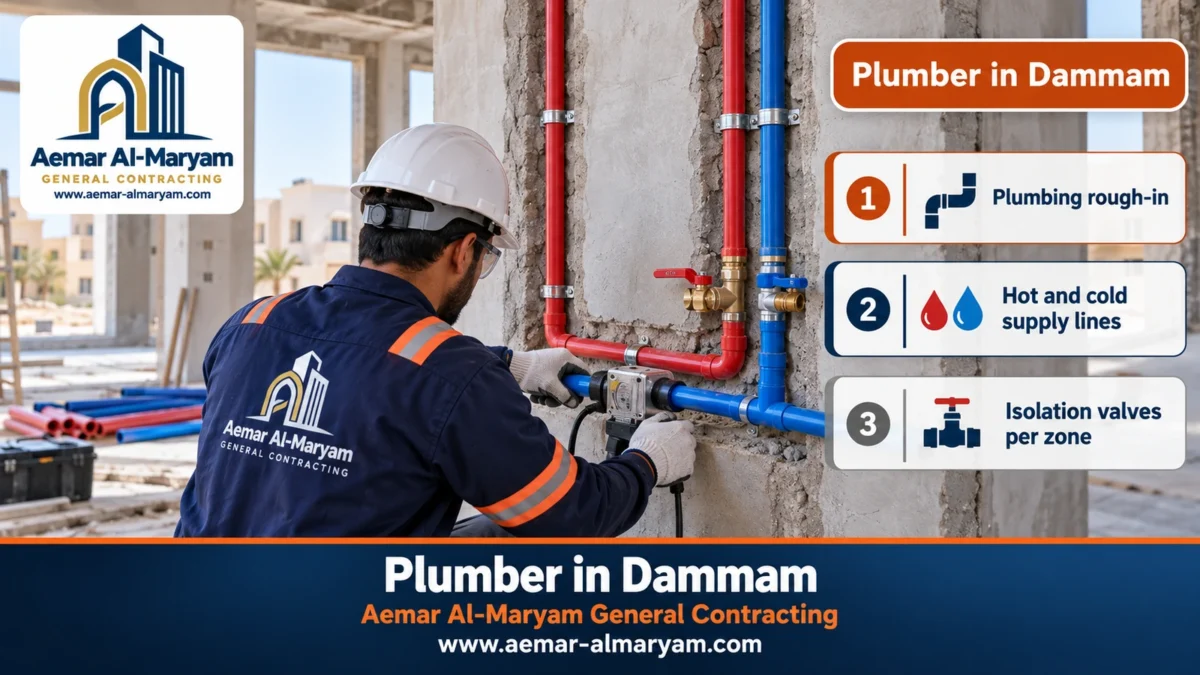
Our rough-in scope includes: routing the main line from the roof tank to each floor; an accessible main valve plus an isolation valve for every bathroom and kitchen; cold and hot lines sized to the number of fixtures; drainage from each fixture to the vertical stacks and on to the inspection chambers at correct falls; vent lines; AC condensate drains; and fixing concealed mixer bodies and concealed cistern frames before tiling. Then we test, photograph the routes and hand you the photos.
When does plumbing rough-in happen? Sequencing with electrics, plaster and tiles
Getting the order of trades right saves you from breaking the same wall twice. The common mistake is letting the plasterer start before plumbing and electrics are finished, so the walls get opened again. The sequence we work to:
- 1Structure and blockwork
Walls are complete, and fixture positions are marked on the floor and walls. - 2Slab penetrations
Holes for stacks and drains are formed before the pour, or cored afterwards; on a cast slab we arrange them through core drilling in Dammam. - 3Wall chases
Straight chases are cut in the blockwork, deep enough for plaster to cover the pipes. - 4Plumbing and electrics together
We run supply and drainage in coordination with the electrical crew so cables never share a route with hot-water pipes. Electrical rough-in is handled under our electrical works service. - 5Testing and photographs
Pressure test on supply, water test on drainage, then every wall is photographed before closing. - 6Closing chases and plastering
Chases are filled with mortar, with mesh where needed, and then plastering begins. - 7Waterproofing and tiles
Bathroom and kitchen floors are waterproofed with the membrane turned up the walls, then tiled, then fixtures are fitted.
Villa plumbing in Dammam
A villa differs from an apartment in three ways: the number of floors, the number of bathrooms, and the presence of an underground tank, a roof tank and a pump. So we start a villa by working out the demand: how many bathrooms on each floor, where the main and the preparation kitchens are, whether there is a basin in the majlis, and whether you want one central heater or a heater per bathroom. From that come the main pipe sizes and the stack positions, which we try to keep in a single wall where possible so that drainage runs are short and joints are few.
In villas we follow what MOMAH’s residential building requirements set out: water piping to the Saudi plumbing code, drainage to the separate sanitary drainage code, and the ground floor’s drainage connected to the main line separately from the upper-floor stacks. That last rule sounds like a detail, but it prevents waste from the floors above backing up into ground-floor fixtures when the external line is blocked.
Annex and majlis plumbing in Dammam
A new annex on the roof or in the courtyard needs a small but complete network: a bathroom and perhaps a preparation kitchen, a water source from the roof tank or a floor line, and a drain that reaches the nearest stack or inspection chamber at a proper fall. We plan that network from the start when we carry out annex and majlis construction in Dammam, and we price it per bathroom and kitchen or per square metre. If the annex is on the roof, we decide before starting where the drainage will pass through the slab, and whether a new hole has to be cored.
Water supply lines in Dammam: pipes, sizes and valves
Water supply lines in Dammam are the pressurised network that carries water from the roof tank or pump to every tap, with separate cold and hot lines. We mostly install them in PPR pipe joined by heat fusion, so that the fitting and the pipe become one piece that does not depend on rubber rings or solvent cement.
PPR fusion uses a welding tool that heats the pipe and the fitting together at about 260 °C (plus or minus 10 °C) for a few seconds that vary with diameter: roughly 5 seconds for 20 mm, 7 seconds for 25 mm and 8 seconds for 32 mm. The pipe is then pushed in straight, without twisting, and left to cool. Overheating chars the joint, and twisting during insertion tears the fused layer inside. Neither is visible to the eye, but both show up in the pressure test, or months later behind the tiles.
| Line | Common size | Notes |
|---|---|---|
| Main line from the tank | 32 mm or larger, depending on floors and fixtures | Branches to each floor, with a valve per floor |
| Bathroom supply | 25 mm incoming, 20 mm to the points | Separate, accessible valve for each bathroom |
| Kitchen supply | 20 to 25 mm | One point for the sink, one for the dishwasher, one for a filter if used |
| Hot line | Same sizes in a higher pressure class | Insulated, with room to expand on long runs |
The sizes in the table are common in homes, not a fixed rule; the right size is calculated from the number of fixtures on the line, its length and its height below the tank. One thing we always allow for is that PPR expands noticeably with heat: a 10-metre hot line can grow by six centimetres or more if its temperature rises by 40 degrees. So we fix it with clips that let it move and build in offsets that absorb the expansion, instead of letting the line bow or push against the joints.
Manifold or branch-and-tee distribution?
With branch-and-tee distribution, one line passes the fixtures in turn and each point is taken off with a tee. With a manifold, a single box sends a separate line to each fixture, so there are no joints inside the wall between the manifold and the fixture, and one fixture can be isolated without cutting water to the whole bathroom. A manifold costs a little more in fittings and uses more pipe, but it reduces hidden joints, which are the places most likely to leak. We suggest it for main bathrooms and new villas, and we leave the choice to you once we have explained the price difference.
Ask for a valve in every wet room
A main valve alone is not enough. When each bathroom and kitchen has its own valve in a visible place, you can shut off one room when something goes wrong and keep the rest of the house running. We never bury a valve behind tiles without an access panel.
Drainage in Dammam: pipe sizes, falls and venting
Drainage in Dammam is a gravity system, so pressure does nothing for it; what it needs is the right fall, the right size and proper venting. We install it in uPVC, and we work from the external inspection chamber upwards to each fixture so that the fall is continuous with no back-falls.
| Fixture | Common drain size | Note |
|---|---|---|
| WC | 110 mm | Never drained at a smaller size, however short the run |
| Shower and bath | 40 mm | With a trap close to the waste |
| Kitchen sink | 40 mm | Grease needs a good fall and a nearby cleanout |
| Washing machine | 40 mm | Through a standpipe with a trap |
| Basin | 32 to 40 mm | Depending on run length and fixtures on the line |
| Stacks and main line | 110 mm or larger | Sized for how many bathrooms and floors it serves |
The fall follows the Saudi plumbing code, which is based on the International Plumbing Code: not less than 2% for small pipes up to about 75 mm, that is two centimetres per metre, and about 1% for pipes from 110 mm to 160 mm, one centimetre per metre, always subject to the drawings. A steeper fall is not better, as many people assume. On short branches a very steep fall lets water outrun the solids and leave them stuck to the pipe, and that is where a blockage begins.
Venting: why does the basin pull water out of the trap?
Every sanitary fitting has a trap that holds a little water to stop sewer gas. When water rushes down an unvented drain, it drags air behind it from the nearest trap and empties it, so you hear gurgling and then smell the drain. That is why we run vent pipes that connect the network to outside air above the roof and tie the fixture branches into them as the drawings require. Where a vent cannot be added in an existing house, we explain the alternatives and their limits first.
Inspection chambers and cleanouts
An inspection chamber is an access point where the external line changes direction or two lines meet, and it lets the line be cleaned without breaking anything. We build new chambers or replace damaged ones, starting from SAR 185 per chamber, with a tight cover and the correct invert level. In Dammam we treat anything buried in the ground with care, because groundwater sits close to the surface in much of the Eastern Province, and its salts attack concrete and steel; chambers are waterproofed and built from materials suited to those conditions.
⚠ Do not discharge AC condensate onto an open roof
Condensate from air conditioners is often left to drip onto the roof or run through a hose to the nearest rainwater outlet. It soaks the waterproofing and leaves stains on the ceiling below. We run a dedicated AC drain line to a trap or suitable outlet, starting from SAR 90 per line.
Suspended drainage in Dammam: what it is and when it is the better choice
Suspended drainage in Dammam means running the upper floor’s drainage under the ceiling of the floor below, hung on metal hangers at a steady fall and then hidden by a gypsum false ceiling, instead of burying the pipes in the bathroom floor fill. Its first advantage is that a leak shows up in the false ceiling and can be fixed through an access panel without breaking the bathroom tiles.
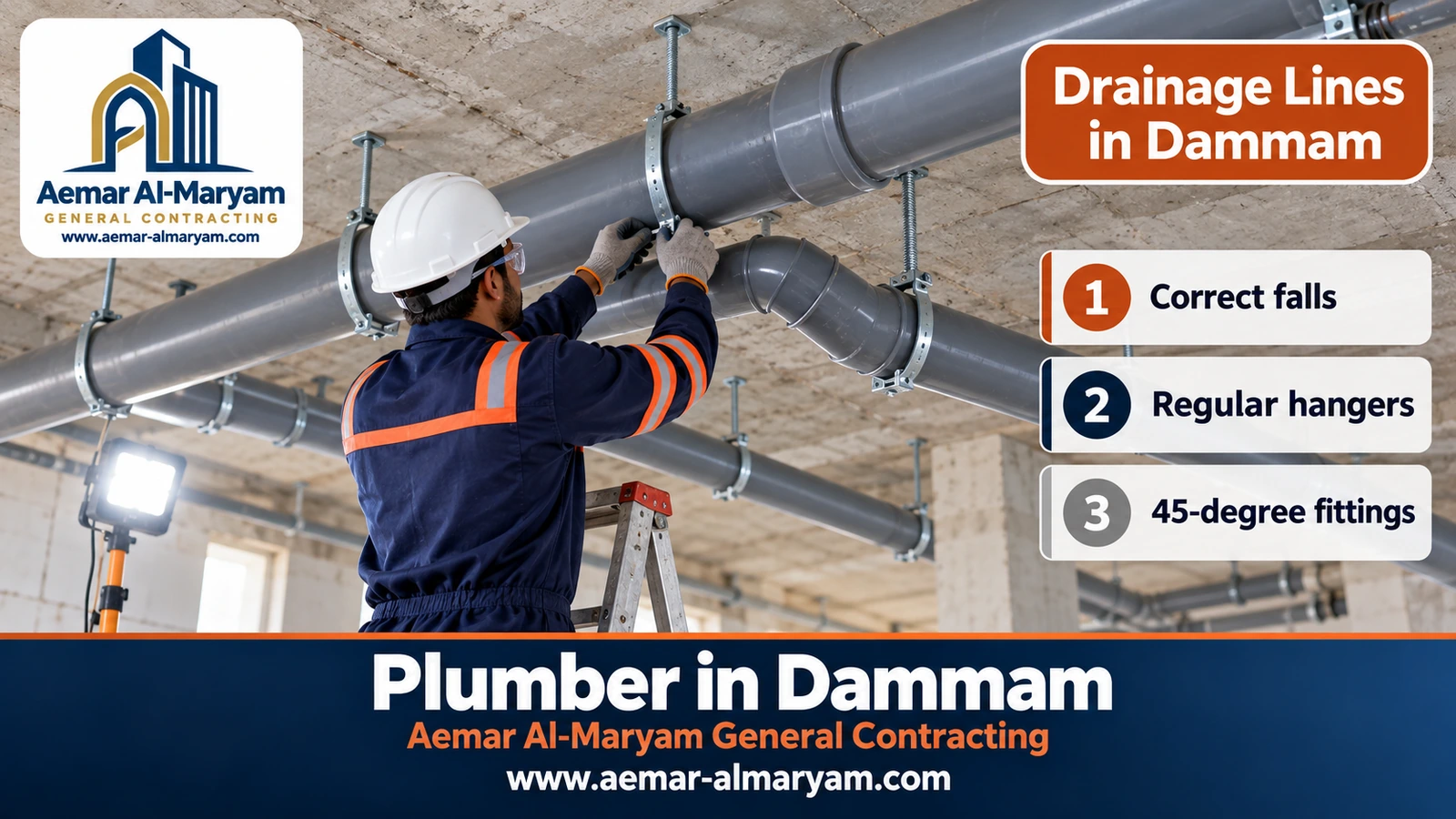
It comes with conditions. The ceiling must be high enough to leave a comfortable height once the false ceiling is fitted; hangers must be fixed at regular spacing so the pipe does not sag and lose its fall; access panels must be left at joints and bends; and the pipes must pass through the slab in clean holes. In an existing house we core the slab rather than break it, then close the ceiling as part of gypsum board installation.
| Item | Drainage buried in the floor | Suspended drainage |
|---|---|---|
| Access to a leak | Bathroom tiles have to be broken | Through a panel in the false ceiling |
| Bathroom floor build-up | Deeper fill to accommodate the fall | Lighter floor, less fill |
| Ceiling height below | Unaffected | Reduced by the false ceiling |
| Cost | Lower in materials | Higher due to hangers and the false ceiling |
| Best suited to | Ground floors and houses with low ceilings | Upper floors and refits without breaking floors |
We do not recommend suspended drainage everywhere. On the ground floor, for example, there is no ceiling below, so drainage stays in the floor and runs to the inspection chambers. Converting an existing bathroom to suspended drainage is priced on inspection, because the work varies with ceiling height, the tiling above and the condition of the slab.
Bathroom plumbing in Dammam and bathroom plumbing finishing
Bathroom plumbing in Dammam covers the cold and hot lines to every fixture, drainage for the WC, basin, shower or bath and floor drain, and the concealed mixer body and concealed cistern frame if you choose them, all done before waterproofing and tiling. Bathroom plumbing finishing is the last stage after tiling: fitting the WC, basin, mixers, bidet spray and accessories and checking every point. Rough-in for a standard bathroom starts from SAR 460 in labour.
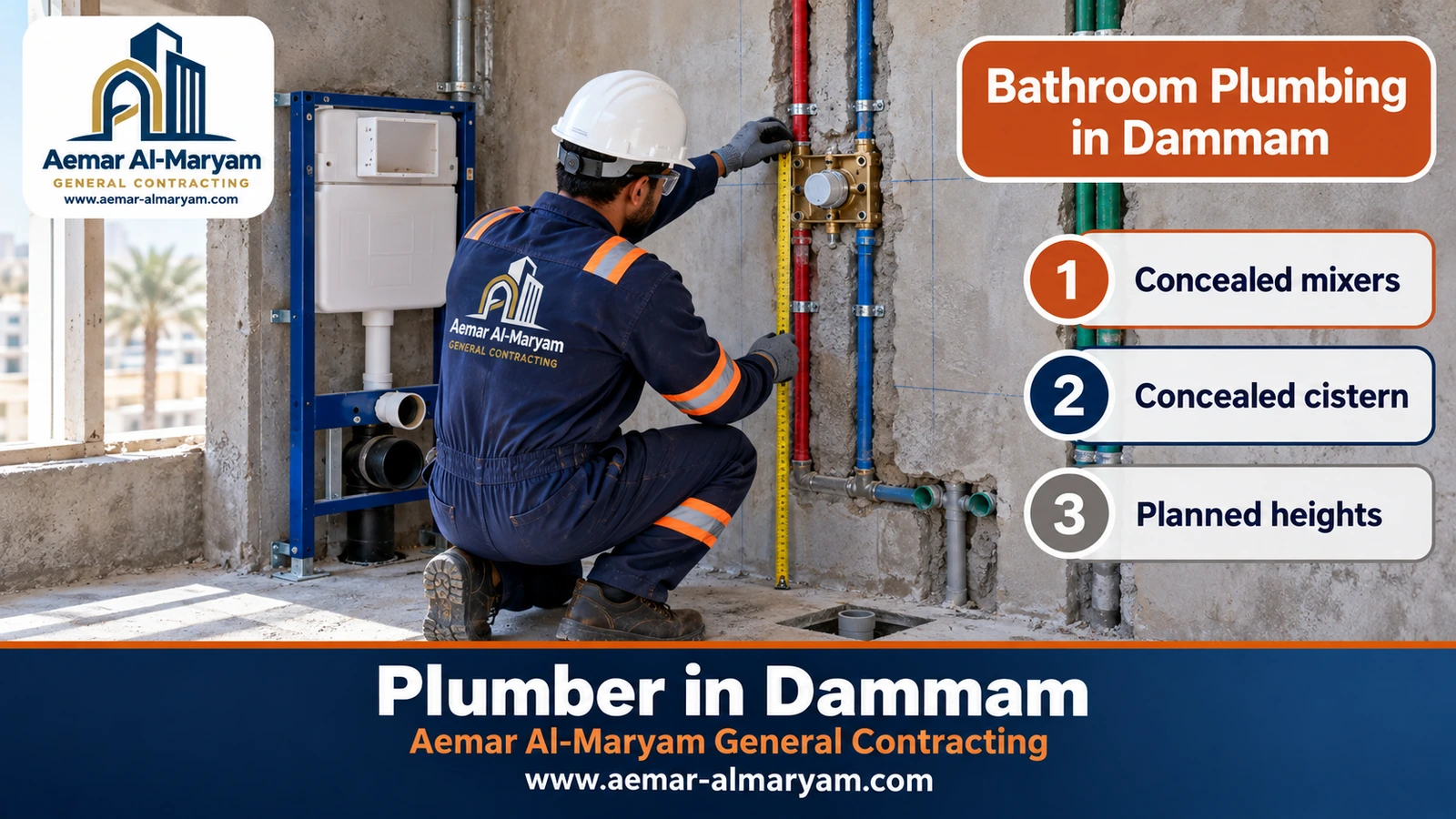
Concealed mixers and concealed cisterns: what goes in before the tiles
A concealed mixer has a body buried in the wall and a trim plate fitted after tiling; a concealed cistern is a tank inside a steel frame behind the wall, with only the flush plate showing. The rule for both is the same: they are fixed at the correct depth and height before tiling, allowing for the thickness of tile and adhesive, because any mistake after tiling means breaking tiles. We run water through the mixer and the cistern during the network test, and we leave the cistern access opening where the manufacturer specifies.
Outlet heights in a bathroom
There is no single mandatory set of heights, because fixtures differ from model to model; the reliable source is the instruction sheet of the fixture you have chosen, read before rough-in, not after. That is why we ask you to choose the basin, WC and mixers early, or at least their type (wall-hung or floor-standing, concealed or exposed), and then set the outlets accordingly:
| Outlet | How we set its height | What we check |
|---|---|---|
| Basin supply and waste | From the basin top height and the pedestal or vanity model | That the connections hide behind the pedestal or inside the vanity |
| Shower mixer | Usually between about one metre and 1.2 metres above the floor | Users’ height and whether there is an overhead or hand shower |
| Bath mixer | Above the bath rim, at a usable distance | The actual bath height once installed |
| WC supply and drain | From the model’s sheet, wall-hung or floor-standing | The concealed cistern frame and flush plate position |
| Bidet spray | Beside the WC within easy reach | That it has its own angle valve |
More important than height are three things often missed: hot on the left and cold on the right, as everyone expects; the floor drain at the lowest point of the floor, not above it; and the floor waterproofed, with the membrane turned up the walls, before tiling. Waterproofing is done by or coordinated with our roof and bathroom waterproofing team in Dammam, and tiling comes after it with our tile installer in Dammam, so the tile falls lead to the drain we positioned.
Bathroom plumbing finishing in Dammam: the final fit-out
After tiling we return to fit the fixtures: the WC with a new seal, fixed to the floor or its frame; the basin and its mixer, from SAR 90; mixer taps from SAR 75 each; the bidet spray and angle valves. Then we run every point and watch the joints under the basin and behind the WC, and we check that water flows to the floor drain without ponding. If you want the whole bathroom renewed, from demolition to tiles and fixtures, look at our bathroom and kitchen renovation service, where a complete bathroom renovation starts from SAR 2,300 and plumbing is one part of it.
Baths and jacuzzis
A fixed bath or jacuzzi needs a suitably sized waste, an access panel for the jacuzzi pump, and a dedicated electrical point prepared by the electrical crew. We set the position and dimensions from the model’s sheet before tiling, and price it on inspection.
Kitchen plumbing in Dammam
Kitchen plumbing rough-in in Dammam covers hot and cold supply to the sink, a point for the dishwasher, a point for a water filter if you want one, and a 40 mm waste from each with a good fall. It starts from SAR 135 in labour, which is less than a bathroom because a kitchen has fewer points and no 110 mm WC drain.
What matters most in a kitchen is that the points match the cabinet design: the sink position, the width of the dishwasher bay, and the fridge position if it needs water. So we ask for the kitchen layout or cabinet dimensions before running anything, and we leave the points where drawers will not foul them. Grease is what blocks kitchen drains most often, so we give the line a good fall and place a cleanout somewhere reachable. If you are renewing the whole kitchen, cabinets, services and tiles, see our bathroom and kitchen refit service or our Dammam renovation work.
- ✓Washing machine: a valved supply point and a trapped standpipe waste, ideally in the laundry room rather than the kitchen.
- ✓Water filter: a separate valved cold point under the sink, so the filter can be changed without cutting water to the sink.
- ✓Annex or preparation kitchen: the same items at smaller sizes, and we check that its waste reaches a stack or inspection chamber at a proper fall.
Re-piping older homes in Dammam: when it is needed and how we do it
Re-piping a house in Dammam means replacing the old supply network, usually galvanised steel in older homes, with a new PPR network, and it may include drainage if the old pipes are cracked or the wrong size. It becomes necessary when scattered repairs cost more than replacement, when the water runs brown, or when pressure is weak throughout the house.
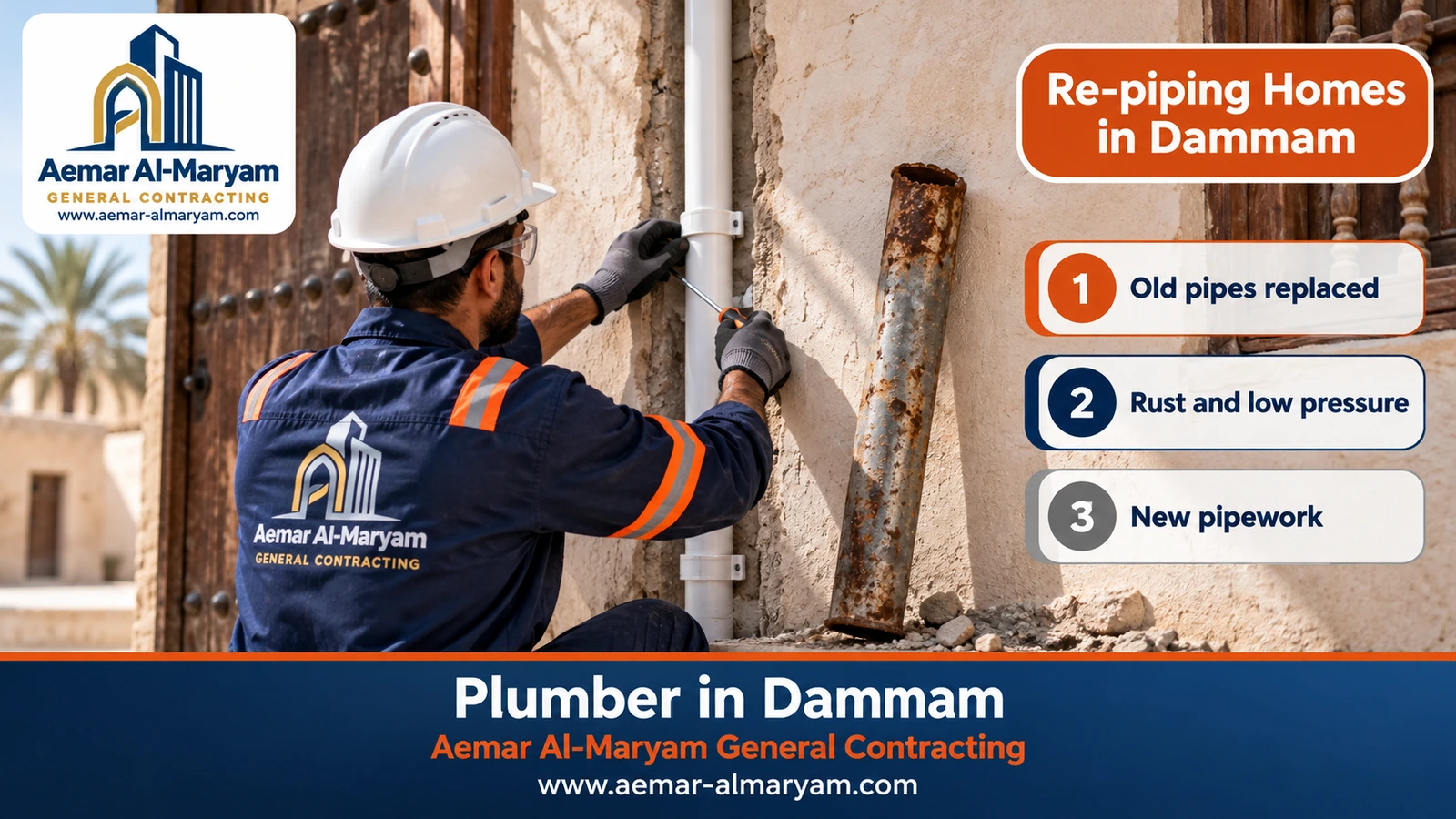
Signs that the pipes in your house have reached the end of their life
- ✓Repeated leaks in different places: each repair exposes a weakness somewhere else, so the problem is the network, not one point.
- ✓Brown or rusty water when a tap is first opened: a sign of corrosion inside galvanised steel, which also narrows the bore.
- ✓Weak pressure at every tap: once the pump and tank are ruled out, the cause is scale inside old pipes.
- ✓A meter that moves with every tap closed: a hidden leak that needs detecting before anything is broken.
- ✓Renewing every bathroom and the kitchen: if the tiles are coming off anyway, re-piping at the same time costs less than coming back later.
Can pipes be replaced without breaking walls?
Partly, yes. Supply lines can sometimes run along neat exposed routes inside cupboards or above a false ceiling and drop down to the points, and upper-floor drainage can be converted to suspended drainage under the ceiling instead of breaking floors. But points inside tiled walls still need opening along their route. The difference is that we cut a defined chase with a saw rather than breaking at random, and close it after testing. We estimate with you how much tiling will be opened before we start, so you can decide whether to retile the whole wall or just make good the opened strips.
Replacing a damaged section of pipe starts from SAR 165 per section or point, while replacing a house’s entire network or converting it to suspended drainage is priced on inspection: the bathroom count, run lengths and the amount of tiling to open all change it. When re-piping is part of a wider renovation we coordinate it with the renovation contractor in Dammam, and breaking out with our demolition contractor in Dammam, so no wall is opened twice.
Water heater installation in Dammam: electric and central
Our water heater installation in Dammam includes fixing the heater on brackets that carry its full weight, connecting the cold inlet and hot outlet with valves, fitting a temperature and pressure relief valve with a discharge pipe to a safe place, then commissioning and checking. Installing an electric storage heater starts from SAR 140 in labour; a central heater with a return and circulation line is priced on inspection.
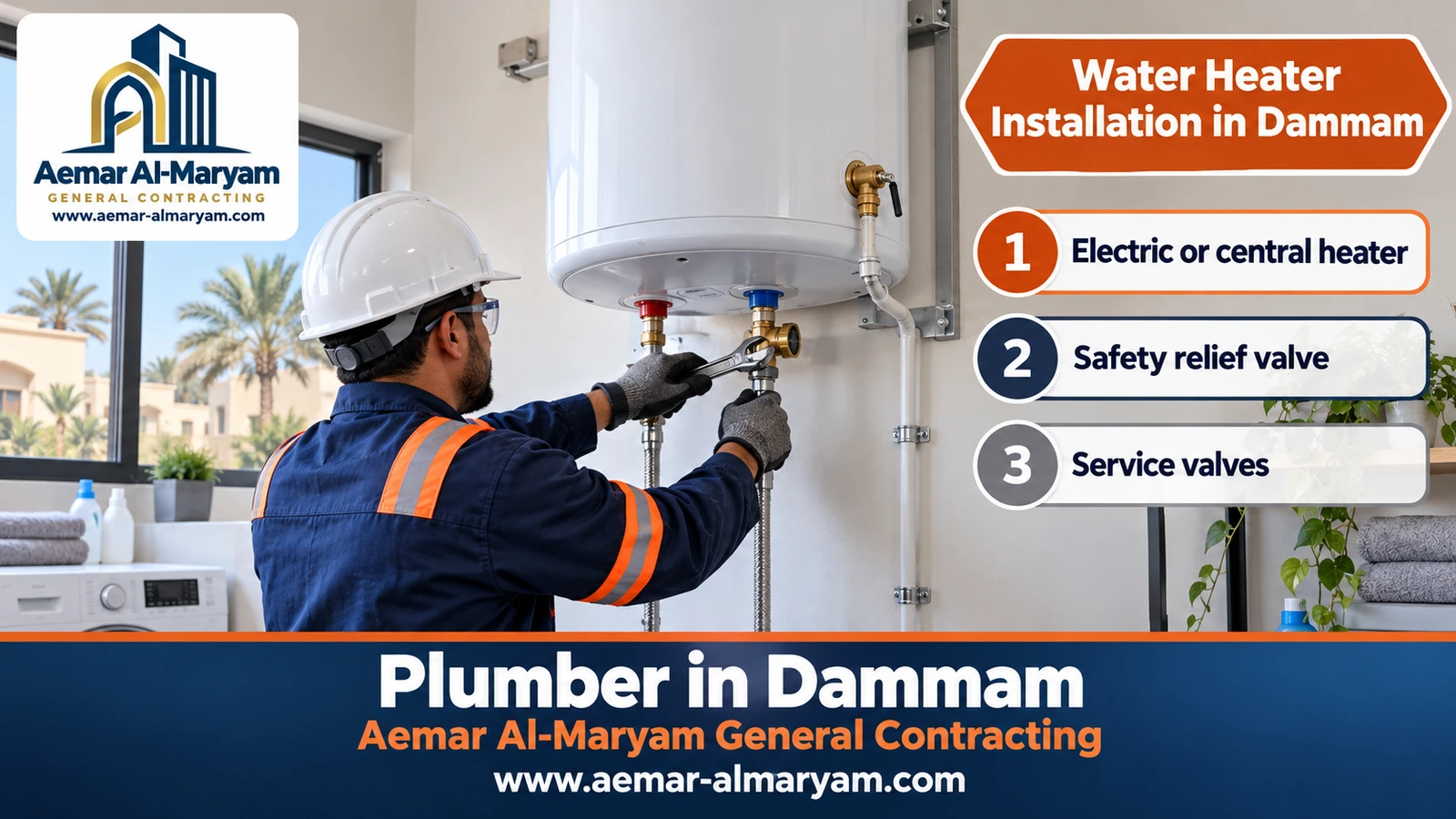
The relief valve is not an optional extra. The plumbing code requires safety devices on water heaters, and the valve’s job is to open if the temperature or pressure inside the tank rises beyond its limit, releasing water through the discharge pipe instead of letting the tank fail. That is why we route its discharge to a drain or somewhere it cannot hurt anyone, and we never plug it or run its pipe upwards.
| Type | When it suits | What we consider |
|---|---|---|
| Electric storage heater per bathroom | Houses and flats, and where bathrooms are far apart | Tank size for the number of users, and a short run to the bathroom |
| Central heater for several bathrooms | New villas and bathrooms close together | A return line and circulation pump so you do not wait long for hot water |
| Instantaneous heater | A distant basin or preparation kitchen | Enough electrical capacity, decided by the electrical crew |
What temperature should you set the heater to?
International health guidance recommends storing hot water at 60 °C or above to limit the growth of Legionella bacteria, and delivering it so that taps reach about 50 °C within a minute of opening. Cold water is best kept below 20 °C where possible. But water above 44 °C starts to scald children and elderly people, so we fit a thermostatic mixing valve on the line to the bathroom they use: the tank stays hot, and the water reaches the skin at a safe temperature.
Poor hot water is not always a faulty heater
Before you replace the heater: sediment at the bottom of the tank, a failed element, a faulty thermostat, an undersized pipe or air in the line all produce the same complaint. We diagnose the cause on site before proposing any replacement.
Water pumps and low water pressure in Dammam
Water pump installation in Dammam usually takes one of two forms: a transfer pump that lifts water from the underground tank to the roof tank, after which the house runs by gravity, or a booster pump with a small pressure vessel and a switch that starts it when a tap opens. Installing and connecting a pump starts from SAR 275 in labour, and the pump itself is priced separately.
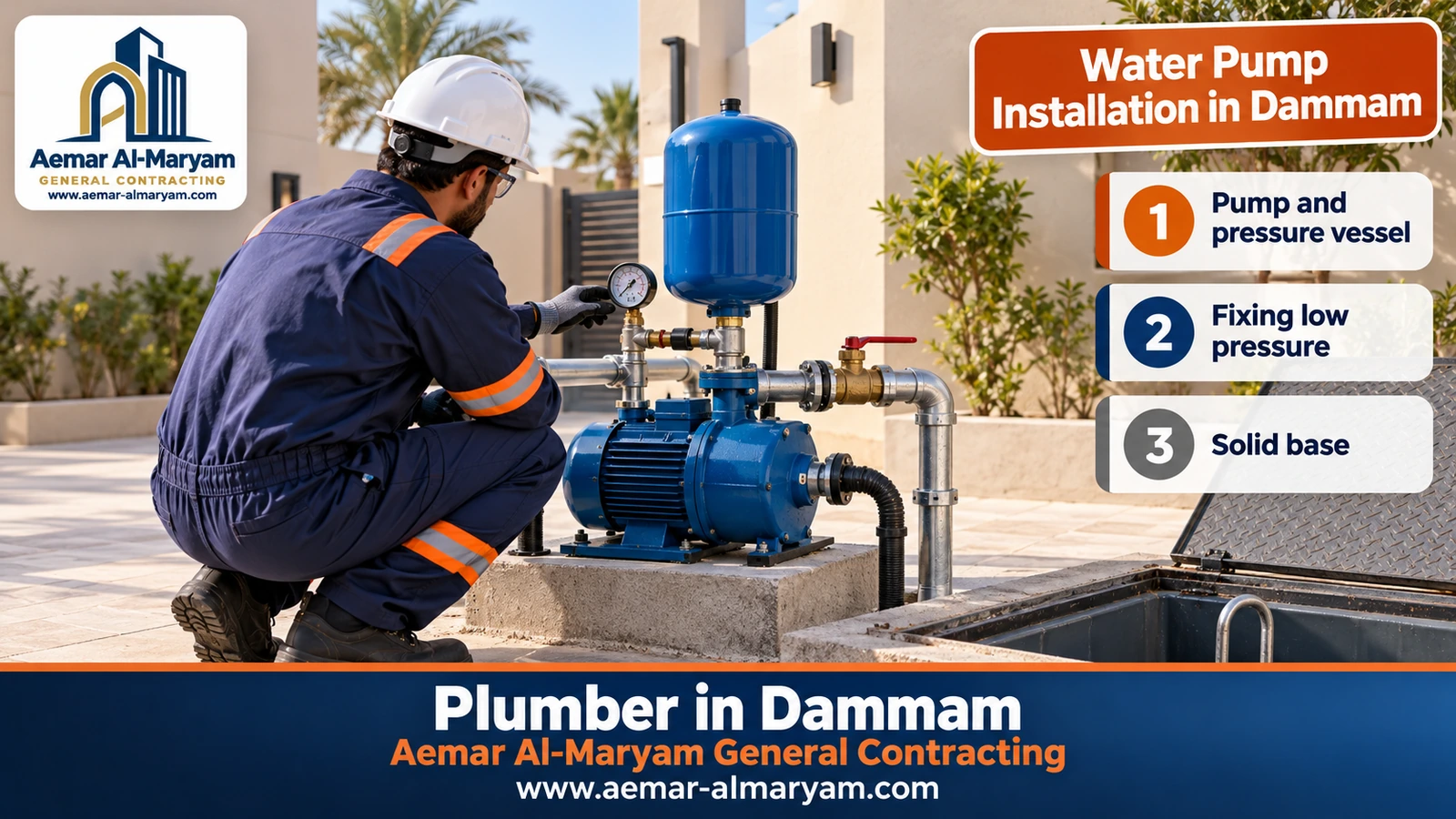
We mount the pump on a solid base that stops vibration, with a valve on the suction side and one on the delivery side, a non-return valve that stops water running back to the tank, and a pressure gauge so you can read its condition. We shade it from direct sun where possible and confirm its electrical supply suits its rating. We set the pressure switch to a value that suits the house and no higher, because excess pressure strains joints and mixers.
⚠ Never connect a pump to the water meter
Pumping directly from the meter line or bypassing the meter is a violation, and the National Water Company warns of fines of up to SAR 50,000 for removing the meter and connecting directly. A pump draws from the underground tank, never from the public main. The company also requires a separate meter for every residential or commercial unit as a building-permit condition, so if your building is divided into flats, plan each flat’s line from its own meter.
Low water pressure in Dammam: where to start the diagnosis
Low pressure is one complaint with many causes, so we check it in an order that starts with the simplest. Diagnosing and fixing low pressure starts from SAR 135 per visit; anything that needs parts or new lines is added after agreement.
- 1Whole house or one point?
One point usually means a blocked mixer aerator or a half-closed angle valve. - 2Only on the upper floor?
The roof tank may not sit high enough above the top floor; the answer is a small booster pump. - 3Tank and float valve
A tank that never fills or a stuck float gives intermittent pressure. - 4Pump and pressure switch
We read the gauge, watch it cut in and out, and check the non-return valve. - 5Pipe sizes and valves
An undersized main or a main valve not fully open, the simplest cause and the one most often forgotten. - 6Old pipework
If everything above is ruled out, scale inside old steel is the cause, and the cure is replacing the sections.
Water tanks in Dammam: underground, roof and their connections
Most houses in Dammam have two water tanks: an underground tank filled from the water network, and a roof tank fed by the pump that supplies the house. We connect or install a roof tank starting from SAR 920, and we connect the underground tank to the pump and the network; building a new underground tank, with excavation, casting and waterproofing, is priced on inspection.
For tanks we follow the residential building requirements: the two tanks together should hold at least five days of the occupants’ needs, tanks must be tightly waterproofed inside and out, and the distance between the water tank and the septic tank must not be less than one metre. That last rule matters in older houses still on septic tanks, where a leak can contaminate a nearby water tank unnoticed.
- ✓Fill connection: from the meter to the underground tank, through a float valve that closes when full.
- ✓Overflow and vent: an overflow pipe with an insect screen, and a covered vent.
- ✓Lid: tight, and raised above the ground or roof level so washing water and rain cannot get in.
- ✓Drain valve: to empty the tank for cleaning without a pump.
- ✓Lining: a drinking-water-safe lining, coordinated with the tank section of our waterproofing guide.
The water reaching Dammam homes from the public network is desalinated and operated by the National Water Company, and the Saudi Water Authority has announced expanded desalination capacity in the Eastern Province serving Dammam, Al Khobar, Dhahran, Qatif, Saihat, Al-Ahsa, Ras Tanura and Safwa. So the cleanliness of your water after the meter depends on your own tank and pipes, not on the source.
Leak detection in Dammam: the short version
Leak detection in Dammam locates a leak before anything is broken, starting with a meter test and moving on to instruments. You can begin yourself: close every tap, the heaters and the pump, then watch the meter for ten minutes; if it moves, there is a leak in the network after the meter. A bill that suddenly jumps, damp patches on walls and ceilings, and floor tiles that lift or whose joints change are other signs.
Instrument-based detection (thermal camera, moisture meters and pressure testing), its details and its prices are covered in the leak-detection section of our roof waterproofing and leak detection guide for Dammam. Our plumbing role starts once the location is known: we open only at that point, repair the joint or replace the section, and test it before closing. If the leak left stains on a wall or ceiling, putting them right is a job for our painting contractor in Dammam; if damp has caused cracking, see crack repair in Dammam.
Drain blockages and sewer smells in Dammam
Most drainage problems in Dammam come down to one of four causes: the wrong fall, grease and deposits in the kitchen line, a dry or missing trap, or a broken pipe under the floor. We clear basin and floor-drain blockages from SAR 90 per visit, but what matters more to us is finding out why the blockage keeps returning, because repeated clearing treats the symptom, not the cause.
Sewer smell in the bathroom: where does it come from?
- ✓An unused floor drain: the trap dries out and the smell rises; pour a little water into it every week.
- ✓The WC seal: if the seal between the WC and the drain fails, the smell escapes at the base.
- ✓No venting: the drain siphons the traps, so the gurgling and the smell keep coming back.
- ✓A waste with no trap: in some older houses the drain connects straight to the line; the fix is fitting a trap.
- ✓A broken pipe: a constant smell together with damp in the wall or the ceiling below the bathroom.
We fix the cause rather than masking the smell. If back-ups keep happening on the ground floor in particular, we check whether its drainage is tied into the main stack with the upper floors, which the requirements prohibit; the cure is to separate the ground-floor line and run it straight to the inspection chamber.
Plumbing pressure test and drainage test in Dammam before closing the walls
A plumbing pressure test in Dammam is a step we never skip before closing a wall: we fill the supply lines with water, raise the pressure with a hand test pump to a value above working pressure according to the pipe manufacturer’s instructions, and watch the gauge. We test drainage by filling it with water to a column of at least 3 metres for at least 15 minutes, as the Saudi plumbing code requires.
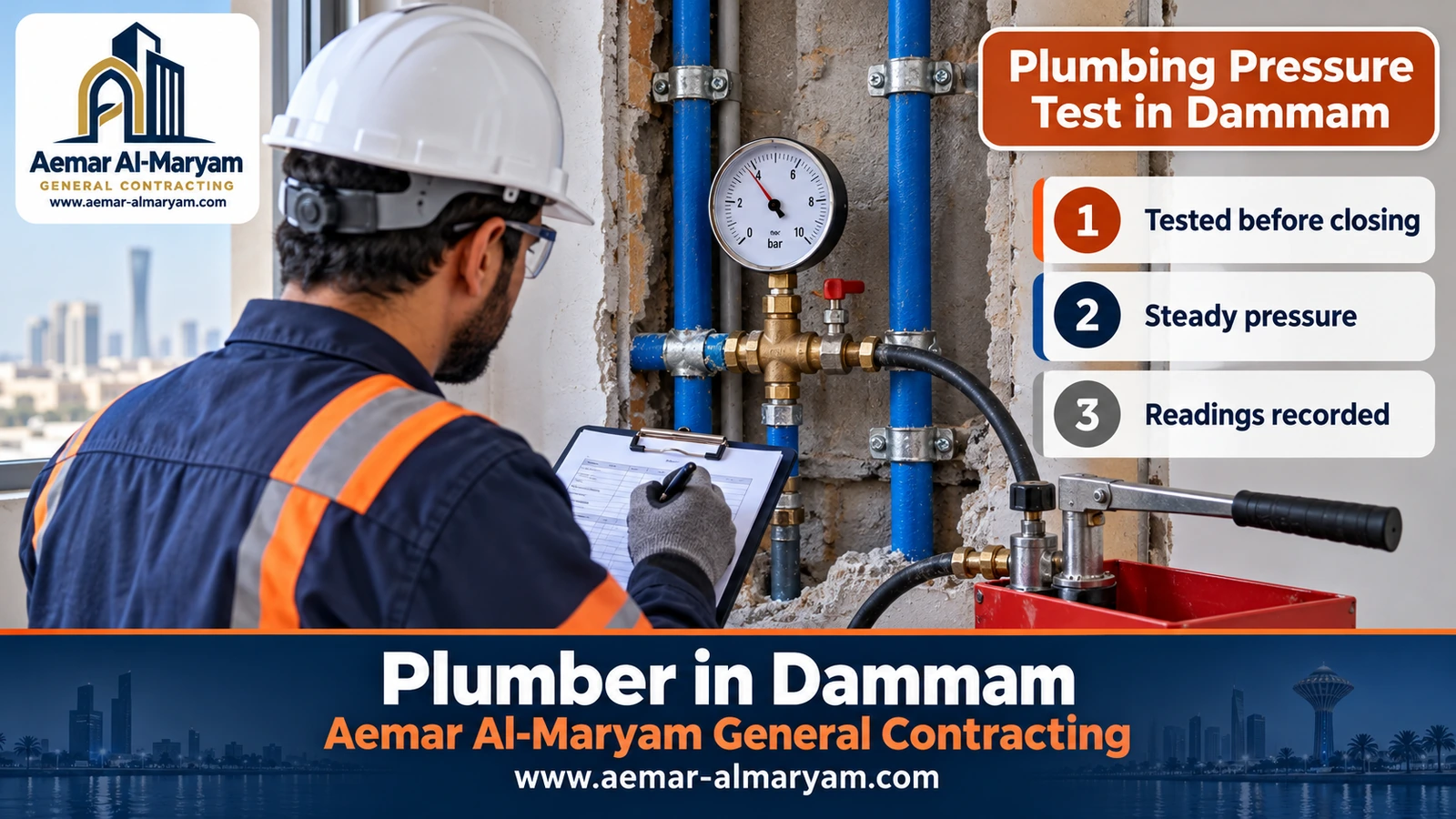
The Saudi plumbing code requires the supply network to prove tight under water pressure no lower than the system’s working pressure, and it allows drainage to be air-tested at 35 kPa for 15 minutes instead of the water column. On PPR lines we go beyond the minimum, following what pipe makers recommend: a pressure above working pressure (one and a half times working pressure is often quoted), raised in stages, with air bled from the highest points, then the line left to stabilise and watched. Any drop in the reading means we find the joint and remake it before tiles cover it.
- 1Cap the outlets
Every line end is sealed with a test plug. - 2Fill and bleed
The line is filled slowly and the highest outlet opened until all the air is out. - 3Raise the pressure in stages
With the hand pump, up to the test value set for the pipe. - 4Watch and record
We note the reading at the start and after the stabilising period, and look at every joint. - 5Drainage test
Plug the lowest outlet, fill the line to a 3-metre column of water and watch it for at least 15 minutes. - 6Photograph, then close
We photograph the wall, the lines and the gauge reading, then allow the chases to be closed.
Keep the photos of your pipe routes
Photos of the walls before they are closed, with a tape measure visible, tell you years later where the pipes run, so you do not drill into one while hanging a shelf or a TV. We send you these photos after every test.
The plumbing materials we use in Dammam
For supply we mostly use PPR pipe, for drainage uPVC, and we suggest alternatives when there is a reason to. We do not name a particular manufacturer; we set the specification and pressure class, and you choose from compliant products on the market, or we supply them as part of the quoted items.
| Material | Use | Jointing | Notes |
|---|---|---|---|
| PPR | Cold and hot supply | Heat fusion at about 260 °C | The most common in homes; higher pressure class for hot lines; expands with heat |
| uPVC | Drainage and venting | Solvent cement or ring seals | Not for pressurised supply; 110 mm for WCs |
| CPVC | Cold and hot supply | Solvent cement | An alternative to PPR on some projects |
| PEX | Cold and hot supply | Compression or press fittings | Flexible and suits manifolds; usually dearer than PPR |
| Copper | Supply | Soldered | The most expensive; rare in new homes |
| Galvanised steel | Old supply lines | Threaded | We do not install it; we replace it in older homes |
Among the mistakes we see in houses: PPR used for drainage, fittings from more than one system mixed in the same network, and a pipe rated for cold water used on the hot line. That is why our quote states the material and pressure class for each line, so you know exactly what you are paying for.
Salts and groundwater in the Eastern Province
Across much of the region the water table is shallow, and the salts it carries rise into concrete and attack steel. So we treat inspection chambers, underground tanks and buried pipes as sitting in a harsh environment: we waterproof them and choose materials that resist salts.
How plumbing work is carried out in Dammam, step by step
Our plumbing jobs follow the same steps whether it is one bathroom or a whole villa; only the size of each step changes:
- 1Photos or inspection
You send photos and drawings on WhatsApp, or we visit to measure. - 2Items and estimated cost
We send exactly what we will do: points, materials, testing, and who re-plasters. - 3Agreeing materials and dates
You choose the materials or we supply them, and we fix the start date and duration. - 4Setting out
We mark routes and outlet positions on the walls and review them with you. - 5Chases and penetrations
We cut chases and form slab holes by coring or saw cutting as needed. - 6Pipework and fusion
We run supply, drainage and vents, and fix mixer bodies and cistern frames. - 7Testing and photographs
Pressure and drainage tests, then every wall photographed. - 8Closing and handover to the next trade
Chases closed, ready for waterproofing, plaster and tiles. - 9Final fit-out
After tiling we fit the fixtures, run every point and hand over.
In occupied homes, water is shut off only for agreed hours, floors and nearby furniture are covered, and debris leaves daily. Rough-in for a single bathroom typically takes one to two days for chases, pipework and testing, after which waterproofing and tiling follow; the final duration is set after inspection.
Plumbing prices in Dammam: our “starts from” table
Our plumbing prices in Dammam are labour rates that start from the figures below, with pipes and fittings of your choice unless stated otherwise. Each is provisional pending a site visit and agreement; the final figure comes from the site visit or the drawings and reflects points, run lengths, floor and access.
| Item | Unit | Starts from |
|---|---|---|
| Bathroom rough-in (hot and cold supply plus drainage for standard points) | Bathroom | SAR 460 |
| Kitchen rough-in (sink, dishwasher or washing machine, filter) | Kitchen | SAR 135 |
| Rough-in for a new building or annex | m² of built area | SAR 23 |
| Replacing a damaged supply pipe section | Section or point | SAR 165 |
| Whole-house re-piping or conversion to suspended drainage | — | On inspection |
| Electric storage heater installation with relief valve | Heater | SAR 140 |
| Central heater with return and circulation line | — | On inspection |
| Installing or replacing a mixer tap | Mixer | SAR 75 |
| Installing a basin with its mixer | Basin | SAR 90 |
| Installing and connecting a tank water pump | Pump | SAR 275 |
| Installing or connecting a roof tank | Tank | SAR 920 |
| New underground tank (excavation, casting, waterproofing) | — | On inspection |
| Inspection chamber | Chamber | SAR 185 |
| AC condensate drain line | Line | SAR 90 |
| Clearing a basin or floor-drain blockage | Visit | SAR 90 |
| Diagnosing and fixing low water pressure | Visit | SAR 135 |
| Complete bathroom renovation (demolition, waterproofing, plumbing, tiles) | Bathroom | SAR 2,300 |
Items marked “on inspection” carry no figure because they vary too much from one house to another; a WhatsApp message to 0547879578 with photos and dimensions lets us work out an estimated cost. For large jobs we set the price after an inspection or from the drawings. For rates across our other trades, open the prices page.
What pushes plumbing costs up or down?
- ✓Number of points: each supply or drainage outlet is an item, so a main bathroom with more fixtures costs more than a guest bathroom.
- ✓Distances: a bathroom far from the main stack needs longer lines and harder falls.
- ✓Floor and access: carrying materials to an upper floor without a lift, or working at a high ceiling, takes longer.
- ✓New or existing: rough-in in a shell building is faster than opening tiled walls in an occupied house.
- ✓Materials: pipe type and pressure class, a manifold instead of tees, and the type of mixers and cisterns.
- ✓Grouping: a single trip covering several items costs less per item than separate trips.
Worked example: re-plumbing a three-bathroom house in Dammam
An illustrative example: a house with three bathrooms and a kitchen, whose owner wants the bathroom and kitchen plumbing redone, plus a new electric heater and a booster pump:
| Item | Calculation | Labour |
|---|---|---|
| Rough-in for 3 bathrooms | 3 × 460 | SAR 1,380 |
| Kitchen rough-in | 1 × 135 | SAR 135 |
| Electric heater installation | 1 × 140 | SAR 140 |
| Booster pump installation | 1 × 275 | SAR 275 |
| Estimated labour total | SAR 1,930 |
That figure is labour only. It excludes the pipes, fittings, heater and pump, the bathroom floor waterproofing (from SAR 26 per square metre in our waterproofing guide), and any breaking out, re-plastering and tiling, which are priced on inspection. If the building were a new 300 m² shell, the calculation would be per square metre instead: 300 × 23 = SAR 6,900 in rough-in labour before materials. These numbers are for illustration; the actual cost is set after inspection and agreement.
Plumbing mistakes we keep finding in Dammam homes, and our fix for each
Most of what we are called in to fix in existing homes comes from rough-in mistakes that a few extra minutes would have prevented. These are the ones we see most, and what we do to avoid them:
| Mistake | What happens later | What we do |
|---|---|---|
| Too little fall, or a back-fall | Repeated blockages and standing water in the line | Check every run with a level before fixing |
| Closing the wall without a test | A leak behind the tiles that appears months later | No wall is closed before pressure and drainage tests are recorded |
| Mixing fittings from different systems | Joints that do not fuse properly | One system, one material, on each line |
| An uninsulated hot line | Heat loss, condensation and a long wait for hot water | Insulate hot lines and keep them short |
| Hot and cold reversed at the mixer | Constant annoyance and a scalding risk | Colour-coded lines checked at fit-out |
| Unsecured pipes | Water hammer when a tap is shut | Clips at regular spacing |
| Floor drain set above the surrounding tiles | Water ponding in the bathroom | Drain at the lowest point, tile falls coordinated |
| No waterproofing before tiling | Damp in the next wall and the ceiling below | Floor membrane turned up the walls before tiling |
| Valves buried with no access | Breaking tiles to shut off the water | Valves in visible places or behind access panels |
Choosing a plumbing contractor in Dammam: what the quote should say
Choose a plumbing contractor in Dammam by what he writes down before he starts, not by what the advert promises. A good quote breaks down the items and names the materials and the test; a weak one is a single large figure with no detail. Put these questions to anyone you are considering and compare the answers:
| Question | The answer that should reassure you |
|---|---|
| What pipe and pressure class? | For example PPR in a stated class for hot and another for cold, and uPVC drainage in stated sizes. |
| Is the price labour only or with materials? | A clear split between labour and materials, and who buys what. |
| How and when will you test? | A pressure test on supply and a water test on drainage before closing, with you present if you wish. |
| Will I get photos of the routes? | Yes, a photo of every wall before it is closed. |
| Who closes the chases and re-plasters? | A written item: them or another contractor, and at what cost. |
| Where will the valves be? | A visible main valve and a valve for every wet room. |
| How long, and what happens to the water meanwhile? | An approximate number of days and fixed shut-off hours. |
Do not let the lowest price be the only test. The difference between two quotes is usually an item missing from the cheaper one: the test, the re-plastering or the valves. Ask to see previous work too; some of ours is on the projects page.
Plumbing as part of renovation and finishing in Dammam
Plumbing inside a bigger project costs less when it runs with the other trades on one programme: re-piping before new plaster, rough-in before waterproofing and tiles, an annex network planned with the build. Related services:
■ Renovation
Replacing the old network within a renovation project in Dammam.
■ Holes and openings
Drain and vent holes through slabs by core drilling, and floor openings by concrete cutting.
■ Breaking out
Removing old bathrooms with our demolition contractor.
■ False ceilings
Hiding suspended drainage with gypsum board.
■ Moisture-resistant boards
Lightweight bathroom walls in cement board.
■ Tiling
Bathroom and kitchen tiling after testing with our tile installer.
The plumbing works page summarises the service, and combined bathroom and kitchen refits are under bathroom and kitchen renovation.
Plan your plumbing before the tiles go down
Send photos of the space, the drawings and the number of bathrooms and kitchens; we will send back the items and an estimated cost, then set a date for the inspection or the start of work.
Plumber in Al Khobar and Dhahran, plus Qatif and other towns in the region
We carry out plumbing outside Dammam the same way: an appointment after photos or an inspection, and a crew travelling from Dammam with fusion and testing equipment. The request we receive most often outside Dammam is for a plumber in Al Khobar, followed by Dhahran, because they are close by and their buildings are much like Dammam’s.
Plumber in Al Khobar and Dhahran
In Al Khobar we carry out rough-in, re-piping, bathroom plumbing and water heaters in flats and villas, in districts including Al Thuqbah, Al Olaya, Al Aqrabiyah, South Khobar, the Green Belt, Al Hada and Madinat Al Ummal. In Dhahran we do the same work for villas and houses. Our prices in both cities are the same as in Dammam, and we group nearby jobs into one visit. If the plumbing is part of a house renovation in Al Khobar, see the renovation contractor in Al Khobar.
Qatif, Saihat, Jubail, Al-Ahsa and other towns
Our crews also reach Saihat next to Dammam and Qatif; northwards Ras Tanura, Jubail and Khafji; and south and west Abqaiq and Al-Ahsa, along with Hafr Al-Batin. For distant towns, travel is priced at inspection, and combining jobs on one trip brings the per-item cost down. In Jubail Industrial City, water and sewerage services are run by Marafiq, so any new connection to the public network there goes through it; in Dammam and the surrounding cities it goes through the National Water Company.
Dammam districts we cover for plumbing
We are based in Al Rawdah district in Dammam, and from there we reach both the older districts and the newer schemes, including:
The list gives examples rather than limits; we reach any district inside Dammam, so share your location pin in a WhatsApp message and we will arrange the visit. Coverage details are on the Dammam area page.
What to send on WhatsApp for a plumbing estimate
The clearer your photos and details, the closer the estimate will be to the final cost, and for small jobs they may save an inspection visit altogether. Send to 0547879578:
- ✓Photos of the space: a wide shot of the bathroom, kitchen or wall, and a close-up of the fault or pipe.
- ✓Drawings or dimensions: the plumbing or architectural drawing if you have it, or rough room measurements.
- ✓How many: the number of bathrooms and kitchens the work covers.
- ✓Floor and building age: and whether the house is occupied or a shell.
- ✓Existing pipe type: if you know it, or a photo of an exposed pipe.
- ✓What you need: rough-in, re-piping, a heater, a pump, a tank, or a specific fault.
- ✓Location: your district or a map pin.
A plumber in Dammam with a clear appointment and an itemised quote
Message your photos now; our reply lists the items, an estimated cost and the earliest available date for inspection or work.
Related pages on plumbing and finishing
Tags