

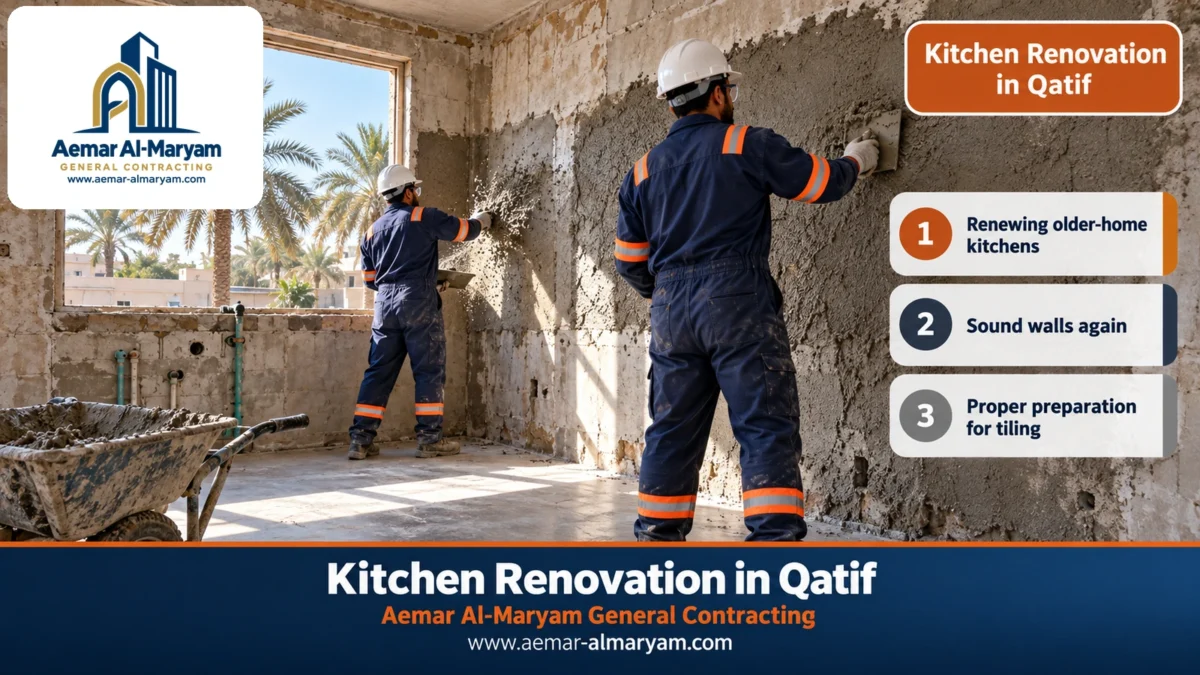
Does the kitchen in your older Qatif house have floor tiles that sound hollow when you tap them, white salt creeping up the wall from the skirting, or a drain smell that comes back however often you clean the sink? New cabinet doors will not fix any of that. Kitchen renovation in Qatif, as Aemar Al-Maryam General Contracting carries it out, begins by stripping the tiles and the failed plaster back to sound wall and slab, then a spatter coat and fresh cement plaster, new waste pipework with a floor drain and calculated falls, and a waterproofing membrane that is flood-tested before a single tile goes on it. Our rates open at SAR 2,300 for a small kitchen done end to end, SAR 18 per m² to re-plaster walls, SAR 26 per m² to waterproof the floor and sink zone, and SAR 165 to renew a failed length of drain. Each one is provisional until we have looked at the kitchen and agreed the scope; call or WhatsApp 0547879578.
Older houses in Qatif, particularly those near the farms and the coast, live with groundwater close to the surface and salts that climb the walls by capillary action. In a kitchen that combines with daily sink water and leaks from tired pipes, so the bedding under the tiles lets go, the plaster flakes at skirting level and old galvanised supply pipes corrode from the inside. That is why, in Qatif kitchens, we start with the water rather than the finishes: find where it comes from, stop it, and then build on something dry.
Below we explain what we usually find under the tiles of older Qatif kitchens, how we strip it and rebuild the walls with a spatter coat and plaster, how we design new drainage with a floor drain and proper falls, and why we leave a full day of water standing on the floor before tiling. Then come the prices and a worked example for a kitchen in an older house.
Older-kitchen renovation in Qatif in brief
- In scope: stripping tiles and failed plaster, spatter coat and cement render, new sink waste and a floor drain laid to falls, new supply pipework, floor and sink-zone membrane with a flood test, tiling, appliance circuits, a hood opening, ceiling and paint.
- Outside our work: cupboards and cabinets of every material, whether that means sourcing, making, mounting or mending them.
- Prices from: complete small kitchen SAR 2,300; tile removal SAR 14/m²; plastering SAR 18/m²; membrane SAR 26/m²; floor ceramics SAR 23/m²; drain section SAR 165; kitchen plumbing SAR 135.
- Tests: a water-column test on the drains before burial, a 24-hour flood test on the membrane before tiling, and a pressure test on the supply.
- Contact: photos of the kitchen, the bottom of the walls and under the sink to WhatsApp 0547879578.
Kitchen Renovation in Qatif’s Older Houses: What Lies Under the Tiles?
In most older Qatif kitchens we find one or more of the following beneath the tiles, and we can usually tell which before breaking anything from clear signs on the surface:
| What you see | What is usually underneath | What we do |
|---|---|---|
| Floor tiles near the sink that sound hollow | A sand bed that came away after a long leak | Strip tiles and bedding to the slab, then membrane and screed |
| White salts and blistered paint low on the wall | Moisture rising from the ground, or a pipe weeping inside the wall | Remove the failed plaster, cure the source, spatter coat and new render |
| A permanent drain smell | A trap that has dried out, or a pipe that has cracked or lost its fall | New waste pipework at a proper fall, water-tested |
| Water pooling after the floor is washed | No floor drain, or falls running the wrong way | A new floor drain with falls towards it |
| Rusty water at first draw and weak pressure | Corroded old galvanised steel pipes | New PPR supply pipework |
Fix the source before the finish
The most expensive mistake in older houses is re-tiling a kitchen while water is still arriving from below or from a pipe in the wall. A few months later the tiles are hollow again and the salt is back on the plaster. We do not start tiling until we know where the damp comes from and have stopped it.
Kitchen Maintenance in Qatif: Which Kind Do You Mean?
People type “kitchen maintenance in Qatif” with two very different jobs in mind. One is cabinet maintenance: loose hinges, sticking drawers, swollen doors and peeling laminate. That is work for a kitchen carpenter, not for us. The other is maintenance of the room itself: a leak under the sink, a slow or smelly drain, tiles that have lifted, plaster falling off a wall, a socket that runs hot, a stained ceiling. That is our work.
Not every problem needs a full renovation. We can replace the failed pipe section, take up only the tiles around a leak, waterproof that patch and re-tile it, or add a circuit for a new appliance. But we will tell you straight if the problem is bigger than where it shows, for example when the whole waste run has no fall, because repeated patching then costs more than doing it properly once.
| Problem | Is a local repair enough? | When wider renovation is needed |
|---|---|---|
| A leaking joint under the sink | Yes, replace the joint or section | When the water has spread under a large area of tiles |
| A few raised tiles | Yes, lift and re-lay them | When the hollow sound runs across the whole floor |
| A smell from the floor drain | Sometimes, by repairing the trap | When the pipe is cracked or has no fall |
| A breaker tripping with two appliances on | Yes, a dedicated circuit for the heavy one | When the wiring is old and has no earth |
What We Do Not Do: Cabinets
We do not work on kitchen cabinets at all. We do not supply them, make them, fit them or repair old ones, whether timber or aluminium, and we do not sell appliances. Cabinet makers and joinery workshops in Qatif handle that side.
In short, our work comes before the carpenter and clears the way for him. If the kitchen still has old cabinets you want to sell or keep, the carpenter or the owner takes them out before we arrive. When we hand the room back, the carpenter receives rendered walls that are straight, a floor at one level, and the water, waste and power outlets exactly where he drew them. One piece of advice for older houses: never fix new cabinets to a wall that still carries salts, because the cabinet base is the first thing to rot.
Stripping an Old Kitchen in Qatif Back to Sound Material
Stripping an old kitchen in Qatif does not stop at the tiles. We remove the floor and wall tiles with their bedding, then sound the plaster underneath: anything hollow, salt-saturated or crumbling comes off down to the blockwork or concrete, while plaster that is hard and well bonded stays. Breaking out tiles with their bedding is charged from SAR 14 per m².
When does all the plaster have to come off?
- ✓When salts cover a large height of the wall: the plaster is saturated and a new coat will not hold.
- ✓When large areas ring hollow: the plaster has already separated from the wall.
- ✓When it is gypsum plaster in the sink area: gypsum does not belong in damp places.
- ✓When rusted steel shows in a column or beam: we stop and treat it, or refer it to crack and concrete repair in Qatif.
While we break out, the rest of the house is protected with polythene over the kitchen door and boards on the corridor floor, and the debris leaves in bags. In terraced houses we agree noisy-work hours so the neighbours are not disturbed. Larger demolition elsewhere in the house is covered by our demolition contractor in Qatif page.
Spatter Coat and New Plaster for Qatif Kitchen Walls
A spatter coat, known locally as tartasha, is a rough cement coat thrown hard onto the bare wall so that the new plaster has something to grip, especially on smooth concrete or on old blockwork after cleaning. ASTM C926 specifies its mix as one part cement to no more than two parts sand, asks for it to be left rough, and keeps it damp for at least 24 hours. Without it, new plaster can debond and sound hollow when tapped, which tradesmen call drumming.
- 1Clean the wall
Brush off dust and salts, wash the wall and leave it damp rather than wet. - 2Spatter coat
A rich cement mix thrown on by trowel or machine and left rough. - 3Keep it damp
Spray the spatter coat for at least a day so it does not dry too fast. - 4Dots and screeds
Reference points and bands that keep the wall and corners straight. - 5Cement render
A coat of suitable thickness, never stronger than the spatter beneath it. - 6Curing
Keep the render damp and let it dry before paint or tiles.
Our plastering rate for kitchen walls opens at SAR 18 per m². In a kitchen we use cement plaster, not gypsum, because gypsum does not tolerate moisture. Freshly rendered walls should not receive ordinary paint until fully dry, typically around 28 days, although the areas planned for tiles can be tiled sooner. More on our plastering contractor in Qatif page.
Kitchen Drainage in Qatif: a New Floor Drain and Proper Falls
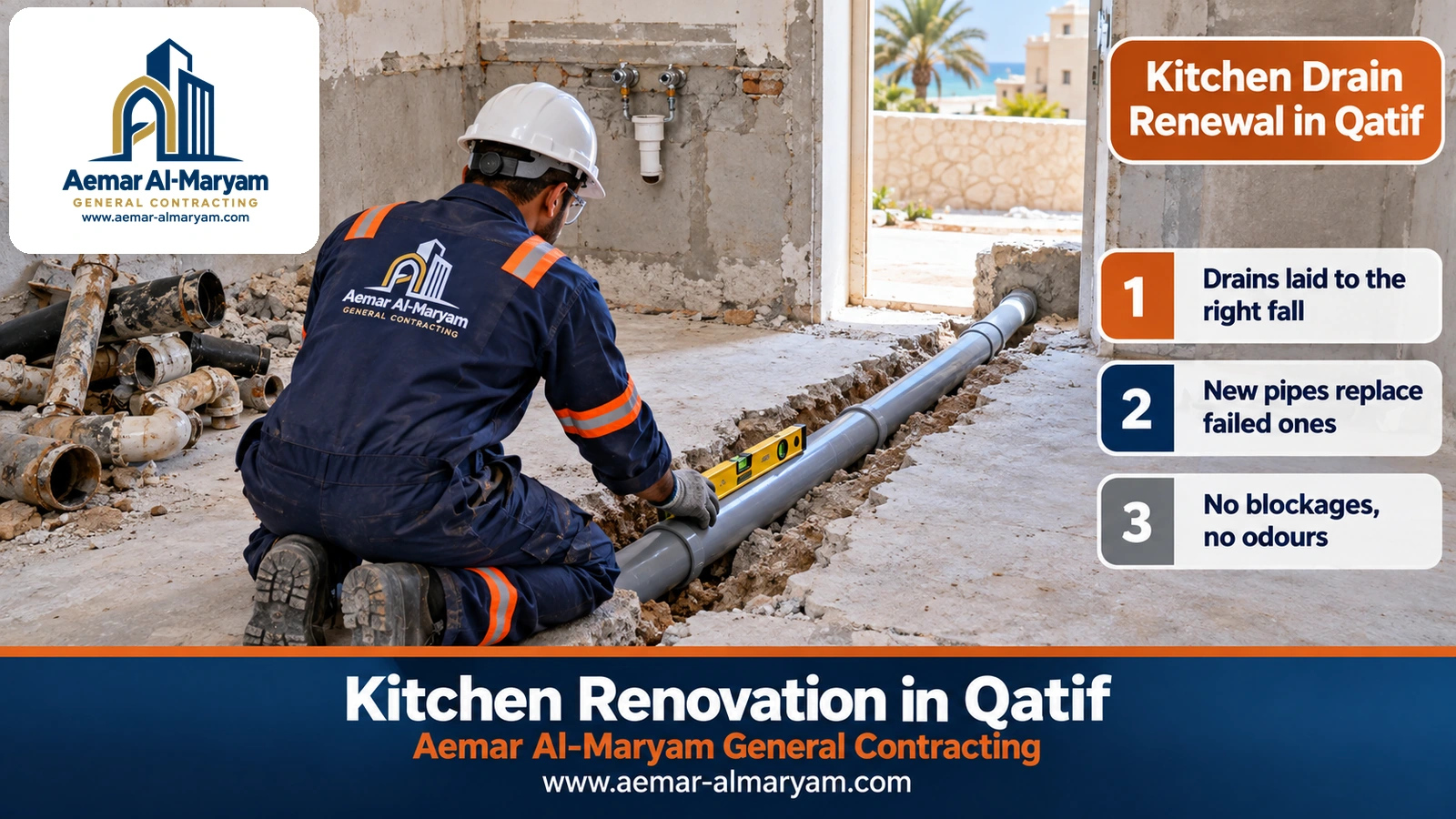
Most kitchens in older Qatif houses either have no floor drain or have one sitting at the highest point, so water lies around it. During renovation we redesign the whole waste system: the sink waste, the dishwasher connection and a floor drain at a low point near the washing area, all running at the right fall to the external drain line.
Sink and dishwasher waste
The sink waste is a 40 mm pipe behind a trap, dropping about 2 cm per metre, which is close to a 2% fall. Waste runs are uPVC, never the heat-fused supply pipe, and the dishwasher joins either ahead of the sink trap or through its own trap so smells cannot come back.
Floor falls towards the drain
The fall to a floor drain is gentle enough that you never feel it underfoot. Building-inspection firms in the Kingdom publish 0.5% to 1% for kitchen and bathroom floors, and international references give 1:80 to 1:50 around a floor waste. We form the fall in the screed under the membrane, not just in the tiles, so water still reaches the drain even if some gets under the tiling.
Testing the drains before burying them
Before burying a waste pipe we cap its end and fill it to a 3-metre column of water, as the Saudi plumbing code SBC 701 requires, and watch the level for fifteen minutes. Any drop means a joint to remake. We photograph the route after the test so you keep a record.
Ground-floor drainage kept separate
Residential building requirements say ground-floor drainage should join the network separately from the stacks serving upper floors. In many older houses the ground-floor kitchen is tied into the stack from the bathrooms above, so any blockage pushes water back up through its floor drain. Where we find this we propose separating it as part of the renovation and price it after inspection.
Renewing a failed length of waste or supply pipe costs from SAR 165 for each length or outlet. For wider plumbing in the house see our plumber in Qatif page.
Supply Plumbing and Sink Replacement in Qatif
For SAR 135 upwards we rough in the kitchen: hot and cold lines to the sink, each on its own angle valve, an outlet for the dishwasher or washing machine, and a connection for a water filter. In older houses we replace corroded galvanised pipes with heat-fused PPR, add a main kitchen isolating valve within easy reach and avoid buried joints in walls wherever we can. The lines are then tested at no less than working pressure before plastering. Changing just the sink or mixer starts from SAR 75.
Kitchen Waterproofing in Qatif and the Flood Test
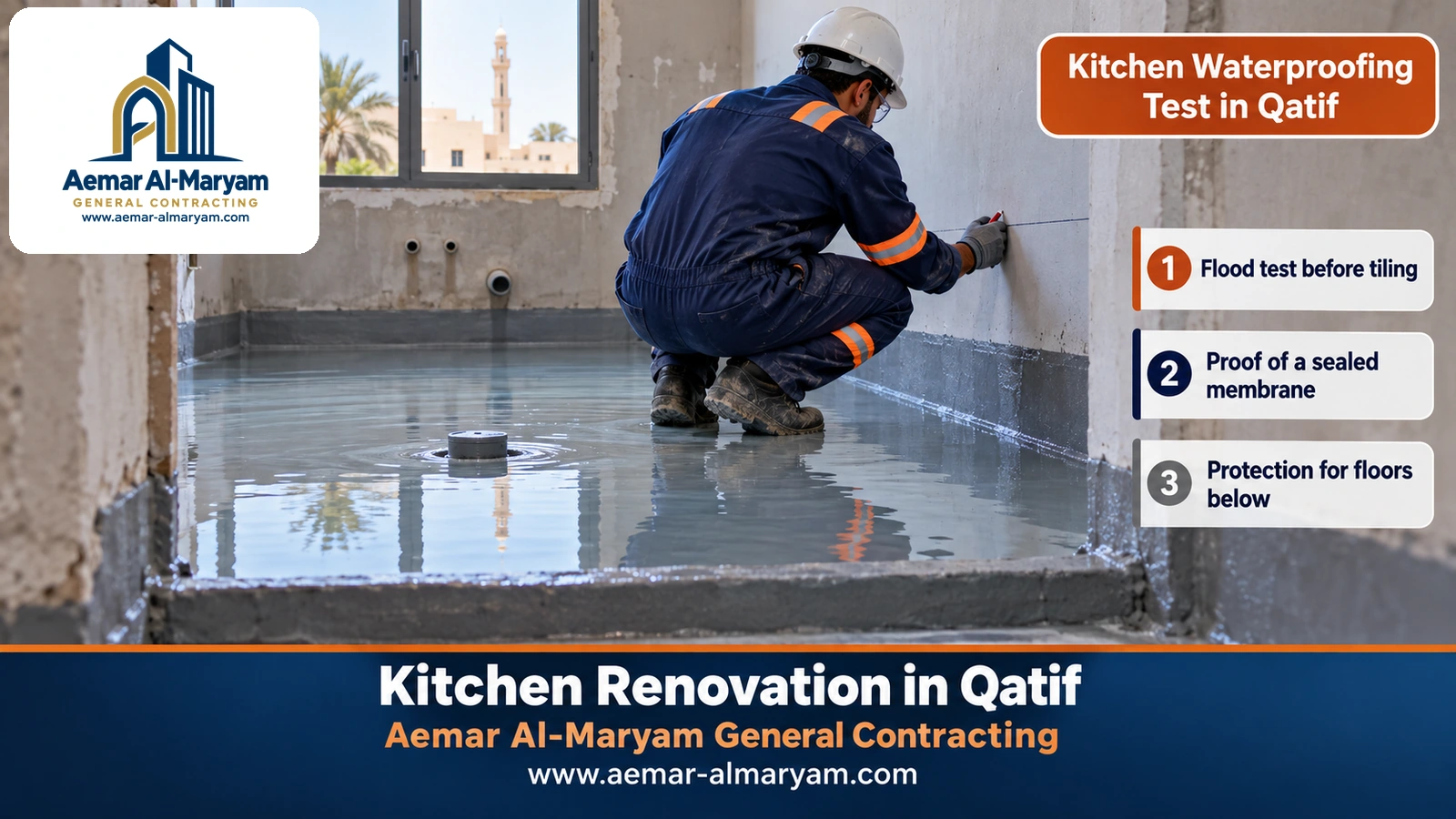
In a ground-floor kitchen of an older Qatif house we waterproof the whole floor, not just the sink zone, because moisture can come from below as well as from use. A flexible membrane goes onto the sloped screed, turns up the walls by several centimetres, climbs the wall behind the sink until it is 15 cm or more higher than the bowl rim, and is reinforced around the floor drain and pipe penetrations. Waterproofing starts from SAR 26 per m².
How we run the flood test
- 1After the membrane cures
We wait the time the manufacturer specifies before adding water. - 2Cap the drain
With a tight temporary plug. - 3Dam the doorway
A strip of mortar or fast-setting material keeps the water in the kitchen. - 4Flood
Water a few centimetres deep across the whole floor. - 5Mark it
A pencil line on the wall at the water level. - 6Watch
At least 24 hours, checking the ceiling below if there is a room under the kitchen.
If the level holds and no damp appears below, we drain the water and start tiling. If it drops, we find the weak point, repair it and test again. That extra day on the programme is far cheaper than breaking up new tiles a year later.
Kitchen Floor and Wall Tiles in Qatif
After the flood test we tile the floor in slip-resistant ceramic or porcelain on a C2 improved cementitious adhesive with full coverage under each tile, keeping the fall to the drain. Floor ceramics start from SAR 23 per m² and porcelain up to 60×60 from SAR 32. On the walls we tile between worktop and wall units and behind the sink and hob, from SAR 27 per m². If you would rather we supply the tiles, economy tiles with adhesive and fixing start from SAR 37. Details on our tile installer in Qatif page.
A tip for older houses
Where the floor tiles meet the wall, ask for a flexible sealant gap rather than rigid grout. Older houses move slightly with heat and humidity, and a flexible joint stops the tile edges cracking.
Kitchen Electrics in Older Qatif Houses
Plenty of older houses in Qatif still have two-pin sockets with no earth, and some still run on the old 127 V system, although a Council of Ministers resolution moved residential supply to 230/400 V. When we renovate a kitchen we run new circuits: a dedicated one for each heavy appliance such as the oven, dishwasher and water heater, three-pin sockets above the worktop, and a 30 mA RCD for the kitchen, as IEC 60364, the basis of the Saudi code SBC 401, requires.
On price: every power point added to a working kitchen costs from SAR 75, each extra breaker in the board from SAR 90, and hood or water-heater power from SAR 65. Converting the whole house from the old voltage needs coordination with the electricity company and is priced at inspection; see our electrician in Qatif page.
Extractor, Ceiling and Paint
In older kitchens the extractor is often a fan in the window or a small hole in the wall. As part of the renovation a modern hood gets its own duct opening, cored at 5 or 6 inches through an outside wall for SAR 140 upwards, finished with a flap cowl. If the ceiling has been damaged by an old leak, we take down the damaged boards and put up green moisture-resistant gypsum (SAR 74 per m² and up), or repair and render the concrete soffit itself. Then come coats of paint that stand up to wiping, from SAR 14 per m² for economy paint with materials and SAR 32 for a better grade.
Renovating Flat Kitchens in Qatif
Not every Qatif kitchen is in an older house. Districts such as Al Shati have flats in newer buildings, and their problems are different. The main one is that water leaking from a flat kitchen does not stay with you; it turns up in the ceiling of the neighbour below. In flats we therefore focus on three things: waterproofing the sink and dishwasher zone with a flood test while someone watches the ceiling of the flat underneath, leaving the building’s shared waste stack alone unless the building management agrees, and keeping noisy work to agreed hours.
A flat kitchen is usually smaller, so the layout matters more than the floor area: the sink near the waste stack, the hob on a wall that allows a hood outlet, and space for a washing machine if the flat has no laundry room. We draw this with the carpenter before first fix, so we do not end up with a long waste run or a twisting hood duct.
Renovating or Refreshing a Qatif Kitchen?
A refresh is enough when the problem is cosmetic: tiles that are well bonded but dated, faded paint or a worn mixer. Where there are salts, hollow tiles, drain smells or rusty pipes, cosmetic work buys a few months at most before the trouble shows again. In Qatif’s older houses we see the second case far more often.
Refreshing an old Qatif kitchen without a full strip-out
If the inspection shows the tiles are well bonded, with no damp or leak beneath them, the kitchen can be refreshed with minimal breaking out: we roughen and clean the old tiles and tile over them with improved adhesive, or replace only the wall tiles between worktop and wall units, then renew the paint and mixer and add sockets. Remember that a second layer of tiles lifts the floor level by at least a centimetre, which affects the door, the skirting and the height of under-counter appliances, and it is never suitable over hollow tiles or areas with salts.
Heritage buildings
Heritage and mud-brick buildings in the old towns fall under a specialist authority with its own approvals, and we do not take on their restoration. Our work is in modern concrete and blockwork houses, old or new.
Kitchen Renovation Cost in Qatif
Kitchen renovation cost in Qatif opens at SAR 2,300 for a small kitchen needing every basic item, and older houses usually add plastering and drainage. The lines below are the ones that keep appearing on Qatif quotes:
| Work item | Unit | Starting rate (SAR) |
|---|---|---|
| Complete small kitchen renovation, no cabinets | kitchen | 2,300 |
| Old tiles stripped with their bedding | m² | 14 |
| Cement plaster for kitchen walls | m² | 18 |
| Floor screed and levelling | m² | 14 |
| Flexible membrane for floor and sink zone | m² | 26 |
| Failed waste or supply section replaced | section or point | 165 |
| Kitchen plumbing rough-in (sink, washer, filter) | kitchen | 135 |
| Sink or mixer fitted or changed | mixer | 75 |
| Floor ceramics, labour | m² | 23 |
| Wall ceramics, labour | m² | 27 |
| Tiles supplied by us (economy), fixed | m² | 37 |
| Extra power point | point | 75 |
| Breaker for a dedicated circuit | breaker | 90 |
| Cored hood opening | opening | 140 |
| Economy paint with materials / better grade | m² | 14 / 32 |
| Moisture-resistant gypsum ceiling | m² | 74 |
| Separating ground-floor drainage or converting old voltage | — | at inspection |
| Kitchen cabinets | — | not offered |
These are labour rates unless stated, and they remain estimates until we inspect and agree, since wall and floor condition, tile type, floor level and the distance to the external drain all change them. For a quick estimate send photos and sizes on WhatsApp 0547879578; our general rates are in the price guide.
Worked example: a 3 x 4 m kitchen in an older Qatif house
An illustrative labour-only example: a ground-floor kitchen 3 m high, with a 1 x 1 m window and a door 0.9 m wide and 2.1 m high. The floor is 12 m², and the walls are (3 + 4) x 2 x 3 = 42 m², less 1.89 for the door and 1 for the window, giving 39.11 m². All walls need tiles stripped and new plaster; 8 m² behind the worktop are tiled and the rest painted:
| Item | Calculation | Amount (SAR) |
|---|---|---|
| Stripping old tiles from floor and walls | (12 + 39.11) x 14 | 715.54 |
| Spatter coat and plaster on the walls | 39.11 x 18 | 703.98 |
| Waterproofing the whole floor | 12 x 26 | 312 |
| Floor ceramics | 12 x 23 | 276 |
| Wall ceramics behind the worktop | 8 x 27 | 216 |
| Economy paint on the remaining walls | 31.11 x 14 | 435.54 |
| Two new waste sections (sink and floor drain) | 2 x 165 | 330 |
| Sink, washer and filter plumbing | 1 x 135 | 135 |
| Total | 3,124.06 |
The example leaves out tile material, electrics, the hood, any separation of ground-floor drainage, cabinets and appliances. Its purpose is to show how plastering and full-floor waterproofing add up in an older house, lines that rarely appear in a modern flat kitchen.
What changes the cost of your kitchen?
- ✓How much failed plaster has to come off.
- ✓How far the external drain is from the kitchen, and whether a long floor trench is needed.
- ✓Whether the drainage is shared with upper floors and needs separating.
- ✓Tile type and size, and who supplies the material.
- ✓The state of the electrics: a few added circuits, or a full rewire from the old voltage.
Kitchen Renovation Steps for an Older Qatif House
- 1Inspection
We sound the tiles and plaster, check drainage, supply and the board, and trace the damp. - 2Agreement
Written items with quantities, prices and a stage programme. - 3Strip-out
Tiles, failed plaster and old pipes. - 4Drainage and supply
New routes, a water-column test on the drains and a pressure test on the supply. - 5Electrics
Appliance circuits and the hood opening before plastering. - 6Spatter coat and plaster
With damp curing and the required waiting time. - 7Screed and membrane
Falls to the drain, then waterproofing and a 24-hour flood test. - 8Tiling
Floor first, then walls. - 9Ceiling, paint and handover
After which the carpenter fits the cabinets.
The duration is set after inspection, because the plaster needs damp curing and time, the flood test takes at least a full day, and the amount of strip-out in an older house is never fully known until work starts.
Common Mistakes in Renovating Older Kitchens
- ✓Tiling over hollow old tiles: the problem simply moves into the new tiles.
- ✓New plaster on a salty wall without treatment: the salts return within months.
- ✓Plaster on smooth concrete with no spatter coat: it debonds and drums.
- ✓A floor drain at the highest point: water pools around it.
- ✓A membrane with no flood test: you only learn of a flaw from the neighbour’s ceiling.
- ✓Supply pipe used for waste: the wrong material, with joints that leak.
Before You Sign: What to Ask a Kitchen Renovation Contractor in Qatif
- ✓Will you find the source of the damp before starting? If the answer is to tile straight over a salty wall, the problem will come back.
- ✓Does the work include a spatter coat before plastering? And for how many days will the plaster be kept damp?
- ✓Where will the floor drain go, and at what fall? And will the fall be formed in the screed or only in the tiles?
- ✓Will you test the drains and the membrane in front of me? And will I get photos of the tests?
- ✓What does the price leave out? Materials, cabinets, appliances, electrics, drainage separation.
Kitchen Handover Checklist
- ✓Photos showing both water tests: the drain column and the floor flood.
- ✓A bucket of water poured on the floor runs to the drain and does not pool.
- ✓No hollow sound when tapping the tiles and the rendered walls.
- ✓The sink drains quickly and there is no smell from the floor drain.
- ✓Every socket is three-pin, and pressing T on the RCD cuts the kitchen power.
- ✓Hood air leaves through the outside wall.
Why Aemar Al-Maryam for Your Qatif Kitchen?
■ We start at the source
Damp and drainage are dealt with before any finish.
■ Spatter coat and plaster done right
Coats in the right order, damp curing and enough time.
■ Drains with falls and tests
A water column before burial and a 24-hour flood before tiling.
■ An honest scope
We do not do cabinets, and we say so from the start.
Kitchen Renovation Across Qatif, Tarout Island and Nearby
Our crews drive up from Dammam on booked days and work across Qatif, including:
Everything we offer locally is listed on the Qatif area page. When the kitchen is one part of a bigger house project, see renovation contractor in Qatif and bathroom renovation in Qatif. For kitchens in nearby cities: kitchen renovation in Saihat, kitchen renovation in Dhahran and kitchen renovation in Dammam.
How to Book a Kitchen Renovation in Qatif
Send the following on WhatsApp 0547879578 and you will get an estimated cost before the visit:
- ✓Photos of the lower walls: at skirting level and behind the sink cabinet.
- ✓Photos of the floor: and the floor drain if there is one.
- ✓A photo of the distribution board: and the existing sockets.
- ✓Sizes: kitchen length, width and height.
- ✓House age and floor: and whether there is a room under the kitchen.
- 1Send the photos
Or give us a call. - 2Estimated cost
From the photos and the price table. - 3Inspection
Sounding, checking and tracing the damp. - 4The work
In sequence, with the tests. - 5Handover
Against the checklist, with the photos.
An older kitchen rebuilt from the base up
Send photos of the walls, floor and under the sink, and we will tell you what needs stripping, what can stay and the estimated cost.
Related pages for Qatif
Tags