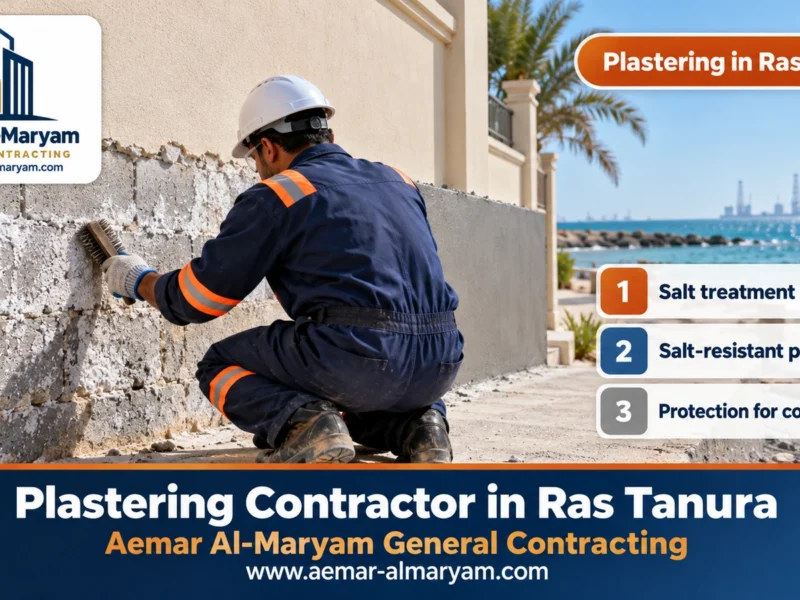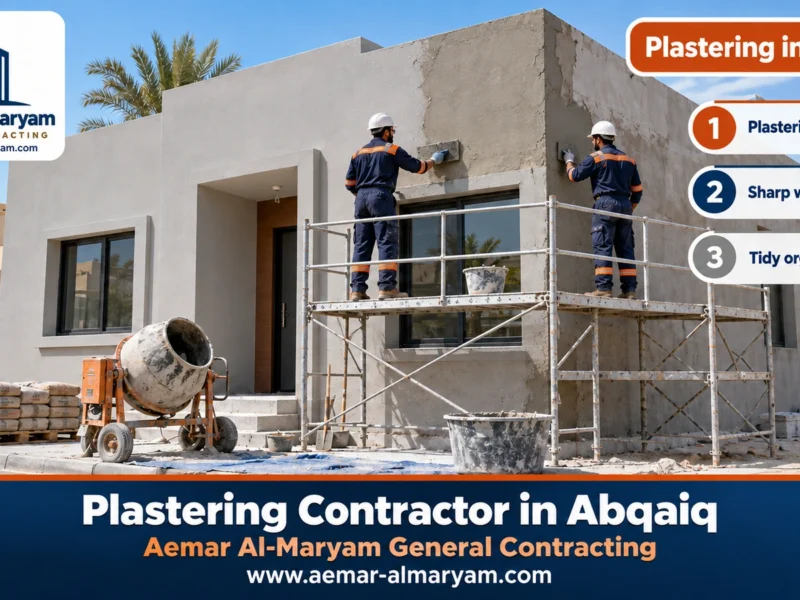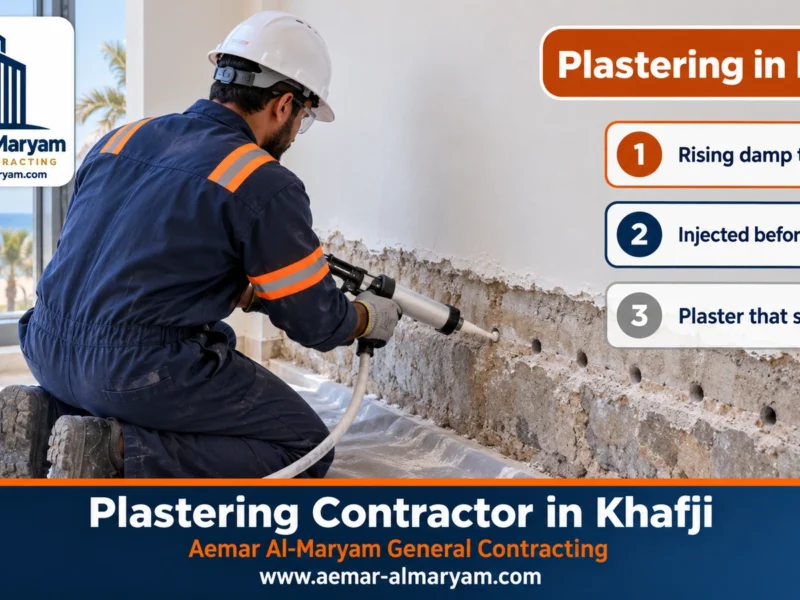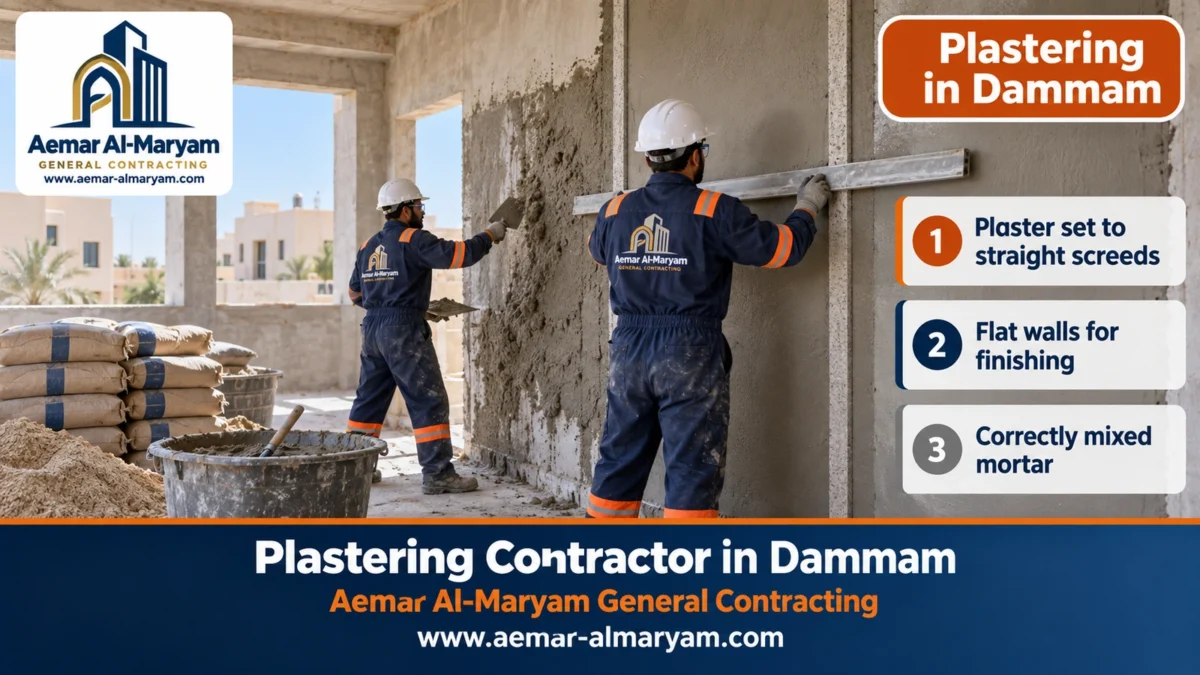
A plastering contractor in Dammam from Aemar Al-Maryam General Contracting plasters your interior walls and ceilings, renders facades and boundary walls, and strips and re-plasters tired old walls. Every job follows the same sequence: wet the background, apply a scratch coat on smooth concrete, set dots and screeds to a level, then rule the plaster off with a long straightedge, with mesh over every block-to-concrete joint and several days of water curing afterwards. Labour-only interior plaster starts from SAR 6.5 per square metre, screeded interior plaster with corner beads from SAR 11, interior plaster including materials from SAR 13 and external plaster from SAR 14. Treat them as provisional: they are confirmed once we have seen the walls and agreed the work. To reach us, ring or WhatsApp 0547879578.
Plaster is the layer nobody notices once the paint goes on, yet it decides how a house looks for years. Is the wall flat or wavy under the hallway light? Is the corner crisp or chipped? Does a straight crack appear beside the column after the first summer? Do white salts creep up the bottom of the wall? Almost all of this is settled on the day the plaster is applied: by the mix, the coat thickness, how the wall was wetted and how the plaster was cured afterwards. This page gathers what a homeowner, landlord or site manager in Dammam needs before agreeing a plastering job: the types of plaster, the working sequence, typical mixes and thicknesses, common defects and their causes, our starting prices, and a worked example so you can estimate your own area.
Plastering in Dammam at a glance
- What we do: internal plaster for bedrooms, halls, majlis rooms, ceilings and stairwells; external render for facades, boundary walls and annexes; re-plastering of old walls; internal gypsum plaster; and coloured render.
- How we do it: wet the background, scratch coat on concrete, dots and screeds set with a level, a coat of roughly 15–20 mm ruled off with a straightedge, mesh over every block-to-concrete joint, and metal beads on external corners.
- Prices start from: SAR 6.5/m² basic interior labour, SAR 11/m² screeded interior labour with beads, SAR 13/m² interior including materials, SAR 14/m² external labour, SAR 18/m² external including materials and SAR 23/m² to strip and re-plaster an old wall. Provisional until we inspect and agree.
- After plastering: cement plaster is kept damp for about 7 days and is not painted until it has dried properly.
- Where we work: all of Dammam, and we travel to Al Khobar, Jubail, Qatif, Saihat, Dhahran, Al-Ahsa and other Eastern Province towns.
- To order: send photos of the walls and rough sizes on WhatsApp 0547879578, or call us directly.
Plastering contractor in Dammam: what we plaster and how we take on the job
A plastering contractor in Dammam takes a wall after the blockwork or after old plaster has been removed, and hands it back flat, sound and ready for skim, paint or tiles. We handle the whole job: measuring the areas, supplying materials or working with yours, preparing the background, setting the line and level, curing the plaster and finally checking it with a straightedge and a tap test before handover.
■ Internal plaster
Walls of bedrooms, halls, majlis rooms, corridors and stairwells, plus concrete ceilings.
■ External render
Villa and building facades, boundary walls and annexes, in a richer mix and two coats.
■ Re-plastering
Stripping loose or salt-damaged plaster in older houses and replacing it properly.
■ Patching and repairs
Making good after electrical and plumbing chases, and repairing hollow or broken areas.
■ Gypsum plaster
A smooth gypsum coat for dry interior walls when time is short.
■ Coloured render
A through-coloured cement finish for boundary walls and some facades, with no paint over it.
Our plastering work in Dammam falls into three kinds of project. New buildings where the blockwork and services are finished and the walls are waiting for plaster. Occupied homes where one room, a hall or a facade is being refinished. And older buildings where damaged plaster has to come off before renovation can start. Each needs a different order of work. On a new build we start only after the electrical and plumbing first fix is complete, so nobody cuts into fresh plaster later. Where people are living, the work moves one room at a time with floors and furniture covered. In an older building we deal with the cause of the damage first. A condensed overview lives on our plastering service page.
Plasterer or plastering contractor in Dammam? The difference and how to choose
An individual plasterer in Dammam suits small jobs you can supervise yourself; a plastering contractor suits larger areas and work that needs materials, equipment, a schedule and someone accountable for the result. A plasterer (known locally as a «mallis») mostly sells his time and skill: you usually buy the cement and sand, keep an eye on quantities, and make sure the wall is wetted and cured. A contractor gives you clear line items instead: areas, method, materials, a price per item and a duration.
| Comparison | Individual plasterer | Plastering contractor |
|---|---|---|
| Best for | Patches, one room, filling service chases | A flat, villa, building or full facades |
| Materials | Usually bought by the owner | Supplied by the contractor, or yours by agreement |
| Screeds and corner beads | Depends on the individual and his time | A written line item |
| Water curing | Often left to the owner | Part of the job and the schedule |
| Pricing | Day rate or per metre | Per square metre, item by item |
Plasterer in Dammam: how to spot a capable one
You can tell a capable plasterer in Dammam before any mortar touches the wall. Ask him how he will keep the wall straight. If the answer is “by eye”, expect waves. If he talks about dots and screeds, a spirit level and a long straightedge, a scratch coat on the concrete, mesh at the columns and wetting the plaster afterwards, he knows the trade. Ask to see a wall he finished, lit from the side, rather than a photo taken from across the room.
Plastering in an occupied home in Dammam
Plastering inside a lived-in house is a different job from a building site: dust, water and dropped mortar, with children coming and going. We split the work room by room, cover floors with polythene and card, close the room off with a sheet, take rubble out every day and keep sockets and air-conditioning units protected. Working hours and the rooms you keep using are agreed with you before we start.
Day rate or price per square metre?
A day rate works for short, open-ended tasks: patching after the plumber, closing up openings, repairing a corner. For rooms, flats and facades a price per square metre is clearer, because you know the cost before work starts and it does not grow if the work is slow. We price per square metre for each item, and price small scattered repairs after seeing photos of them.
Internal plastering in Dammam: walls, ceilings and stairwells
Internal plastering in Dammam is usually a single cement coat about 12–15 mm thick on reasonably true blockwork, spread between screeds set with a level, ruled off with a straightedge and floated to an even surface ready for skim and paint. Out-of-true walls may need more, and then the plaster is built up in two coats rather than one heavy coat, because a thick single coat sags and parts from the wall.
Each room has its own details. Halls and majlis rooms need very flat walls, because long walls and side lighting expose every wave. Bedrooms need attention around air-conditioner and curtain positions. Kitchens and bathrooms need cement plaster rather than gypsum because they are wet rooms, and the parts that will be tiled are left with a rougher surface to help the adhesive grip. Electrical and plumbing chases are filled with mortar and covered with a mesh strip before plastering so their line never ghosts through the paint.
Plastering ceilings and stairwells in Dammam
A concrete ceiling is harder to plaster than a wall: the concrete is smooth and absorbs little water, and the plaster is working against gravity. We therefore apply a scratch coat to the ceiling first and let it firm up, then lay a relatively thin coat rather than a heavy one. In stairwells the screeds have to follow the changing slopes and angles, and we take extra care with the edges of the flights and the tall wall that everyone sees as they enter the house.
Levelling screeds under floor tiles
What some people call “floor plastering” is really a cement levelling screed laid on a room floor or roof to correct the level and falls before tiles or waterproofing. It differs from wall plaster in thickness and mix. We set its level with a spirit level on reference points, much like wall screeds, and respect the height difference between the hall, the kitchen and the bathroom, plus drainage falls on courtyards and roofs. If tiling follows, we agree the levels from the start so the screed is not broken out later.
Plaster corner beads in Dammam: straight, protected corners
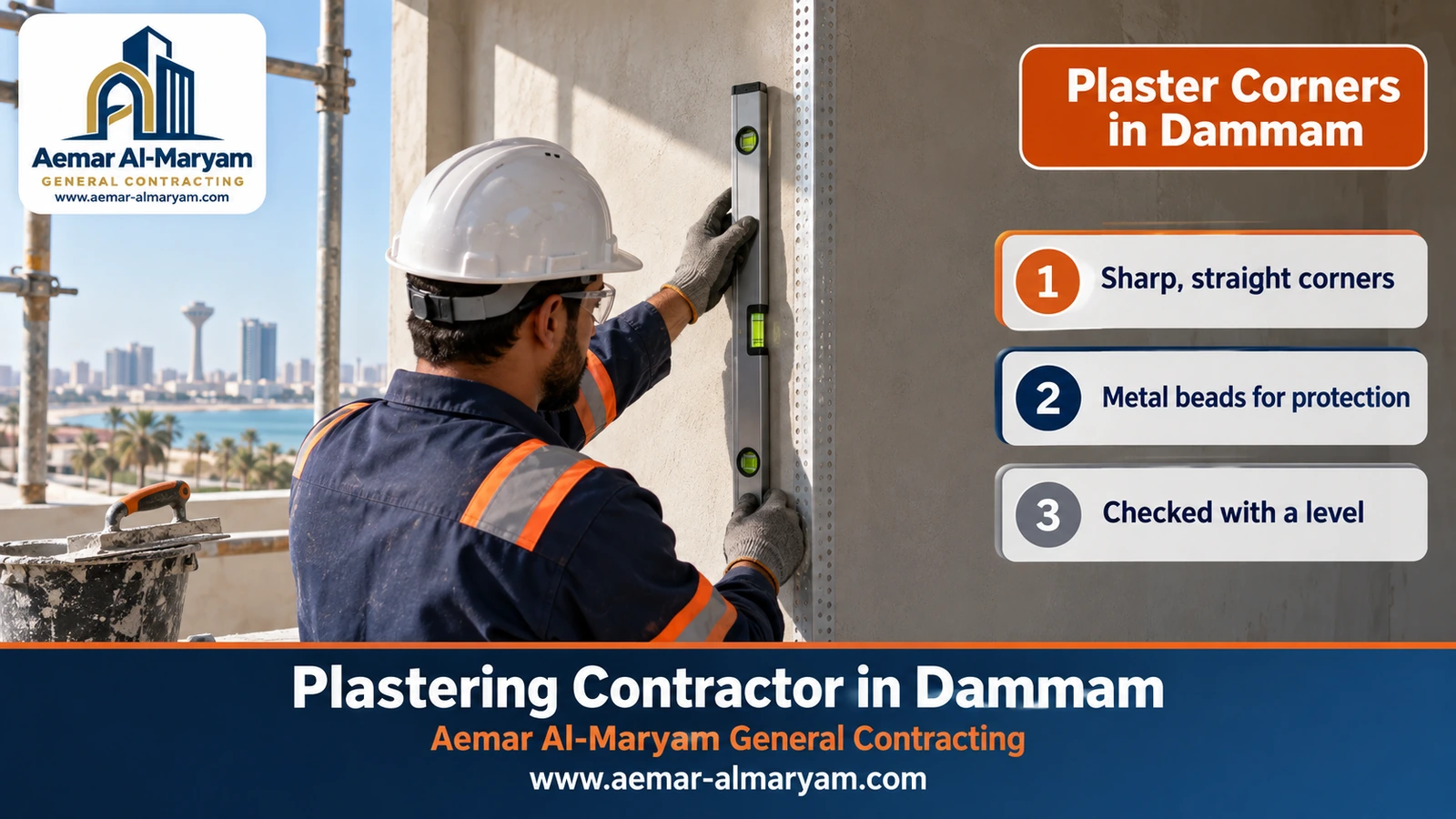
Plaster corners in Dammam are formed with perforated metal or plastic beads fixed plumb to the corner before plastering. The bead becomes a straight reference edge and protects the arris from knocks. External wall corners and the reveals around doors and windows take the most impact, and a chipped or bowed corner stays obvious even after painting.
External rendering in Dammam: facades, boundary walls and annexes
External rendering in Dammam is normally applied in two coats with a total thickness of about 18–20 mm, in a mix richer in cement than internal plaster, with a waterproofing admixture where the specification calls for one. A facade in the Eastern Province faces strong sun, big swings between day and night temperatures, coastal humidity and salts, and any weakness in the render shows quickly as fine cracks or hollow patches.
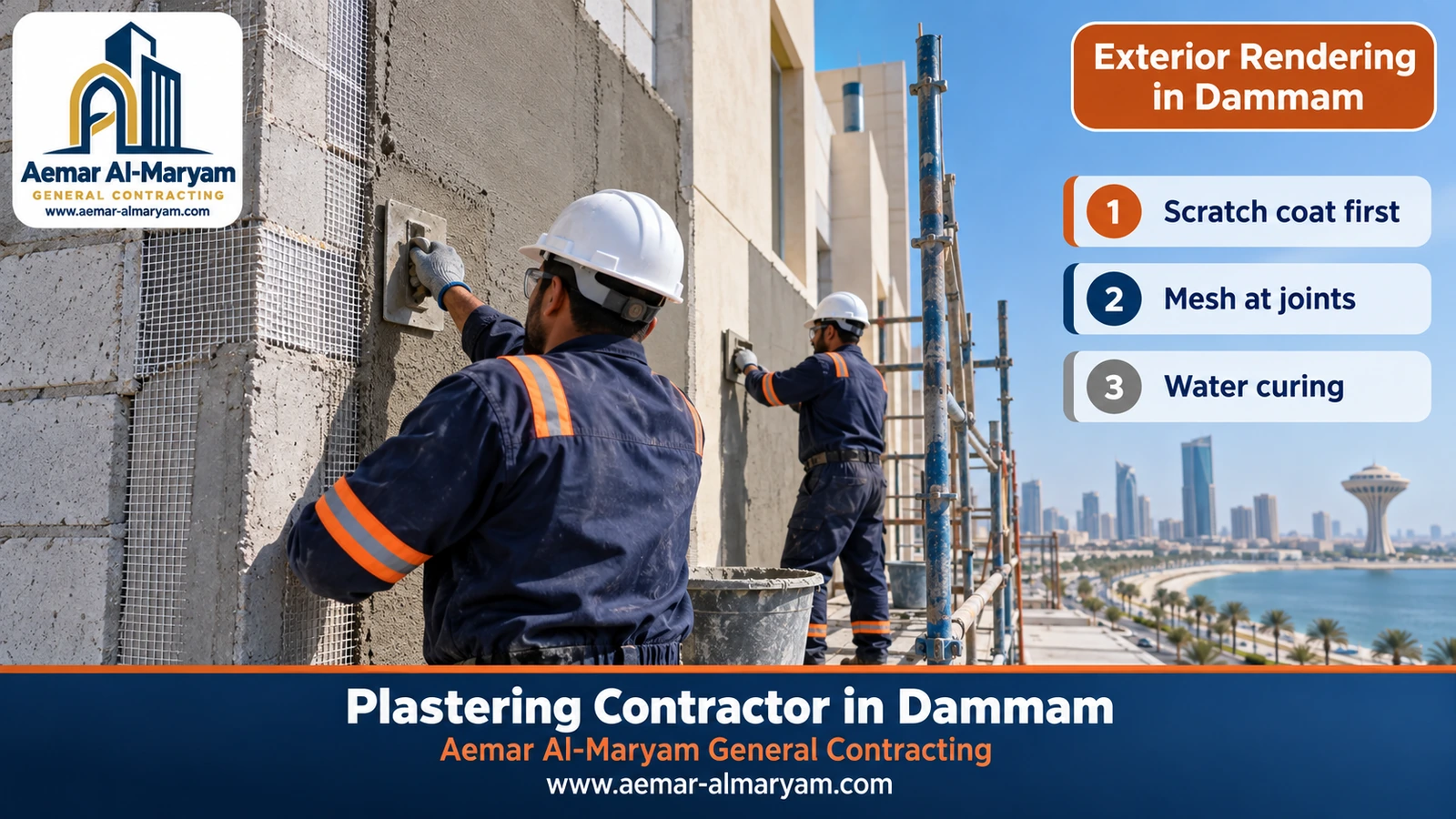
We work a facade from the top down on a fixed scaffold, break it with joints where the background changes or over long runs, fix mesh over every junction between blockwork and columns or beams, and take care with window sills, balcony edges and the small ledges above them so water does not sit there. During the hot months we schedule facade work for the cooler hours at either end of the day, and spray the facade morning and evening for several days after rendering.
Coastal facades and salts
Research on buildings in the Eastern Province links their early deterioration to salts and chlorides in the coastal environment and to groundwater close to the surface at many sites. Those same factors reach the render. So on facades we insist on details that are easy to skip: washed sand and clean water rather than salty sand and water, not taking the render down into damp soil without protecting the base of the wall, and fixing any leak from a tank, AC unit or rainwater spout before the wall below it is rendered. A suitable exterior paint afterwards adds protection; it does not replace a sound render.
Rendering a building facade in Dammam
Rendering an apartment building facade in Dammam differs from a villa in scaffold size, how work is sequenced floor by floor, and protecting people walking below. Before pricing we need a full photo of the facade, the number of floors, its length, and whether it is shared with a neighbour or faces a narrow street, because access and scaffolding affect time and cost more than the square metres do.
Coloured render in Dammam
Coloured render in Dammam is a cement mix that carries its colour in the material, so it needs no paint and is popular for boundary walls and some facades. It does not peel the way paint can. On the other hand, later patches are hard to match to the original shade, and even colour depends on keeping the mix identical from one batch to the next. We therefore order materials for the whole area from one source and try to finish each wall without stopping.
Scratch coat, dots and screeds in Dammam: the basis of a straight wall
The scratch coat, dots and screeds are the stages before the plaster itself, and they are what separate a flat wall from one that reflects the hall lights in ripples. The scratch coat (locally «tartasha») is a strong, rough coat thrown hard onto smooth backgrounds such as concrete to give the plaster something to key into. Dots («bu’aj») are small pads of mortar set to a level at regular spacing. Screeds («awtar») are vertical strips run between the dots to form rails that the straightedge slides along.
- 1Wet the background
Absorbent blockwork is dampened so it does not suck water out of the mix; dense, smooth concrete is not soaked. Dust and any oil are removed first. - 2Scratch coat on concrete
A richer mix, around one part cement to two parts sand, is thrown on hard and left rough, then kept damp for at least 24 hours. - 3Dots
Pads of mortar roughly 1.5 m apart, set with a line and level to fix the finished plane of the plaster. - 4Screeds and beads
The dots are joined with straight vertical screeds, and metal beads are fixed on the corners. - 5Fill and rule off
The bays between screeds are filled and ruled off with a long aluminium straightedge until flat, then floated.
Why “by eye” and “screeded” plaster are priced differently
Plaster ruled off by eye is quicker and cheaper, but it leaves waves that the owner pays for later in extra skim. Plaster set out with dots, screeds and corner beads takes longer, which is why our price table lists it on a separate line.
Plaster mix ratios and thickness in Dammam: the numbers that matter
Typical cement plaster mixes run from about 1:4 to 1:6 cement to sand by volume; external render is usually richer (around 1:4), and the scratch coat richer still (around 1:2). The rule that matters more than any single number: a top coat should never be stronger or richer than the coat beneath it. A strong coat over a weaker one shrinks, pulls on what is underneath, and then debonds or crazes.
| Item | Typical value | Note |
|---|---|---|
| Scratch coat | About 1 cement : 2 sand | Thrown on hard, left rough, kept damp at least 24 h |
| Internal plaster | 1:4 to 1:5 | One coat of 12–15 mm on a true background |
| External render | About 1:4, waterproofing admixture where specified | Two coats totalling 18–20 mm |
| Ceilings | Thinner than walls | After a scratch coat on the concrete |
| Time between coats | About 2 days | Or until the first coat is firm enough to carry the second |
| Cement use | About one 50 kg bag per 10 m² | At roughly 2 cm thick and a mix near 1:4 |
These are guide values drawn from common plastering practice and published specifications for cement plaster. On any project the specification or drawing, where there is one, takes precedence.
Materials matter as much as proportions. Clean washed sand reduces shrinkage and salts; sand with clay in it raises shrinkage and causes crazing. Water should be clean and free of salt, and cement should be fresh and free of lumps. In areas exposed to damp, or near foundations affected by groundwater, a sulphate-resisting cement or special additives may be specified on an engineer’s advice.
Mesh at block-to-concrete joints in Dammam: why walls crack beside columns
Joint mesh in Dammam is a strip of metal or glass-fibre mesh fixed over the line where blockwork meets concrete columns and beams before plastering. The two materials expand and shrink by different amounts, so without reinforcement a straight crack appears exactly along that line. The strip is about 150 mm wide, centred on the junction, fixed firmly and then embedded within the plaster coat rather than sitting on top of it.
We also mesh over chased-in electrical and plumbing runs, around door and window openings in large walls, and over any wide patch where old meets new. Some walls that are likely to move more get mesh across the whole surface; that is a separate line in our price table.
⚠ Mesh does not cure a structural crack
Mesh controls plaster cracks caused by different materials and shrinkage. A crack running through both the plaster and the wall, a diagonal crack from the corner of an opening, or one that keeps widening needs assessment before any plastering. Our crack repair service explains when a crack is cosmetic and when it needs an engineer.
Machine-sprayed or hand plaster in Dammam? When each one fits
Machine plastering in Dammam means pumping a ready, pumpable mortar through a hose and spraying it onto the wall, then ruling it off with a straightedge exactly as with hand plaster. Its advantages are speed on large areas, a uniform mix because it is batched mechanically, and less waste. Its demands are continuous work, because pauses block the hose, daily set-up and cleaning, and ready-mixed materials made for spraying.
| Comparison | Machine (sprayed) plaster | Hand plaster |
|---|---|---|
| Best for | Apartment buildings, projects, large repetitive areas | Rooms, patches, occupied homes, small areas |
| Mix | Ready mortar, mixed mechanically | Cement and sand mixed on site |
| Speed | Much faster on big areas | Slower but flexible |
| Flatness | Still depends on screeds and the straightedge | Depends on screeds and the straightedge |
| Pricing | After inspection, by area and material | From SAR 6.5/m² labour |
A machine does not make a wall flat by itself; flatness always comes from dots, screeds and the straightedge. We recommend machine plaster where the area is large and the work can run continuously. For a single room, an occupied house or repair work, hand plaster is the better fit and causes less disruption.
Gypsum plaster or cement plaster in Dammam?
Gypsum plaster in Dammam is a ready-mixed gypsum-based material mixed with water and spread on interior walls. It sets in about half an hour, needs no water curing, can be painted after a few days, and shrinks very little, so it cracks less. It is not suitable for external walls, nor for bathrooms, kitchens or walls that get damp, because gypsum weakens with water.
| Comparison | Gypsum plaster | Cement plaster |
|---|---|---|
| Where | Dry interior walls and ceilings | Interior, exterior and wet areas |
| Setting and drying | Sets in about 30 minutes, dries in days | Takes weeks to dry fully |
| Water curing | Not needed | About 7 days of spraying |
| Painting | After roughly 3–4 days | Once properly dry; full cure can take up to 28 days |
| Our price | From SAR 41/m² with materials | From SAR 13/m² interior with materials |
Gypsum plaster is not the same as gypsum board. The first is a wet coat spread onto the wall; the second is boards fixed onto a metal frame for dropped ceilings and light partitions. If you are planning that kind of work, our finishing service covers it.
Re-plastering old walls in Dammam
Re-plastering old walls in Dammam starts by removing the weak plaster back to a sound edge, not by putting a new coat over the old one. We tap the wall to map hollow areas, look for salts and damp and ask where they come from, then strip what is needed, clean and wet the blockwork, apply a scratch coat where required and plaster again with screeds as if the wall were new.
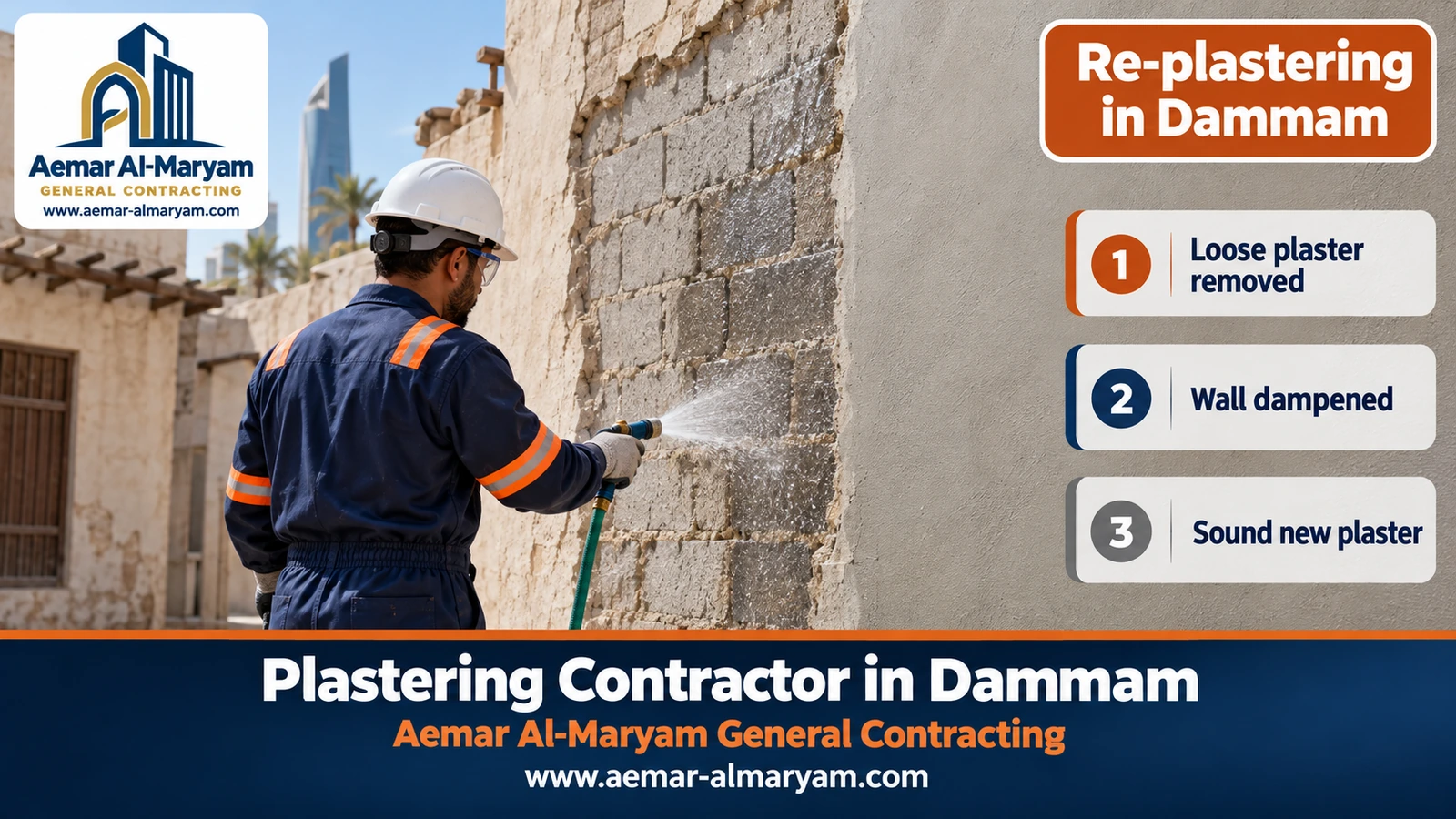
In many Eastern Province houses the reason plaster fails at the bottom of walls is water: a plumbing leak, or groundwater close to the surface rising by capillary action and carrying salts with it. Re-plaster without dealing with the source and the salts and blistering come back in the same place. So we stop the source first, or hand it to whoever should, and then re-plaster. You will find more on why buildings here deteriorate in our guide to a renovation contractor in Dammam.
When is a patch enough?
If the plaster is sound and the defect is confined to a small area (a hole, a service chase, a broken corner), a patch with a mesh strip is enough. If hollowness is widespread or salts show on more than one wall, re-plastering costs less than patches that keep coming back.
Curing plaster with water in Dammam: how many days and how
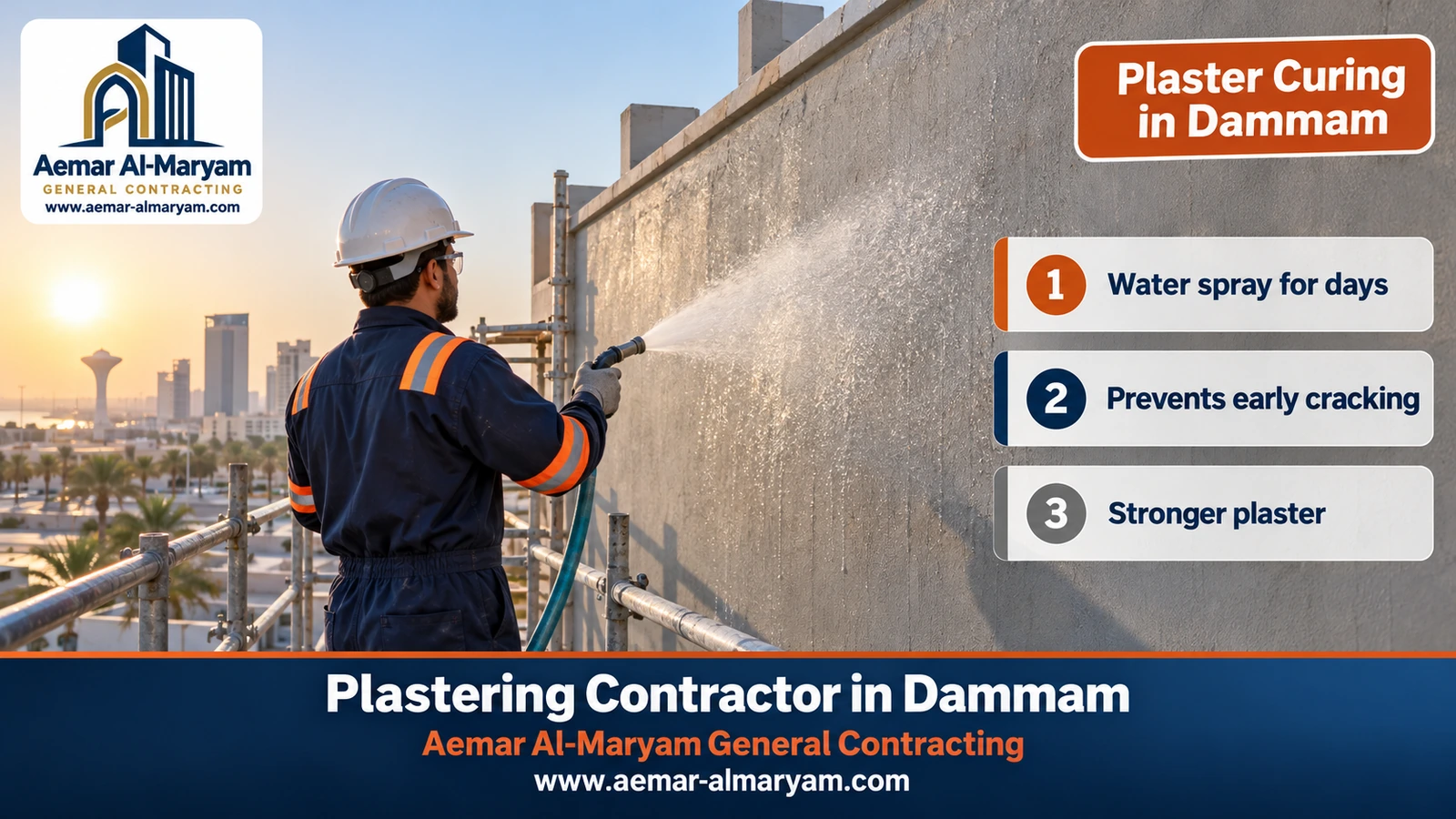
Curing plaster in Dammam means spraying it lightly for about 7 days, early in the morning and late in the day, because cement needs water to finish hardening. Fast drying under Eastern Province sun and wind causes shrinkage, crazing and poor bond. Curing does not mean soaking the wall; it means keeping it damp.
- In summer we start early and avoid laying plaster in direct sun or on days of heavy dust and wind.
- South- and west-facing facades dry faster, so they get sprayed more often.
- Closed rooms dry more slowly, so a lighter spray with moderate ventilation is enough.
- Cement plaster is not painted until it has dried properly, and full curing can take up to 28 days. The order of painting after plastering is explained by our painting contractor in Dammam.
Plaster defects and their causes in Dammam: cracks, hollowness and salts
Plaster defects in Dammam usually have well-known causes, and the cause decides the fix: a surface repair, removing the coat, or a problem in the wall itself rather than in the plaster.
| Defect | What you see | Most common cause | Fix |
|---|---|---|---|
| Crazing and fine cracks | Thin branching lines on the surface | Fast drying, cement-rich top coat, dirty sand, over-floating | Fill the fine cracks; redo the top coat if widespread |
| Straight crack at a column | A vertical or horizontal line on the concrete edge | No mesh over the joint | Open up, fix mesh, re-plaster |
| Crack through the wall | Diagonal from an opening, or widening | Movement in the building | Assessment before any plastering |
| Hollowness and debonding | Drummy sound when tapped, bulging | Smooth concrete with no scratch coat, dry or dusty background, over-thick coat, strong coat over a weak one | Remove back to sound edge, scratch coat, plaster in coats |
| White salts (efflorescence) | Powdery white patches low on the wall | Water carrying salts through the wall; salty sand or water | Stop the water, then dry out and clean |
| Waviness | Uneven reflections under light | No screeds, or rushed work | Level with skim or redo the coat |
Very fine hairline cracks (under about 0.2 mm) in cement render are well known and do not affect its performance; they usually disappear under skim and paint. A crack that returns or widens is a message from the wall that needs reading before any patching. Our renovation service covers crack categories and when an engineer is needed.
Plastering price per square metre in Dammam: our “starts from” table
Our plastering price in Dammam starts from SAR 6.5 per square metre for basic interior labour with your materials, SAR 11 for screeded interior plaster with corner beads and SAR 13 including materials; external render starts from SAR 14 for labour and SAR 18 including materials. We arrived at these numbers by checking the rates that local Dammam and Eastern Province contractors advertise and pricing beneath them, but each figure is a floor: the final price is fixed after we see the wall.
| Item | Unit | Starts from |
|---|---|---|
| Basic interior plaster, labour only (your materials) | m² | SAR 6.5 |
| Interior plaster with dots, screeds and corner beads (labour) | m² | SAR 11 |
| Interior plaster including materials (cement and washed sand) | m² | SAR 13 |
| Ceiling plaster | m² | SAR 14 |
| External render, labour only | m² | SAR 14 |
| External render including materials | m² | SAR 18 |
| Smooth paint-ready plaster finish | m² | SAR 17 |
| Plaster with glass-fibre mesh over the whole surface | m² | SAR 20 |
| Kitchen and bathroom wall plaster | m² | SAR 18 |
| Removing old plaster only | m² | SAR 7.5 |
| Re-plastering an old wall (strip and new plaster) | m² | SAR 23 |
| Treating cracks in a room’s walls before painting | room | SAR 140 |
| Internal gypsum plaster including materials | m² | SAR 41 |
| Coloured render including materials | m² | SAR 32 |
| Machine-sprayed plaster for large areas | — | After inspection |
| Hollow plaster or salts at the base of walls | — | After inspection |
Treat each number as provisional pending our site visit and your agreement; it moves with the condition of the wall, the thickness required, the working height, access and the size of the job. Where the table says “after inspection”, photograph the wall, add its measurements and message them to 0547879578 so we can price it for you.
What pushes the price above the floor? An out-of-true wall that needs a thicker coat or two coats, height that needs scaffolding, a facade on a narrow street, small scattered areas on several floors, stripping old plaster and carting the rubble away, and working in an occupied home that needs protection and daily cleaning. What brings it down? A large continuous area, true blockwork, and easy access.
Worked example: plastering a 4 × 5 m room in Dammam
This illustrates the calculation; it is not a quotation. Take a room 5 m long, 4 m wide and 3 m high:
- Walls: (4 + 5) × 2 × 3 gives 54 m²; deduct the door opening (≈2 m²) and the window (≈1.5 m²) to leave 50.5 m².
- Ceiling area: 4 × 5 = 20 m², so the total is about 70.5 m².
- Basic labour with your materials: 70.5 × 6.5 ≈ SAR 458.
- Screeded labour with beads: walls 50.5 × 11 ≈ SAR 556 and ceiling 20 × 14 = SAR 280, about SAR 836 in total.
- Including materials: 70.5 × 13 ≈ SAR 917.
- Approximate cement: about seven 50 kg bags at close to 2 cm thick.
And a quick external example: a net facade area of 280 m² starts from about SAR 3,920 for labour and about SAR 5,040 including materials, with scaffolding and height added after inspection.
How is plaster measured?
Each wall is measured length times height, and the ceiling is added if it is part of the job. Common practice is to deduct large openings (above roughly 2 m²) and not small ones, because their reveals take time to form. Since practice varies from one contractor to another, we write the measuring method into the agreement before starting and measure with you at handover.
What a plastering agreement should include
A clear agreement prevents most disputes after the work is done, because the word “plaster” on its own covers very different methods and prices. Before starting with any contractor or plasterer, make sure the agreement states:
- Areas for each item (internal, external, ceilings, re-plastering), with the measuring method and how openings are treated.
- Method: ruled by eye or set out with dots and screeds, and whether corner beads and joint mesh are included.
- Materials: who supplies them, the cement and sand to be used, and any admixtures for facades.
- Expected thickness, and what happens if a wall needs more than usual.
- Water curing: how many days, and who does it.
- Scaffolding, rubble removal and site cleaning.
- Duration, a payment schedule tied to completed stages, and how handover is checked.
How long does plastering a room or villa take in Dammam?
A small, ready room usually needs about one working day for the plaster itself, while large halls and complex work take two to three days or more, followed by the curing days before skim and paint. A villa or apartment building depends on the number of crews, the area, the facades and the scaffolding, and we write the duration into the agreement after inspection. We do not recommend squeezing the schedule at the expense of wetting and the time between coats: any day saved there is paid back later in repairs.
Can you paint without plastering?
Sometimes, on interior walls built from very true blockwork or smooth concrete, with a skim or thin coat before painting, and in stores and service annexes. It does not suit facades, out-of-true walls or wet areas, because blockwork absorbs water and its joints and defects show through the paint. We decide after seeing the wall.
How plastering is carried out in Dammam, stage by stage
Whether it is a single room or a whole building, we plaster in Dammam in the same fixed order, because any stage that gets skipped resurfaces in the wall later:
- 1Inspection and measuring
We look at and tap the walls, measure areas and decide the likely thickness and where mesh and beads are needed. - 2Written agreement
Items, areas, materials, measuring method, price, duration and who does the curing. - 3Site preparation
Confirming the electrical and plumbing first fix is complete, covering floors and windows and setting up scaffolding. - 4Background preparation
Cleaning and wetting, a scratch coat on concrete, and mesh over joints and chases. - 5Dots, screeds and beads
Setting the plane with a level and fixing metal beads on the corners. - 6Applying and ruling off
One or two coats depending on location, ruled with a straightedge and floated. - 7Water curing
Regular spraying of cement plaster for about 7 days. - 8Checks and handover
Straightedge, tap test and side lighting, snagging, then cleaning the site.
Accepting finished plaster: what to check yourself
- ✓Flatness: hold a long straightedge (at least 2 m) against the wall in different directions and look at the gaps beneath it.
- ✓Plumb: a spirit level on the wall and on door reveals.
- ✓Corners: straight, crisp, unbroken arrises.
- ✓Bond: tap the wall with a screwdriver handle; a hollow sound means debonded plaster.
- ✓Side light: a torch held parallel to the wall shows waves before the paint does.
- ✓Edges: clean lines around socket boxes and door and window frames.
Plastering mistakes we see in Dammam, and how to prevent them
Plastering mistakes in Dammam repeat because most of them save time on the day and cost more afterwards. The list below comes from walls we have been asked to strip and redo:
■ Plastering a dry wall
The blockwork pulls water out of the mix, which weakens and parts. Fix: wet the wall first.
■ No scratch coat on concrete
Plaster has nothing to key into on a smooth surface, so it goes hollow.
■ One thick coat
It sags and debonds; anything beyond the normal thickness is built up in coats.
■ Joints without mesh
A straight crack beside every column within months.
■ Forgetting to cure
Crazing and a weak surface that shows after painting.
■ Plastering before services
Cutting the wall open again for cables and pipes.
Plastering within renovation and finishing in Dammam
Plastering in Dammam is one link in a chain, and getting the order right saves you doing work twice. On a new build it comes after the blockwork and services and before tiles and paint. In renovation it comes after cracks, damp and rusted reinforcement have been treated, not before. Because we are a general contractor, we can carry out what comes before and after plaster under one agreement if you wish.
- New buildings and annexes: our construction service, and the guide to building annexes and majlis rooms.
- Older houses: our renovation service and the renovation contractor in Dammam guide.
- After plastering: our painting service and finishing service.
- To see examples of our work: the projects gallery.
Plastering beyond Dammam: Al Khobar, Jubail, Qatif and other Eastern Province towns
Our crews plaster in every part of Dammam. A few of the districts we regularly work in: King Fahd Suburb; Al Athir; Al Anud; Al Badiyah; Al Nada; Ghirnatah; Al Shulah; Al Rayyan; Al Fursan; Al Manar; Al Firdaws; Al Hamra; Al Qadisiyah; Al Jalawiyah; Al Khaleej; Al Rawdah; Uhud; Taibah; Al Noor; Badr; Al Mazruiyah; Al Faisaliyah; Al Shati; Ibn Khaldun; Al Itisalat; Al Jamiyin. If your district is not named here, it is still covered.
Beyond Dammam we reach Al Khobar, with districts like Al Thuqbah, Al Hada, Al Aqrabiyah and the southern side of the city, then Jubail, Al-Ahsa, Saihat, Qatif and Dhahran, and further out Khafji, Ras Tanura, Hafr Al-Batin and Abqaiq. The further the city, the more the trip adds to the price, which we set at inspection; combining your plaster, paint or repair items into a single visit spreads that cost thinner. Our Dammam page lists our other services in the city.
Ordering plastering in Dammam: the photos and details to send us
Ordering a plastering contractor in Dammam starts with a message to 0547879578 on WhatsApp. Include the points below with your photos and we will answer with our technical opinion and a rough figure before fixing a visit date:
- ✓Photos of the walls: a full shot of each wall or facade, and a close-up of any hollow area, salts or crack.
- ✓Measurements: each room’s length, width and height, or the facade’s width and how many storeys it has.
- ✓Type of work: internal, external or re-plastering, and whether the building is new or occupied.
- ✓Materials: whether you will supply them or want us to.
- ✓Where: your district, or drop a pin on the map.
- ✓When: your preferred start date, and whether electrics and plumbing are already in.
Why Aemar Al-Maryam for plastering in Dammam?
■ A written method
Scratch coat, screeds, beads, joint mesh and curing, all listed in the agreement.
■ Open pricing
Each item shows its minimum on this page; the binding price is set after a look at your walls.
■ Labour or full supply
We work with your materials or supply them, and the table shows the difference.
■ What comes before plaster
We treat cracks, damp and service chases first, because we are a general contractor.
■ A clean site
Floors and windows protected and a clean-up after every stage.
■ Real photos
Examples from finished projects in our projects gallery.
Get your walls plastered in Dammam
Photograph your walls and send them over, or simply ring us. We suggest the right method for each wall, give you a first figure and fix a day to come and look, in Dammam or a nearby town.
Related pages
Article tags