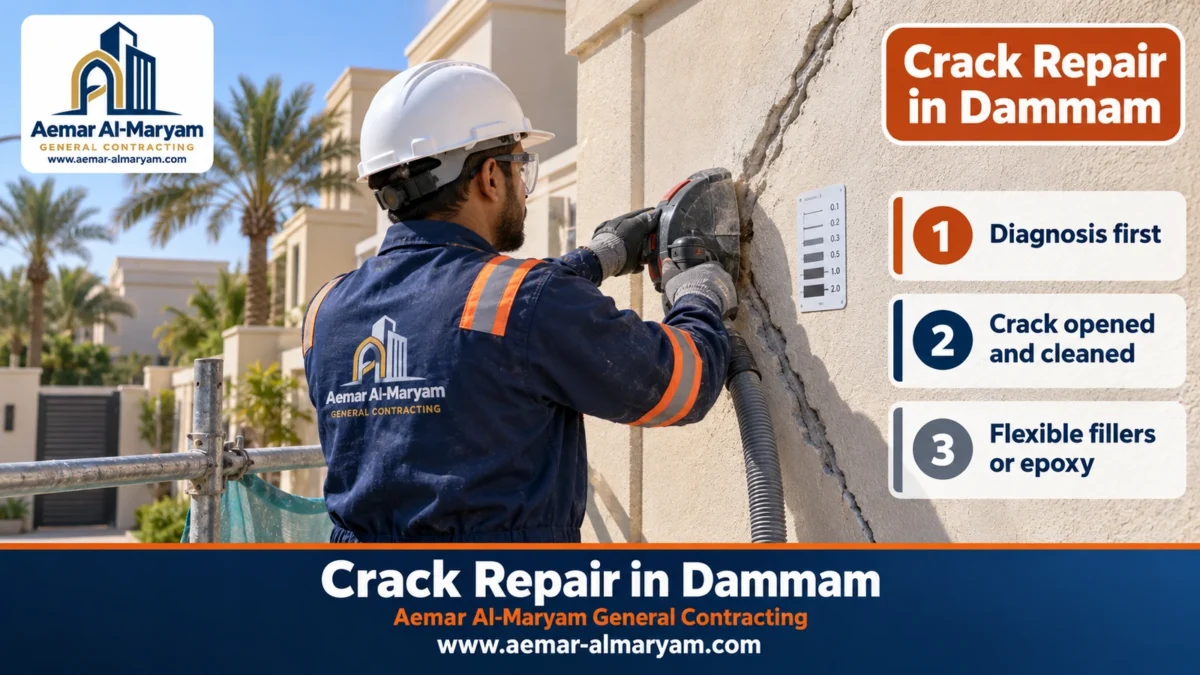
Crack repair in Dammam starts by reading the crack before touching it: how wide is it, where is it, and is it still opening? Then the cause is dealt with, and only after that is the right repair chosen, whether that is fibre mesh and a flexible filler, opening and filling with mortar, epoxy injection, or an engineer’s report before any work at all. At Aemar Al-Maryam General Contracting we repair cracks in interior and exterior walls, ceilings, columns, beams and boundary walls in Dammam and across the Eastern Province. Injecting a crack costs from SAR 32 for each linear metre, and preparing the cracks of a whole room for repainting from SAR 140; these are provisional figures, confirmed once we have seen the site and agreed the work. Ring or message us on 0547879578.
Most people who contact us are not really asking “how do I fill this crack?” They are asking “is this crack dangerous?” That is the right question. A hairline line in the living-room plaster has nothing in common with a diagonal crack running out of a window corner, or a crack that follows the steel in a ceiling slab with a rust stain beside it. This guide explains the crack types we see in Dammam homes and apartment buildings, how to tell a crack that has stopped from one that is still moving, when a skilled technician is enough and when a structural engineer must step in, the correct method for each type, the prices we start from, and what to send us on WhatsApp so you get an estimate quickly.
In short: crack repair in Dammam with Aemar Al-Maryam
- Cracks we handle: plaster and interior wall cracks, facade and exterior wall cracks, ceiling cracks, column and beam cracks, boundary wall cracks, and the wall damage that comes with foundation settlement.
- Methods: fibre mesh and flexible filler, V-groove opening and filling, flexible sealant for moving cracks, epoxy injection, polyurethane injection for wet cracks, and bar stitching once an engineer has decided on it.
- Prices from: injection from SAR 32 a linear metre; room crack treatment ahead of painting from SAR 140; SAR 20/m² for fibre mesh with local re-plastering; SAR 830 for a column cracked by rebar corrosion. Prices are estimates until inspection and agreement.
- When you need an engineer: a crack 5 mm or wider, a crack of any size in a column or a beam, a diagonal crack from an opening corner, a crack that keeps widening, or cracking together with sticking doors and sloping floors.
- The key rule: no crack gets painted before we know its cause and whether it is dormant or live; otherwise it comes back in the same place within months.
- Coverage: all Dammam districts, as well as Jubail, Qatif, Saihat, Al Khobar, Dhahran, Al-Ahsa and other Eastern Province cities.
- Contact: call or WhatsApp 0547879578 with a close-up photo of the crack next to a ruler and a wider photo showing where it is.
Crack repair in Dammam: what we fix and where we start
Crack repair in Dammam, the way we do it, goes through three stages and we never skip one: a diagnosis that identifies the crack type and its cause; dealing with that cause, or confirming that it has stopped; and finally repairing the crack itself and restoring the finish over it. Many of the cracks we are called to have already been “fixed” once or twice with filler and paint, and came back because the first stage never happened.
The repair also depends on which element has cracked, so we split the work into clear groups. You can order one of them or combine several in a single visit:
■ Interior walls and plaster
Hairline and fine cracks in halls, rooms and corridors, treated with mesh and flexible filler, or opened, filled and then repainted.
■ Facades and exterior walls
Cracks where blockwork meets concrete, and render cracking from heat and salts, finished with a moisture-resistant exterior paint.
■ Ceilings and slabs
Cracks in ceiling plaster, cracks running along the reinforcement, and spalling that exposes steel, with the water source above dealt with first.
■ Columns and beams
Corrosion cracks, diagonal and horizontal cracks, repaired by injection or by rebuilding the section according to the engineer’s report.
■ Boundary walls and annexes
Vertical cracks at piers, diagonal cracks from local settlement, and cracking in yards and entrances.
■ Settlement cracking
Monitoring and documenting first, then carrying out what the structural engineer decides after checking soil and footings, and repairing the walls last.
For a brief overview, visit our crack and fissure repair page. If the cracks are part of a home that needs wider work, such as spalling ceilings, bathroom leaks or failing plaster, our guide to renovation contractor services in Dammam covers full renovation.
Choosing a crack repair company in Dammam: what a proper repair looks like
If you are looking for a crack repair company in Dammam, the real difference between one firm and another is not a “miracle” product. It is the questions asked before work begins. A team that reaches for filler and paint before asking how old the crack is, whether it is growing and where exactly it sits is selling you a temporary cosmetic fix. Aemar Al-Maryam is a Dammam-based general contracting establishment with technicians who specialise in injection, plastering, painting and concrete repair, and we bring in a structural engineer whenever a case goes beyond finishing work.
Compare the offers you receive against these points before you compare the figures:
| Point | A proper repair | A quick fix that comes back |
|---|---|---|
| Diagnosis | Width measured, direction and location noted, history of the crack asked about | A quick look and “we’ll fill it and paint it” |
| Cause | Treated, or confirmed to have stopped, before the repair | Never mentioned |
| Material | Chosen by crack type: flexible for moving cracks, epoxy for stable ones, polyurethane for wet ones | One product for every crack |
| Structural cracks | Referred to an engineer, whose report is then carried out | Covered with fresh plaster |
| Pricing | Per linear metre, per room or per element, with the scope stated | A lump sum with no breakdown |
One question that reveals experience
Ask whoever inspects the crack: “Is this crack dormant or still moving, and how do you know?” Someone who knows the trade will talk about measuring and monitoring, not about paint colours.
Wall crack repair in Dammam
Wall crack repair in Dammam depends on how deep the crack goes, not on how it looks. If it is only in the plaster and paint, the repair is a finishing job; if it reaches the blockwork or concrete, it needs opening and filling or injection; and if it is part of movement in the building, the cause has to be treated first. That is why we always start by tapping gently around the crack to find out whether the plaster is still bonded or has come away from the wall.
In Dammam homes, three places crack more than any others: the corners of doors and windows, the line where a block wall meets a column or beam, and the lower part of walls near the ground, where damp and salts rise. Each tells a different story. A crack at a window corner may be ordinary shrinkage or it may be a sign of settlement; a crack along the block-to-concrete line is usually thermal movement between two materials; and a crack low on a wall is usually plaster broken down by salts.
Plaster and interior wall cracks in Dammam
Plaster cracks on interior walls in Dammam are mostly hairline or fine. They appear a few months after finishing, as the mortar shrinks while it dries, or because materials move differently as temperatures change between summer and winter and between the hours the air conditioning runs and the hours it is off. These cracks do not affect the safety of the building, but they spoil the paintwork and return if they are sealed with a rigid filler.
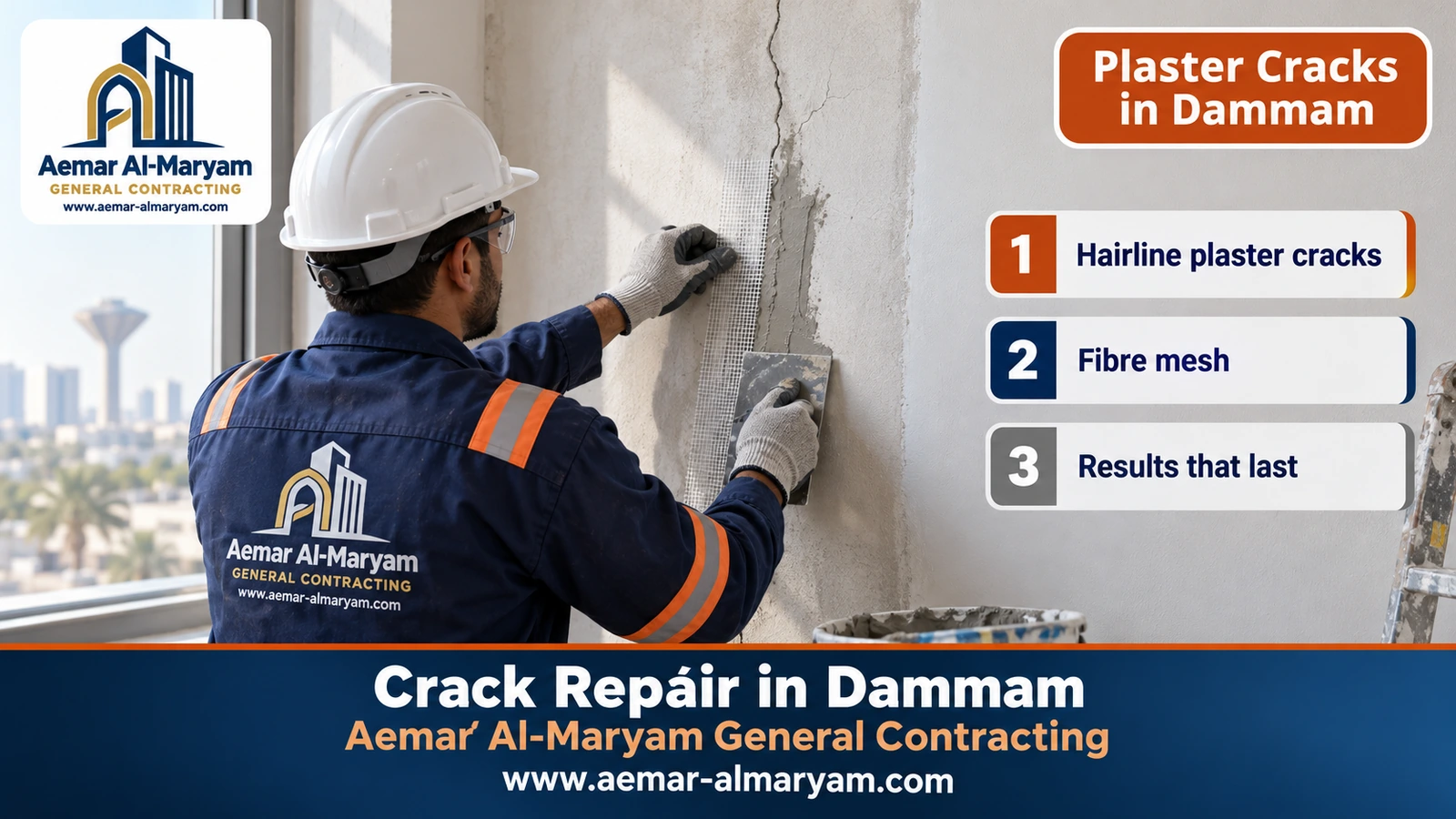
This is the method we follow for interior plaster cracks:
- 1Tap and check
We tap around the crack. A hollow sound means the plaster has debonded and must be removed back to sound material. - 2Open the crack slightly
We widen a fine crack into a narrow V with a sharp tool, so the filler has a key to grip instead of sitting as a skin on top. - 3Clean and prepare
Dust and loose material are removed, and the surface is dampened or primed with a bonding agent to suit the mortar used. - 4Fill
We fill with the right material: a flexible filler or sealant if the crack opens and closes with temperature, or a repair mortar if it is dormant and wider. - 5Fibre mesh
A strip of fibre mesh wider than the crack is bedded in filler along its length, spreading any small movement over a larger area. - 6Level and paint
Once dry, we sand and level, then paint the whole wall or up to the nearest corner so no patch shows.
When a wall is covered in dense branching cracks, or the plaster is swollen and detached over large areas, re-plastering costs less than patching dozens of cracks. In that case our plastering team removes the failed plaster and applies new plaster with mesh along the junction lines, and the job is finished by our painting contractor service in Dammam.
The best fix for wall cracks in Dammam
The best fix for wall cracks in Dammam is the one that suits the crack type, not a single product for everything. This table summarises what we choose in the common cases:
| Crack condition | Suitable repair | Note |
|---|---|---|
| Hairline in plaster, not changing | Flexible filler or a crack-bridging paint, then repaint | No deep opening needed |
| Fine, opens and closes with heat | V-groove and flexible sealant, then fibre mesh and filler | A rigid filler here simply cracks again |
| Where blockwork meets a column | Remove plaster along the line, mesh across both materials, re-plaster | One of the most common cracks in Dammam |
| In stable concrete | Epoxy injection through ports | Restores bond if the crack is stable |
| Water or damp coming through | Polyurethane injection first, and stop the water source | Epoxy alone does not suit a running wet crack |
| Wide, diagonal or growing | Monitoring and an engineer’s report, then the work | Anything earlier only postpones the problem |
Types of cracks in Dammam: width, cause and action
Types of cracks in Dammam are classified in two ways at the same time: by width and by cause. Width tells you how much damage there is and how much work it needs; cause tells you whether the crack will come back. The best-known width scale comes from the UK Building Research Establishment guidance known as BRE Digest 251, which divides cracks into six categories:
| Category | Approximate width | What it means | What we usually do |
|---|---|---|---|
| 0 | Under 0.1 mm | A hairline crack, barely visible | Treated at the next repaint with a flexible filler or paint |
| 1 | Up to 1 mm | A fine crack in internal finishes | Light opening, filling, mesh and paint |
| 2 | Up to 5 mm | Easily filled; some doors and windows may stick | Open and fill with mortar or flexible sealant once confirmed dormant |
| 3 | 5 to 15 mm | Must be cut open and made good; the wall may let in weather and services may suffer | Monitoring and an engineer’s opinion before work |
| 4 | 15 to 25 mm | Extensive damage; sections of wall need breaking out and rebuilding | Engineer’s report, then break out and rebuild |
| 5 | Over 25 mm | Structural damage; beams may lose bearing and the building may need shoring | Keep people away from the area and call an engineer at once |
Width alone is not enough. A 1 mm crack in a concrete column is more serious than a 3 mm crack in the plaster of a partition wall. So we always add the classification by cause:
| Type | How to recognise it | Where it usually appears | Severity |
|---|---|---|---|
| Shrinkage crack | Roughly vertical and much the same width from top to bottom, or stepped along block joints | The middle of long walls and above doors and windows | Usually non-structural |
| Thermal crack | Opens in summer, narrows in winter, and returns in the same place | Block-to-concrete junctions, sun-facing facades, roof edges | Non-structural but recurring |
| Settlement crack | Diagonal from a corner, wider at one end and tapering to nothing at the other | Building corners and below ground-floor windows | Needs an engineer |
| Structural (load) crack | Diagonal in a beam near its support, horizontal mid-element, or with sagging | Beams, columns and slabs | Serious; needs urgent assessment |
| Corrosion crack | Runs along the line of a bar, with rust stains and bulging, then spalling | Ceilings under bathrooms, external columns, car parks | Gets worse until pieces fall |
Hairline cracks in Dammam
Hairline cracks in Dammam are fine lines less than a tenth of a millimetre wide, usually in plaster and paint or on concrete surfaces after casting. In most cases they are not dangerous; they are a normal result of mortar or concrete shrinking as it loses water. Some concrete repair guidance even notes that very fine cracks can heal on their own over time, so we never propose more work for them than they need.
When do hairline cracks deserve attention? When they appear on a column or beam, run along the line of a bar in a ceiling, start widening and multiplying within a few months, or appear suddenly after nearby excavation or a water leak. In those cases we do not treat them as finishing cracks; we start with monitoring and diagnosis.
Serious structural cracks in Dammam
Serious structural cracks in Dammam are the ones that appear in load-bearing elements or point to movement in the building, and their repair starts with a structural engineer’s report, not with a technician’s tools. The clearest signs are:
- ✓A diagonal crack leaving a door or window corner especially when it is wider at one end; it is often linked to settlement under part of the building.
- ✓A crack in a column or beam however thin, particularly a diagonal one near the end of a beam or a horizontal one in a column.
- ✓A crack that is growing you measure it today and again weeks later and it is wider, or it returns after every repair.
- ✓Doors and windows that suddenly stick or a floor that now slopes, or a gap opening between a wall and the ceiling.
- ✓Bulging or falling concrete with exposed steel or rust stains coming out of the crack.
These are the cases people search for as “serious wall cracks”, and the honest answer is that the repair is not simply a material to inject. It is an engineering decision that may include strengthening the foundation or the element before any visible repair.
What causes wall and ceiling cracks in Dammam buildings
The causes of wall and ceiling cracks in Dammam buildings combine general causes found in any city with causes that are sharper in the Eastern Province because of the sea, the soil and the groundwater. Knowing the cause decides whether a repair is enough or deeper treatment is needed:
| Cause | What happens | Typical crack |
|---|---|---|
| Shrinkage of mortar and concrete | The material loses water as it dries and gets slightly smaller | Hairline or fine, vertical or map-like |
| Heat and mixed materials | Concrete, blockwork and plaster expand and contract at different rates | Lines at junctions and at slab edges |
| Groundwater and salts | Damp rises in the base of walls carrying salts that break down plaster | Flaking, swelling and cracks low on the wall |
| Rebar corrosion | Rust takes up more space than the steel and pushes the concrete cover off | A crack along the bar, then spalling |
| Soil or foundation settlement | One part of the building sinks more than the rest | Diagonal, wider at one end |
| Overloading or alterations | Heavy tanks, a removed wall or an extra floor without a design check | Diagonal or horizontal in beams and columns |
| Water leaks | A drain or supply pipe leaking inside a wall or above a ceiling | Cracks with damp patches and peeling paint |
| Vibration and nearby excavation | Heavy plant or foundation digging close to the building | Sudden new cracks |
Dammam has its own pressures. Studies of concrete buildings in the east of the Kingdom found marked deterioration after just 10 to 15 years, with rusting steel ranked first among the causes, followed by sulfate attack, then cracking from environmental conditions. Published work by researchers at King Fahd University of Petroleum and Minerals shows groundwater in many parts of the region lying under 1.5 m deep, moving up and down through the year, with dissolved salts drawn upwards above it through the pores of soil and masonry. In practice this means a crack at the bottom of an outside wall in Dammam may not be a wall problem at all, but a damp-and-salt problem, and filler alone will not hold.
What we do with these causes
We ask about the age of the building, where bathrooms and tanks sit above the crack, whether there has been a leak, and whether the crack appeared after digging nearby. These simple questions save you from a wrong repair that keeps repeating.
Crack monitoring in Dammam: is the crack live or dormant?
Crack monitoring in Dammam is the step that separates a repair that lasts from one that returns. A dormant crack that has stopped moving can be filled with a rigid material or injected with epoxy; a live crack that still opens and closes, or keeps widening, needs a flexible material that can take the movement, or treatment of the cause before any repair. Concrete repair guidance states that live cracks need a flexible sealant if the repair is to work, and that repairing a crack without addressing its cause is a short-term solution.
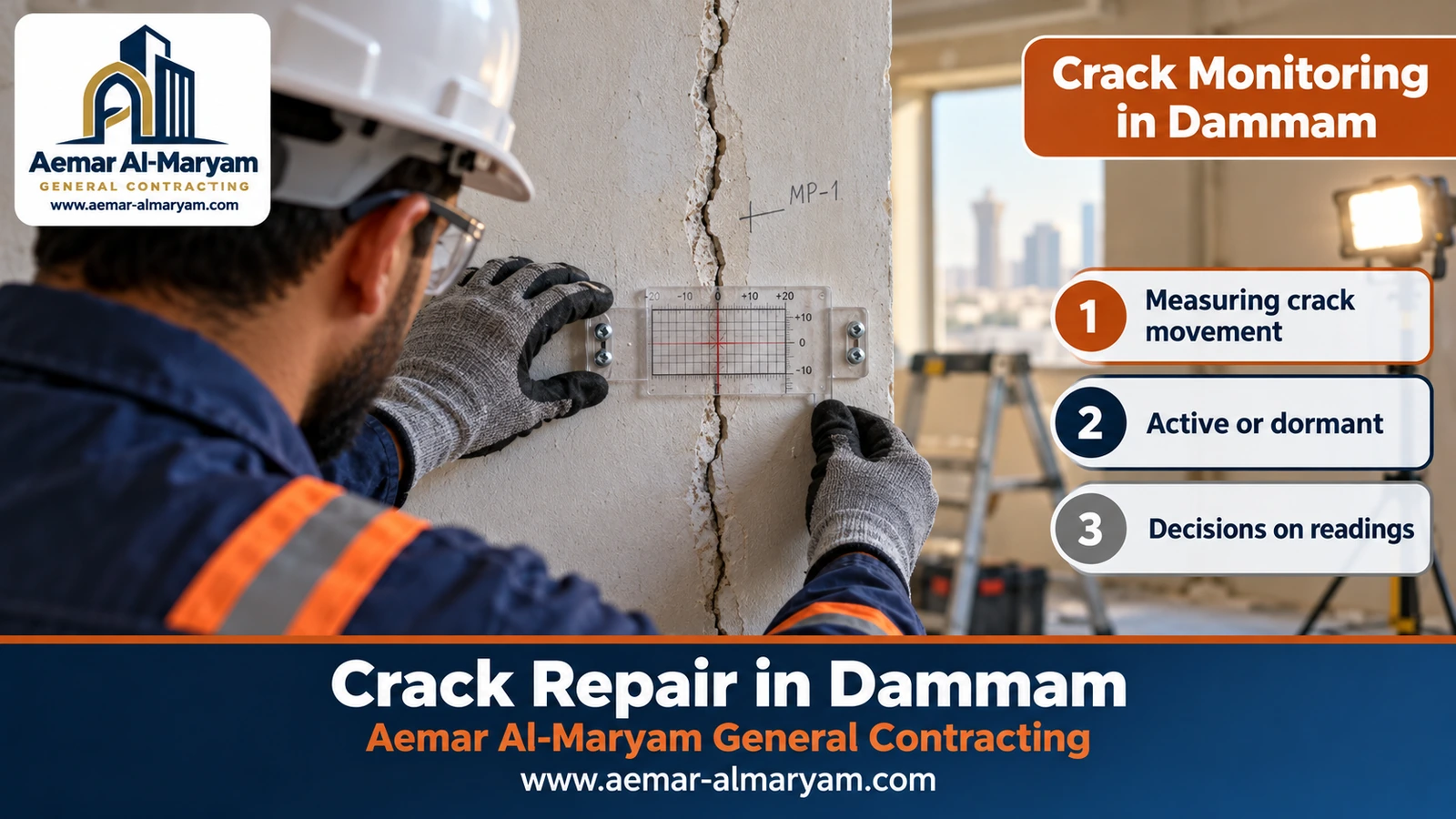
Monitoring is done in one of two ways:
- ✓A crack-monitoring gauge two overlapping clear or metal plates, each fixed to one side of the crack, with a measuring grid. If the crack moves, one plate slides over the other and the movement shows on the grid. It suits long-term monitoring.
- ✓Marks and regular photos a thin pencil line at each end of the crack with the date, and a photo with a ruler taken from the same distance each time. A simple method any homeowner can start today.
If you want to start monitoring yourself before we visit, follow these steps:
- 1Mark both ends
Draw a short pencil stroke at each tip of the crack and note the date next to it. - 2Measure the width
Hold a ruler or a crack-width card at the widest point and take a close-up photo. - 3Photograph from the same spot
Take a wider photo showing where the crack is on the wall, and repeat it from the same angle every time. - 4Repeat the reading
Measure again roughly every two weeks, ideally across both hot days and cooler ones. - 5Record what changed
Has the crack run past the mark? Is it wider? Have new cracks appeared? Has a door started to stick?
How long should monitoring last?
There is no single period that suits every case. A thermal crack needs a comparison between seasons, while a crack that is widening fast shows it is live within a week or two, and we call the engineer. We set the monitoring period at the inspection according to the crack type.
When do you need an engineer for crack repair in Dammam?
You need an engineer for crack repair in Dammam when the crack is in a load-bearing element, has reached 5 mm or more, is getting wider week by week, or points to settlement or overloading. Hairline and fine plaster cracks, and cracks along block-to-concrete junctions, are finishing work that a skilled technician carries out without an engineering report.
In structural cases our role is to carry out what the engineer decides, not to improvise in their place: injecting at the specified locations, rebuilding a concrete section, breaking out and rebuilding part of a wall, or carrying out designed strengthening. Before we start, we tell you which items are our work and which belong to the engineering office.
⚠ When to keep people away from the area immediately
If you see concrete pieces hanging from the ceiling, a ceiling that has started to sag, a column whose surface is crumbling with steel showing, cracks that widen within days, or a crack wider than 25 mm, move people and furniture away from the area and get an engineer the same day. Repairs come after safety is confirmed.
Does crack repair need a permit?
Filling and repainting cracks counts as maintenance, and usually no licence is involved. Fixing structural defects, on the other hand, calls for a building restoration licence applied for online on Balady, with an engineering office under contract handling the file; Balady lists the service time as one to ten days. Altering columns, beams, slabs or bearing walls is a different licence that requires approved drawings.
Epoxy crack injection in Dammam
Epoxy crack injection in Dammam means pumping a liquid epoxy resin into a concrete crack through ports fixed along its length until it fills the crack and hardens, bonding the two sides back together. American Concrete Institute guidance says the method suits cracks 0.05 mm wide and above, that it may not be applicable if the crack will move later, and that damp cracks need a moisture-tolerant epoxy. That is why we never inject a crack before confirming it is dormant.
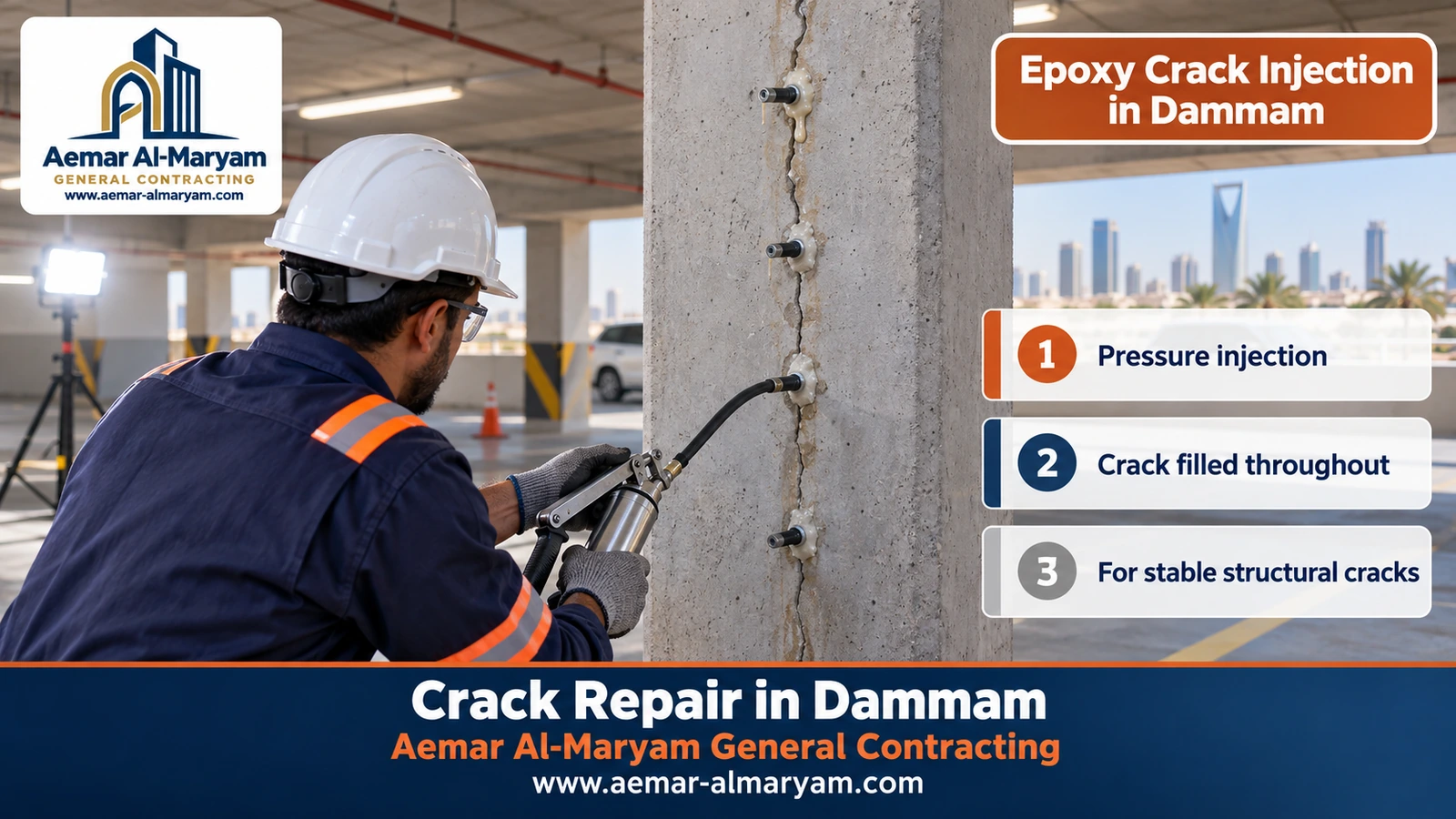
Our injection work follows this sequence:
- 1Locate and measure the crack
We mark where it starts and ends and its width along its length, and confirm it is dormant and dry, or choose the material if it is damp. - 2Clean
We clean the crack and about 13 mm on each side of dust, paint and oil, and open any crumbling edges into a V. - 3Fix the ports
Injection ports are fixed along the crack at spacings that suit its width and the depth of the element. - 4Seal the surface
The crack face between ports is capped so the epoxy cannot escape from the surface while pumping. - 5Inject from the lowest or widest point
We start at the lowest or widest port and pump until epoxy appears at the next one, then move up. - 6Remove and level
Once the resin has cured, the ports and cap seal are removed and the surface is levelled. - 7Check and finish
We check the crack is filled, then re-plaster or repaint; on structural work the engineer may ask for an additional test.
Epoxy is not for every crack. A crack in the plaster of a block wall does not need injection; a crack that moves with heat will simply crack again beside rigid epoxy; and a crack caused by rusting steel is not injected but opened up so the steel can be treated. The natural place for injection is stable cracks in concrete columns, beams, slabs and concrete walls.
Polyurethane injection for wet cracks in Dammam
Polyurethane injection for wet cracks in Dammam is the answer when water or constant damp comes through a crack, as happens in underground tank walls, basements, below-ground car parks and some ceilings under bathrooms. Polyurethane is a flexible material that reacts with water and blocks its path, but it does not restore structural bond the way epoxy does. In some cases polyurethane is injected first to stop the water, and the crack is injected with epoxy once it has dried if it still needs a structural bond.
| Material | When we use it | What it does not do |
|---|---|---|
| Injection epoxy | A dormant concrete crack, dry or slightly damp with a suitable grade, where bond is needed | Does not tolerate later movement |
| Injection polyurethane | A crack letting water through or permanently wet | Does not restore the element’s strength |
| Flexible sealant | A live crack that opens and closes, or a joint between two materials | Not for structural cracks |
| Polymer-modified repair mortar | Wider cracks once opened, and rebuilding edges | Does not take movement |
| Fibre mesh and filler | Plaster cracks and hairlines | Does not repair a crack in the concrete itself |
Exterior wall and facade cracks in Dammam
Exterior wall and facade cracks in Dammam are most often caused by heat. A south- or west-facing wall gets very hot by day and cools at night, and concrete, blockwork and render do not move by the same amount, so a line opens where the wall meets a column or beam. On top of that, Dammam adds damp and salts from the coastal air and from the ground, which weaken exterior render and lift the paint.
Facade cracks usually take one of four forms: regular vertical and horizontal lines along the edges of columns and beams; map cracking in old, weak render; diagonal cracks from window corners; and flaking with swelling at the base of the wall. The first three are usually finishing issues; the diagonal ones need us to rule out settlement; and the last one starts with damp treatment, not with the crack.
Our facade method: we strip the cracked render along the junction lines to a sufficient width, fix mesh that spans both materials, apply new render with a mortar suitable for exterior use, and finish with a moisture-resistant exterior paint. If the whole facade needs renewal we treat it as a full facade renovation, and our plastering and exterior painting services complete the job.
Why does a facade crack return after painting?
Because ordinary paint is rigid, and the line between the blockwork and the column moves with every heatwave. The fix is to cover the line with mesh inside the render, and to use a top coat that is suitably flexible for exterior walls.
Ceiling cracks in Dammam
Ceiling cracks in Dammam come in two completely different kinds. Cracks in the ceiling plaster and paint are usually fine, straight or map-like lines that do not touch the concrete. Cracks in the concrete slab itself are another matter, and the most serious of them run along the line of the reinforcement with brown stains or bulging. The first kind is treated like any plaster crack; the second is a sign that corrosion has started working inside the slab.
The cause in the second case is well known. Water reaches the steel from an unprotected roof, a bathroom above or a leaking pipe, the steel rusts, and rust occupies at least two and a half times the volume of the metal it came from, so it pushes the concrete cover off from the inside. It begins as a fine crack over the bar, then a layer separates, and then pieces fall and the steel is exposed.
Ceiling cracks caused by corrosion are not repaired by injection or filler. Instead, the loose concrete is cut back until the bar is free on every side, the bar is de-rusted and coated, supplementary bars go in wherever the engineer finds the original ones thinned, and the slab underside is reinstated with repair mortar. Most importantly, the water source is stopped: if it is the roof, the solution is roof waterproofing and insulation in Dammam; if it is a bathroom above, its waterproofing and pipework must be repaired.
⚠ A spalling ceiling is not an ordinary crack
A chunk of concrete dropping from a slab can injure anyone sitting or sleeping beneath it. If you see hanging pieces or exposed steel, move beds and furniture out of the way and do not try to knock the pieces down or plaster over them yourself.
Column and beam cracks in Dammam
Column and beam cracks in Dammam are always treated as cases that need an engineer’s opinion before any repair, because these elements carry the building’s loads down to the foundations. During inspection we distinguish three main patterns:
- ✓Longitudinal cracks along the bars at the corners of a column or along the underside of a beam, with rust or bulging. They are usually caused by reinforcement corrosion, and the repair is rebuilding the section, not injection.
- ✓Diagonal cracks near the ends of a beam close to where it sits on the column; they can indicate shear or overloading and need a structural report before any work.
- ✓Horizontal or vertical cracks in a column they may be old, dormant shrinkage cracks that can be epoxy-injected, or they may signal excessive load. Measuring and monitoring decide which.
When repairing a column cracked by corrosion we follow a fixed sequence: the bar is freed all round so there is roughly 19 mm or more of space behind it, cleaned back to bright metal, coated with an anti-corrosion primer, a bonding agent is applied, and the section is rebuilt with non-shrink repair mortar. If the steel has been badly thinned by rust, strengthening needs an engineer’s design, such as jacketing the column or adding steel, and we price it after the report.
We see many of these cases in car-park, courtyard and external columns exposed to damp, and in older apartment buildings whose roofs were never properly waterproofed. For buildings that need more than crack repair, such as several spalled ceilings and columns, see our renovation contractor in Dammam guide for the full scope.
Boundary wall cracks in Dammam
Boundary wall cracks in Dammam are mostly vertical cracks where the block panels meet the wall’s piers. A boundary wall is long, exposed to the sun on both faces, and has no slab on top to hold it, so it expands and contracts freely. These cracks are normally non-structural, but they let water in and ruin the render and paint.
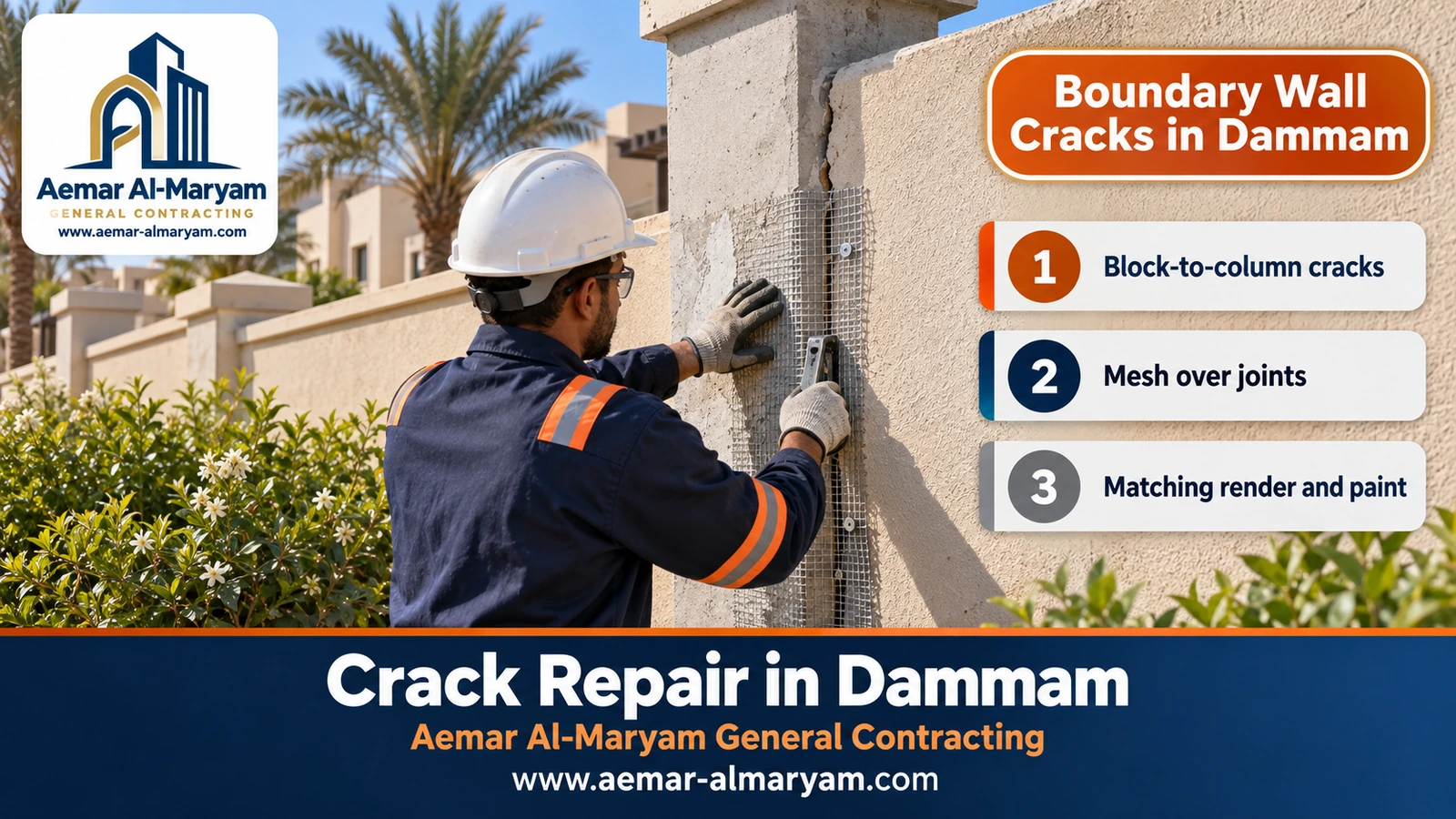
If the crack is diagonal, or the wall itself leans or bows, or the crack is near a large tree, a drain or a spot where irrigation water collects, the cause may be settlement of the wall’s footing. Then we check the footing and stop the water first, and if the lean is obvious, partial demolition and rebuilding may cost less than repair, in which case our demolition team takes that part on.
The usual repair for a vertical boundary-wall crack: strip the render along the crack to a good width on both sides, clean the joint, fill it with a flexible material if it moves, fix galvanised metal mesh or fibre mesh across the pier and the blockwork, re-render, and paint with an exterior paint. On very long walls it can be better to form a deliberate movement joint than to try to stop the movement entirely.
Foundation settlement and building cracks in Dammam
Foundation settlement in Dammam means part of the foundation has gone down more than the rest, producing diagonal cracks in the walls that are usually wider at one end, together with doors and windows that stick, floors that slope, and gaps between walls and ceilings or between floor tiles and walls. This type of damage is not fixed by injection or plaster; it starts with an engineer.
In the Eastern Province in particular, settlement is often linked to water. Published research on the region describes how the fluctuating shallow groundwater dissolves salts in the soil and leaves voids, causing foundation settlement and wall cracking, and notes that settlement damage is commonly reported. Leaking drains and supply pipes under the building, heavy irrigation next to the footings and saline soils add to it.
- 1Document and monitor
We record every crack with photos and measurements and fit monitoring marks to see whether the settlement is still going on or has stopped. - 2Find the water source
We check pipework, drains and places where water gathers around the building, because stopping the water is the first treatment. - 3Engineer’s report
The structural engineer decides, possibly after a soil investigation, whether repair is enough or the foundation needs strengthening. - 4Work to the report
We carry out the items in the report that fall within our scope and coordinate specialist works with the right party. - 5Repair the walls last
Once movement is confirmed to have stopped, we repair the cracks by the method that suits their width, then re-plaster and repaint.
Don’t start with paint
Repairing settlement cracks before the movement stops means paying for them twice: the cracks will come back, possibly in new places.
Crack repair materials we use in Dammam
The crack repair materials we use in Dammam are chosen for the crack type, not for whatever happens to be in the van, and every material is written by name into the itemised scope, so nothing unknown ends up in your walls:
■ Injection epoxy resin
For dormant concrete cracks, including moisture-tolerant grades.
■ Injection polyurethane
For cracks letting water through; flexible and blocks the water path.
■ Flexible sealant
For live cracks and joints between two different materials.
■ Polymer-modified repair mortar
For filling wider cracks and rebuilding edges and sections.
■ Bonding agent and anti-corrosion primer
Before mortar on old concrete, and on steel after cleaning.
■ Fibre and galvanised mesh
To spread movement across junction lines and under render.
Crack stitching in Dammam
Crack stitching in Dammam means setting bars across a crack in slots cut into the wall and then filled with grout, tying both sides of the crack together and sharing the load between them. Recognised installation guidance requires the cause of cracking to be established by a structural engineer and eliminated before stitching, and the bar spacing to be checked by the engineer. So we never stitch a crack without a report, and we never offer it as a fix for a crack that is still moving because of ongoing settlement.
Crack repair prices in Dammam
Crack repair prices in Dammam are usually calculated per linear metre of crack for injection, per room for finishing cracks before repainting, per square metre when a wall needs mesh and re-plastering, and per element for column repair. These are the prices we start from:
| Item | Unit | From |
|---|---|---|
| Concrete crack injection, epoxy-based or cementitious grout | linear metre (lm) | SAR 32 |
| Treating the cracks in one room before painting (opening, filling, mesh, filler) | room | SAR 140 |
| Plaster crack repair with fibre mesh and local re-plastering | m² | SAR 20 |
| Repairing a concrete column cracked by rebar corrosion | column | SAR 830 |
| Facade cracks repaired within a facade refresh: new render plus paint | m² | SAR 41 |
| Moisture-resistant exterior paint after repair | m² | SAR 18 |
| Polyurethane injection for cracks letting water through | — | On inspection |
| Crack stitching with bars | — | On inspection, after the engineer’s report |
| Installing and reading crack-monitoring gauges | — | On inspection |
| Repairing settlement cracks | — | On inspection, after the engineer’s report |
| Repairing spalling ceilings | — | On inspection |
Every rate here is provisional until the site visit and our agreement, and it moves with the length, width and depth of the crack, its location and height, how easy it is to reach, the material required and the condition of the plaster around it. Items marked “on inspection” are priced after the visit; send photos of the crack with a ruler on WhatsApp 0547879578 for an estimate. To compare these with our other services, see our estimated prices page.
How is the cost of a crack repair in Dammam worked out?
The cost of a crack repair in Dammam is the crack length or wall area multiplied by the item rate, plus whatever is needed before and after. A worked example: a dormant 3-metre crack in a beam injected with epoxy starts from about SAR 96 for the injection (3 × 32), with painting of the treated area added if you want it. A room with several hairline plaster cracks is priced as one item, from SAR 140, before painting.
- ✓Width and depth a wider, deeper crack uses more material and needs more ports.
- ✓Location and height a crack in a high ceiling or on a third-floor facade needs scaffolding or a lift.
- ✓Moisture a crack letting water through needs a different material and an extra step.
- ✓What surrounds the crack detached plaster or rusted steel means extra items before the repair.
- ✓Number of cracks per visit fewer separate call-outs mean a lower cost per crack, so list every crack in the house at once.
Common mistakes that make cracks return in Dammam homes
Crack repair mistakes in Dammam homes are so common that most of the cracks we treat had already been “repaired” before. These are the main ones:
- ✓Sealing a live crack with a rigid material ordinary filler or cement over a moving crack cracks again, usually right beside the repair.
- ✓Painting straight over the crack the paint hides it for a few weeks, then the line shows more clearly than before.
- ✓Injecting a corrosion crack injection closes the crack, but the rust carries on behind the epoxy and the concrete falls later.
- ✓Ignoring the water source repairing a ceiling crack while a bathroom leak continues above means the crack and the spalling come back.
- ✓Leaving debonded plaster in place new material on hollow plaster ends with both falling off together.
- ✓Judging a crack in a structural element by eye column and beam cracks need a report, not a quick opinion.
- ✓Rushing the finish painting mortar that has not dried causes new cracks and flaking.
How crack repair in Dammam works with Aemar Al-Maryam
The steps of crack repair in Dammam with us are clear from your first message to handover:
- 1Photos on WhatsApp
You send photos of the cracks, and we give you an initial view of their type and whether they need an urgent visit. - 2Inspection
We measure the cracks, note their direction and location, tap the plaster around them and ask about their history and nearby water sources. - 3Diagnosis
We classify each crack as finishing work, needing monitoring, or needing an engineer, and tell you so plainly. - 4Scope and cost
We write out the items, quantities, materials and estimated price for each item, with what is and is not included. - 5Treat the cause
Stopping a leak, waterproofing a roof, treating damp or carrying out the engineer’s report, before the crack itself is repaired. - 6Repair
Injection, opening and filling, mesh or section rebuilding, according to each crack’s type. - 7Finish
Plaster and paint for the treated area or the whole wall so no patches show. - 8Handover and follow-up advice
We hand over the work with monitoring advice and come back to you if you notice any change.
You can see examples of completed work on our projects page.
After crack repair in Dammam: how to stop cracks coming back
After crack repair in Dammam, keeping the result is partly up to you, and most of it is about water and heat:
- ✓Check the roof before winter cracked waterproofing and blocked roof drains mean water on the slab and then cracks and spalling below.
- ✓Watch the base of exterior walls swelling or salt bloom is a sign of rising damp that needs early treatment.
- ✓Fix leaks immediately a drain or supply pipe leaking under the building or inside a wall affects both foundations and plaster.
- ✓Keep irrigation away from the footings do not let garden water collect beside the walls of the house or the boundary wall.
- ✓Do not add loads without a design check new tanks on the roof or removing a wall need an engineer’s opinion.
- ✓Keep an eye on repaired cracks photograph them every few months during the first year; if a new fine line appears, tell us early.
To protect the slab from the water behind most corrosion cracks, see our waterproofing and insulation service.
Crack repair across the Eastern Province: Al Khobar, Qatif, Jubail, Al-Ahsa and more
Outside Dammam the method does not change and neither do the starting rates. Visits are booked according to how far the city is; for the more distant ones, the cost of getting the crew there is agreed at inspection and spread across the jobs, so bundling several repairs into one trip pays off. Every city also has a renovation guide of its own:
| City | Renovation guide | City page |
|---|---|---|
| Al Khobar | Al Khobar renovation guide | Al Khobar |
| Dhahran | Dhahran renovation guide | Dhahran |
| Qatif | Qatif renovation guide | Qatif |
| Saihat | Saihat renovation guide | Saihat |
| Jubail | Jubail renovation guide | Jubail |
| Ras Tanura | Ras Tanura renovation guide | Ras Tanura |
| Al-Ahsa | Al-Ahsa renovation guide | Al-Ahsa |
| Abqaiq | Abqaiq renovation guide | Abqaiq |
| Khafji | Khafji renovation guide | Khafji |
| Hafr Al-Batin | Hafr Al-Batin renovation guide | Hafr Al-Batin |
Dammam districts where we repair cracks
Our teams cover all of Dammam; districts we regularly visit include Al Faisaliyah, Al Adamah, Al Shati, Al Nada, Al Mazruiyah, Al Jalawiyah, Taibah, Al Firdaws, Badr, Al Rayyan, Al Noor, Al Qadisiyah, Ohod, Al Anud, Al Dabab, Al Hamra, Al Rawdah, Ghirnatah, Al Khaleej, Al Athir, Al Manar, Al Shulah, Al Fursan, Al Badiyah, Al Jamiyin, Al Dawasir, Al Itisalat, Ibn Khaldun, King Fahd Suburb, Al Mubarakiyah and Al Nuzhah.
Ordering crack repair in Dammam: photos and facts that speed up your estimate
To order crack repair in Dammam, send the following on WhatsApp to 0547879578. The clearer the information, the more accurate the estimate:
- ✓A close-up of every crack with a ruler or a coin beside it so the width shows.
- ✓A wider photo showing where the crack is: wall, ceiling or column, and how close it is to a door or window.
- ✓When the crack appeared whether it is growing, and whether it was repaired before and came back.
- ✓Related signs damp, rust, flaking, sticking doors or a leak nearby.
- ✓Building details its type and approximate age, the floor, and the district.
- ✓Preferred timing and whether the home will be occupied during the work.
Photograph the crack and send it now
A clear photo with a ruler is enough for us to tell you whether the crack looks like a finishing job or needs an urgent visit, with an estimate before we come.
Related pages
Tags