Roof waterproofing in Dammam means stopping rain and wash-down water from reaching the roof slab, and cutting the heat the roof passes into the top floor, using a layered system chosen after the roof has been inspected: a waterproof membrane of torch-on bitumen or a liquid coating, a thermal layer of sprayed foam or insulation boards, and protection over both. At Aemar Al-Maryam General Contracting we waterproof and insulate concrete and tiled roofs, line water tanks, waterproof bathrooms and foundations, and trace hidden leaks before anything is broken open, in Dammam and across the Eastern Province. Bitumen membrane waterproofing starts from SAR 13 per square metre, spray foam from SAR 23, a sprayed foam water-and-heat system with a protective top coat from SAR 42, and a layered system of waterproofing, insulation boards and protective tiles from SAR 46. Every figure is an estimate, confirmed once we have inspected and agreed the scope. To reach us, phone or message 0547879578 on WhatsApp.
A roof in Dammam takes more punishment than any other part of the building. The summer sun heats the slab all day and the night lets it cool again, the coastal air carries moisture and salt, and the rain, when it finally comes, comes hard and collects in every low corner and around every drain. A single split in an old membrane is enough to let water reach the steel in the slab. First a brown ring appears on a bedroom ceiling, then the paint flakes, and a few years later a piece of concrete drops. That is why we never start by selling a product. We start by asking where the water gets in, and why.
This guide walks you through the systems on offer and which roof each one suits, the specifications that separate careful work from a quick job, how we line water tanks and waterproof bathrooms and foundations, how a hidden leak is traced, what each item costs, and which photos will save you a wait if you send them before we visit.
At a glance: waterproofing and insulation in Dammam
- What we treat: roofs of villas, houses, apartment buildings and annexes, both bare concrete and tiled; underground and rooftop concrete tanks; bathrooms and kitchens; footings and ground beams.
- Systems: torch-on bitumen membranes, sprayed polyurethane foam, thermal insulation boards, liquid membranes (acrylic, polyurethane, polyurea, cementitious) and clear coatings over sound tiles.
- Prices from: SAR 13/m² membrane, SAR 23 foam, SAR 42 sprayed foam water-and-heat system with a protective top coat, SAR 46 layered system: waterproofing + insulation boards + protective tiles, SAR 26 bathroom waterproofing, SAR 46 drinking-water-safe tank epoxy, SAR 140 to trace a leak in a bathroom or kitchen. Prices are estimates until inspection and agreement, and they change with the roof condition, area, floor level, materials, thickness and access.
- Inspection first: we find the water source, check the falls and the state of any old membrane, then choose the system.
- Testing: a flood test of at least 24 and at most 72 hours before protection and tiles go down.
- Cities: Dammam and all its districts, together with Al Khobar, Dhahran, Saihat, Qatif, Jubail, Al-Ahsa and other towns of the Province.
- To order: phone or WhatsApp 0547879578, attaching photos of the roof, drains and ceiling stains and the approximate roof area.
Roof Waterproofing in Dammam: What We Do and Why It Starts With an Inspection
Roof waterproofing in Dammam, the way we do it, begins with a diagnosis and ends with a water test. We walk the roof, check the drains, the corners and the parapet walls, and work out whether the problem is the membrane itself, falls that never carry water to the outlet, or a broken pipe wetting the slab from inside. Only then do we choose the system, measure the real area, carry out the work and test it before handing over.
Often, on inspection, the stain on their ceiling often turns out to come from a rooftop tank that weeps, an air-conditioning drain dripping into one corner, or broken tiles around a gully. Waterproof the whole roof without dealing with any of that and the stain stays exactly where it is, while the owner has paid for work he never needed. So our first question is always the same: does the stain appear only after rain, or at any time of year?
■ Roof waterproofing and insulation
Waterproof and thermal systems for bare concrete roofs, tiled roofs and annex roofs, with corrected falls and reinforced drains.
■ Water tanks
Cleaning, drying and crack repair, then a lining rated for contact with drinking water, for underground and rooftop concrete tanks.
■ Bathrooms and kitchens
A flexible membrane laid over the whole floor and turned up the walls ahead of tiling, then water-tested before it is hidden.
■ Foundations
Bituminous coatings and membranes on footings, column necks and ground beams before backfilling, against damp and salt.
■ Leak detection
Locating hidden leaks with a thermal camera, moisture readings and pressure tests before anything is opened up.
■ Waterproofing within renovation
Re-waterproofing an old roof together with crack repair and spalling ceilings in one renovation job.
For a one-page overview, see our waterproofing and insulation service page. This guide goes further and explains each system and each part of the building in turn.
Signs That Your Roof Waterproofing in Dammam Has Failed
In most homes you don’t need instruments to tell that a roof membrane has had its day. Go up onto the roof the morning after the first proper rain and then look at the top-floor ceilings from inside. Any of these means it is time for an inspection:
- ✓Brown stains or rings on a top-floor ceiling: water has reached the concrete, and it usually returns to the same spot after every rain.
- ✓Water still standing on the roof a day after rain: the falls are not taking water to the outlet, and that alone wears out any membrane.
- ✓Blisters, bubbles or splits in the membrane: it has lost adhesion or has been baking in the sun without protection.
- ✓Hollow-sounding roof tiles or open joints: water slips between the tiles and stays trapped underneath.
- ✓Ceiling paint peeling from inside, or white salt deposits: persistent moisture is evaporating through the plaster.
- ✓Top-floor rooms that stay hot into the evening: there is no heat insulation, or it is too thin or has broken down.
Roof Waterproofing Company in Dammam: How to Choose Who Does Your Roof
Pick a roof waterproofing company in Dammam that explains the whole system to you, not just the name of a product: which layers, how thick each one is, how the drains and corners will be detailed, how long the flood test lasts and what will shield the membrane from the sun. A good material fails when it is laid on a dusty roof with no falls, while an ordinary material can last a long time when it is installed with care.
Waterproofing adverts across the Eastern Province tend to look alike: big discounts, promises of many years, and the word “approved” without saying approved by whom. We are not asking you to take our word for anything either. Ask any contractor the questions below, ours included, and compare the answers you get:
| Your question | An answer that should reassure you |
|---|---|
| What is causing the leak on my roof? | A specific cause after inspection (falls, a drain, an expired membrane, a tank, a pipe), not “it just needs waterproofing”. |
| What layers are in the system, and how thick? | A clear sequence: cleaning and repairs, primer, membrane, thermal layer, protection, with the thickness of each. |
| How will you treat the drains and parapets? | Extra reinforcement at each outlet, and the membrane taken at least 150 mm up the wall above the finished roof surface. |
| Will you flood-test it, and for how long? | Yes, for 24 to 72 hours before the membrane is covered. |
| What protects the membrane from the sun? | Tiles, a flexible reflective coating or a screed, never a membrane left bare. |
| What does the price include and exclude? | Itemised: stripping old layers, falls, materials, protection, tiling, debris removal. |
Ask for the system specification, not a product name
A product name tells you very little when you compare two quotes. One quote at SAR 13 for membrane and another at SAR 30 may differ in thickness, number of layers and whether any protection is included. Ask for itemised quotes and compare them line by line.
Roof Insulation Materials in Dammam: Types and the Layers of a Complete System
Roof insulation materials in Dammam do one of two jobs. Waterproofing stops water getting through; thermal insulation slows the flow of heat. Some materials partly do both, closed-cell polyurethane foam being the obvious example. A roof that has never been treated usually needs both jobs done, combined in one properly ordered system.
| Type | What it does | Where it fits | What it needs |
|---|---|---|---|
| Modified bitumen membrane | Waterproofing with a torch-welded sheet | Flat concrete roofs that will be tiled or protected | Primer, correct laps, protection from the sun |
| Sprayed polyurethane foam | Heat insulation plus good water resistance, with no seams | Roofs crowded with AC bases and pipes; annex roofs | A flexible protective coat on top and a skilled sprayer |
| Thermal boards (polystyrene) | Heat insulation only | Over the membrane, under the tiles | A membrane below and a protective layer above |
| Liquid membranes | A continuous membrane brushed, rolled or sprayed on | Complex roofs, repairs, roofs with minor movement | The datasheet thickness on a dry, clean surface |
| Cementitious waterproofing | Waterproofing that bonds to damp concrete | Tanks, bathrooms, roofs that will be covered | Reinforcing mesh at corners and proper curing |
| Clear coatings over tiles | Seals pores and fine joints | Sound tiles with minor seepage | Tiles that are bonded, and correct falls |
Roof Waterproofing Layers in Dammam, From Slab to Tiles
A complete system on a new roof, or on a roof stripped back to the slab, is built from the bottom up in the order below. Depending on the system a layer may be combined with another or left out, but the principle doesn’t change: water is stopped before it reaches the concrete, heat is cut before it reaches the ceiling, and every layer is protected by the one above it.
- 1Concrete roof slab
Clean and dry, with any cracks repaired before the first layer goes down. - 2Screed to falls
Lightweight concrete or mortar giving a continuous slope to the drains, so no water stands. - 3Primer
A bonding coat that helps the membrane grip the surface. - 4Waterproof membrane
Bitumen sheet or a liquid membrane, turned up the walls and reinforced around the outlets. - 5Thermal layer
Insulation boards or foam, at a thickness set by the heat performance you need. - 6Separation and protection
A separating layer, then a protective screed so nothing below gets damaged. - 7Tiles or reflective coating
The visible finish that takes foot traffic and the sun.
Waterproofing Roofs in Dammam: When Is Waterproofing Alone Enough?
Waterproofing on its own is enough in Dammam when the roof already has heat insulation, when the aim is to stop a leak in a tiled roof that has a sound thermal layer under it, or on service roofs and warehouses where heat matters less. A lived-in house whose roof has never been insulated needs heat insulation as well, because in Dammam the top floor pays for the missing insulation every single summer.
Successful waterproofing depends on three things before the material is even chosen. Water must run quickly to the drain. The weak points, meaning corners, outlets, AC bases, pipe penetrations and movement joints, must get an extra reinforcing layer. And the membrane must climb far enough up the walls that water can’t sneak in over its top edge. That is why preparing a roof sometimes takes us longer than laying the waterproofing itself.
Bitumen Membrane Waterproofing in Dammam: Specifications to Watch
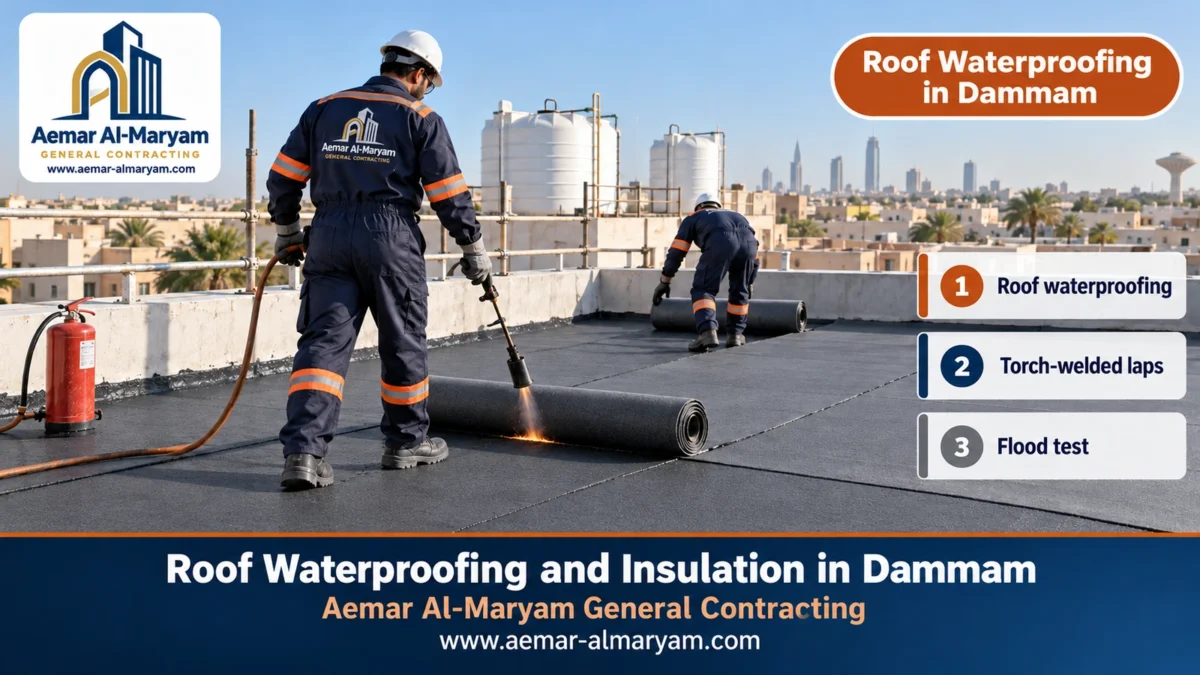
Torch-on bitumen membrane is the most common roof waterproofing in Dammam: rolls of polymer-modified bitumen laid over a primer and welded with a gas torch into one continuous sheet. Its quality lies in details the owner never sees once the tiles are down, so ask to see them before anything is covered:
- ✓Laps: each roll overlaps its neighbour by the width stated on the product datasheet, typically not less than 75 to 100 mm along the sides and 100 mm or more at the roll ends, with a continuous weld and no gaps.
- ✓Upstands: at least 150 mm above the finished roof surface, as well-known British flat-roof standards require, with the top edge fixed and covered.
- ✓Drains: an extra reinforcing piece dressed into the outlet, because the drain is where all the water goes.
- ✓Surface before welding: dry and clean, with the primer fully dry. Torching onto dust or damp creates blisters that lift later.
- ✓Protection: an exposed membrane needs a mineral or metal-faced cap sheet or a reflective coat, and is better still under a protective screed and tiles.
Torches on an occupied roof
Bitumen rolls are welded with a gas torch, so we keep cylinders away from heat sources and take care around plastic tanks, AC lines and cables. Where something on the roof can’t tolerate heat, we switch to a cold-applied liquid system instead.
Heat Insulation for Roofs in Dammam: How It Cools the Top Floor
Roof heat insulation in Dammam is a layer of material that conducts heat poorly, placed over the roof slab to slow the sun’s heat on its way into the rooms below, which lightens the load on the air conditioners. The usual materials on homes are sprayed polyurethane foam and polystyrene boards, and the thicker the layer, the less heat gets through.
We won’t promise a fixed percentage off your electricity bill; that depends on walls, windows and AC hours. What owners usually notice is cooler top-floor rooms in the evening.
Spray Foam Insulation in Dammam: Density, Thickness and the Protective Coat
Spray foam insulation in Dammam is made by spraying two liquids that react on the roof and expand into a rigid, closed-cell foam bonded to the concrete with no joints. It insulates against heat and resists water at the same time. Its great advantage on roofs crowded with AC stands and pipes is that it wraps around them with no cutting or welding.
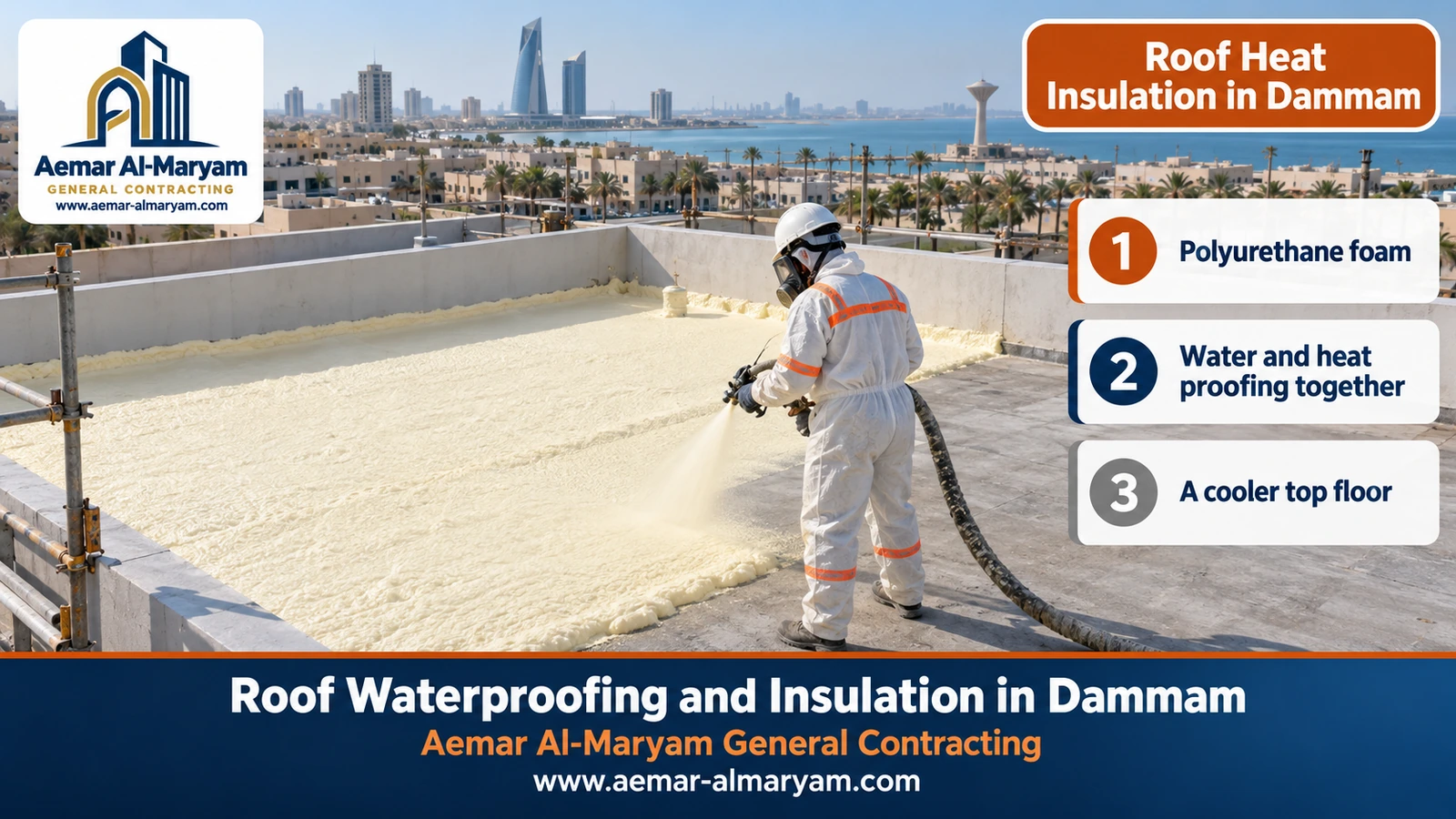
Because the foam is manufactured on site, its quality depends on the person spraying it. The figures below come from a published technical specification for sprayed foam roofing. We follow them, or a higher figure where the product calls for it:
| Item | Specification | Why it matters to you |
|---|---|---|
| Foam type | Closed-cell, high-density roofing foam | Light wall foam can’t take foot traffic or standing water |
| In-place density | About 45 to 48 kg/m³ | Lower density gives a brittle surface that cracks underfoot |
| Minimum thickness | 25 mm on the roof, 13 mm at drains | Anything thinner gives insulation not worth having |
| Usual thickness on homes | 3 to 5 cm in re-roofing work | It goes up when a higher thermal performance is needed |
| Surface flatness | No ponding, no dip over 13 mm under a 3 m straightedge | Ponds shorten the life of the coating |
| Protective coating | Flexible coating in two coats, at least 0.5 mm dry | Sunlight degrades the surface of bare foam |
Source: a published technical specification for sprayed polyurethane foam roofing, and product datasheets. Final thickness is set after inspection.
Never accept bare foam
Foam resists water but not sunlight. The specification does not allow foam to stand overnight without its first protective coat, and foam left for weeks under the Dammam sun turns to a brown powder that erodes away. If your roof has been sprayed and not coated, ask for the protection straight away.
As for the question “what does foam insulation cost per square metre?”, a standard layer starts from SAR 23 per square metre with us, rising with extra thickness, the protective coat and tiling. You’ll find every item in the price table further down.
Thermal Insulation Boards for Roofs in Dammam
Extruded or expanded polystyrene boards are a sound thermal choice when tiles will go on top. They are laid tightly over the waterproof membrane with staggered joints, then covered by a separating layer and a protective screed. They give an even thickness but need a membrane below and protection above. Boards alone start from SAR 14 per square metre.
Thermal Insulation Requirements for New Buildings in Dammam
Thermal insulation is not optional on new buildings in Saudi Arabia. An order made thermal insulation mandatory for all new residential and commercial buildings, and it was rolled out in phases with Dammam among the first cities. As local press reported when it began, it is tied to the building permit through a thermal insulation undertaking signed by the owner and the engineering office, and to inspections by the electricity company of the walls, roof and windows before power is connected and the completion certificate is issued.
What the code means for your roof
The residential energy conservation code (SBC 602) divides the Kingdom into three climate zones and sets a maximum heat-transfer value for roofs in each, and the designer works out the insulation thickness needed to meet it. On a new house we follow the thickness and specification on the approved drawings. On an existing house, a 3 to 5 cm foam layer improves the roof a great deal, but it is not necessarily equal to what the code asks of a new build, and we will tell you so plainly before the work starts.
Liquid Waterproofing in Dammam: Acrylic, Polyurethane, Polyurea and Cementitious
Liquid waterproofing membranes in Dammam are brushed, rolled or sprayed on and cure into a continuous membrane with no laps. That makes them ideal for roofs full of details, for patch repairs and for annex roofs, and they do away with the torch where using one would be risky. They differ in flexibility, UV resistance, price and how they are applied:
■ Acrylic coating
A flexible water-based coating, usually reflective white, applied in two or more coats with mesh at the corners. Suits exposed roofs and works as the protective coat over foam. From SAR 23/m².
■ Liquid polyurethane
A tough rubbery membrane with strong adhesion and flexibility that bridges small crack movement. Needs a completely dry substrate. Priced after inspection by thickness.
■ Polyurea
Hot-sprayed with a dedicated rig and set within seconds, very resistant to foot traffic and abrasion, suited to commercial roofs and large tanks. From SAR 55/m².
■ Cementitious
A polymer-modified mortar brushed or trowelled on in two coats that bonds to damp concrete and is then covered. On roofs from SAR 15/m².
The secret with all of these is the same: dry film thickness. A tin that covers 10 square metres according to its datasheet will fail if it is stretched over 20. So we calculate quantities from the area and the required thickness, apply the number of coats specified, and reinforce corners and drains with mesh or tape before the first coat.
Tiled Roof Waterproofing in Dammam Without Removing the Tiles: When It Works and When It Doesn’t
Waterproofing a tiled roof in Dammam without lifting the tiles works when the tiles are firmly bonded, the falls are right, and the problem is limited seepage through the joints or the porous tile surface. We deep-clean the tiles and joints, re-grout any open joints, then apply a clear or acrylic coat that seals the pores and keeps the look of the tiles. This option starts from SAR 10 per square metre.
If the tiles sound hollow when tapped, if water stands on them after rain, or if the membrane beneath has broken down, a clear coat only postpones the problem. Water already trapped under the tiles stays trapped, and wrong falls stay wrong. In that case we’ll tell you straight that the fix is to remove the tiles and old layers and rebuild the system properly.
| Condition of the tiled roof | Suitable fix |
|---|---|
| Bonded tiles, open joints, seepage only after heavy rain | Cleaning, re-grouting and a clear or acrylic coat |
| Bonded tiles but water ponds in one corner | Local correction of the falls in that corner, then coating over the tiles |
| Hollow tiles over large areas | Remove the tiles, rebuild the waterproofing and re-tile |
| Ceiling stains that have nothing to do with rain | Leak detection first; the source may be a tank or a pipe |
Best Roof Insulation Type for Dammam: An Honest Comparison
No single type of roof insulation is best for every roof in Dammam. The best one is the system that fits your roof’s condition, its use and your budget, and is installed to its full specification. Here are the strengths and the weaknesses side by side:
| System | Strengths | Weaknesses | Best for |
|---|---|---|---|
| Layered system: waterproofing + insulation boards + protective tiles (from SAR 46/m²) | Waterproofing and heat insulation together; a protected roof you can walk on | Heavier, costlier and slower to build | Roofs over living rooms that need foot traffic and lasting protection; new houses |
| Sprayed foam water-and-heat system with a protective top coat (from SAR 42/m²) | Seamless, wraps around penetrations, fast, lightweight | Coating must be renewed periodically; needs a skilled sprayer | Large, plain roofs with little foot traffic; crowded roofs, annexes, apartment buildings |
| Bitumen membrane + protection | Economical, proven, widely available | Waterproofing only; suffers in the sun if left bare | Roofs already insulated, service roofs |
| Liquid membranes (acrylic / PU) | Continuous film, no torch, easy to repair | Only as good as the thickness and the dryness of the surface | Repairs, complex roofs, coating over foam |
| Clear coat over tiles | The cheapest fix, nothing broken out | Won’t fix hollow tiles or wrong falls | Sound tiles with minor seepage |
A rule of thumb
A roof with no heat insulation: a foam system with a protective top coat if it is large and plain with little foot traffic, or the layered system with insulation boards and tiles if it sits over living rooms and will be walked on. A roof that is insulated but leaks: a waterproof membrane alone. A sound tiled roof with slight seepage: a coating over the tiles. The inspection tells you which group your roof is in.
Water Tank Waterproofing in Dammam: Underground, Rooftop and Safe for Drinking Water
Water tank waterproofing in Dammam means lining a concrete tank on the inside with a material that stops water getting out or in, and that is safe in contact with drinking water. An underground tank in the Eastern Province faces two risks: its water can leak away and soak the ground around the foundations, and salty or contaminated groundwater can seep in through cracked walls.
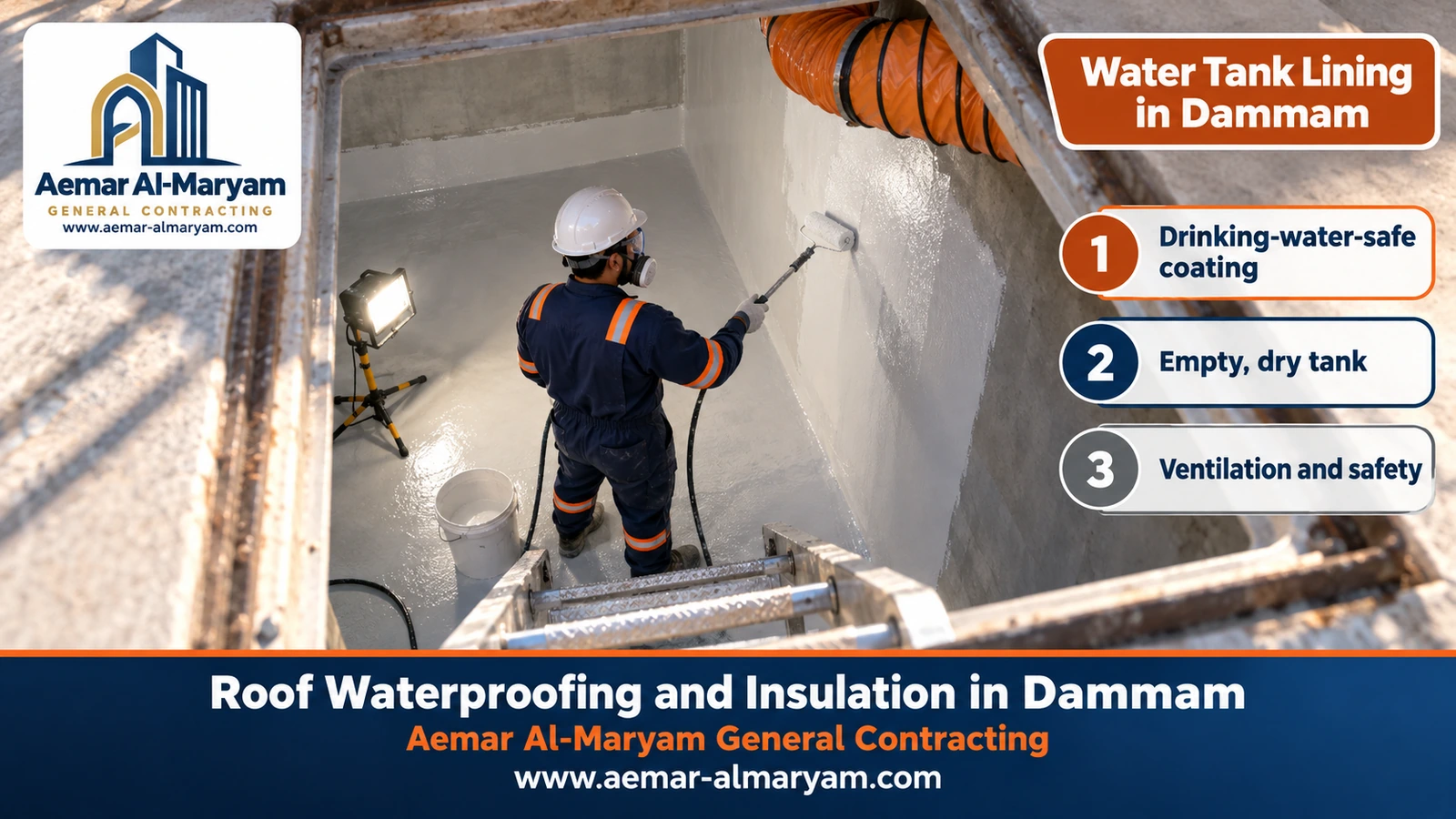
Underground Water Tank Waterproofing in Dammam
The underground tank is the one that most needs waterproofing, because it sits in damp soil and its leaks can’t be seen. We drain it, clean it and dry it out, check the cracks, the floor-to-wall corners and the pipe entries, repair the cracks before lining, and then apply the lining in coats right up to the tank’s internal soffit. We also pay attention to the access hatch and its cover so that dust and yard wash-water can’t get in.
Rooftop Concrete Tank Waterproofing in Dammam
A concrete tank on the roof suffers from heat more than from leaks, but when it does weep it wets the slab below and shows up on the room ceiling as if the roof itself were leaking. We line it inside just like an underground tank, and can insulate its top and sides against heat if you want cooler water in summer. Ready-made plastic and fibreglass tanks aren’t lined; instead we check their base and connections.
Is Tank Waterproofing Safe for Drinking Water?
A tank lining is safe for drinking water when the product is rated for contact with potable water under a recognised health certification, such as the international standard NSF/ANSI 61 for drinking water system components and their health effects, and when it is applied and cured the way its datasheet says. Not every epoxy is suitable for tanks. Some epoxies are made for floors and release substances you don’t want in the water you drink.
- 1Mature concrete
A new tank isn’t lined until the concrete has matured; one potable-water lining datasheet requires at least 28 days. - 2Surface preparation
Removing weak laitance and dirt, opening the surface, and repairing cracks and honeycombing. - 3Ventilation throughout
A fan at the hatch and an operative with a respirator; no work in a closed space without airflow. - 4Coats as specified
The number of coats and the thickness stated on the datasheet, with the corners reinforced. - 5Curing time before filling
Depends on the product. The datasheet of one epoxy lining rated for drinking water states seven days at about 21 °C. - 6Rinse and fill
The tank is washed out, the first rinse water drained, and then it is filled.
Safety inside the tank
A tank is a confined space, and solvent fumes inside it are dangerous. We never go in without continuous ventilation and someone standing by at the hatch, and we don’t allow smoking or sparks near the opening while the work is under way.
Lining a concrete tank with a cementitious material starts from SAR 14 per square metre, and with an epoxy suitable for drinking water from SAR 46 per square metre, measured over the walls, floor and internal soffit. Prices are estimates until inspection and agreement, and they change with the roof condition, area, floor level, materials, thickness and access.
Bathroom Waterproofing in Dammam: The Right Method Before Tiling
Bathroom waterproofing in Dammam is a flexible membrane that covers the entire bathroom floor and turns up the walls, laid after the plumbing and before the tiles. If water gets past a tile joint or around the gully, the membrane stops it and sends it to the drain instead of into the neighbour’s ceiling or the next wall. A bathroom with no membrane, or with one that has worn out, is behind most of the damp patches on apartment ceilings.
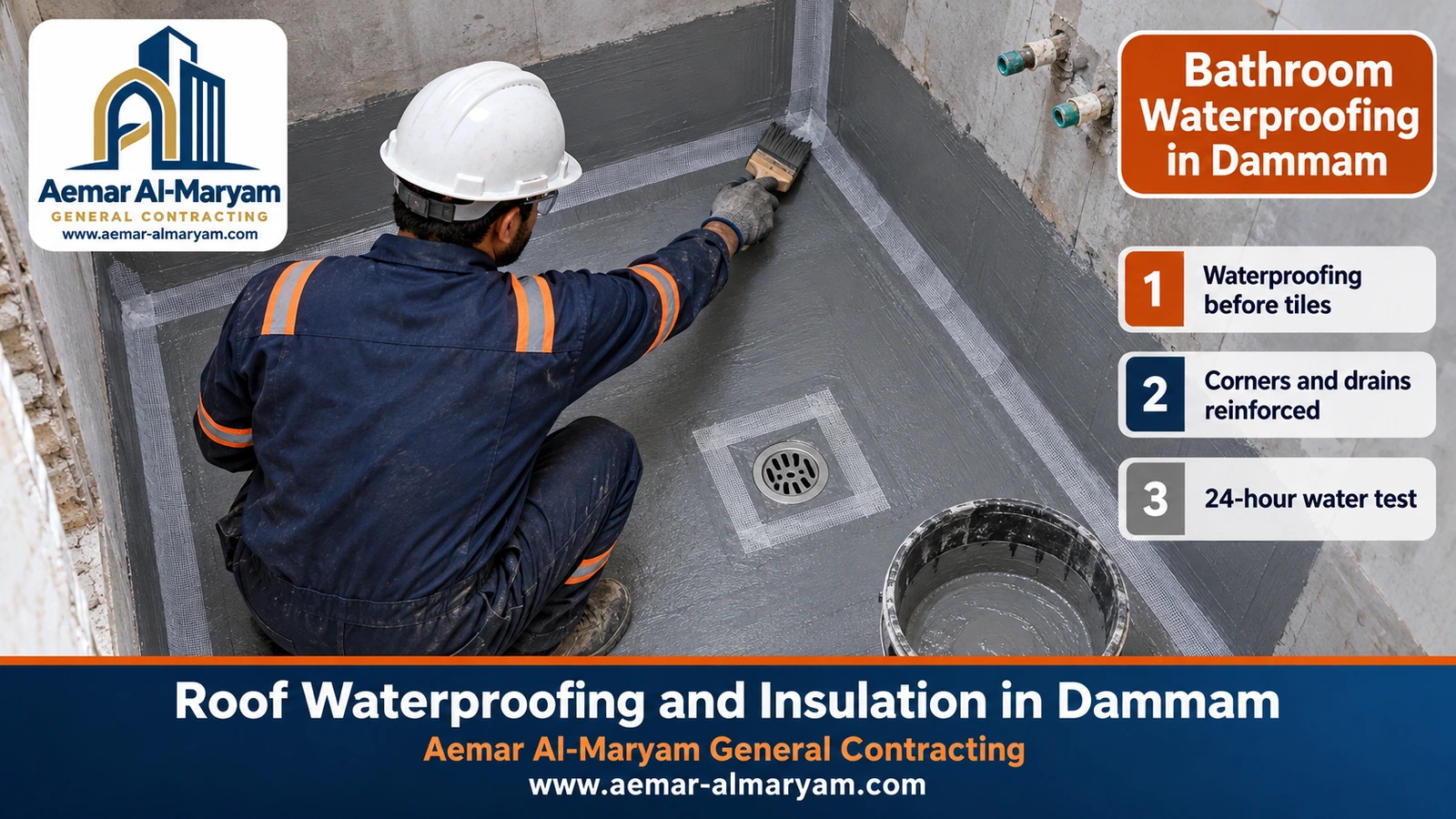
This is how we waterproof a bathroom, and it is the method we suggest you ask any contractor for:
- 1Strip back to the slab
Remove the tiles and old layers and clean off the remaining mortar. - 2Plumbing first
Replace damaged pipework and pressure-test it before any waterproofing, because a membrane can’t fix a pipe. - 3Falls to the drain
A mortar bed giving a clear slope to the floor gully so no water stands. - 4Reinforce corners and drain
Rubber tape at every floor-to-wall junction and around pipes and the gully. - 5Two coats of flexible membrane
Cementitious or liquid membrane across the floor and up the walls, and up to 1,800 mm in the shower area. - 6Water test
Plug the gully and flood the floor for 24 to 48 hours while watching the ceiling below. - 7Protection and tiling
A protective layer, then tile adhesive and tiles, without nailing through the membrane.
The 1,800 mm height in the shower and 150 mm above the rim of a built-in bath come from published international requirements for wet-area waterproofing, and we apply them because shower walls get soaked every day. Bathroom waterproofing starts with us from SAR 26 per square metre of waterproofed floor and wall, while a full bathroom renovation with stripping out, plumbing and tiling starts from SAR 2,300; that larger job is covered on the bathroom and kitchen renovation page.
Waterproofing a Bathroom Without Removing Tiles: Does It Work?
Waterproofing over existing bathroom tiles is a partial fix. If the seepage comes only through the grout, re-grouting with a water-resistant grout and a clear coat over the tiles will reduce it. But if the original membrane has failed, or the pipe under the floor is broken, no coating on top of the tiles can reach the cause. So we inspect the bathroom first and tell you whether a surface treatment is enough or the floor has to come up.
Kitchens are waterproofed the same way when they sit over a lived-in room or have a floor drain, and their supply lines are tested before any membrane goes down. If the pipework is old, it’s better to renew it first; see our plumbing works service.
Foundation Waterproofing in Dammam: Why Eastern Province Soil Calls for It
Foundation waterproofing in Dammam is a bituminous coating or membrane applied to the concrete footings, their necks and the ground beams before backfilling, separating the concrete from damp, salty soil. In the Eastern Province this is not a luxury. Published studies of the region note that the groundwater table generally lies less than 1.5 m below the surface and rises and falls, dissolving salts and moving them about.
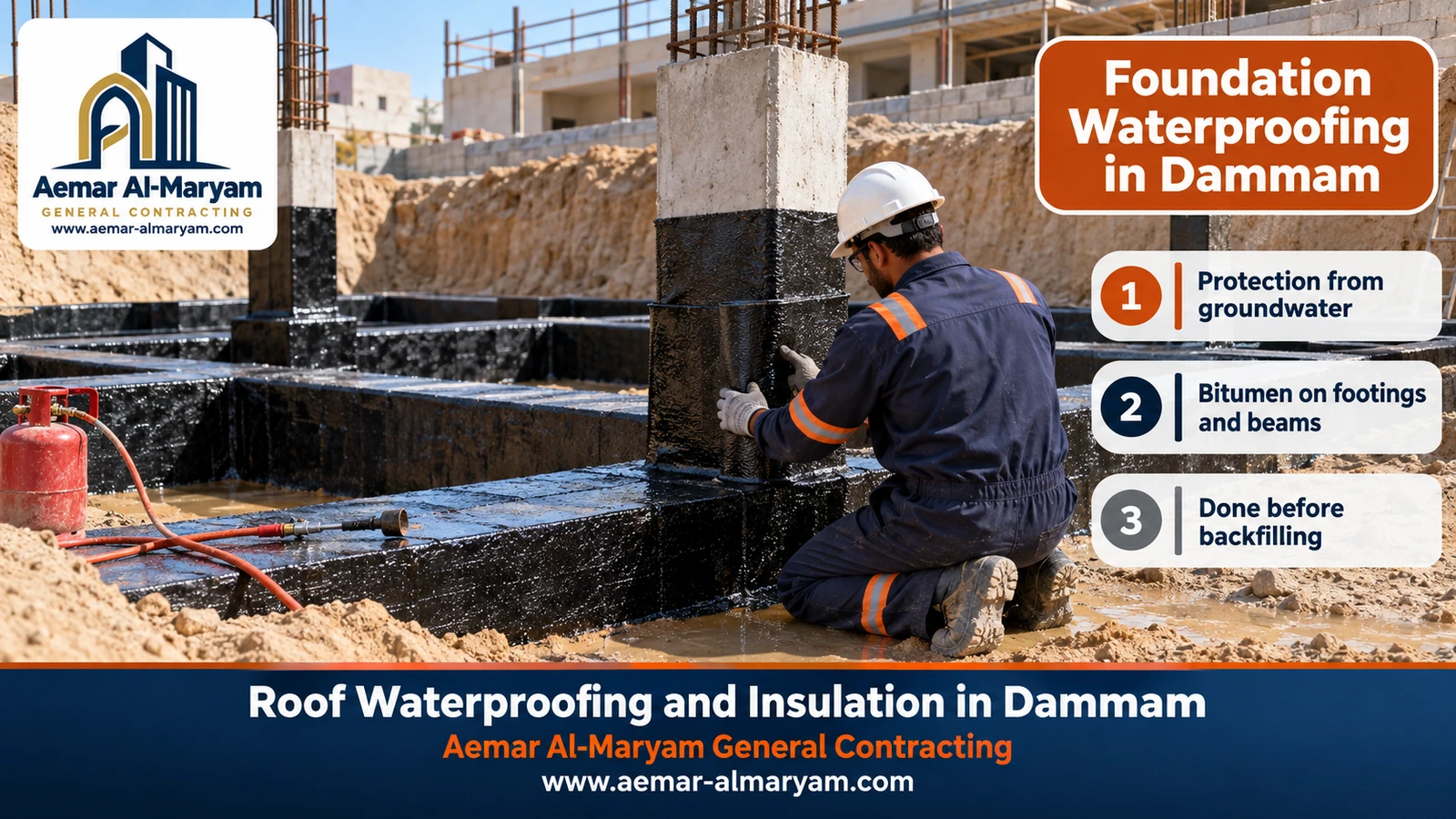
Researchers at KFUPM in Dhahran recorded salts climbing by capillary action about 75 cm above the water table, and free moisture in reinforced concrete buildings at greater heights than expected, which speeds up the deterioration of foundations and buried elements. Older research linked the decay of many Eastern Province buildings within 10 to 15 years to reinforcement corrosion, followed by sulfate attack. These figures come from research papers, not from any single site, but they explain why salt appears at the foot of the walls in so many homes in Dammam and Al Khobar.
- ✓New construction: two coats of bituminous coating or a membrane on footings, necks and ground beams, protected before backfill so stones don’t scratch it.
- ✓Under the ground slab: a damp-proof membrane over the compacted fill and beneath the concrete.
- ✓Existing houses: rising damp at the base of the walls needs a diagnosis before treatment: is it groundwater, or a leaking tank or drain? We price it after inspection.
Once the moisture has reached the steel, with rust showing or the concrete cracking, the job becomes renovation rather than waterproofing alone; our renovation contractor in Dammam article explains that work, alongside the crack repair service.
Leak Detection in Dammam: Find the Leak Before Breaking Anything
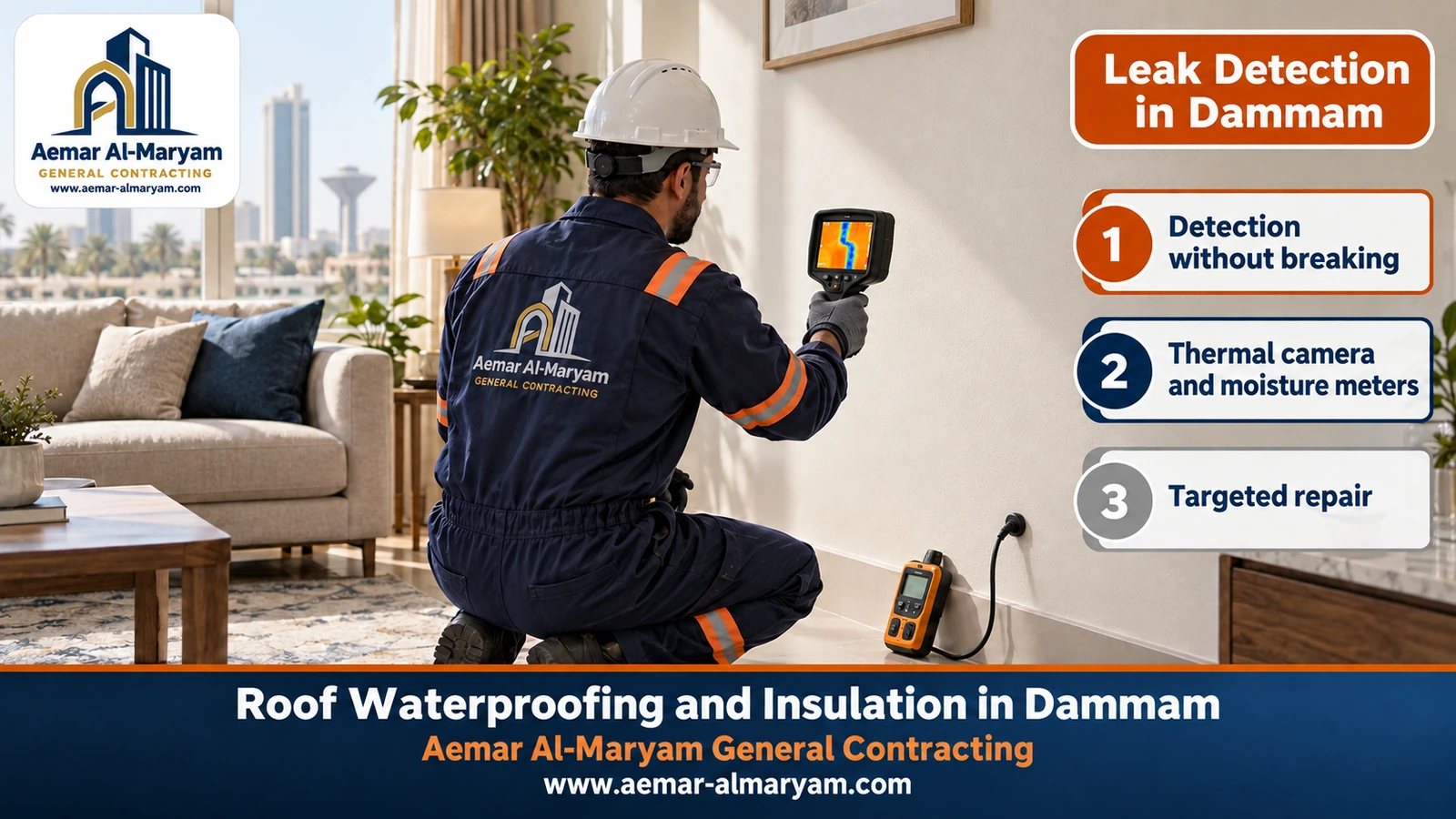
Water leak detection in Dammam means pinpointing a hidden leak with instruments that break nothing, then opening up only the confirmed spot for the repair. A damp patch on a wall doesn’t always sit above the broken pipe. Water travels inside walls and floors and surfaces far from its source, and whoever starts breaking at the stain can end up demolishing the whole wall without finding anything.
The Meter Test: Do You Have a Leak at All?
Before you call anyone, try this simple test, which reveals a leak in the pipework after the meter:
- 1Shut off every water use
Taps, water heaters, the washing machine and the tank float valve if you can. - 2Record the meter
Write down the reading or take a photo of it on your phone. - 3Wait half an hour
With nobody in the house using any water. - 4Compare the reading
If it has moved while everything was off, there is a leak somewhere after the meter.
Signs of a Hidden Leak in Dammam Homes
- ✓A sudden jump in the water bill with no change in how you use water.
- ✓A damp patch, flaking paint or white salt on a wall next to a bathroom or kitchen.
- ✓Swollen wooden skirting, or tile joints changing colour in one area.
- ✓A musty smell in a closed room, or a stain on a lower-floor ceiling under a bathroom.
- ✓The sound of running water with all taps off, or a tank float that never stops filling.
Leak Detection Equipment and What Each Tool Shows
| Tool or method | What it reveals | Its limits |
|---|---|---|
| Thermal camera | Temperature differences on wall and floor surfaces that point to cold or hot water | It reads surface temperature, not water itself, so its result is confirmed with another tool |
| Moisture meter | Moisture levels in plaster, tiles and timber | Measures near the surface, not deep inside the wall |
| Pressure test | Whether a closed line loses pressure, meaning it has a break | Identifies the leaking line, not the exact point |
| Ground microphone | The sound of water escaping from a pipe under tiles | Affected by background noise |
| Dye and flood tests | Leaks from floor gullies, shower trays and roofs | Needs time and watching the ceiling below |
No single instrument is enough every time. We usually start with the thermal camera and moisture readings to narrow down the area, confirm with a pressure or flood test, and then open a small hole at the confirmed point. Repairing the pipe afterwards is plumbing work priced on its condition, after which we make good the tiles, plaster and paint in the opened area.
What we offer and what we don’t
We provide instrument-based leak detection as an inspection service ahead of repair and waterproofing, and give you a written summary of what we found with screenshots from the camera. We do not issue reports accredited by outside bodies, so if you need a report for a particular party, ask them which providers they accept reports from.
Tracing a leak in a bathroom or kitchen starts from SAR 140, a full flat from SAR 200, a villa or whole floor from SAR 280 and a water tank from SAR 140. Prices are estimates until inspection and agreement, and they change with the roof condition, area, floor level, materials, thickness and access. We also cover leak detection in Al Khobar and Dhahran within our visit schedule.
Flood Testing in Dammam: How Long It Takes and How It Is Done
A flood test in Dammam means covering the finished waterproofing with a layer of water after temporarily plugging the drains, leaving it for at least 24 hours and no more than 72 hours, and then checking the ceiling below. That duration is set out in a well-known American guide to flood testing horizontal waterproofing (ASTM D5957), which also sets the water depth: at least about 25 mm at the highest point and no more than about 100 mm at the lowest.
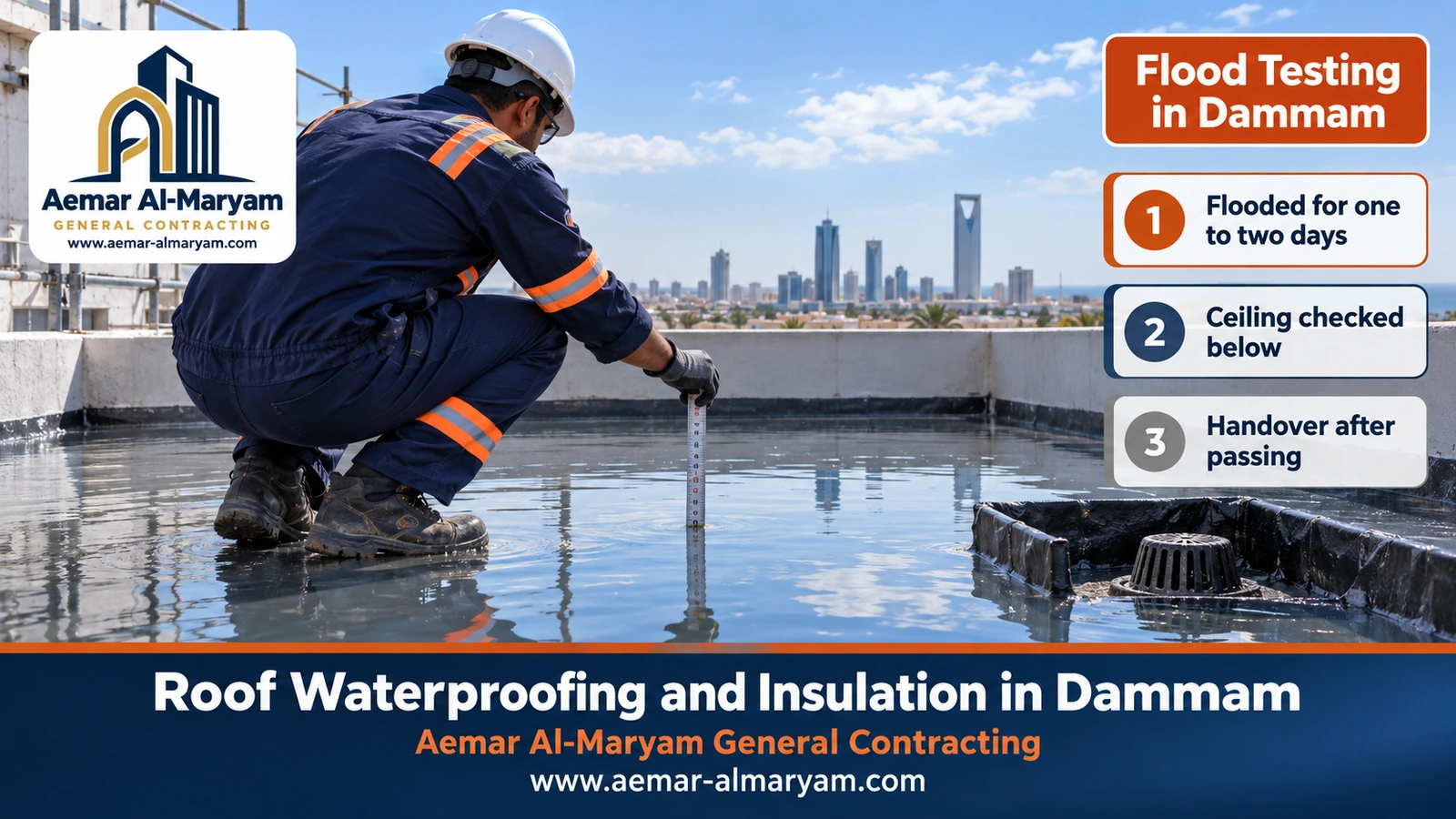
The test is done before the protective layer and tiles, because discovering a fault after tiling means breaking the tiles. If any seepage shows, we dry the area, repair the fault and test again. We never flood a roof deeper than the stated depth: 100 mm of water puts roughly 100 kilograms on every square metre of the slab.
A whole week of flooding?
You may hear that a flood test needs a week. It doesn’t. The technical reference sets 24 to 72 hours, and flooding for longer than that only delays the job and loads the slab for no reason. In bathrooms, 24 to 48 hours is usually enough.
Roof Waterproofing Steps in Dammam, From Inspection to Handover
We carry out roof waterproofing in Dammam in a fixed sequence, and every step has a reason behind it. Some steps are shorter on a clean new roof; others take longer on an old roof with layers built up over the years:
- 1Inspection and measuring
Checking the roof, drains, parapets, tanks and services, photographing ceiling stains and measuring the true area. - 2System and scope
The type of waterproofing, the layers, thicknesses and what the price includes, written down before we start. - 3Stripping and cleaning
Removing blistered membrane or hollow tiles, then sweeping, washing and drying the roof. - 4Cracks and falls
Sealing cracks and correcting the falls, or laying a new screed to the drains. - 5Priming and detailing
Primer, then reinforcement at drains, corners, AC bases and pipe penetrations. - 6Waterproofing
The membrane, then the thermal layer or foam, according to the chosen system. - 7Flood test
24 to 72 hours, with the ceiling checked from below. - 8Protection and handover
The protective screed, reflective coating or tiles, then cleaning the roof and removing the debris.
As for timing, waterproofing an ordinary villa roof usually takes a few working days, plus one to three days for the flood test, then the time for protection and tiling. We avoid working on a wet roof.
Roof Waterproofing Prices in Dammam: “Starts From” Table
Our roof waterproofing prices in Dammam begin at SAR 13 per square metre for bitumen membrane, SAR 23 for spray foam SAR 42 for a sprayed foam water-and-heat system with a protective top coat and SAR 46 for a layered system of waterproofing, insulation boards and protective tiles, while the table below lists where each of the remaining items begins. Prices are estimates until inspection and agreement, and they change with the roof condition, area, floor level, materials, thickness and access.
| Service | Unit | Starts from |
|---|---|---|
| Bitumen membrane waterproofing | m² | SAR 13 |
| Sprayed polyurethane foam (standard layer) | m² | SAR 23 |
| Sprayed foam water-and-heat system with a protective top coat | m² | SAR 42 |
| Layered system: waterproofing + insulation boards + protective tiles | m² | SAR 46 |
| Thermal insulation boards (polystyrene) | m² | SAR 14 |
| Acrylic liquid roof coating | m² | SAR 23 |
| Cementitious roof waterproofing | m² | SAR 15 |
| Polyurea coating | m² | SAR 55 |
| Tiled roof without removal (clear or acrylic coat) | m² | SAR 10 |
| Concrete tank lining, cementitious | m² | SAR 14 |
| Tank lining with drinking-water-safe epoxy | m² | SAR 46 |
| Bathroom waterproofing (floor and walls) | m² | SAR 26 |
| Full bathroom renovation (strip-out, membrane, plumbing, tiles) | bathroom | SAR 2,300 |
| Leak detection, bathroom or kitchen | visit | SAR 140 |
| Leak detection, full flat | visit | SAR 200 |
| Leak detection, villa or whole floor | visit | SAR 280 |
| Leak detection, water tank | visit | SAR 140 |
| Foundation, footing and ground beam waterproofing | — | After inspection |
| Stripping old waterproofing and new screed to falls | — | After inspection |
Prices are estimates until inspection and agreement, and they change with the roof condition, area, floor level, materials, thickness and access. Where an item says “after inspection”, a few photos and rough sizes sent to 0547879578 on WhatsApp are enough for a first estimate. Prices for the rest of our work are collected in the estimated price guide.
Cost to Waterproof a 200 m² Roof in Dammam: A Worked Example
Take a 200 square metre villa roof: bare concrete, falls in good order, no old membrane to strip. On our starting prices, before tiling and before any extra work, the estimated cost looks like this:
| System | Calculation | Estimated cost from |
|---|---|---|
| Bitumen membrane only | 200 × 13 | SAR 2,600 |
| Standard spray foam layer | 200 × 23 | SAR 4,600 |
| Sprayed foam water-and-heat system with a protective top coat | 200 × 42 | SAR 8,400 |
| Layered system: waterproofing + insulation boards + protective tiles | 200 × 46 | SAR 9,200 |
An illustration only. The real price changes with the thickness required, stripping old layers, correcting falls, tiling, floor level and how materials get up to the roof.
What Pushes the Price of Roof Waterproofing Up or Down?
- ✓Area: small roofs are often priced with a minimum charge, while large areas bring the rate per metre down.
- ✓Roof condition: stripping old membrane or hollow tiles and correcting falls are separate items.
- ✓Thickness and coats: 5 cm of foam is not 3 cm, and two coats of coating are not one.
- ✓Details: many AC stands, pipes and upstands add time and reinforcement.
- ✓Access: a high roof and awkward lifting of materials add time and labour.
- ✓Protection and finish: tiles or a reflective coat over the waterproofing carry their own cost.
How Long Roof Waterproofing Lasts in Dammam, and When to Renew It
How long roof waterproofing lasts in Dammam isn’t decided by the material alone. Workmanship, protection from the sun and maintenance count just as much. Sprayed foam is the clearest example: published research on foam roofs puts their effective service life at more than 30 years, but only with the protective coating renewed, at an average of about 15 years between recoats. Foam left without protection starts to erode within a few years.
| System | What makes it last | When to check it |
|---|---|---|
| Foam with protective coating | Recoating once the coat wears; no walking on it in sharp-soled shoes | Every year, and after any work on the roof |
| Membrane under tiles | Well-welded laps, sound protection and tiles, clean drains | After every rainy season |
| Exposed membrane | A cap sheet or reflective coat that is renewed | Every summer, for splits and blisters |
| Liquid membranes | The right thickness from the start, and a refresh coat when it fades | Every year |
| Clear coat over tiles | Periodic reapplication and re-grouting | It lasts less than a full system |
We won’t quote you a fixed lifespan for each system, because a number like that depends on dozens of factors. The practical rule is this: clear the drains before the rains, check the roof after the first downpour, and don’t let anyone fix an AC base or a pipe through the membrane without sealing it again.
Common Roof Waterproofing Mistakes in Dammam
What we repair most often in Dammam is not waterproofing made with poor materials, but waterproofing laid with a mistake that could have been avoided. These are the faults we come across most when inspecting roofs:
- ✓Waterproofing a roof with no falls: water sits on the membrane for days after each rain and wears out its weakest point.
- ✓Ignoring drains and corners: most leaks start at an outlet or where the roof meets a wall, not in the middle of the roof.
- ✓Turning the membrane up the wall by only a few centimetres: water creeps over the edge and gets under it.
- ✓Leaving foam or membrane in the sun with no protection: the surface cracks and erodes long before its time.
- ✓Waterproofing a damp or dusty surface: adhesion is weak and blisters appear after the first summer.
- ✓Thinning the coating to cut the price: a liquid membrane at half its specified thickness only looks good on handover day.
- ✓Skipping the flood test: the fault is found after tiling, when fixing it costs far more.
- ✓Waterproofing the roof while the tank keeps weeping: the ceiling stain stays, because the roof was never the source.
Waterproofing as Part of Renovation and Annex Work in Dammam
Re-waterproofing the roof belongs in any serious renovation of an older house in Dammam, because water coming through the roof is one of the reasons ceilings spall and their steel rusts. If your ceiling is flaking and the bars are showing, the right order is: stop the water from above with waterproofing, repair the ceiling from below, then paint. Our renovation contractor in Dammam article covers this, as does our renovation service. After the leak is stopped, painting hides what the stains left behind; details are in our guide to the painting contractor in Dammam.
The roof of a new annex or outdoor majlis needs the same waterproofing and heat insulation as the main house, and it is often forgotten because the annex is small. We can do it as the annex is built or afterwards. If the roof has cracks that need treatment before waterproofing, see the crack repair service.
Roof Waterproofing in Al Khobar, Dhahran, Qatif and Other Eastern Province Cities
We waterproof roofs and trace leaks in every city of the Eastern Province and schedule visits from Dammam according to location. For the more distant cities, travel is priced after inspection, and grouping several jobs into one visit brings the cost down for the client. Each city has its own services page and a renovation guide describing our work there:
| City | City page | Renovation and waterproofing there |
|---|---|---|
| Al Khobar | Al Khobar service page | Al Khobar renovation guide |
| Dhahran | Dhahran service page | Dhahran renovation guide |
| Qatif | Qatif service page | Qatif renovation guide |
| Saihat | Saihat service page | Saihat renovation guide |
| Jubail | Jubail service page | Jubail renovation guide |
| Al-Ahsa | Al-Ahsa service page | Al-Ahsa renovation guide |
| Ras Tanura | Ras Tanura service page | Ras Tanura renovation guide |
| Abqaiq | Abqaiq service page | Abqaiq renovation guide |
| Khafji | Khafji service page | Khafji renovation guide |
| Hafr Al-Batin | Hafr Al-Batin service page | Hafr Al-Batin renovation guide |
In Al Khobar, Qatif and Saihat, close to the sea, humidity and salt run higher, so we pay extra attention to shielding the membrane from the sun and to treating salt at the base of walls. In Jubail Industrial City, work follows the Royal Commission’s requirements within its area.
Dammam Districts We Serve for Waterproofing and Leak Detection
From our base in Al Rawdah we reach every part of the city, older quarters and new plans alike, among them:
To see photos of work we have carried out in Dammam and beyond, visit our projects gallery, and for the city page see our services in Dammam.
How to Order Roof Waterproofing in Dammam: The Photos and Details to Send on WhatsApp
The quickest route to an estimate is to send the right photos from the start. They tell us which system suits your roof before we visit, so we arrive with the right tools. Send these on WhatsApp to 0547879578:
- ✓An overall photo of the roof: from two angles, showing the drains, parapet walls and tanks.
- ✓Photos of the ceiling stains from inside: naming the room, and whether they appear only after rain or all the time.
- ✓The approximate area: or the roof dimensions, and the number of floors.
- ✓The roof’s condition: bare concrete or tiled, whether it was waterproofed before, and roughly when.
- ✓The tanks: underground or rooftop, concrete or plastic, if the job includes them.
- ✓Location and district: plus a convenient time for the inspection.
- 1Send the photos
On WhatsApp, or call us directly. - 2Receive an estimate
Based on the photos and our starting prices, noting anything that needs confirming on site. - 3Inspection
We inspect and measure the roof and settle the system and the items. - 4Agreement and work
We start on the agreed date and flood-test before the protection goes on. - 5Handover
A clean roof, debris removed, and an explanation of the maintenance your roof needs.
Waterproof your roof before the rains
Photograph your roof and the stains on your ceilings and send them over. We will suggest the system that fits, with its estimated cost, and then fix a day to inspect the roof in person.
More on waterproofing and repairs
Tags