
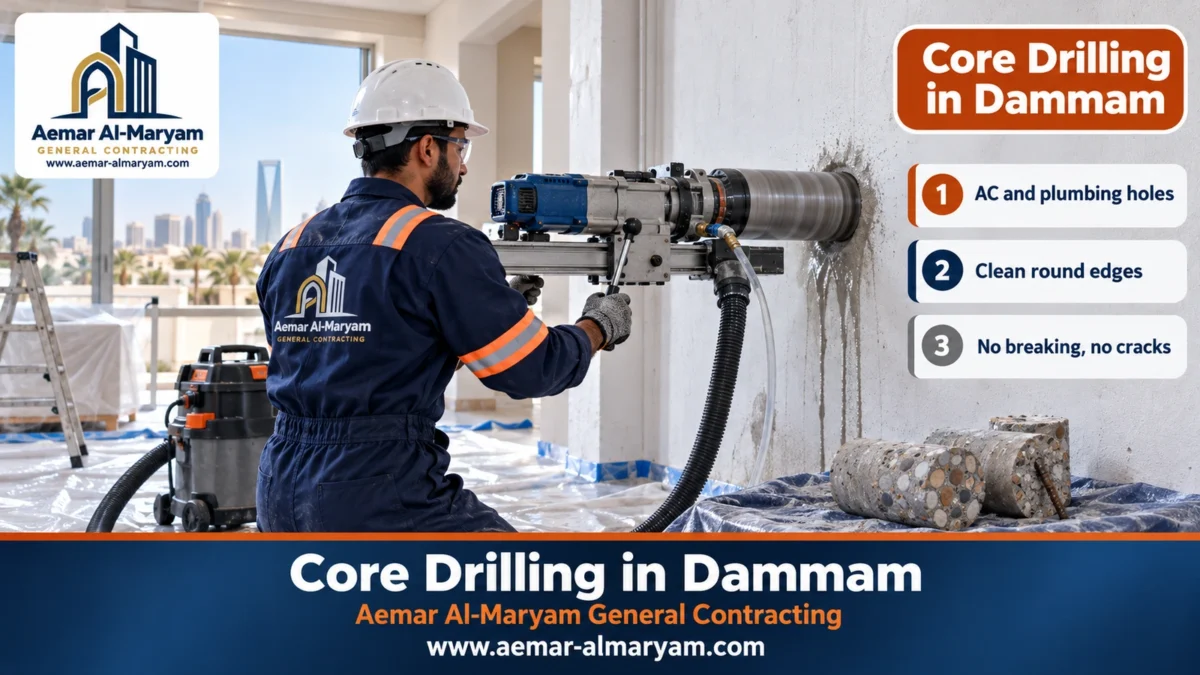
Core drilling in Dammam means cutting clean, round holes through concrete walls, slabs and block walls with a diamond core rig, so that AC lines, drain and water pipes, extractor ducts and cables can pass through without breaking the surrounding structure. At Aemar Al-Maryam General Contracting we drill core holes in homes, flats, villas, apartment buildings, shops and warehouses across Dammam and the whole Eastern Province, from small holes for a single cable up to large openings for ventilation ducts, and we scan for rebar and services before every hole and vacuum the water as we drill. An AC hole or small core starts from SAR 90, a 5–6 inch core from SAR 140 and an 8 inch core from SAR 230; every figure is an estimate until we inspect and agree the job. Phone or WhatsApp: 0547879578.
Most people who need a core hole are in the middle of another job. The AC technician is waiting for the hole before he can hang the new split unit; the plumber cannot drop a new soil pipe from the upper floor; the kitchen fitter needs an outlet for the hood before the cabinets go up. This guide answers the questions that come before the booking: which diameter do you need, can the wall or slab take it, what does it cost, and how is it done inside an occupied home without turning it into a building site? At the end you will find the ordering steps and the details that let us price your hole from a few photos.
Core drilling in Dammam at a glance
- What we drill: split and central AC holes and duct penetrations, drain and water pipe holes between floors, kitchen and bathroom extractor outlets, electrical and telecom holes, and rows of large cores in warehouses and projects.
- Where: reinforced concrete walls, block walls, roof and floor slabs, and ground slabs, in occupied buildings or before finishing.
- Prices from: SAR 90 for an AC hole or any core up to about 100 mm; SAR 140 for 5–6 inch; SAR 230 for 8 inch; SAR 320 for 10–12 inch; larger sizes priced at inspection. Every figure is an estimate pending a site visit and agreement.
- Method: a core rig anchored on a stand, a water-cooled diamond core bit, a rebar and services scan before drilling, and continuous wet vacuuming of the slurry.
- When an engineer is needed: large slab openings, any hole in a beam or load-bearing wall, and any hole in a post-tensioned slab. Columns are never cored.
- Coverage: every district of Dammam, with regular visits to Al Khobar, Qatif, Dhahran, Jubail, Saihat, Al-Ahsa and other Eastern Province towns.
- Getting a price: phone or message 0547879578 with a photo of the spot, the diameter you need and the wall or slab thickness.
Core drilling in Dammam: what is a core hole and when do you need one?
A core hole is a cylindrical opening cut with a hollow, tube-shaped bit whose rim carries diamond segments. As the bit turns it grinds away only a thin ring of concrete, and when it breaks through it releases a solid cylinder, the “core”, with exactly the diameter of the hole. That cylinder gives the method its name. What you are left with is a smooth-sided hole of a pre-chosen size, made without hammering the wall or chipping around the opening.
In Dammam you will usually need one in one of these situations: installing a new split AC or moving an old one; running a drain or water pipe from one floor to the next; making an outlet for a kitchen hood or a bathroom extractor; passing electrical or telecom cables between rooms; or preparing central AC and duct routes in a commercial building. In warehouses and factories the request is often a row of large cores for water, fire-fighting or compressed-air pipework.
■ Air conditioning
the hole for the copper pair, condensate drain and power cable of a split unit, plus duct and pipe holes for central and VRF systems.
■ Plumbing and drainage
slab holes for soil and waste stacks between floors, and wall holes for water lines.
■ Kitchens and bathrooms
hood and extractor outlets, oven and grill flues, and vents for internal bathrooms.
■ Electrical and telecom
small holes for cables and conduits between rooms, floors and electrical rooms.
■ Projects and warehouses
rows of large cores in thick walls for water, fire-fighting and air lines.
■ Renovation work
replacement holes when plumbing or AC routes change, and concrete samples when an engineer asks for them.
If you actually need a whole wall section removed or a doorway opened, that is a different job with different machines, covered on our concrete cutting in Dammam page. This page is dedicated to round holes of every kind. A short summary of the service is also on the core drilling service page.
Concrete coring in Dammam with a diamond core rig
Concrete coring in Dammam means making a round hole in concrete with a core drill whose diamond bit rotates around a fixed axis, cutting through concrete and reinforcing steel together without impact. It is the method we use for every hole, from a small cable hole to a large duct opening, because the motor is mounted on a stand that holds the drilling line, so the hole comes out straight and exactly where it was marked.
The older method you will still see on some sites is to drill a ring of small holes with an ordinary hammer drill and then chisel or break out the middle until the opening is big enough. The trouble is that repeated hammering shakes the wall, leaves a ragged edge, can knock off plaster or tiles on the far side, and leaves a large patch to repair once the pipe is in. The difference is easiest to see side by side:
| Item | Diamond core drilling | Hammer drill and chisel |
|---|---|---|
| Shape of the hole | round, to a set diameter, smooth sides | irregular and larger than needed |
| Vibration | rotation only, no impact | repeated hammering carried into the wall |
| Rebar | cut cleanly inside the hole | exposed, bent and left sticking out |
| Far side of the wall | usually breaks through without spalling tiles or plaster | plaster and tiles burst around the exit |
| Making good afterwards | a thin ring around the pipe | a wide repair around the opening |
| Dust | low, because drilling is water-cooled | heavy and airborne |
Search terms vary a lot, so it helps to know that “core drilling”, “concrete coring”, “core cutting” and “drilling a core in concrete” all describe the same thing: a round hole made with a core rig. “Concrete cutting and coring” combines coring with straight saw cuts, and further down we explain when a job needs both.
Drilling holes in walls in Dammam: concrete or block
Holes in walls in Dammam are drilled with a core rig when they are round and up to about 30 cm, and cut with a wall saw when they are square or large, such as doors and windows. Most household requests are the first kind: an AC hole, a pipe hole, an extractor outlet or a cable hole, and each is normally finished in a single visit.
Coring block walls and concrete walls in Dammam
A block wall is easier to core than reinforced concrete, but it needs a different kind of care. Hollow blocks can crack if the bit is pushed too hard, and their internal voids make the bit chatter if the speed is wrong. On block we therefore run a higher speed with lighter feed pressure, and we often drill dry with dust extraction when water would harm the wall or the paint. Reinforced concrete is always drilled wet, because the water cools the diamond segments as they pass through steel and keeps the dust down.
In older traditional houses in Dammam a single wall can contain both: blockwork above and a concrete beam below. This is where scanning first pays off, because moving the hole a few centimetres is far better than drilling into the beam.
When does a wall hole become a cutting job?
If the opening must be square or rectangular, for example a rectangular duct, a small window or a doorway, a core alone will not do it. We either drill cores at the corners and join them with saw cuts, or cut the whole opening with a diamond wall saw. Large openings of this kind are explained, including load-bearing walls and propping, on the door and window openings page.
Before we drill your wall
If you can, mark the position of the hole on both sides and check that the other side is not a kitchen cabinet, a distribution board or a bathroom mirror. We measure and check before starting anyway, but knowing what is behind the wall saves time on the day.
AC core holes in Dammam
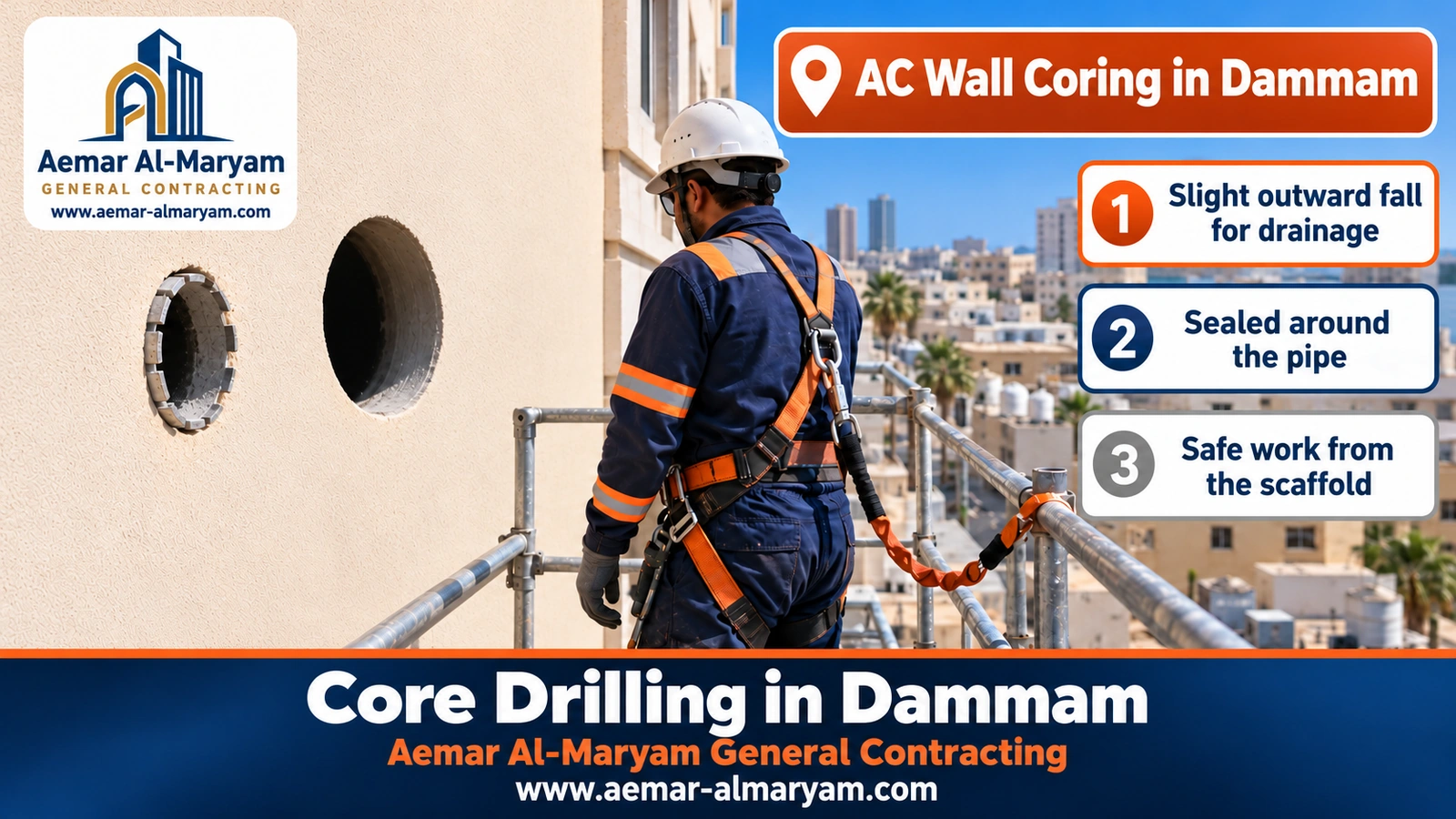
An AC core hole in Dammam is the request we receive most often, and it starts from SAR 90 per hole. We drill it through the external wall at a diameter that takes the copper pipes, the condensate hose and the power cable together with their insulation, and with a slight fall towards the outside, so that condensate and rainwater run out of the wall instead of back into the room.
What size and slope does a split AC hole need?
There is no single diameter for every air conditioner; the reference is the installation manual of the unit itself. As an example, the installation manual of many wall-mounted splits asks for a feed-through hole of 65 mm with a downward slope towards the outside. Many domestic units fall into this range, while larger units or thicker pipe runs need a 3 or 4 inch hole. That is why we ask for the model and capacity of the unit, or speak directly to your AC technician, before choosing the bit.
- Slope: we tilt the motor slightly on its stand so the hole falls towards the outside and water runs out, not in.
- Height: set by the position of the indoor unit, usually just below or behind it, while keeping clear of the ceiling and the beam.
- Distance from corners: we stay away from columns, wall corners and beam lines, which is exactly what the rebar scan reveals.
- Outside face: we check what the hole will open onto: a neighbour’s walkway, a window, or a suitable place to mount the outdoor unit.
Central AC, duct and VRF penetrations
In villas and commercial buildings the holes are not limited to the copper pair. There are larger refrigerant lines, combined condensate drains and sometimes the air ducts themselves. These holes typically range from 5 to 8 inches and above, and are often drilled through slabs and internal walls between rooms. We prefer to receive the HVAC layout from the contractor or consultant, because a rectangular duct may need a sawn opening rather than a core.
Core hole or window-AC opening?
A window-unit opening is not a core hole. It is a large rectangular opening the size of the unit, cut with a saw and usually needing a lintel above it. Anyone replacing a window unit with a split normally needs two things: the old opening closed with block or concrete, and a small new core hole for the pipes. We can do both in one visit if you ask.
Do we install the air conditioner?
No. We prepare the hole only and hand it over clean and ready for your AC technician. If the technician can be present while we drill, even better, because he can set the height and slope himself.
Kitchen and bathroom core holes in Dammam
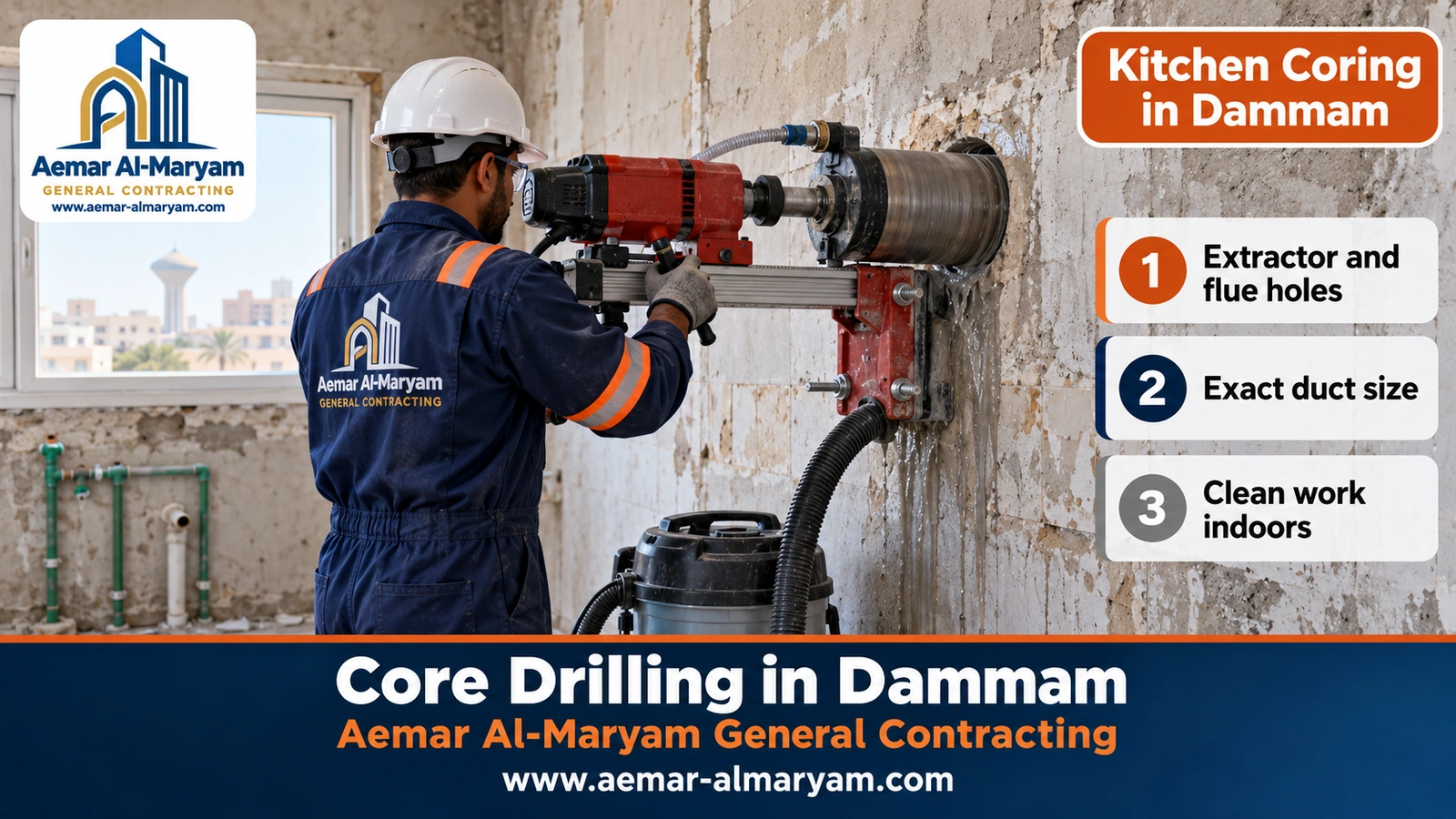
Kitchen and bathroom core holes in Dammam are usually drilled during a refurbishment, before the cabinets and tiles go in, because drilling is quicker and cleaner at that stage. They include the kitchen hood outlet, the bathroom extractor hole, holes for basin and trap pipes, and sometimes a flue for an oven or a grill in an outdoor kitchen.
Extractor fan core holes in Dammam: what size?
Domestic bathroom extractors are generally designed for a 100 mm duct, while kitchen hoods commonly use a 150 mm duct, so the hole is usually around 4 inches for a bathroom and 6 inches for a kitchen. The deciding factor is still the fan or hood manual, because some powerful units need a larger outlet, and any narrowing reduces airflow and makes the motor louder. Remember that a bathroom fan is not a substitute for a kitchen hood, which carries grease and heat.
Height matters too. The kitchen hood outlet sits high, near the ceiling and above the cooker, so we drill it from a scaffold or a stable platform, with the stand anchored firmly to the wall, because horizontal drilling near the ceiling needs a rigid mount.
Gas pipe sleeves and flues
We drill the round hole that a gas pipe or a flue will pass through, but running and connecting the gas line is a job for a qualified gas technician, and we do not do it. We leave enough clearance in the hole for a protective sleeve so that the pipe never rubs against the concrete.
If your kitchen or bathroom refurbishment includes new pipework, see our plumbing works page for the installation we carry out after the holes are made.
Slab and ceiling core drilling in Dammam
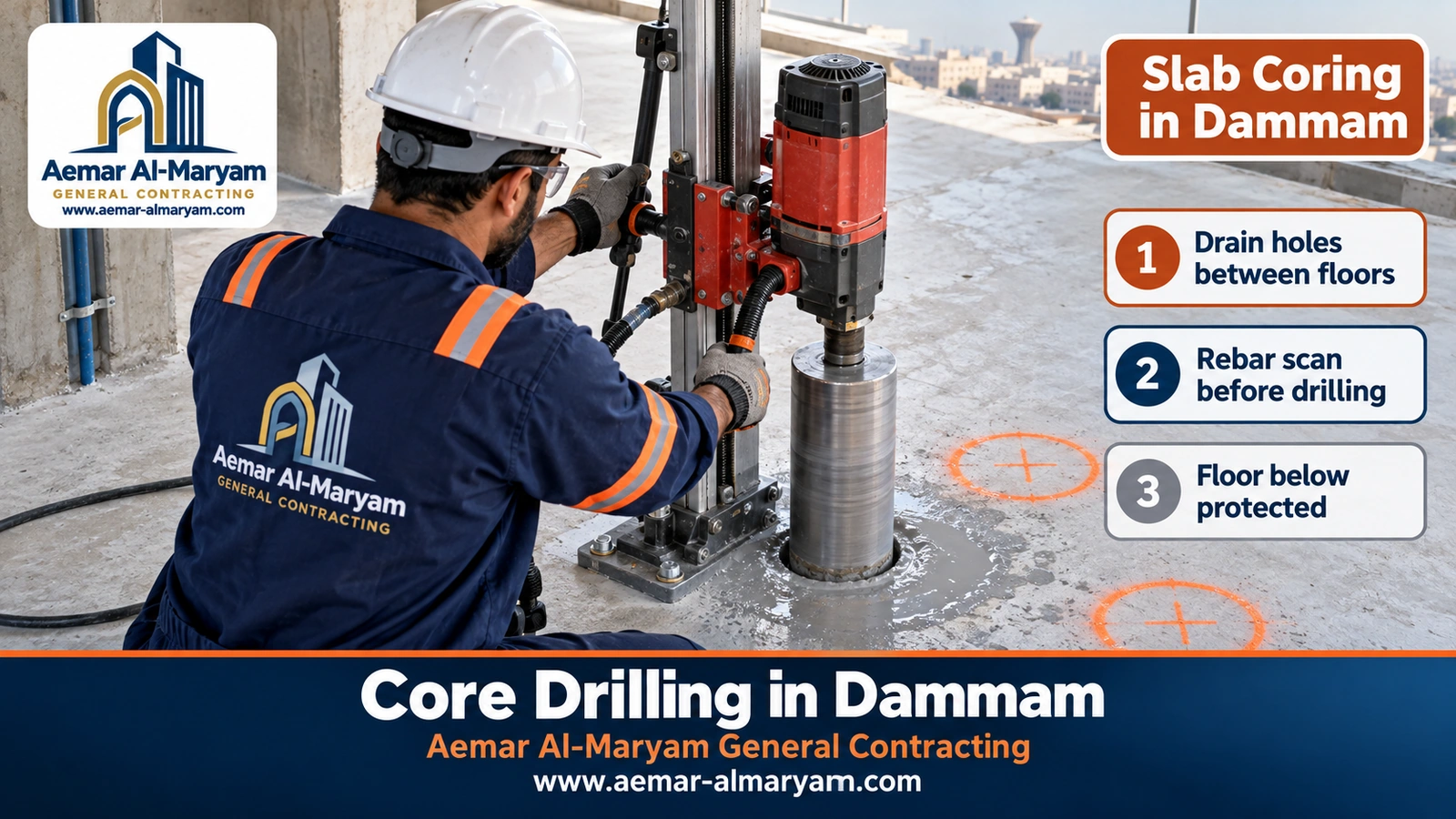
Core drilling through a slab in Dammam is possible and safe in most residential floors, provided we scan for rebar and services first and keep the hole clear of columns and beams. The rig is anchored upright on the slab from above, and the floor below is protected from water and from the core dropping out when it breaks through.
Drain and water pipe holes between floors
The most common slab holes are for soil pipes when a bathroom is added upstairs or a WC is moved. The usual domestic drain pipe is 110 mm, which plumbers call “4 inch”, so it needs a slightly larger hole, usually in the 5 inch class, to leave room for the pipe and the sealing material around it. Basin wastes and smaller drains need smaller holes.
- We locate the hole from above and below together, so it does not land under a beam or inside a suspended gypsum ceiling full of lights.
- We fix a catch or a barrier under the hole so the concrete core cannot fall onto the floor or onto anyone below.
- We vacuum the drilling water from above and cover the floor below with heavy plastic, because some water comes through at the end of the cut.
- Once the pipe is in, the hole is packed from above with non-shrink mortar; on an external roof a waterproofing collar is added around the pipe.
Core drilling a beam: only on an engineer’s design
A beam carries the slab and transfers its load to the columns, and any hole through it cuts part of its main steel. We therefore drill a beam only on a design by a structural engineer who specifies the position, the diameter and whether strengthening is needed. Columns are never cored at all. In many cases the simplest answer is to move the pipe route slightly so that it passes through the slab beside the beam.
⚠ Post-tensioned slabs
Some recent apartment blocks and commercial buildings use slabs that are compressed by stressed steel strands. Severing one of those strands can release a dangerous amount of force and damage the floor it holds up. If your building is of this type, or you are not sure, tell us before the inspection so that we scan with ground-penetrating radar to locate the tendons and their depth, and we do not drill without the engineer’s approval.
Core hole sizes in Dammam: which diameter do you need?
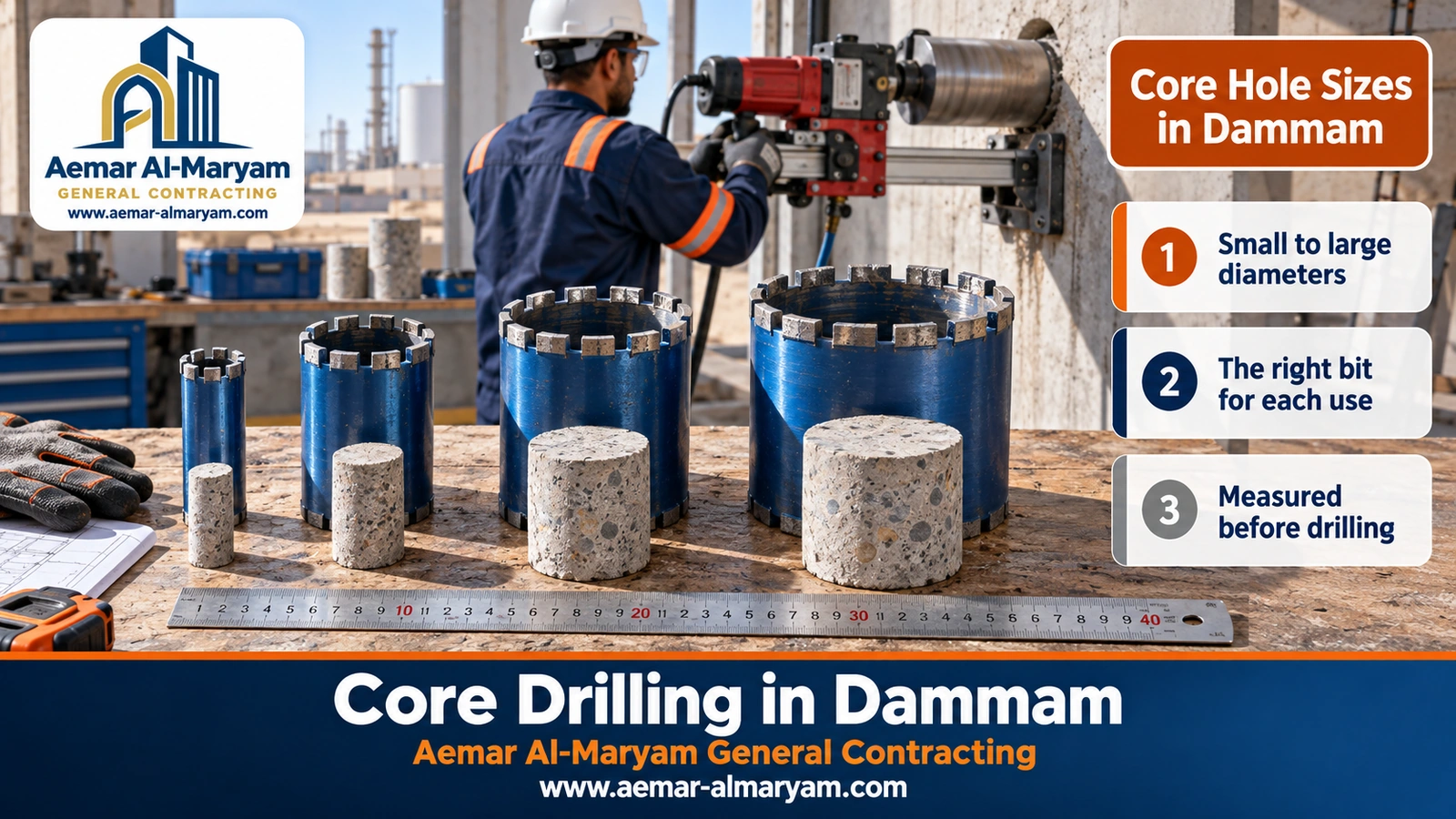
The size of a core hole is chosen from what will pass through it, plus a small allowance for insulation or sealant. The local market names sizes in inches, while the diamond bits themselves are made in millimetres, so the approximate table below gives both:
| Common size | Approx. in mm | Typical use |
|---|---|---|
| 1–2 inch | 25–50 mm | an electrical or telecom cable, a small water pipe |
| 2.5–3 inch | 65–80 mm | a domestic split AC (a common example: 65 mm) |
| 4 inch | 100–110 mm | a bathroom extractor, larger AC lines, a bundle of cables |
| 5–6 inch | 125–160 mm | a 110 mm drain pipe with sealant, a kitchen hood on a 150 mm duct |
| 8 inch | about 200 mm | oven flues, central extract, central AC pipework |
| 10–12 inch | 250–300 mm | large ventilation ducts, main pipes in projects |
| Above 12 inch | up to 500 mm and more with large rigs | projects and warehouses, assessed at inspection |
Note: the final size is set by the equipment manual, the AC technician or the plumber, and we drill the diameter required. If you are not sure, send the model of the unit or the pipe diameter and we will suggest the size.
As for depth, a standard diamond core bit for rig drilling has a working length of about 450 mm, which is enough for an ordinary residential wall or slab in one pass. Thicker walls in industrial buildings, tanks and foundations are drilled with extension pieces or from both sides. Large stand-mounted core motors reach diameters of 500 mm and more; anything bigger is made by stitch drilling (overlapping cores) or with a wire saw.
A practical point about inches: a “4 inch” pipe is not exactly 4 inches across on the outside. Plumbing sizes are nominal names, and the outside diameter of the pipe plus whatever goes around it is what the hole must clear. This is why we ask for the pipe itself, or its marking, rather than just the name of the size.
Rebar and services scanning before core drilling in Dammam
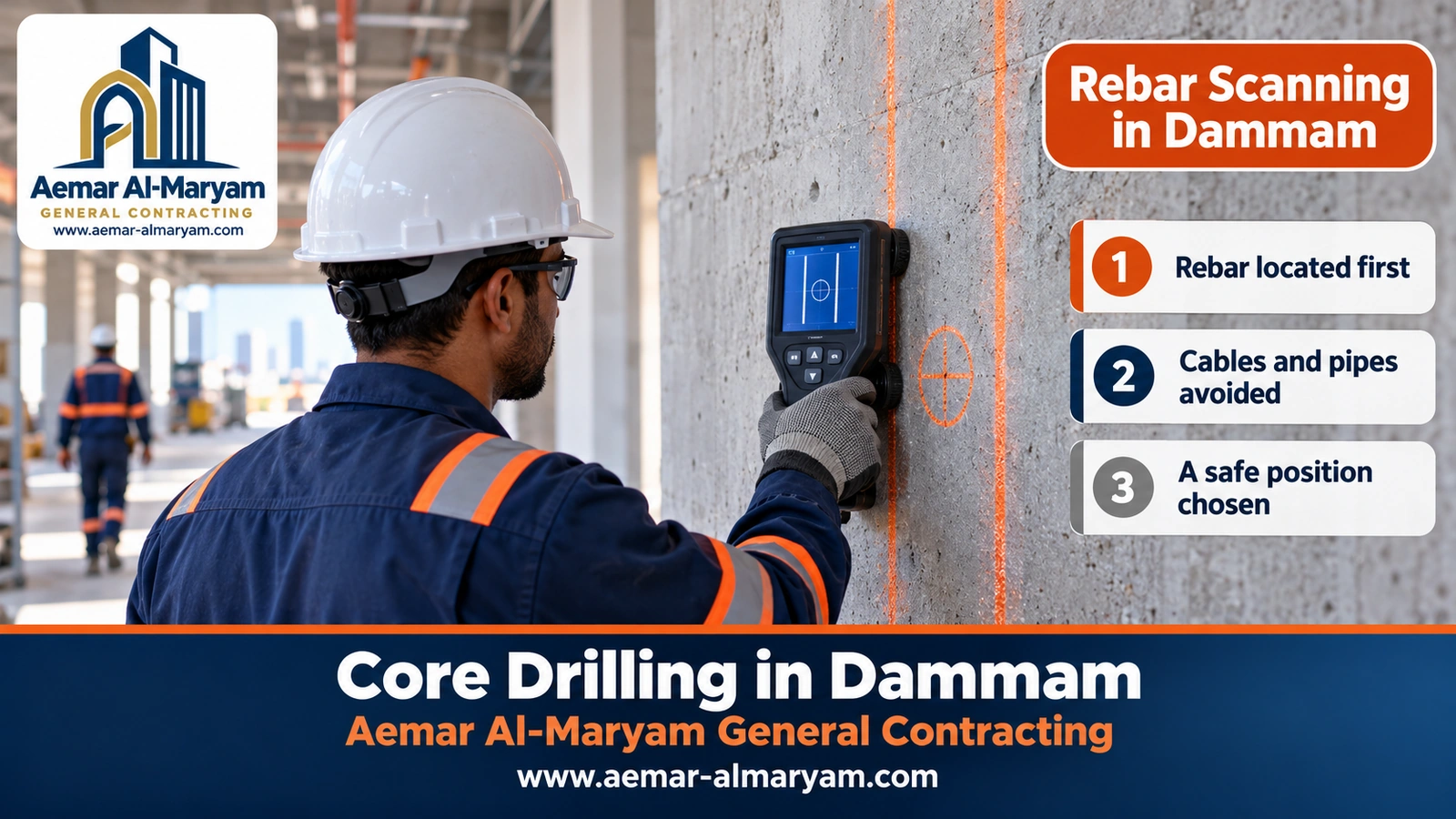
Before any core hole in reinforced concrete in Dammam, we pass a rebar detector over the position and the area around it, chalk the bar positions on the surface and place the hole between them wherever we can. It takes a few minutes, and it protects the main reinforcement as well as the cables and pipes buried in the wall or slab.
■ Reinforcing steel
we find the direction and spacing of the bars, then move the hole so it cuts as little steel as possible or passes between two bars.
■ Electrical and water lines
we look for buried conduits and pipes, ask about service routes, and isolate power to the wall when in doubt.
■ Post-tension tendons
in post-tensioned slabs, ground-penetrating radar is used to locate the tendons and their depth before any drilling.
■ Thickness
we measure the wall or slab thickness to choose the bit length and know whether one pass is enough.
Does a core bit cut through rebar? Yes. Diamond segments cut any bar that lies in their path, and you will see it in the extracted core. Cutting a secondary bar for a small services hole is routine in building work. Cutting main bars in a beam or near a column, or several adjacent bars for a large hole, is a decision for the engineer, who may require strengthening around the opening.
Ground-penetrating radar is the accepted non-destructive method for imaging what is inside concrete before cutting or coring: rebar, tendons, conduits and pipes, as well as the concrete cover and the slab thickness. For most houses a rebar detector is enough; for commercial slabs and any building where post-tensioning is suspected, radar is the right tool.
Wet or dry core drilling: which suits your Dammam building?
Wet coring is the standard method for reinforced concrete in Dammam. Water is fed through the motor into the bit, cooling the diamond segments and carrying the concrete dust away as slurry, so no crystalline silica dust is thrown into the room. Diamond bits made for heavily reinforced concrete are designed for wet drilling, and running them dry burns the segments and slows the work.
Dry coring is mainly used on block and brick walls, or in rooms where water is unacceptable, such as next to electrical panels or equipment. In that case a vacuum is connected to the drill to draw the dust off at the source. The table sums up the difference:
| Wet coring | Dry coring | |
|---|---|---|
| Material | reinforced concrete, slabs, thick walls | block, brick and light walls |
| Dust | turned into slurry and vacuumed | drawn off by a vacuum attached to the drill |
| Water | needs vacuuming and floor protection | none |
| Diameters and depths | all diameters and depths | usually limited diameters and depths |
| In an occupied home | fine with vacuuming and covers | good for small holes in block |
Either way, we use water-protected electrical connections, cover the area around the hole, and vacuum water or dust continuously, so slurry never dries on the tiles where it becomes hard to remove.
Core drilling machines in Dammam: the equipment we bring
A core drilling machine, often called a “core machine”, is a powerful low-speed, high-torque motor that drives a hollow diamond bit and is mounted on a stand that keeps the drilling line straight. What we bring to your site in Dammam depends on the diameter and the location:
Stand-mounted core rigs
These are the backbone for reinforced concrete, slabs and large holes. The stand is fixed to the wall or slab with an anchor, or with a vacuum base on suitable surfaces, and the motor is fed along the column with a feed handle. For example, well-known rig systems drill concrete from 12 mm up to 500 mm, and some larger motors reach 650 mm on a stand.
Hand-held coring for small holes
For small holes in blockwork, or a single cable, a hand-held drill with a small bit may be enough. It is not suitable for an AC hole in thick reinforced concrete, because a hand cannot hold the line or resist the torque if the bit snags on steel. That is why we use a stand even for AC holes.
Diamond bits, scanners and vacuums
- Bits in many diameters: from small cable sizes to large duct sizes, with extensions for thick walls.
- Rebar detector: to locate bars and services before drilling, plus ground-penetrating radar where post-tensioned slabs are involved.
- Wet and dry vacuum: to collect drilling water and slurry, or dust when coring dry.
- Water collection ring: fitted around the bit for horizontal and overhead holes, so water is caught before it runs down the wall.
- Marking and measuring tools: a laser level, tape and chalk to set out the centre of the hole and align both faces.
What about “laser coring” and “thermal coring”?
You may see both phrases in adverts. In reality, holes in buildings are drilled with diamond segments; on site, the laser is a measuring and marking tool that sets the centre and the line, not something that cuts concrete. We have not found a technical reference describing a “thermal coring” method for opening building concrete either. What matters to you is the result: an accurate round hole made by a diamond rig on a fixed stand. We cover the laser question in detail on the laser wall cutting in Dammam page.
Core drilling machine prices: buy, rent or hire a contractor in Dammam?
We do not sell or rent core drilling machines; we drill the holes with our own equipment, so you will not find a machine price on this page. Machine prices change a great deal with the manufacturer, the motor power, the maximum diameter and whether the stand and bits are included, and you can compare them at tool shops in Dammam and online stores. What we can offer is a practical comparison to help you decide:
| Option | Best for | What to budget for |
|---|---|---|
| Buying a machine | a contractor, AC or plumbing workshop drilling holes every week | motor and stand, a bit for each diameter, a wet vacuum, a rebar detector, re-tipping of worn segments, and training |
| Renting a machine | a large temporary job by a team already experienced in anchoring and drilling | the daily rate, bits usually charged separately or by wear, transport, and liability for any damage |
| Hiring a core drilling contractor | a homeowner, building owner or shop that needs one hole or a limited number | the price per hole, which covers equipment, scanning, vacuuming and clean-up |
If you need one hole or ten, hiring a contractor is usually cheaper, because a single large-diameter bit can cost about as much as several finished holes. If you are thinking of buying, a few points deserve attention: choose the motor power for the largest diameter you will drill in reinforced concrete, make sure the drill can be mounted on a stand and takes a water feed, and check that bits in your diameters are available locally. As an example, a mid-sized 3,200 W diamond drill is rated for wet drilling in concrete up to 350 mm when mounted on its stand.
If you rent a machine yourself
Do not drill a slab or near a beam without a rebar scan, do not run the machine on an exposed extension lead with water around, and do not try horizontal drilling with the machine held in your hands without a stand. Most injuries and drilling damage come from these three.
Core drilling prices in Dammam
Core drilling prices in Dammam start from SAR 90 for an AC hole or a small core, SAR 140 for a 5–6 inch core, SAR 230 for an 8 inch core and SAR 320 for a 10–12 inch core. These are starting estimates, and we confirm the actual figure once we have seen the site and agreed the scope.
| Type of hole | Approx. diameter | Price from |
|---|---|---|
| Split AC hole or small hole (electrical, water, bathroom fan) | up to about 100 mm (4 inch) | SAR 90 per hole |
| 5–6 inch core (110 mm drain, kitchen hood) | 125–160 mm | SAR 140 per hole |
| 8 inch core (flues, central AC) | about 200 mm | SAR 230 per hole |
| 10–12 inch core (large ventilation, main pipes) | 250–300 mm | SAR 320 per hole |
| Larger diameters, rows of cores in thick walls, or beam holes on an engineering design | per drawing | quoted after a site visit; WhatsApp your photos and measurements to 0547879578 and we reply with an estimate |
Estimated prices: they start from the figures above for a wall or slab of normal residential thickness. The final price is agreed after inspection and depends on the diameter, thickness, rebar density, floor level, access and number of holes.
What makes a hole cost more?
- Diameter: a bigger hole means a bigger bit, more wear on the diamond segments and more time.
- Thickness: a 30 cm wall is not a 15 cm wall, and a wall thicker than the bit length needs extensions or drilling from both sides.
- Steel: heavily reinforced concrete slows drilling and wears the bit faster.
- Location and height: a hood outlet near the ceiling or a hole on a facade needing a scaffold is not the same as a hole at floor level.
- Direction: drilling a ceiling upwards from below is harder than drilling a slab downwards from above.
- Site conditions: an occupied home with marble floors needs more covering and protection than a shell building.
Wall or ceiling: which costs more?
For the same diameter and thickness, the difference is small if the slab can be drilled from above, because the rig anchors easily and the water is vacuumed where it collects. If the hole can only be drilled from below, the effort rises: water runs back onto the machine and the operator, a collection ring and extra protection are needed, and that is reflected in the price.
How to keep the cost down
- ✓Group the holes into one visit: AC, extractor and plumbing holes in the same house can be drilled in one day, so each hole carries a smaller share of the set-up.
- ✓Decide the size up front: enlarging a hole after it is drilled costs almost as much as drilling a new one.
- ✓Drill before finishing: coring a bare wall is quicker and cleaner than coring through tiles, paint and gypsum.
- ✓Prepare the space: move furniture, provide power and water nearby, and arrange access with the building caretaker.
For the prices of our other services, such as cutting, demolition and renovation, see the prices page.
AC, extractor or drain hole?
Photograph the spot, tell us the diameter and the wall or slab type, and we reply with an estimate and our next free slot.
Core drilling in an occupied home in Dammam: protecting furniture and finishes
Yes, we drill core holes in occupied flats and villas in Dammam almost every day, and the secret lies in the preparation rather than the drilling. A small hole takes little time, but water and slurry can mark marble, parquet or gypsum if they are not controlled.
- 1Cover the floor and the wall
heavy plastic sheeting on the floor well beyond the work area, and tape to protect the paint around the hole. - 2Move what can be moved
we ask you to move light furniture, and we cover what stays, such as wardrobes and appliances. - 3Catch the water at the source
a collection ring around the bit and a vacuum running throughout drilling, so no water runs down the wall. - 4Protect the far side
we cover whatever faces the hole in the next room or outside, and make sure the core cannot drop onto anything. - 5Clean before leaving
we remove slurry and debris, wipe the floor and hand over a hole ready for installation.
In apartment buildings we sometimes ask to coordinate with the neighbour next door or below, especially for slab holes, because part of the work happens in their home. It is a small step that avoids a lot of awkwardness.
Noise is the other question residents ask about. A core rig is far quieter than a breaker because it does not hammer, but a large hole in thick concrete still produces a steady grinding sound for a while. In apartment buildings we schedule drilling within normal daytime hours and let you know roughly how long each hole will run, so you can warn your neighbours in advance.
Concrete coring for projects and warehouses in Dammam
Concrete coring for projects in Dammam differs from a household hole in number, diameter and thickness: the brief may be dozens of holes through a thick concrete wall or through slabs on several floors, in sizes from 4 to 12 inches and more. We handle this kind of work alongside the main contractor or the HVAC, plumbing and fire-fighting subcontractors.
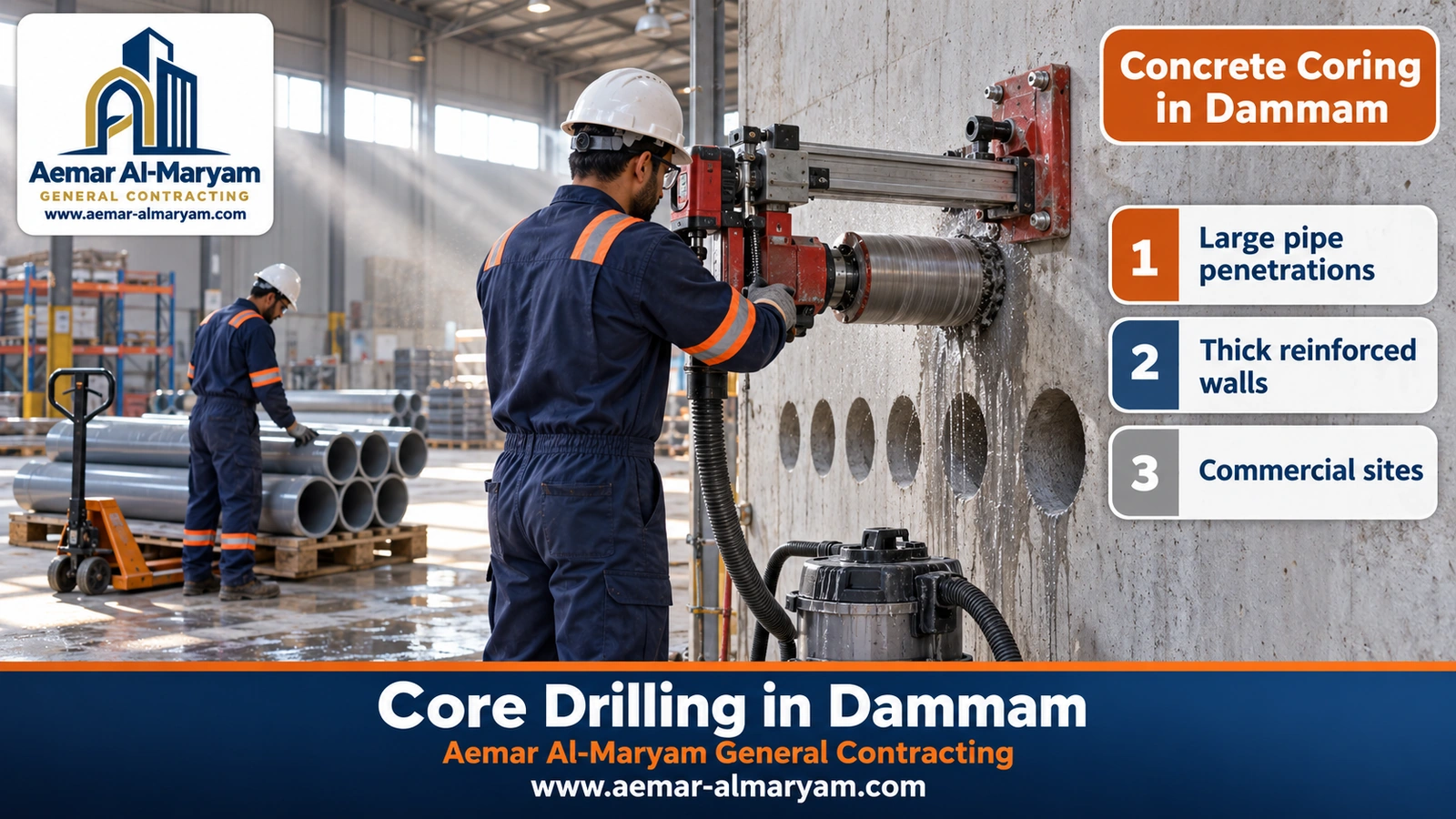
- Approved layout: we receive the penetration drawing, number the holes on site, and review with the engineer any hole that falls near a column or beam.
- Sequence: we drill floor by floor or zone by zone so other trades are not held up.
- Spacing: we keep the spacing shown on the drawing, because closely spaced holes weaken the concrete left between them.
- Firestopping: where required, penetrations between floors are sealed with fire-rated sealants from a tested system specified by the consultant.
- Records: we hand over a list of the holes drilled and their diameters, with photos of each zone on request.
You can see examples of our cutting and coring work in the projects section.
Core drilling or concrete cutting in Dammam: when is a core enough?
A core alone is enough when the opening is round and within the diameter a rig can drill. Square, rectangular or large openings need concrete cutting with a saw, and sometimes both together, which is why “core drilling and concrete cutting” so often appear in the same request.
| What you need | The right tool | Read more |
|---|---|---|
| A round hole for AC, a pipe or an extractor | core rig | this page |
| A rectangular duct or access opening | corner cores joined by saw cuts, or a saw only | concrete cutting in Dammam |
| A new doorway or window through concrete | diamond wall saw | door and window openings |
| A precisely lined wall cut people call “laser” | diamond saw with laser marking | laser wall cutting in Dammam |
| Openings for stairs or a lift shaft through a slab | saw cutting with propping on an engineer’s design | concrete cutting service |
For door and window openings we sometimes use coring as a helper step: small holes at the corners of a rectangular opening so the saw never overruns the marked line and the corners come out clean.
Does a core hole in Dammam need an engineer or a permit?
Small services holes, such as an AC hole, a basin waste or a cable hole, normally do not need an engineer once the scan confirms they are clear of structural members, because they do not change the structure of the building. A hole in a beam, a large hole in a slab, a group of closely spaced holes in a load-bearing wall, or any hole in a post-tensioned slab is a structural modification and needs the opinion of a structural engineer.
Engineer, permit or neither?
A practical rule of thumb; the final word belongs to a licensed engineering office:
- Usually not needed: an AC, extractor, cable or small pipe hole in a wall or slab, away from columns and beams.
- Engineer’s opinion needed: large or multiple holes in a slab, holes in a load-bearing concrete wall or near a column, or in a post-tensioned slab.
- Design and possibly a permit: a hole in a beam, or any change to the structural elements of the building. Depending on the case, the engineering office you appoint may need to apply on Balady for a restoration licence or for an amendment to the building’s approved components.
- Never: coring a column.
In those cases we drill to the drawing the engineer approves and do not improvise the position or the diameter. If the work is part of a wider refurbishment of the building, our renovation contractor in Dammam guide explains when a restoration permit is needed and how it is obtained.
After drilling: sealing and waterproofing core holes
A core hole is not finished when the core comes out. Once the pipe is through, the gap around it has to be sealed; otherwise rain, insects or hot air get in, or bathroom water leaks to the floor below. How it is sealed depends on where the hole is:
■ External AC hole
the lines are sleeved or insulated, then the gap is closed from outside with a weatherproof sealant, keeping the fall towards the outside.
■ Drain hole in a slab
the gap around the pipe is packed with non-shrink mortar in stages, then waterproofed from above in bathrooms before tiling.
■ Hole through a roof
a waterproofing collar around the pipe is bonded into the roof membrane so rainwater cannot track down.
■ Commercial buildings
penetrations between floors are closed with fire-rated sealants from a tested system, as the consultant specifies.
■ Redundant or misplaced hole
filled with concrete or structural mortar, then plastered and made ready for paint.
■ Enlarging an existing hole
possible with a larger bit and careful anchoring, but harder than drilling a fresh hole if the position allows.
We carry out the basic sealing around the hole if it is part of the agreement; full roof and bathroom waterproofing is covered on our waterproofing and insulation page.
How we carry out core drilling in Dammam, step by step
- 1We receive your request and photos
on WhatsApp: hole position, diameter, thickness, floor and building type. We send you an estimate. - 2We book the slot and prepare equipment
we pick the bits for the diameters required and load the stand, vacuum and protection. - 3We mark and scan
we set out the centre of the hole by measurement and laser, scan for rebar and services, and adjust the position with your approval if needed. - 4We protect the area
covering the floor, furniture and the far side, and securing the core so it cannot fall. - 5We anchor the rig and drill
fixing the stand, setting the slope or plumb, then drilling wet or dry depending on the material. - 6We remove the core and clean up
we take out the core, vacuum water and slurry, and wipe the area. - 7We hand over the hole
we check the diameter, position and slope with you, and seal the hole if that is part of the agreement.
A normal domestic hole in an ordinary wall is usually done within a single short visit, including set-up and cleaning. Large diameters, thick walls, ceilings drilled from below and rows of holes take longer, and we give you a realistic time window when we confirm the booking rather than a promise measured in minutes.
Common concrete coring mistakes in Dammam and how to avoid them
- ✓Drilling without a scan: hitting a buried water pipe or power cable costs many times the price of the hole.
- ✓An AC hole with no fall: condensate and rain run back into the room and ruin the wall and the paint.
- ✓An undersized hole: the pipes and insulation get crushed, or the technician ends up enlarging it by breaking.
- ✓Drilling a beam on guesswork: cutting main bars without a design weakens the member that carries the slab.
- ✓Hand-held coring in thick concrete: the hole wanders, the bit binds, and the machine can twist in the operator’s hands.
- ✓Letting slurry dry: concrete slurry on marble or in floor drains is hard to remove once it sets.
- ✓Forgetting the far side: the bit breaking out into a kitchen cabinet, a distribution board or a neighbour’s facade.
Choosing a core drilling contractor in Dammam
Choose a core drilling contractor in Dammam who uses a stand-mounted rig rather than a hand-held drill in concrete, scans for rebar before drilling, brings a vacuum and floor protection, and gives you a clear price per hole before starting. These questions help you compare quotes:
- Is the price per hole by diameter, and does it include clean-up and water vacuuming?
- Will you scan for rebar and services before drilling, and what happens if the hole lands on a main bar?
- Do you drill concrete wet, and how do you protect the floor and the far side?
- Can you drill the AC, drain and extractor sizes in a single visit?
- Who decides on holes close to beams or columns?
At Aemar Al-Maryam every hole follows the same routine: a scan before drilling, a rig on a stand, wet drilling in concrete, continuous vacuuming, and a published “from” price per hole by diameter. We decline any hole in a column, or in a beam without a design, however small. Our base is in Dammam, so we can usually reach most districts the same day, depending on the schedule.
How to order core drilling in Dammam
The quickest way is to send the following on WhatsApp to 0547879578. We reply with an estimate and the earliest available slot:
- ✓A photo of the hole position: from both sides if possible, with the spot marked.
- ✓The diameter or purpose: split AC, drain pipe, kitchen hood, cable, and the model of the unit if it is an AC or a fan.
- ✓Thickness and material: concrete or block, and an approximate thickness if you know it.
- ✓Number of holes: and where they are in the house or building.
- ✓Floor and access: does the hole need a scaffold, or can it be drilled from a roof?
- ✓District and preferred time: and whether the home is occupied.
At handover, check three things: the diameter is the one you asked for, the hole is where we agreed on both faces, and an AC hole falls towards the outside. If you prefer, our online request form works too, and we phone you back.
Core drilling in Al Khobar, Dhahran, Qatif and across the Eastern Province
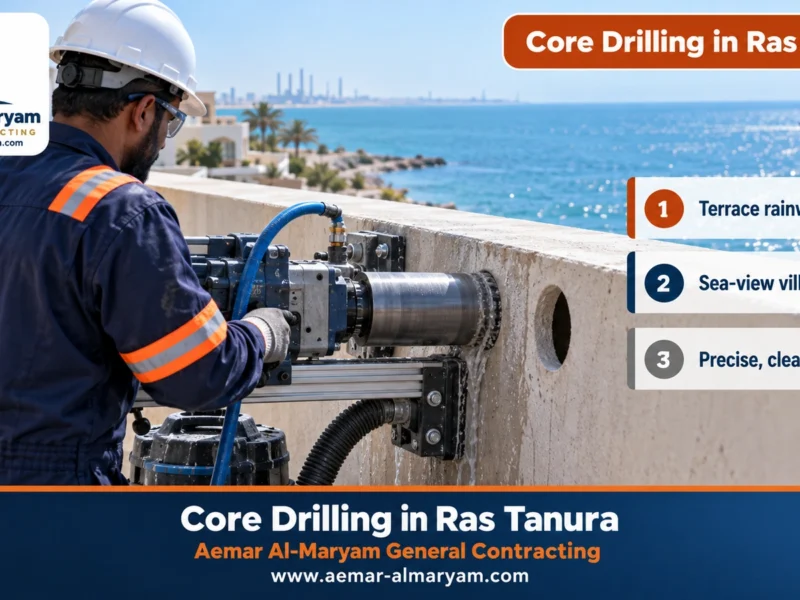
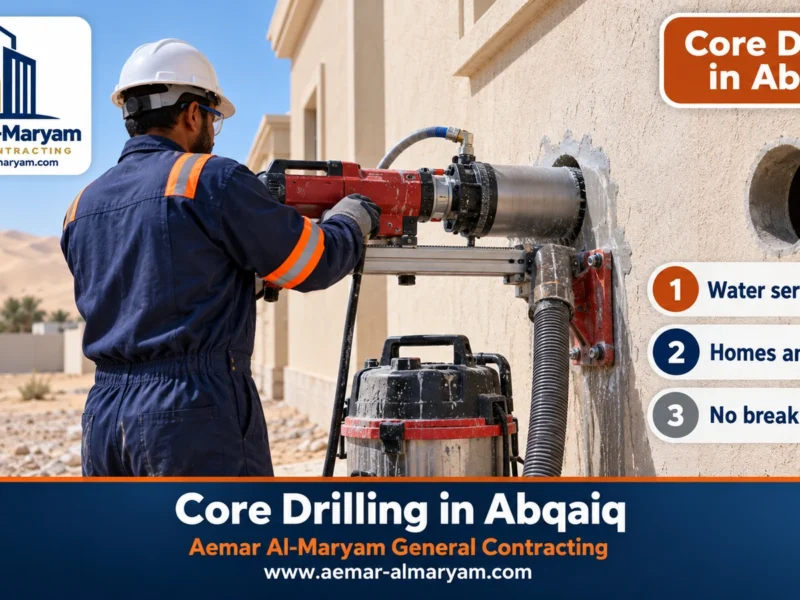
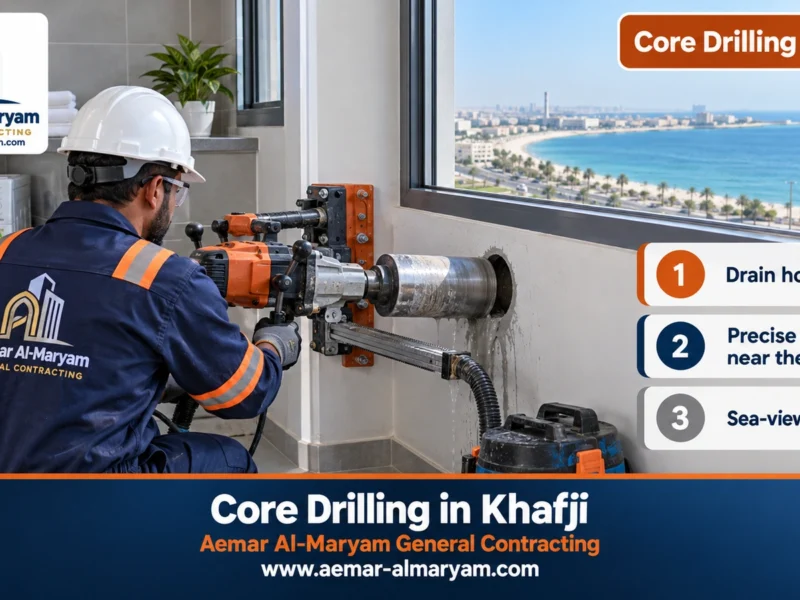
Outside Dammam, the hole prices start from the same figures listed on this page, and we schedule the more distant towns so that requests are grouped into one visit. For far-off cities, travel is priced at inspection, and the more holes in the same visit, the smaller each hole’s share. Each city has its own concrete cutting and coring page:
Core drilling and concrete cutting across the Eastern Province
- ➤ Al Khobar: concrete cutting and coring
- ➤ Dhahran: concrete cutting and coring
- ➤ Qatif: concrete cutting and coring
- ➤ Saihat: concrete cutting and coring
- ➤ Jubail: concrete cutting and coring
- ➤ Al-Ahsa: concrete cutting and coring
- ➤ Ras Tanura: concrete cutting and coring
- ➤ Abqaiq: concrete cutting and coring
- ➤ Khafji: concrete cutting and coring
- ➤ Hafr Al-Batin: concrete cutting and coring
Each town also has an area page listing everything we do there: Qatif, Al Khobar, Saihat, Dhahran, Jubail, Ras Tanura, Al-Ahsa, Abqaiq, Hafr Al-Batin and Khafji.
Dammam districts we serve for core drilling
We work in every district of Dammam, from older neighbourhoods of traditional houses to newer districts of villas and apartment buildings, including:
If your district is not on the list, that does not mean we do not reach it; drop us a location pin on WhatsApp and we will confirm when we can come.
Ready for your core hole?
Call us or send photos of the spot on WhatsApp 0547879578, and we will send an estimate for each hole by diameter and the earliest slot in your district.
Article tags