Working as a plastering contractor in Hafr Al-Batin, the Aemar Al-Maryam General Contracting team plasters new villas, houses and annexes inside and out, finishes facades in through-coloured render that needs no paint, and re-plasters cracked walls, using a method built around the city’s heat, dust and big day-night temperature swings: spatterdash on concrete, mesh over every joint, sieved clean sand, and days of spraying and covering after the work. Per square metre we start at SAR 6.5 for internal labour, SAR 13 internal with materials, SAR 14 for facade labour, SAR 18 for facades with materials and SAR 32 for coloured render with materials, all provisional until inspection. Call or WhatsApp 0547879578.
Set far inland on the northern edge of the province, Hafr Al-Batin has fierce summers, cold winter nights and winds that carry dust for much of the year. Cement plaster feels all three directly. Heat pulls the water out before the cement can harden, dust settles on the wall and weakens the bond, and the jump from midday heat to dawn chill works the different materials in a wall against each other until the joints crack. A good mix is therefore only half the story; what matters just as much is the week after the plaster goes on. This page sets out our method step by step, gives our price table, costs a living hall and lists what to send us to get started.
In short: plastering in Hafr Al-Batin with Aemar Al-Maryam
- What we do: internal plaster for halls, majlis rooms, bedrooms and ceilings, villa facade and boundary-wall render, coloured facade render, and re-plastering cracked walls.
- What is different here: wet curing under hessian with shade netting on the scaffold, joint mesh, spatterdash on concrete and sieved sand.
- Summer hours: external rendering starts at dawn, stops at midday and is postponed on heavy-dust days.
- Prices from: internal SAR 6.5/m² labour or 13 with materials; external 14 labour or 18 with materials; coloured 32; ceilings 14; re-plastering 23.
- Travel from Dammam: priced on inspection day, and it weighs less on each item when several jobs share one visit.
- Getting started: message 0547879578 with pictures of the walls, their measurements and the name of your district.
Plastering contractor in Hafr Al-Batin: plaster that copes with heat, dust and temperature swings
A plastering contractor in Hafr Al-Batin is judged after a full summer, not on handover day. Plaster that dried in a few hours under July sun can look fine for a week, then craze, part from the columns and crumble at the edges. Most of what we do in the city is about preventing that: choosing working hours, shielding the coat from sun and wind, reinforcing joints and insisting on clean materials.
■ Villas under construction
Full plastering once services are in: spatterdash, dots, screeds, beads and mesh, inside and out.
■ Coloured facades
Through-coloured render with materials for facades and boundary walls, with no paint needed.
■ Halls and majlis rooms
Long, true walls under strong light, and spattered concrete ceilings.
■ Annexes and outdoor majlis
Plaster for new rooftop or courtyard annexes, with junctions protected by mesh.
■ Cracked walls
Drummy or cracked plaster stripped and rebuilt on a sound base.
■ Patches and chases
Grooves for cables and pipes closed and meshed before the finishing coat.
Many villa owners in Hafr Al-Batin manage their own builds and order plastering as a separate stage between structure and finishing, so we specify the method and quantity for every wall and the owner knows exactly what each payment covers. For an overview, our plastering service page explains the service, and the Hafr Al-Batin page lists everything else we do in town.
Curing plaster with water in Hafr Al-Batin: hessian, shade and timing
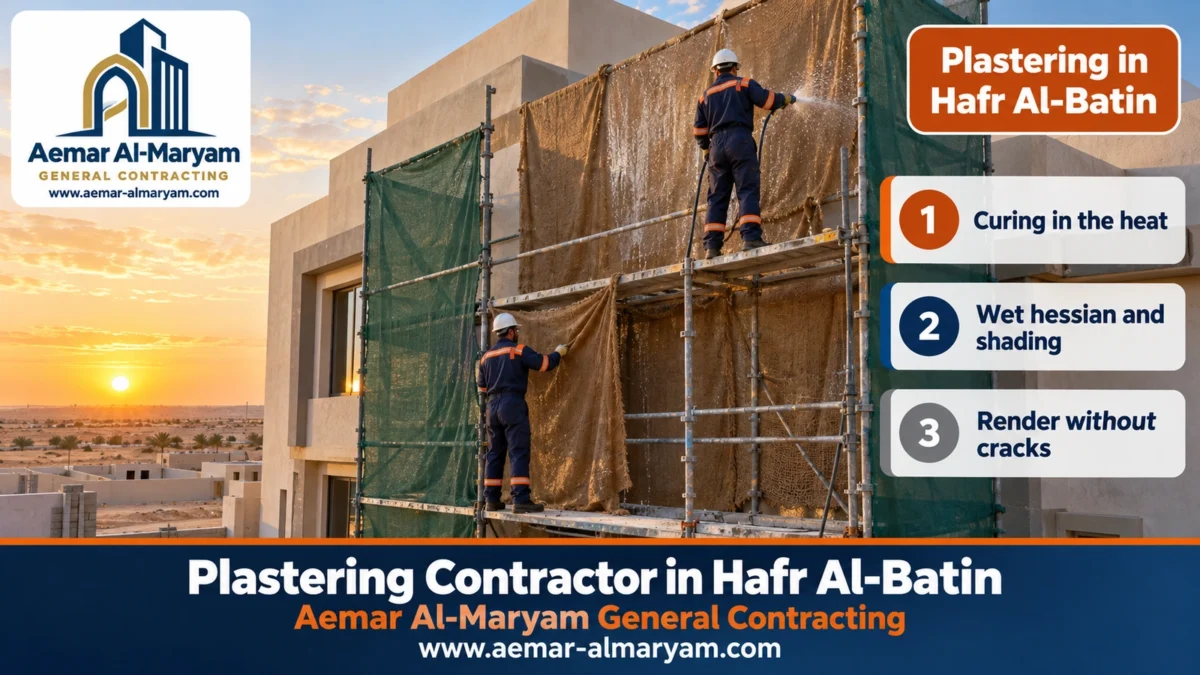
Curing in Hafr Al-Batin means keeping cement plaster damp for around seven days after application, and it needs more care here because dry air, high temperatures and wind strip water from the coat faster than the cement needs to harden. A coat robbed of its water too soon will shrink, craze and hold on weakly, and no later coat of paint can put that right.
On exposed facades in summer we do not rely on spraying alone. Once the coat has firmed, we hang wet hessian sheets over it and re-wet them whenever they dry, so the surface holds moisture for hours rather than minutes, and we stretch shade netting across the scaffold so the sun never hits fresh render directly. Indoors, a light spray is enough, with windows closed when dusty winds blow.
- In summer we start external rendering at dawn, stop at midday to protect both the coat and the crew, and finish before sunset.
- We spray morning and evening, more often on south- and west-facing walls.
- On heavy-dust days we postpone facade work, since dust sticks to soft render and weakens it.
- On bitterly cold winter evenings we avoid rendering facades late in the day, so the coat does not begin hardening in freezing air.
- Paint waits until the cement plaster is properly dry; cement keeps gaining strength for up to four weeks, and the painting sequence is covered under painting contractor in Hafr Al-Batin.
Who does the spraying?
The agreement states how many curing days are needed and who handles them. If you live on or near the site, we may agree that you take over the last few days after we show you how; otherwise it stays part of our work and our schedule.
Spatterdash, dots and screeds in Hafr Al-Batin
Spatterdash is the first thing we put on smooth concrete columns, beams and soffits in Hafr Al-Batin, because plaster finds nothing to grip on smooth concrete and will later sound hollow. The mortar is cement-heavy, roughly a bucket of cement per two buckets of sand, flicked on hard with a trowel or a hand spatter tool and left coarse, then kept damp for at least a full day; in Hafr Al-Batin heat we wet it several times during that day.
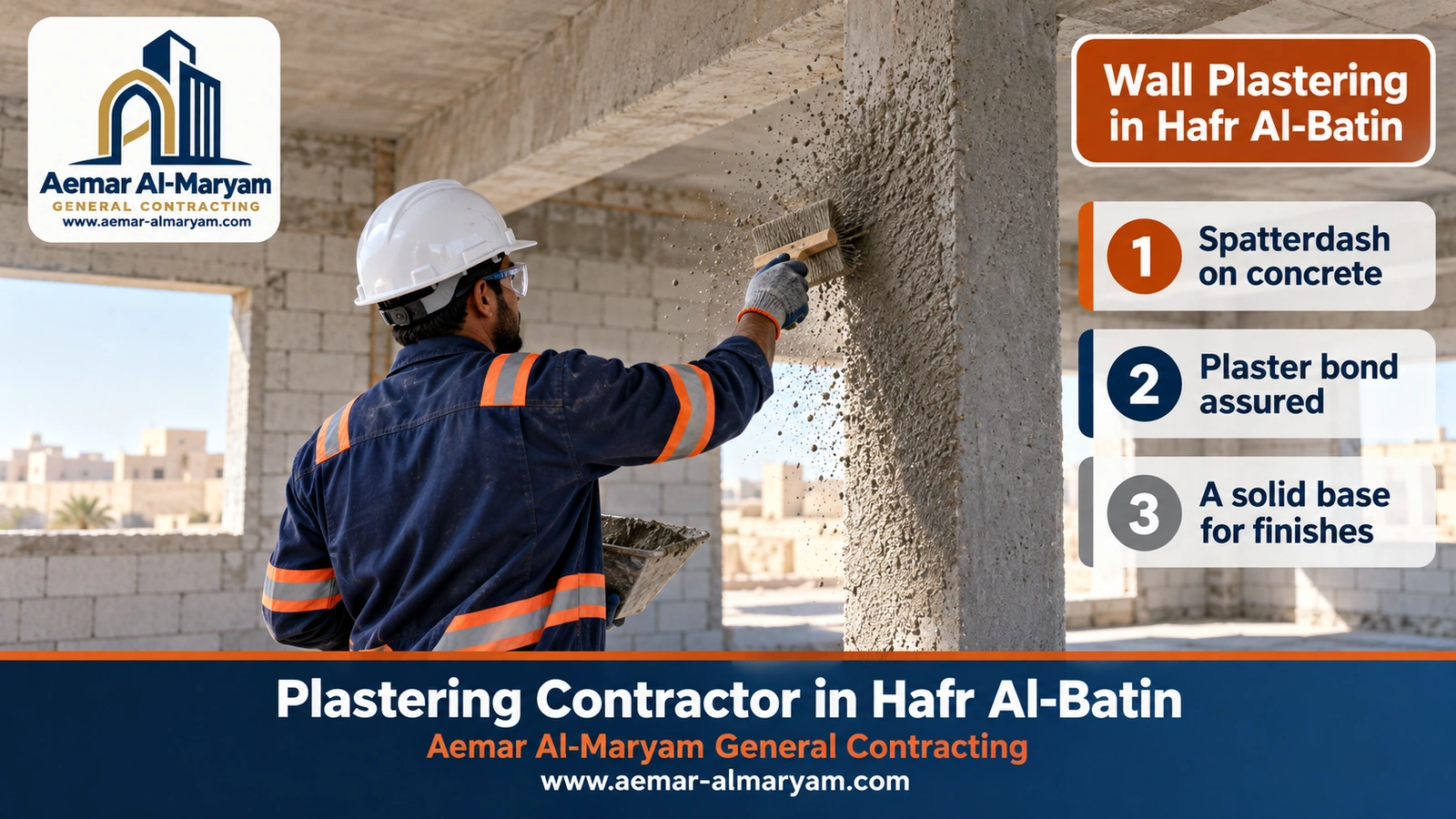
Dots come next: spots of mortar set with a line and level roughly a metre and a half apart, fixing the level of the finished surface. Each vertical run of dots is then joined into a screed, and the space between two screeds is filled with mortar and ruled with an aluminium straightedge. In wide halls where window light exposes every ripple we give the screeds all the time they need, because whatever is saved there the owner pays back later in extra filler.
The gap in our table between plastering “by eye” and plastering on dots, screeds and beads (SAR 6.5 against SAR 11 a square metre for labour) is the price of that accuracy.
Plastering materials in Hafr Al-Batin: sieved sand, clean water, fresh cement
Sand needs special attention here, because the sand delivered to sites can contain pebbles, lumps, clay and fine dust. Pebbles drag lines across the surface when it is ruled off, and clay and dust increase shrinkage and crazing. So we sieve the sand on site through a large wire screen before mixing: the pebbles stay behind and clean fine sand falls through.
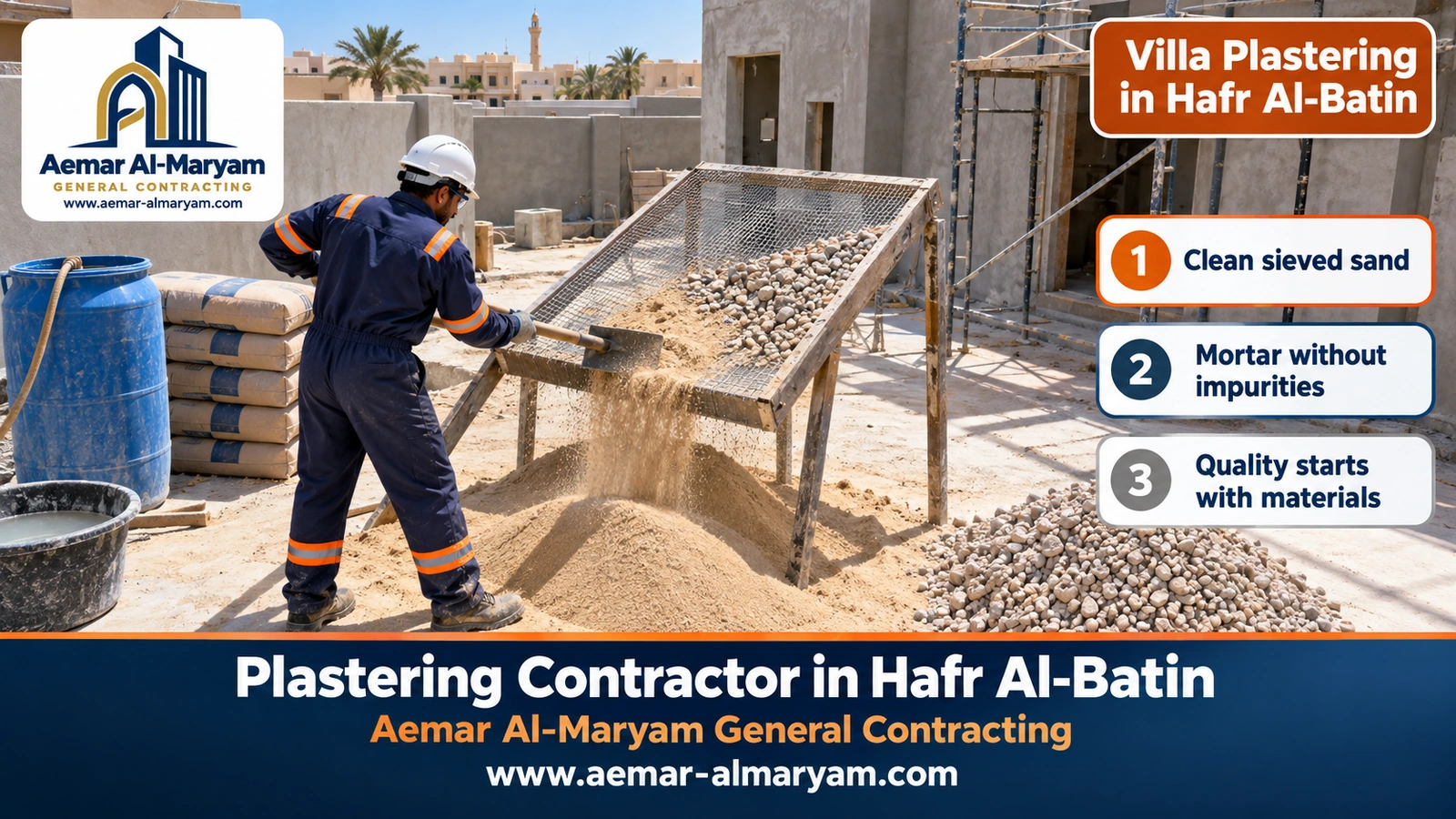
- Cement is used fresh and free of lumps, stored off the ground on boards and away from sun and damp.
- Water comes from a covered drum, so dust stays out and it does not sit heating in the sun for hours.
- We mix only as much as will be used before it starts to stiffen, and never re-temper set mortar by adding water.
- Admixtures, whether damp-resisting or bonding agents, follow the specification or the engineer, not guesswork.
The plastering tools we work with
The core tools are simple but decide the result: a trowel for laying on, a float for finishing, a long aluminium straightedge for ruling between screeds, a level and line for setting dots, metal beads for corners, mesh for joints, a sieve for sand, a spatter tool for the dash coat, fixed scaffold for facades and tall ceilings, and hessian, shade netting and hoses for curing. On large areas we add a spray machine.
Mix ratios and thickness for plastering in Hafr Al-Batin
Plasterers typically mix one measure of cement with four to six of sand, raising the cement content on facades compared with rooms and even more in spatterdash. In hot weather, though, we never make a mix richer than it needs to be, because an over-rich mortar shrinks more and crazes sooner.
| Layer | Approximate thickness | Usual mix | Note for Hafr Al-Batin |
|---|---|---|---|
| Spatterdash | A thin, rough layer | Around 1:2 | Wetted repeatedly on its first day |
| Rooms and halls | 12–15 mm | 1:4 to 1:5 | One coat on even blockwork |
| Facades | 18–20 mm in two coats | Around 1:4, damp-resisting admixture if specified | About two days between coats, then hessian |
| Ceilings | Lighter than walls | As for internal walls | After spattering the concrete |
| Cement use | Around 2 cm | Around 1:4 | Roughly a 50 kg bag per 10 m² |
Reference figures from common practice and specifications; your project’s drawings or specification take precedence. One fixed rule: a stronger coat never goes over a weaker one.
Mesh-reinforced plaster in Hafr Al-Batin: joints and temperature swings
Mesh is a necessity in Hafr Al-Batin, not a luxury. The wide gap between daytime heat and night-time cold makes block and concrete expand and contract every day by different amounts, and any unreinforced junction between them ends up with a straight crack. So before plastering we fix a mesh strip about 15 cm wide on every block-to-concrete boundary, half on each side, and bury it in the coat.
Mesh also goes over cable and pipe chases, around wide window openings and along the line where a new annex meets an existing building. Where a wall faces the harsh south or west sun, or has a history of cracking, full-surface fibre mesh is worth considering; it is priced from 20 SAR per square metre.
⚠ Not every crack comes from the heat
Hairlines and straight joint cracks usually come from shrinkage and the mix of materials. A diagonal crack leaving the corner of a door or window, one that keeps widening, or one that comes with a sinking floor may point to a problem in the building itself and needs assessing before any plaster, as explained under crack repair in Hafr Al-Batin.
External rendering and facade plastering in Hafr Al-Batin
Hafr Al-Batin facades get two coats of render, together roughly 18 to 20 millimetres thick, after spatterdash on concrete, joint mesh and setting out screeds and beads. The first coat is ruled and left rough to key the second, which follows once the first has firmed. We work from the top down, break long walls with joints, and give sills and wall copings a fall to shed the rain, which is rare here but can be heavy.
Rendering labour on facades is priced from 14 SAR per square metre, or from 18 SAR when we supply the materials; scaffold and working height are added once we have seen the building.
Coloured render for facades in Hafr Al-Batin
Coloured render is a popular choice for villa facades and boundary walls in Hafr Al-Batin: a cement mortar coloured through its body, so it needs no paint and will not peel in the sun the way paint eventually does. Supplied and applied, it is priced from 32 SAR per square metre. Three conditions make it work in this climate:
- All facade materials from one batch and one source, so the shade does not change from wall to wall.
- Each wall finished in one continuous run where possible, because a stop line shows in the colour.
- Steady curing and covering, because uneven drying in the sun leaves blotchy patches.
Patches made in coloured render years later seldom match, so at handover we give you the colour reference and source where we can.
Rendering boundary walls and annexes
Villa boundary walls in Hafr Al-Batin are long and exposed, and new annexes butt against existing buildings; in both, the junction is the weak point. We mesh every line where new meets old and break boundary walls with joints at suitable spacing. If the annex or majlis itself is still to be built, our page on annex and majlis building in Hafr Al-Batin covers it.
Internal plastering in Hafr Al-Batin: halls, majlis rooms and ceilings
Indoors in Hafr Al-Batin we normally lay a single cement coat, somewhere around 12 to 15 millimetres on straight blockwork, between screeds, then rule it and float it. Halls and majlis rooms in modern villas are wide with large windows, and strong side light shows any ripple once painted, so screeds and corners get careful setting out and every exposed corner and opening receives a metal bead.
Wet rooms such as kitchens and bathrooms are always done in cement, with a rough key left wherever tiling follows; they are priced from 18 SAR per square metre. If rooms are air-conditioned during the work, we keep the airflow off fresh plaster, because a direct blast dries it just as fast as the sun.
Plastering ceilings in Hafr Al-Batin
Concrete ceilings are spattered first and then given a coat lighter than the walls, since the mortar is working against gravity; soffit work is priced from 14 SAR per square metre. In tall halls we work from a fixed internal scaffold rather than ladders so the ruling stays even.
Machine plastering or hand plastering in Hafr Al-Batin?
Machine plastering suits villas under construction with large continuous areas, because the machine mixes mortar consistently and sprays it fast, shortening the job and reducing waste. Because the pump must keep running or the line clogs, it calls for planning around summer hours: we start early and order the walls so work stays in shade where possible. Single rooms, patching and occupied homes are better done by hand. Hand or machine, a flat wall still depends on the screeds and the rule, and we quote spraying only after a site visit.
Gypsum plaster or cement plaster in Hafr Al-Batin?
Gypsum plaster in Hafr Al-Batin works well on dry internal walls and ceilings. It sets in around half an hour and needs no wet curing, which sidesteps the fast-drying problem in the heat; it is ready for paint in a matter of days and barely shrinks. Supplied and fixed, it is priced from 41 SAR per square metre. Its enemy is water, which is why facades, bathrooms, kitchens and the lower parts of ground-floor walls that might pick up damp are all kept cement.
| Question | Gypsum plaster | Cement plaster |
|---|---|---|
| Dry hall or bedroom | Suitable and quick | Suitable and cheaper |
| Facades and boundary walls | Not suitable | Suitable in two coats |
| Bathroom and kitchen | Not suitable | Suitable |
| Wet curing | Not needed | About a week |
| Starts from | SAR 41 per m² with materials | SAR 13 per m² internal with materials |
Plasterer or plastering contractor in Hafr Al-Batin?
A plasterer in Hafr Al-Batin is fine for a small job where you buy the materials and keep an eye on progress. A full villa, coloured-render facades or cracked walls that need diagnosing are better handed to a contractor, someone who takes the measurements, brings the materials, puts the method and curing plan on paper and stays responsible for the programme until handover.
| Comparison | Plasterer | Plastering contractor |
|---|---|---|
| Curing and covering | Usually left to the owner | A written item in the schedule |
| Mesh and beads | As agreed verbally | At every joint and corner |
| Sand | Used as delivered | Sieved before mixing |
| Coloured render | Depends on experience | One material batch and continuous work |
| Billing | Daily wage or metre rate | An itemised metre rate |
Plasterer in Hafr Al-Batin: what to ask
Before agreeing with a plasterer in Hafr Al-Batin, ask: what hours will he work in summer? How will he protect the facade from the sun once rendered? Will he sieve the sand? Spatter the columns? Mesh the joints? His answers about the heat in particular show whether he knows the city. Ring or message us any time on 0547879578.
Daily wage versus metre rate in Hafr Al-Batin
Day rates suit scattered patching; per-metre pricing is clearer for anything measurable. In summer especially, a day rate costs the owner more, because real working hours shrink when outdoor work stops at midday, while the square-metre rate stays the same.
Re-plastering old walls in Hafr Al-Batin
Re-plastering old walls in Hafr Al-Batin starts with tapping to find hollow and cracked areas, then breaking them out until we reach sound plaster that grips well, because a new coat laid over a weak old one falls away with it. What we see most in the city are column-line cracks where no mesh was used, facades that crazed because they dried too fast, and hollow patches around soffits that were never spattered.
- 1Tap and photograph
We mark the extent of hollow and cracked plaster and photograph it for you. - 2Break out
Weak plaster comes off back to a sound edge; removal alone starts at SAR 7.5 a square metre. - 3Clean and dampen
Dust and debris are cleared and the block is wetted before work. - 4Spatter and mesh
On concrete, joints and every line where old meets new. - 5Plaster and cure
On screeds, then about a week of spraying and covering.
Stripping plus a new coat starts at SAR 23 a square metre. If the problem goes beyond plaster, such as settlement, leaks or roof waterproofing, see renovation contractor in Hafr Al-Batin.
Plaster defects in Hafr Al-Batin and their causes
Most plaster defects in Hafr Al-Batin are linked to heat, fast drying and dust, and a few to workmanship:
| Defect | What it looks like | Usual cause here | Remedy |
|---|---|---|---|
| Crazing | A web of fine lines across the facade | Rapid drying in sun and wind, or an over-rich mix | Fill the lines or replace the finishing coat, then cure correctly |
| Straight crack by a column | A line along the concrete edge | Unmeshed joint plus temperature swings | Open the crack, mesh and re-plaster |
| Hollow plaster | A dull, empty sound when tapped | No spatterdash on concrete, a dusty wall or an over-thick coat | Break out the whole hollow patch and rebuild coat by coat |
| Score marks and pits | Scratches left when ruling off | Unsieved sand with pebbles | Sieve the sand and redo the top coat |
| Blotchy coloured render | Uneven shades | Mixed material batches or uneven drying | One batch of material and steady curing |
| Widening diagonal crack | Leaving a window or door corner | The building itself is moving | Structural check first, plaster afterwards |
Treating fine cracks in a single room ahead of paint is priced from 140 SAR; for hollow plaster spread over bigger areas we give a figure after sounding the walls.
Plastering price per square metre in Hafr Al-Batin: our opening rates
In Hafr Al-Batin our rates per square metre open at 6.5 SAR for indoor labour on your materials and 13 SAR on ours, 14 SAR for facade labour and 18 SAR with materials, and 32 SAR for coloured render supplied and applied. Every line:
| What you need | Price starts at |
|---|---|
| Labour for hall and room walls with your materials | 6.5 SAR/m² |
| Internal labour with dots, screeds and metal beads set out | 11 SAR/m² |
| Internal work with cement and sieved sand | 13 SAR/m² |
| A hall or room ceiling | 14 SAR/m² |
| Labour to render villa facades | 14 SAR/m² |
| Facades with all materials | 18 SAR/m² |
| Coloured render for facades with materials | 32 SAR/m² |
| Fibre mesh covering the entire wall under the plaster | 20 SAR/m² |
| Smooth finish ready for paint | 17 SAR/m² |
| Walls that get wet daily: bathroom and kitchen | 18 SAR/m² |
| Old plaster removal on its own | 7.5 SAR/m² |
| Removal and fresh render on an old wall | 23 SAR/m² |
| Hairlines in one room’s walls before painting | 140 SAR per room |
| Internal gypsum plaster with materials | 41 SAR/m² |
| Machine plaster for large villa areas | at inspection |
| Drummy plaster coming away from the wall | at inspection |
| Salts or damp at the base of a wall | at inspection |
Opening rates only; the real figure is settled at inspection and agreement and depends on the wall’s condition, thickness, height, scaffold, access and area. Travel to Hafr Al-Batin is set at inspection as a separate item. Lines marked “at inspection” are worked out from the pictures and measurements you send to 0547879578.
Worked example: plastering a 4.5 × 6 m hall in Hafr Al-Batin
A walk-through of the arithmetic, not a quotation. The hall measures 6 by 4.5 m with 3 m walls; it has one door (around 2 m²) and a pair of windows (around 3 m² between them).
- Walls: 2 × (4.5 + 6) × 3 = 63 m²; deduct 5 m² for openings, leaving 58 m².
- Ceiling: 4.5 × 6 = 27 m²; total 85 m².
- Labour with your materials, no screeds: 85 × 6.5 ≈ SAR 553.
- Labour on dots, screeds and beads: walls 58 × 11 = SAR 638 and ceiling 27 × 14 = SAR 378, so SAR 1,016.
- With our materials: 85 × 13 = SAR 1,105.
- Cement: about nine bags for a thickness near 2 cm.
Coloured facade example
A villa facade of 220 m² net of openings: in coloured render with materials it starts at 220 × 32 = SAR 7,040 and needs no paint afterwards; in ordinary render with materials it starts at 220 × 18 = SAR 3,960, with exterior paint on top. Scaffold and travel follow inspection. The fair comparison is coloured render on one side, and plain render plus paint plus future repainting on the other.
How plaster is measured
Every wall is its run multiplied by its height, and the soffit is added if it is in the job. By convention, an opening of more than roughly two square metres comes off and a smaller one does not, because its reveals cost time. We fix this method in the contract and take the final measurements with you present.
Can blockwork be painted directly in Hafr Al-Batin?
Sometimes on very regular internal blockwork or smooth concrete after a skim or thin coat, or in a store or service annex. Not on Hafr Al-Batin facades: bare block cracks along its joints as temperatures swing, and that shows through the paint.
How long does plastering take?
Expect roughly one working day for a prepared room, two or more for a big hall, and a facade several days depending on area and the two coats, followed by curing. In summer, daily outdoor hours are shorter, so we plan the duration around that and write it into the agreement.
Plastering steps in Hafr Al-Batin
- 1Pictures first
Your WhatsApp photos and measurements let us suggest a method and an early number. - 2Inspection
Tapping, measuring, and checking joints, concrete and the sand on site. - 3Agreement
Items, quantities, materials, summer working hours and the curing plan. - 4Getting ready
Cables and pipes in, floors covered, sand screened, hessian and shade cloth on hand. - 5Surface preparation
Roughening coat on concrete, mesh strips on boundaries, then dots, screeds and beads set true. - 6Plastering
One coat indoors and two on facades, in morning and late-afternoon hours. - 7Curing
Spraying and hessian cover for about a week. - 8Handover
A joint inspection, snag fixes and a clean site.
Inspect the plaster before you accept it
- ✓Line: a long straightedge across the wall in several directions with no obvious gaps beneath.
- ✓Joints: no straight cracks along columns and beams.
- ✓Surface: no branching hairlines and no pebble scratches.
- ✓Tapping: no hollow sound on ceilings or around columns.
- ✓Colour: for coloured render, one even shade across the whole wall.
Mistakes we see in Hafr Al-Batin plastering
■ Rendering at midday
A coat that dries before it hardens, then crazes.
■ Uncovered facades
Sun and wind pull the water out within hours.
■ Unsieved sand
Scratches, pits and extra shrinkage.
■ Columns not spattered
Hollow plaster on smooth concrete.
■ Joints without mesh
A crack at every column after the first winter.
■ Air-con aimed at fresh plaster
Fast drying indoors as well.
How we serve Hafr Al-Batin from Dammam
Hafr Al-Batin lies among the furthest towns on our map from the Dammam office, so every project there is planned before we set off. Photos and the inspection pin down items and quantities; materials, mesh, beads, hessian and scaffold are loaded before departure so nothing runs short on site; and the schedule keeps the crew indoors at midday and outdoors in the morning and late afternoon. The travel charge is worked out at inspection rather than quoted as a flat fee.
Put your jobs into one visit
Internal plaster with the facades, the villa with its boundary wall and annex, or plaster with crack treatment and painting: every added item dilutes the trip cost carried by the rest. If a neighbour wants similar work, let both jobs share the same visit.
Being a general contracting firm, we can also run the work on either side of the plaster within one contract: construction, renovation, painting and finishing. Examples are in our project gallery.
Hafr Al-Batin districts we cover
We work right across the city, in neighbourhoods such as Al-Fayhaa and Al-Wurud, Gharnata and Al-Rayyan, Qurtubah and Al-Masif, Al-Andalus and Al-Nakheel, Al-Shifa and Al-Wadi, Al-Raed and Al-Sulaymaniyah, Al-Yarmouk and Al-Batin, Al-Rabwah and Al-Baladiyah, Al-Muhammadiyah and Al-Khalidiyah, and Al-Aziziyah and Al-Rawdah. If your district is not listed, message us.
For work in other Eastern Province cities: plastering contractor in Dammam, plastering contractor in Al-Ahsa and plastering contractor in Khafji.
Why Aemar Al-Maryam for plastering in Hafr Al-Batin?
■ A method for the heat
Summer hours, hessian cover, shade netting and regular spraying.
■ Details in writing
Spatterdash, mesh, beads and sieved sand are all contract items.
■ Coloured facades
One material batch and continuous work for a single, even shade.
■ Published prices
Every item’s starting rate is here, and travel is a clear line.
How to order a plastering contractor in Hafr Al-Batin
One complete WhatsApp message to 0547879578 is the fastest route to a method and a first number. Include:
- ✓Photos: each wall or facade in full, plus close-ups of any crack or hollow patch.
- ✓Sizes: hall and room dimensions, or facade width and number of floors.
- ✓Finish: standard plaster then paint, or coloured render for the facade.
- ✓Building status: new under construction or occupied, and whether services are finished.
- ✓Materials: yours or ours.
- ✓District and timing: district or map pin, and when you want to start.
Plaster that survives a Hafr Al-Batin summer
Snap the walls and facades and message them, or simply ring. You will hear which method and working hours fit the season, and then we pick an inspection date together.
Read next before plastering in Hafr Al-Batin
- ➤ Our plastering in detail
- ➤ Building and construction
- ➤ Renovation
- ➤ Crack treatment
- ➤ Painting after plaster
- ➤ Interior finishing
- ➤ Building renovation in Hafr Al-Batin
- ➤ Painting in Hafr Al-Batin
- ➤ Cracks in Hafr Al-Batin
- ➤ Building an annex or majlis
- ➤ The complete plastering guide
- ➤ Our services in Hafr Al-Batin
- ➤ Our price list
- ➤ Inspection request
Article tags