Crack repair in Hafr Al-Batin is really about movement. This is an inland desert city where buildings heat up through a summer day and cool down at night, where a fierce summer gives way to a cold winter, so concrete, blockwork and stone expand and shrink thousands of times over a building’s life. Wherever that movement has no joint to breathe through, it makes a crack of its own. On top of that, when rain arrives in a few heavy bursts it can soak the soil around foundations and let it move. Aemar Al-Maryam General Contracting repairs cracked parapets, roofs, stone facades, walls, boundary walls and columns in Hafr Al-Batin. Our rate for injecting a crack begins at SAR 32 a linear metre and for treating a room’s cracks ahead of painting at SAR 140, confirmed only once we have inspected and agreed. Call or WhatsApp 0547879578.
We cover Hafr Al-Batin from our Dammam base on scheduled visits: your photos are reviewed first, then we arrive with the materials that suit what we saw. The road cost is set at inspection and weighs less on each item the more jobs you add to the visit. With settlement cracks in particular we follow one rule without exception: the engineer goes first, and we follow.
Crack repair in Hafr Al-Batin at a glance
- The leading cause here: thermal expansion and contraction between hot days and cool nights, and between summer and winter, in elements without enough joints.
- What we see most: a horizontal crack between parapet and roof slab, cracked joints in stone facades, cracks in long boundary walls, and shrinkage cracks in new concrete.
- After heavy rain: diagonal cracks and sticking doors can mean the soil has moved; the work then starts with a structural engineer’s report.
- Our approach: flexible materials for what moves, rigid ones for what has settled, mechanical fixing for loose stone, and the cause treated before the appearance.
- Starting rates: SAR 32 per linear metre injected; SAR 140 per room for crack treatment before repainting; SAR 20/m² for mesh with patch render; SAR 41/m² for facade cracks handled inside a facade repair. Every rate is provisional pending inspection, and the road cost is agreed on site.
- Get in touch: photos of the crack with a ruler on WhatsApp to 0547879578.
Crack repair in Hafr Al-Batin: why buildings crack in a desert climate
Crack repair in Hafr Al-Batin starts from a simple fact: every material in a building moves with heat, and each moves by a different amount. A concrete roof under the midday sun gets far hotter than the room below it, so it expands and pushes on whatever surrounds it, then shrinks back as it cools at night. A block wall and the concrete column beside it do not move by the same amount. Stone fixed to a facade expands differently from the mortar behind it. In an inland city like Hafr Al-Batin, where the gap between daytime heat and night-time cool is wide on many days of the year, that push and pull repeats daily.
The result is a family of cracks we know well: a straight horizontal line at the foot of a roof parapet, vertical cracks repeating every few metres along a long boundary wall, cracked joints in stone cladding followed by some pieces working loose, and a straight crack where blockwork meets the column on every floor. We call these cracks live because they open and close with temperature, which is why neither hard filler nor ordinary render can fix them. They need materials that move with them, or a joint that lets the movement happen in one planned place instead of everywhere.
■ Parapets and roof edges
A horizontal crack between parapet and slab that lets rainwater into the ceiling below.
■ Stone facades
Cracked joints and shifted stones that need mechanical fixing, not just mortar.
■ Long boundary walls
Regular vertical cracks where there are no expansion joints.
■ New concrete
Shrinkage cracks in yard slabs and annexes that were not kept moist after casting.
■ Block meets concrete
Crack lines at columns and beams that repeat floor after floor.
■ Cracks after rain
Diagonal cracks and sticking doors after heavy rain, which call for an engineer.
If you need repairs beyond the cracks, the Hafr Al-Batin renovation contractor page is the place to start; the service itself is described on the crack repair service page.
What causes cracks in Hafr Al-Batin buildings
The causes of cracks in Hafr Al-Batin buildings are listed here in the order we meet them, with what marks each one out:
| Cause | How it shows | Crack type |
|---|---|---|
| Daily and seasonal thermal movement | Straight lines at parapets, in boundary walls and on facades | Live, opens and closes |
| Materials moving differently | Crack where blockwork meets a column, or stone meets mortar | Usually live |
| No expansion joints | Cracks at regular spacing along long elements | Live |
| Shrinkage of new concrete | Short hairlines hours or days after casting | Dormant once the concrete settles |
| Soil soaked by heavy rain | Diagonal cracks, sticking doors, sloping floors | Possibly live; engineer |
| Water leaking under a footing | Local sinking near a tank or pipes | Live until the water is stopped |
| Added loads | Cracks in columns or beams after an annex or rooftop tank | Structural; engineer |
When a crack looks different at breakfast and at noon
If a parapet or boundary-wall crack looks wider on a cool morning and narrower at midday, it is a live thermal crack. It is treated with a flexible sealant, not cement.
Parapet and roof cracks in Hafr Al-Batin
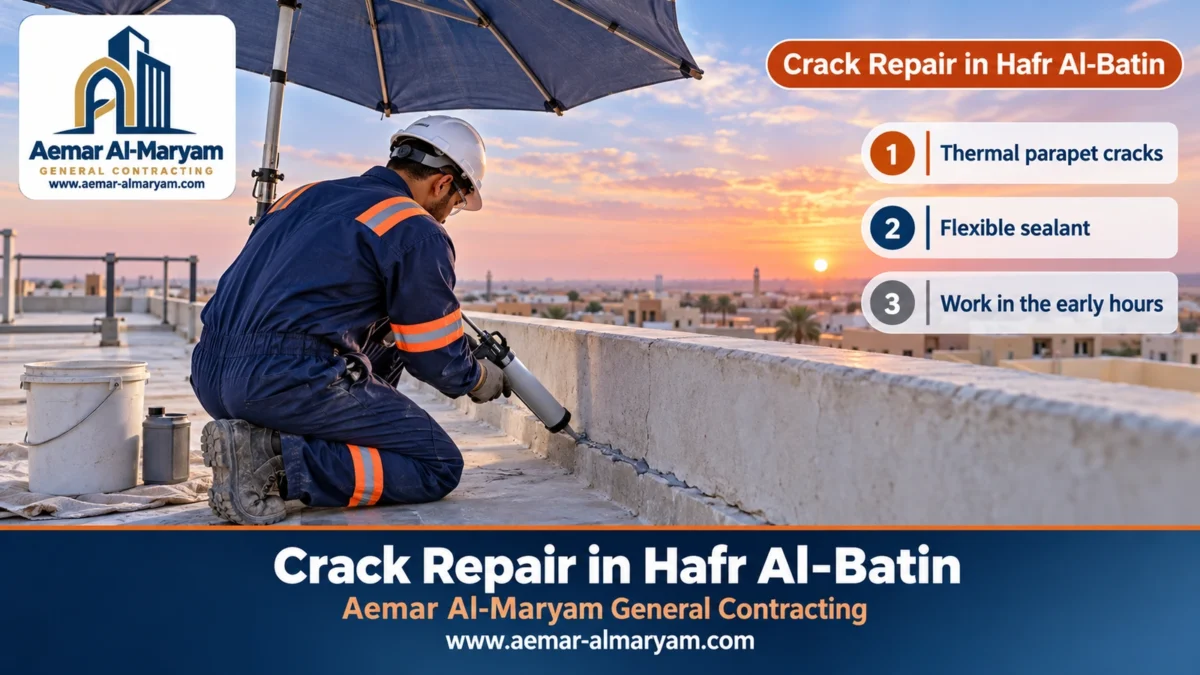
Parapet cracks in Hafr Al-Batin are among the repairs we do most and the ones most often ignored. The roof slab takes the sun directly and expands more than the parapet standing on it, so a straight horizontal crack opens between them along the length of the roof, and over the years the parapet may lean slightly outwards. The danger is not its look but its position: it sits at the weakest point of the roof waterproofing, so rain gets in through it to the ceiling and wall below.
We repair it by cutting the crack into a neat channel, cleaning it, laying a backing strip in the bottom so the sealant does not stick to the base, then filling it with a flexible sealant that tolerates movement and sunlight, and finally renewing the waterproofing over the junction so that it turns up the parapet. In summer we prefer to do this early in the morning, because flexible materials need a surface that is not scorching hot to bond well. If the whole roof waterproofing is tired, it is better value to treat the crack and the roof together; see roof waterproofing and insulation in Hafr Al-Batin.
Shrinkage cracks in new concrete
Shrinkage cracks in new concrete in Hafr Al-Batin appear in yard slabs, annexes and new roofs when the concrete dries too fast under sun and dry wind. They are short, shallow hairline cracks, typically 1 to 2 mm wide, that show up in the first hours or days after casting. Preventing them is far easier than repairing them: cover the concrete with wet hessian or sheeting that holds the moisture in, keep it wet for several days after casting, and avoid casting in the heat of the day. If they appear and then stabilise, we treat them with a surface seal or injection depending on depth.
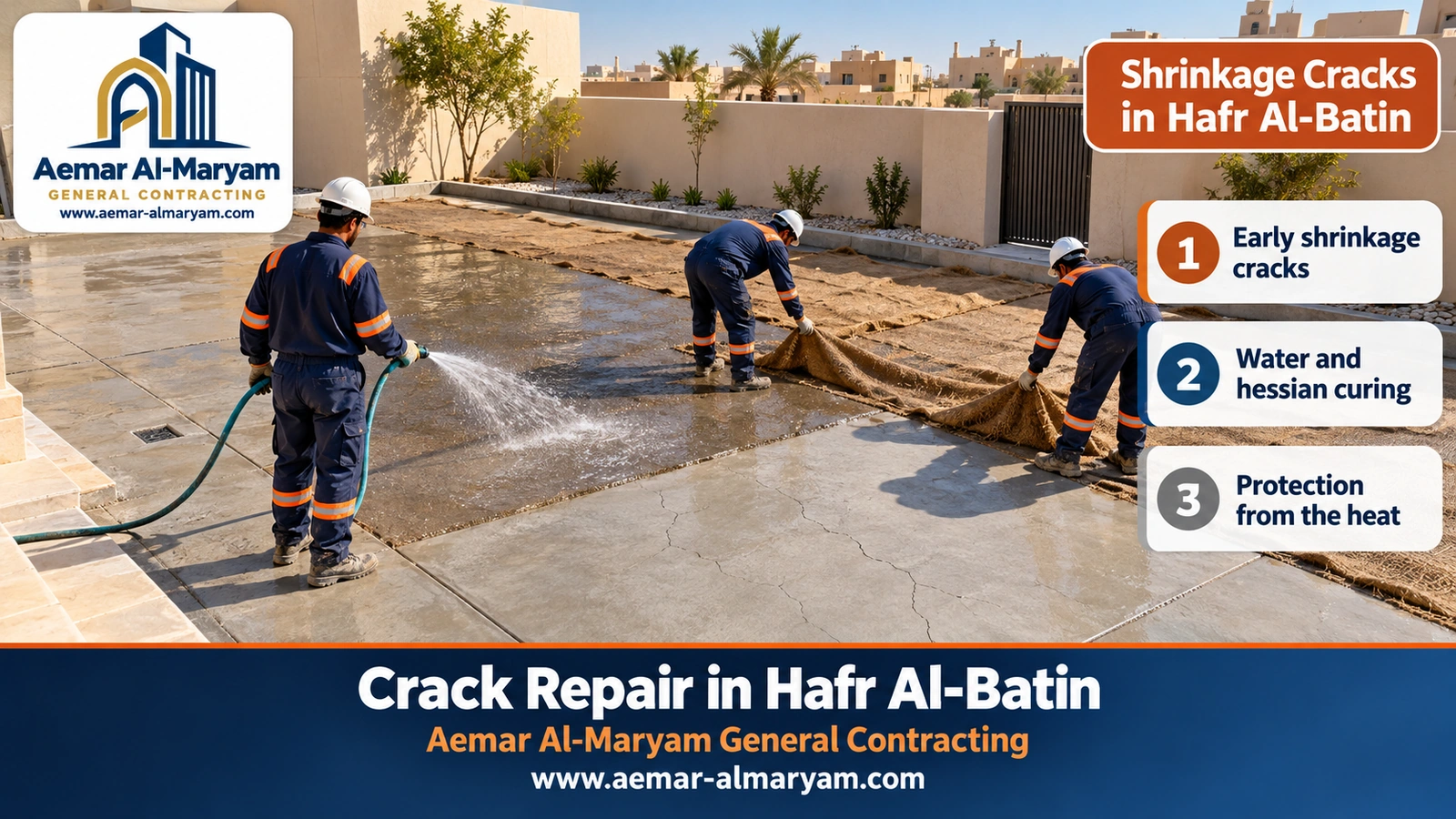
If you are building an annex or a new yard
Ask the contractor to set joints in large slabs, to keep the concrete moist after casting, and to cast early in the morning. Those three steps prevent most of the shrinkage cracks we are called to later.
Stone facade and exterior wall cracks in Hafr Al-Batin
Stone facade cracks in Hafr Al-Batin have their own character. Natural stone is fixed with mortar onto a block or concrete wall, and the three expand by different amounts. Over the years the mortar joints between pieces crack, then a stone works loose here and another there, especially high on the facade and above openings. A loose stone is not fixed by fresh mortar in its joint, because it has lost its bond with the wall behind it.
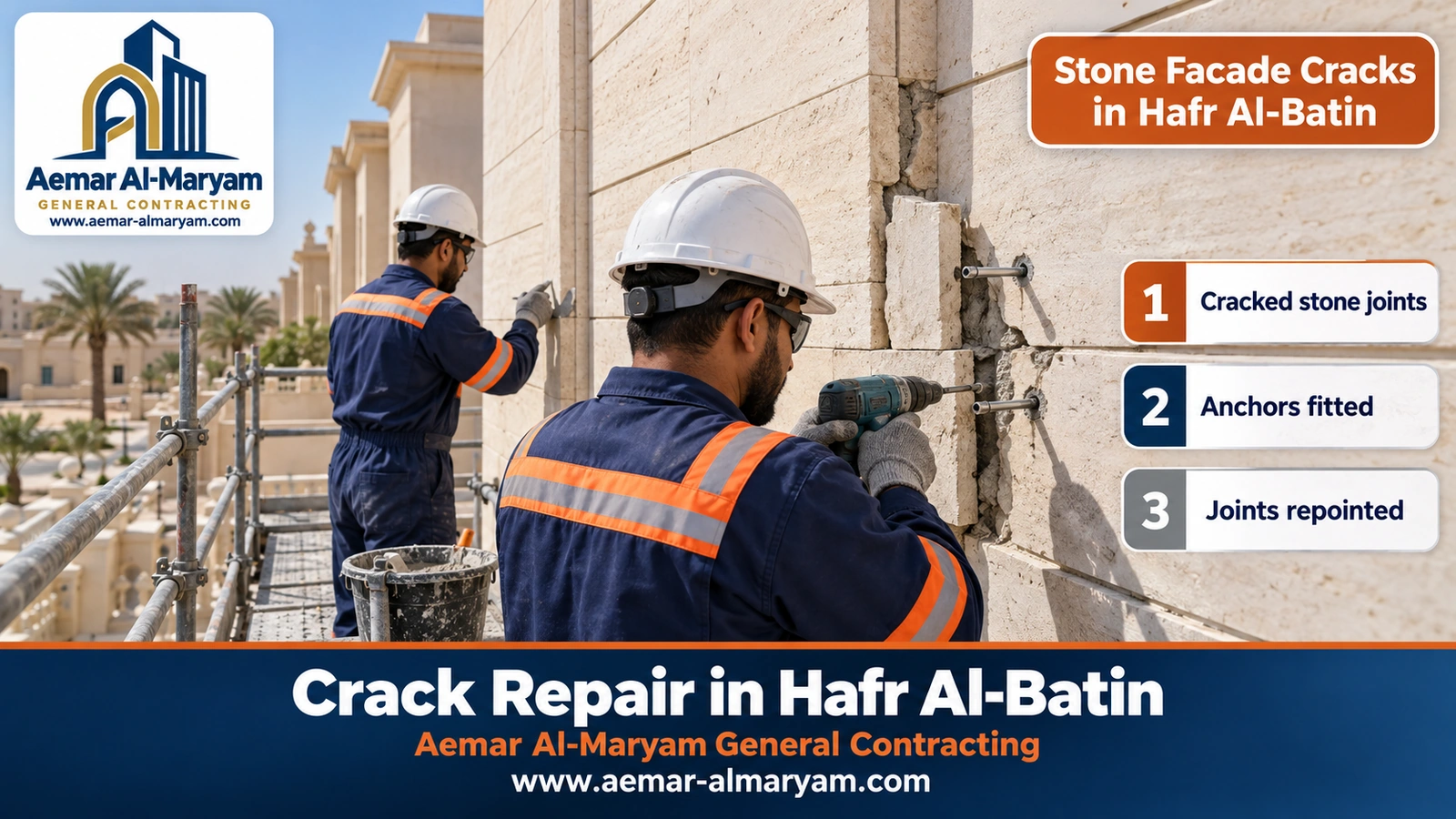
Our method on a cracked stone facade: we tap the pieces to find those that have come away, then fix each loose stone with stainless steel anchors set in holes drilled through it into the wall behind, and replace any piece too damaged to fix with a matching one. Then we rake out the cracked mortar from the joints, clean them, repoint in a stone-coloured mortar, and leave flexible movement joints where long facades need them. How many stones are involved and how high they sit decide the cost, so this is quoted on site.
⚠ A stone that could fall
If you see a stone sitting proud of its neighbours, or with an open joint all the way round it, keep people and cars clear of the area below and send us a photo so we can give it priority.
Exterior render cracks and block-to-column cracks
Plain rendered facades show straight cracks along column and beam lines and web cracking in render that takes the sun. We open junction cracks and cover them with mesh lapping both sides before re-rendering, and give web-cracked render an elastic coat that spans the fine lines. When the cracks are handled inside a wider facade repair, the rate begins at SAR 41 a square metre. For colours and heat-reflective paints, read painting contractor in Hafr Al-Batin.
Settlement and building cracks in Hafr Al-Batin: the engineer first
Settlement cracking in Hafr Al-Batin can appear after a season of heavy rain, when the soil around foundations becomes saturated and softens or moves, or when rainwater collects against a wall with poor drainage. It can also appear near an underground tank or pipes leaking below ground. The signs are a slanting crack that starts at a door or window corner and opens out at one end, doors that now stick, a floor that has tilted, and gaps opening between wall and ceiling or between tiles and wall.
In these cases we start nothing: no injection, no stitching, no repair, however annoying the crack is. We record and measure the cracks, fix monitoring marks on them, and ask a structural engineer to examine the footing and the ground beneath and decide whether the movement has stopped and why it happened in the first place. The fix may be as simple as directing rainwater away from the wall and repairing a leak, or it may need footing strengthening carried out by a specialist contractor. Once the engineer confirms the cause is dealt with and the movement has stopped, we come back to repair the cracks and finishes. Pricing for settlement crack repairs follows the engineering report and the inspection.
⚠ After heavy rain
If new cracks appear or old ones widen quickly after rain, a ceiling starts to sag, or a column cracks, clear people from that part of the house and do not leave the call to an engineer until tomorrow.
Rainwater around the house
After rain, look at where water gathers around your house. Paving that falls towards the wall, or a downpipe discharging at its base, is enough to soak the soil under the footing every season.
Wall crack repair in Hafr Al-Batin
Wall crack repair in Hafr Al-Batin begins by deciding whether the crack is live or dormant, because in a city with such wide temperature swings that distinction chooses the material. A live crack is opened, filled with a flexible sealant and covered with wide mesh that tolerates movement; a dormant crack is filled with repair mortar, or injected if it is in concrete, and the finish restored.
Fixing cracks in walls
- 1Read it
We measure the crack, note its direction and position, and tap around it to check the render is sound. - 2Open it
We cut the crack into a V to a depth that suits the material going in. - 3Clean it
We remove dust thoroughly; in Hafr Al-Batin, dust is what most often ruins adhesion. - 4Fill it
Flexible sealant for live cracks, repair mortar for dormant ones, injection for concrete. - 5Mesh and render
Fibre mesh lapping beyond the crack on both sides, then patch rendering to match the wall texture. - 6Paint
Once dry, we paint up to the nearest corner so the repair disappears.
Restoring interior cracks
Restoring interior cracks in Hafr Al-Batin homes is simpler than exterior work, because temperatures indoors are steadier. Most are render cracks or cracks at columns, treated with mesh and filler. Treating all the cracks in a room ahead of painting starts at SAR 140, and cracked render that needs mesh and patching starts at SAR 20 a square metre. For new or extensive rendering, see plastering contractor in Hafr Al-Batin.
Types of cracks in Hafr Al-Batin
Crack types in Hafr Al-Batin are classified here by behaviour as well as width, because behaviour is what picks the material:
| Type | Tell-tale sign | Suitable material |
|---|---|---|
| Live thermal | Width changes between morning and noon, or between seasons | Flexible sealant and a movement joint |
| Shrinkage | Short hairline in new concrete or render | Surface seal, or mesh and filler |
| Material junction | Straight line at a column, beam or stone | Wide mesh and render, or flexible mortar |
| Settlement | Diagonal, wider at one end, with movement signs | No material before the engineer’s report |
| Structural | In a column, beam or slab | Injection or repair as the engineer decides |
Measured across, anything below 0.1 mm counts as hairline, anything to 1 mm as fine, up to 5 mm a clear crack to fill and watch, over 5 mm needs an engineer, and over 25 mm is structural damage that means keeping people away.
Hairline cracks in Hafr Al-Batin
Hairline cracks in Hafr Al-Batin appear in render and new concrete, and most are shrinkage that does not threaten the building. Outside, though, they fill with dust and then take in winter rain, and widen over time. They are treated with a flexible coating or flexible filler before painting; any that appear on a column or beam get examined.
Serious structural cracks in Hafr Al-Batin
Serious structural cracks in Hafr Al-Batin are cracks in columns, beams and slabs, cracks wider than 5 mm, and diagonal cracks linked to settlement. We propose no repair for them before a structural engineer’s report, and afterwards we follow what the report specifies, whether injection, stitching or strengthening.
Hafr Al-Batin cracks that are serious enough for an engineer
- ✓A crack that has reached 5 mm, or keeps getting wider between readings with no clear link to temperature.
- ✓A crack in a column, beam or concrete slab.
- ✓A slanting crack running off an opening and broadening towards one end, with doors that jam or a floor that tilts.
- ✓New cracks, or old ones widening, after heavy rain or a leak below ground.
- ✓A parapet that has leaned outwards or clearly separated from the roof.
- ✓Cracks after an annex or rooftop tank was added.
Permits
Purely cosmetic work goes ahead without a permit in most cases. Anything involving columns, beams, slabs or footings needs a restoration permit issued through Balady via an engineering office you contract.
Crack monitoring in Hafr Al-Batin
Crack monitoring in Hafr Al-Batin has a twist: a thermal crack moves daily and seasonally without the building being in any danger, while a settlement crack widens in one direction over time. Good monitoring separates the two, which is why we ask for readings at the same time of day, say every morning, so daily heat movement is not mistaken for movement of the building.
- 1Mark it
Draw a short pencil line across each tip of the crack and note the day. - 2A photo at the same hour
Photograph the widest point beside a ruler, at the same time of day and the same angle. - 3Spaced readings
Repeat over several weeks, and add a reading after any heavy rain. - 4Reading the result
Steady widening in one direction means the building is moving; back-and-forth changes with no trend mean thermal movement.
Where needed we fit clear monitoring gauges that show movement in millimetres, and the engineer decides how long each case should be watched.
Epoxy crack injection in Hafr Al-Batin
Epoxy crack injection in Hafr Al-Batin suits dormant concrete cracks 0.05 mm wide and above, such as a crack in a beam that stopped once its cause was dealt with, or a deep shrinkage crack in a slab that has stabilised. The resin glues the two faces back into one piece. A live thermal crack at a parapet or in a boundary wall is not injected with epoxy, because the movement would split the concrete beside it; that is a job for flexible sealant.
The routine is the usual one: clean, set ports, cap the face, pump from the bottom port upward until resin reaches the next, cut the ports off after curing and make good. Pricing begins at SAR 32 for each linear metre injected. For wet cracks, such as in underground tank walls, we use polyurethane, which stops water and stays flexible; it is priced at inspection.
Ceiling cracks in Hafr Al-Batin
Ceiling cracks in Hafr Al-Batin usually come from the roof above. A top-floor ceiling lives under a slab that expands and contracts every day, so hairline cracks appear in its render, and a crack may show where the ceiling meets the outside wall. If the roof waterproofing or parapet is cracked, rain reaches the ceiling and leaves stains and flaking. That is why we deal with the roof and parapet first, then the ceiling from below with mesh, filler and paint. A straight crack along the ceiling steel with rust stains needs the area opened and the steel treated, and restoring flaking ceilings is priced at inspection.
Column and beam cracks in Hafr Al-Batin
Column and beam cracks in Hafr Al-Batin are less tied to corrosion than in coastal towns and more to loads and movement: an annex built on the roof, a heavy rooftop tank, or settlement under a column. Even so, we can find rusting steel where water has been leaking into an element for years. In every case the engineer makes the decision. Repairing a column cracked by rebar corrosion starts from SAR 830, and any strengthening the engineer specifies is priced at inspection.
Boundary wall cracks in Hafr Al-Batin
Boundary wall cracks in Hafr Al-Batin are the clearest example of thermal movement. A long wall exposed to the sun on both sides expands along its length, and without expansion joints it develops vertical cracks at fairly regular intervals, usually at the columns. The fix is to turn some of those cracks into proper movement joints filled with flexible sealant and to treat the rest with mesh and render. A wall that leans or has a long diagonal crack, however, is moving at its footing, usually because of rain or irrigation water at its base, and the footing is checked first. If a damaged section has to be taken down and rebuilt, see the demolition and breaking service.
Crack repair prices in Hafr Al-Batin
Crack repair prices in Hafr Al-Batin are our standard item rates, charged per linear or square metre, per room or per column, with travel estimated at inspection:
| Item | Unit | From | Note |
|---|---|---|---|
| Epoxy or grout injection of concrete cracks | linear metre | SAR 32 | Dormant cracks only |
| Cracks in a room treated before painting | room | SAR 140 | Opened, filled, meshed and skimmed |
| Fibre mesh on render cracks with patch rendering | m² | SAR 20 | Interior and exterior walls |
| Facade cracks within a full facade repair | m² | SAR 41 | Render and paint |
| Exterior paint resistant to damp | m² | SAR 18 | After the repair |
| Column cracked by corroding steel | column | SAR 830 | After opening up |
| Parapet crack with flexible sealant and waterproofing over it | — | At inspection | Depends on length and roof condition |
| Fixing loose stone and repointing | — | At inspection | Depends on number of pieces and height |
| Polyurethane injection of a wet crack | — | At inspection | Tanks and damp walls |
| Crack stitching | — | At inspection | After the engineer’s report |
| Settlement cracks | — | At inspection | After the engineer’s report |
| Monitoring gauges | — | At inspection | For undecided cracks |
None of these numbers is final before we visit and agree; a crack’s size and location, how high we have to work and whether scaffolding is needed all move the price. Items shown as “at inspection” are priced after the visit; meanwhile a WhatsApp photo with a ruler, sent to 0547879578, gets you a rough figure. Our wider rate card lives on the prices page.
A worked example for a Hafr Al-Batin villa
A villa with four rooms whose cracks need treating before painting, an exterior wall with render cracked at its columns over 15 square metres, and a dormant 3-metre crack in the entrance beam that the engineer has confirmed has stopped. At starting prices: rooms 4 × 140 = SAR 560, mesh and render 15 × 20 = SAR 300, injection 3 × 32 = SAR 96, about SAR 956 for the items, plus travel estimated at inspection and the parapet crack, if there is one, once seen. This is an illustrative sum; the actual cost is fixed after the inspection.
The best season for the work
Thermal cracks are best treated in the milder months, or early in the morning in summer, when the crack is midway through its movement rather than at its widest or narrowest. Grouping your jobs into one visit also spreads the road cost.
The best fix for wall cracks in Hafr Al-Batin
The best fix for wall cracks in Hafr Al-Batin gives movement its place: a flexible material or a joint for what moves with heat, a rigid material for what has settled, and an engineer for anything moving because of the ground.
- ✓Horizontal crack at the parapet: flexible sealant in a neat channel, then waterproofing turned up the parapet.
- ✓Repeated vertical cracks in a boundary wall: turn some into movement joints; mesh and render the rest.
- ✓Loose stone on a facade: fix with corrosion-resistant anchors, then repoint.
- ✓Shrinkage cracks in new concrete: surface seal or injection once stable, and proper curing next time.
- ✓Dormant crack in a beam: epoxy injection after the engineer’s view.
- ✓Diagonal crack after rain: engineer, monitoring and dealing with water and soil before any repair.
Why cracks come back in Hafr Al-Batin buildings: common mistakes
- ✓Cement or hard filler in a thermal crack: it debonds or cracks with the first heatwave.
- ✓New mortar around a loose stone without fixing it: the stone stays loose and the joint cracks again.
- ✓Repairing a settlement crack before the engineer’s report: the movement continues and the crack returns or moves elsewhere.
- ✓Applying flexible materials to a scorching or dusty surface: they lose their bond quickly.
- ✓Letting rainwater pool at the footings: the soil gets soaked every season and the footing moves.
- ✓Skipping the curing of new concrete: shrinkage cracks that could easily have been prevented.
Our crack repair steps in Hafr Al-Batin
- 1Photos
You send photos of the cracks and your location; we tell you whether they look thermal, shrinkage, or a case for an engineer. - 2Scheduling
We set a visit that groups your jobs; in summer, exterior work is planned for the morning. - 3Inspection
Measuring, tapping and separating live from dormant cracks, with an engineer recommended where needed. - 4Quotation
Items with quantities and rates, and travel listed separately. - 5The work
Flexible materials, stone fixing, injection and render, each where it belongs. - 6Finishing
Paint and clean-up, plus advice on keeping the cracks from returning.
What Hafr Al-Batin clients get with Aemar Al-Maryam
- ✓We understand thermal movement: and choose the material on that basis, not on price alone.
- ✓Engineer first on settlement: no solution offered before we know the ground has stopped moving.
- ✓Experience with stone facades: mechanical fixing, not patching with mortar.
- ✓Published starting prices: with every item spelled out before the work starts.
- ✓Joined-up work: from the crack to the waterproofing and paint with one team.
Hafr Al-Batin districts where we repair cracks
We work across Hafr Al-Batin. Among the districts we visit: Al-Wurud, Al-Rayyan and Al-Masif; Al-Yarmouk, Al-Raed and Al-Shifa; Al-Andalus, Al-Sulaimaniyah and Al-Nakheel; Al-Wadi, Al-Fayha and Gharnatah; Al-Batin, Al-Rabwah and Al-Muhammadiyah; Al-Aziziyah, Qurtubah, Al-Rawdah, Al-Baladiyah and Al-Khalidiyah. Our city page is Hafr Al-Batin.
Further afield we work in Khafji by the sea and the Al-Ahsa oasis; for the most complete treatment of the subject, see our Dammam crack guide.
How to order crack repair in Hafr Al-Batin
Send these on WhatsApp to 0547879578:
- ✓The crack, close up a ruler or coin in the frame for scale.
- ✓A photo showing where it is parapet, boundary wall, stone facade or interior wall.
- ✓Whether its width changes between morning and noon, or after rain.
- ✓Other signs sticking doors, a tilting floor, a stone sitting proud.
- ✓The building’s age and whether an annex or tank has been added.
- ✓Your district and other jobs you would like included in the visit.
Send a photo of the crack now
From the photo we can tell whether the crack is thermal or needs an engineer, and suggest a visit date to Hafr Al-Batin that groups your jobs.
Further reading
Tags