Building maintenance in Qatif from Aemar Al-Maryam General Contracting is aimed first at the older house: the home that has served its family for many years, whose rainwater downpipes coming down from the roof have corroded, whose living-room tiles now ring hollow underfoot, and whose annex or farmhouse needs outdoor sockets and lights that can live with humidity and dust. We start with an inspection visit that gives you a photographed fault list ranked by risk, then carry out the repairs on scheduled visits where the items are grouped together. Tracking down one electrical or water fault costs from SAR 90, a top-to-bottom check of the house from SAR 230, and the crew’s trip out to Qatif is estimated when we survey; none of these figures is final until we have seen the house. Our number is 0547879578.
An older house does not need someone who fixes one fault and leaves; it needs someone who reads its history: what was added later, where the roof water actually runs, and why the paint is flaking at the base of one external wall in particular. So this page is arranged in an order that suits houses in Qatif, Tarout and Safwa. We start with where water gets in, then what moves underfoot, then electrical safety outside the house, and after that the inspection, a seasonal calendar, prices and a worked example.
In short: maintaining older houses in Qatif
- Rainwater downpipes: corroded or cracked pipes replaced, fixed with clamps and discharged away from the base of the wall.
- Hollow tiles: found by tapping, lifted, the cause dealt with and re-laid on a full adhesive bed; from SAR 92 per job.
- Farmhouse electrics: weatherproof outdoor sockets with sealed lids, RCD protection, a new point from SAR 75.
- Salts and damp: we find the source before any plaster or paint; treatment is priced at inspection.
- Inspection: fault diagnosis from SAR 90, full house inspection from SAR 230 with a photographed list.
- Travel: priced at inspection, and grouping items into one visit lowers each item’s share.
- Getting started: send 0547879578 pictures of your roof outlets, downpipes, suspect tiles and the fuse board.
Building maintenance in Qatif: why an older house is different
Building maintenance in Qatif changes when the house is older, because its faults have built up and are linked to each other, and many of them were fixed before with temporary solutions. The pipe coming down from the roof may already have been patched twice, the floor tiles may have been laid over older tiles, and the outdoor electrics may have been run in a hurry for an annex or majlis added years after the house was built. That is why in Qatif we inspect before we repair, and we ask the owner about the house’s history: roughly when it was built, what has been added, and which faults come back every year.
Qatif’s position between the sea and the palm groves adds two more factors: humid air, and a water table that lies shallow across large parts of the Eastern Province, lifting dissolved salts into the lowest courses of the walls. Together they speed up the rusting of exposed steel, the corrosion of metal pipes and the flaking of exterior paint, and they turn any water left standing at the foot of a wall into a double problem. Hence our three priorities in older houses: send the water away, stabilise what is underfoot, and make the outdoor electrics safe.
■ Water first
Rainwater downpipes, roof drains and their outlets, because water left at a wall’s base produces salts and flaking.
■ Underfoot
Hollow and broken tiles, and finding out whether the cause is old adhesive, damp or movement in the floor.
■ Electrical safety
Outdoor sockets and lights in courtyards and farmhouses, and RCD protection.
■ Walls
Salts, damp and cracks in old plaster, treated once the cause is known.
Rainwater downpipes on older Qatif houses
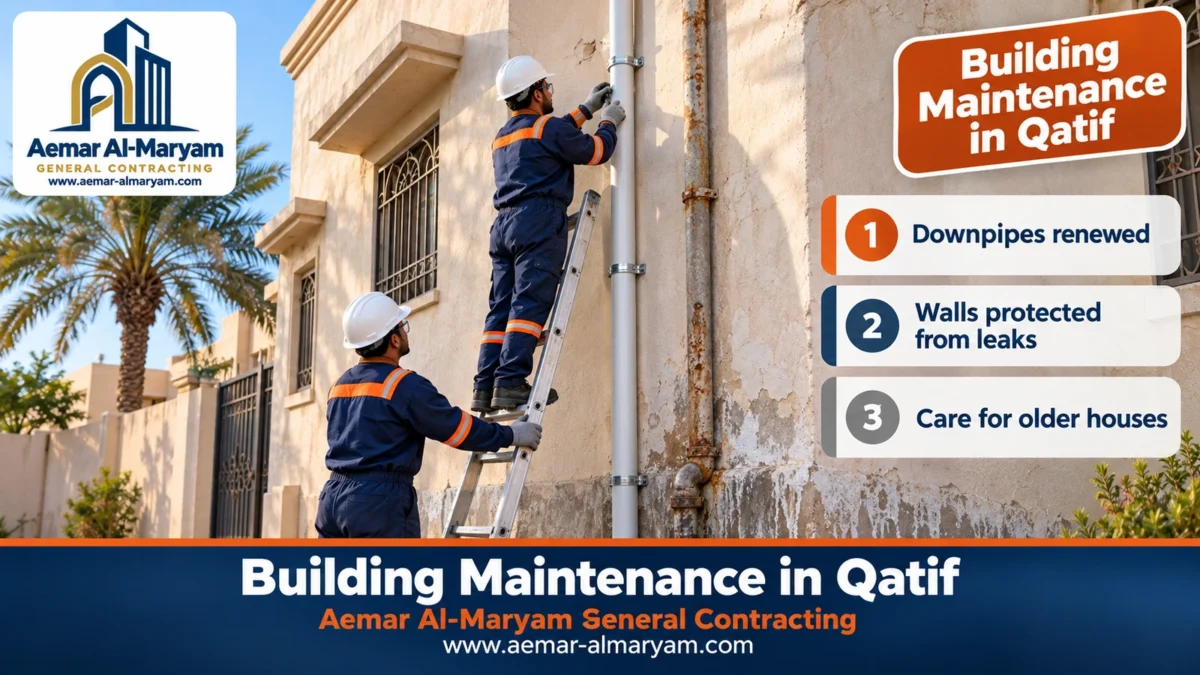
Rainwater downpipes on older houses in Qatif are among the items we replace most often, because they work only a few days a year and are then forgotten. An old metal pipe rusts from the inside until it perforates; a plastic one that has spent years in the sun turns brittle and cracks at the first knock; and the clamps holding it to the wall work loose, so the pipe leans and leaks from its joints down the facade. The result is dark streaks on the outside wall, salts at its base, and water pooling in the courtyard after every rain.
Rainy days are few in this region, yet a single storm can drop a lot of water in an hour or two. One downpour on a roof with a blocked drain or a broken pipe is enough for water to pond over the waterproofing or run down the facade. That is why we recommend checking downpipes and roof drains before the rain season, not after the stain has appeared.
How we replace a rainwater downpipe
- 1Check the drain from above
We clear the roof outlet and its grating of dust and leaves, then pour water to see whether it runs freely or backs up. - 2Trace the pipe
We find where it leaks: at the joints, through holes in the pipe body, or where it has parted from the roof outlet. - 3Replace the full run
We prefer to replace the pipe from the outlet down rather than patch one section, using pipe suited to outdoor exposure. - 4Fix it with metal clamps
Clamps at regular spacing, anchored into the wall itself rather than into cracked plaster. - 5Send the water away
We connect the pipe to a drain or finish it with a bend that throws water clear of the wall’s base. - 6Test with water
We pour water on the roof and watch the whole run before we leave.
We quote downpipe replacement after seeing it, since the cost turns on the height of the house, the number of pipes and how they can be reached, and we usually group it with other items in a single visit. If the roof outlet itself or the waterproofing around it is damaged, that is waterproofing work, covered in roof waterproofing in Qatif.
Do not repaint the facade before fixing the pipe
A stain under a leaking downpipe will not be hidden by paint; it returns with the first rain, bringing fresh flaking with it. Fix the pipe first, let the wall dry, then treat the salts and paint.
Hollow tiles in Qatif: how we find them and how we fix them
Hollow tiles in Qatif, often called drummy tiles, are tiles that have lost their bond with the adhesive beneath. You can hear them when you tap them, and over time they may lift or crack. They are common in older houses for recurring reasons: adhesive applied in dabs rather than a full bed, no movement joints in large floor areas, rising damp or a leak beneath the floor, or tiles expanding with heat in sunny living rooms.
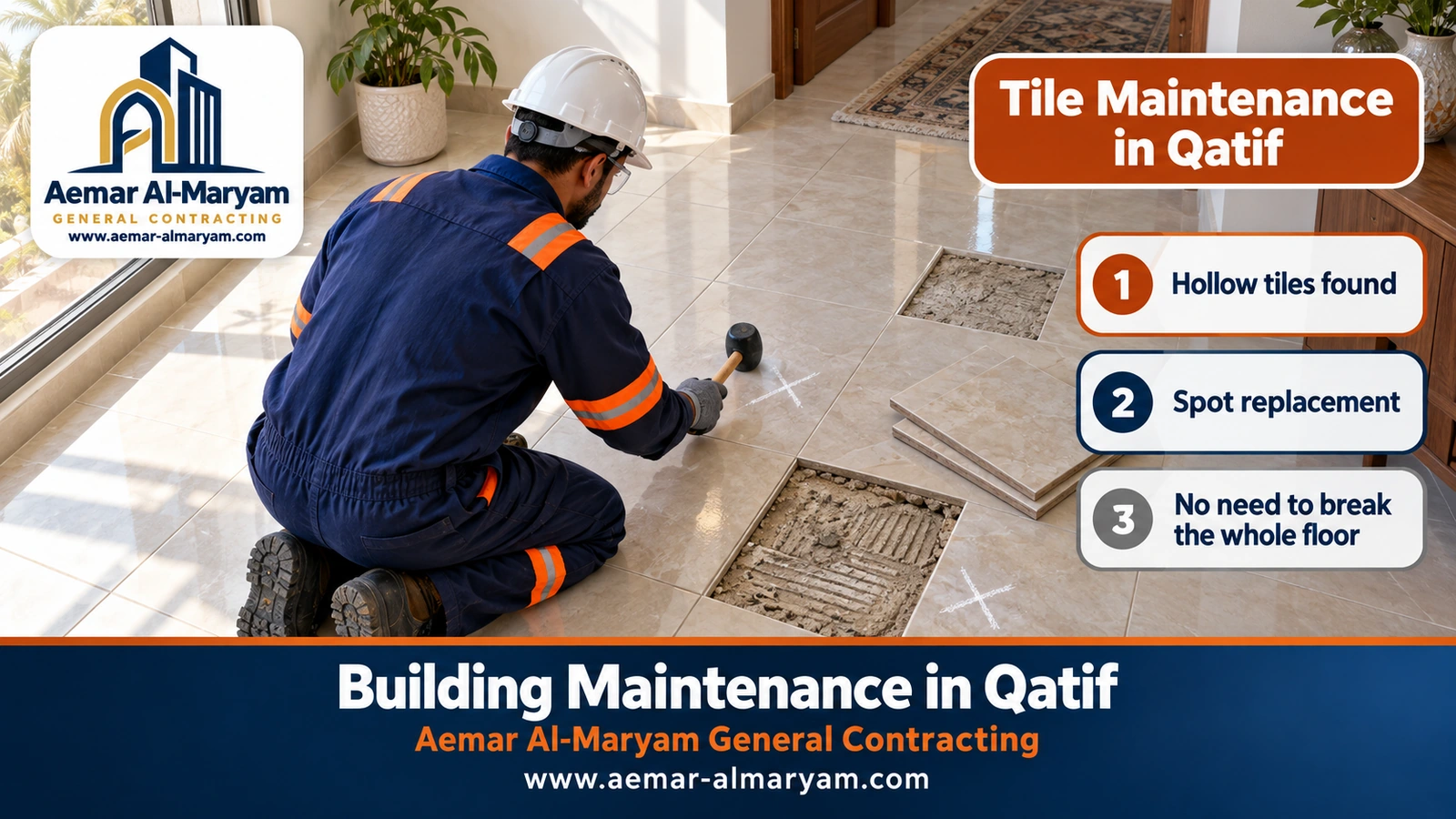
We start by tapping the floor tile by tile with a small rubber mallet and marking the hollow ones in chalk, so we can see the size of the problem: scattered tiles or one continuous area. Then we lift the hollow tiles carefully and look at what is underneath. If the old adhesive is dry and crumbling and the screed below is sound and dry, we remove the old adhesive and re-lay with adhesive that covers the whole back of the tile. If we find moisture under the tiles, we stop, because the cause is then a leak or rising damp that must be dealt with first, or the tiles will simply come loose again.
Matching old tiles
The hardest part of repairing old tiles is that their size or colour may no longer be made. So we first ask whether the owner has spare tiles left over from construction, then look for a close substitute, and if that fails we suggest taking sound tiles from a hidden spot, such as under a fixed cabinet, and putting the substitute there instead, or designing a contrasting strip that looks intentional. Repairing broken or hollow tiles for a limited number of pieces starts from SAR 92 per job; if the hollowness covers most of the floor, the answer is usually re-tiling, explained in tile installer in Qatif.
A test you can do yourself
Walk slowly across the living-room floor barefoot, or tap the tiles with the wooden handle of a screwdriver. A sound tile gives a dull, solid note and a hollow one a drum-like sound. Photograph the hollow area and send it to us, telling us whether it is near a bathroom or kitchen.
Farmhouse electrics in Qatif: outdoor points and lighting
Electrical maintenance on farmhouses and courtyards in Qatif starts with the outdoor points, because they face the most humidity, dust and sun and get the least attention. We often find ordinary indoor sockets mounted outside with cracked lids or none at all, cables run along walls with no protective conduit, wall lights with water inside them, and outdoor circuits with no RCD protection.
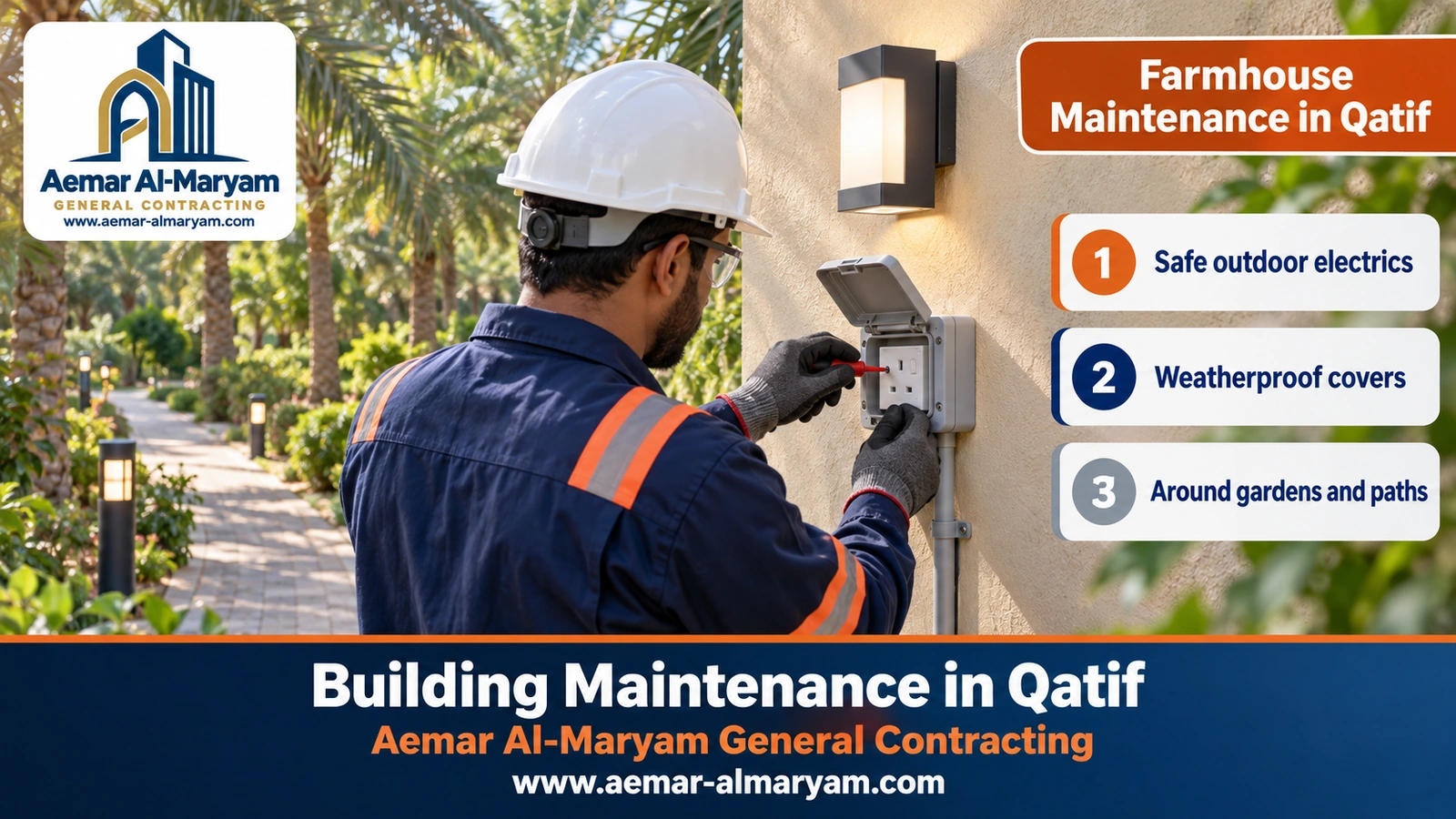
What we do: we isolate the circuit and confirm it is dead, then replace the outdoor socket with one designed for exposed locations, with a lid that closes over the plug. We raise it off the ground and away from irrigation sprays, run the cable in conduit suited to outdoor use, and replace water-damaged light fittings with outdoor-rated ones. Most importantly, we check that every outside circuit sits behind an RCD rated at 30 mA, which is what cuts the supply if current leaks through a person or through water.
| What we find on farmhouses | The risk | What we propose |
|---|---|---|
| Outdoor socket with no lid or a cracked one | Water and dust ingress, short circuits | A weatherproof socket with a sealed lid, raised off the ground |
| Cable run exposed along a wall | Insulation damaged by sun and abrasion | Outdoor-rated conduit and regular fixings |
| Outdoor circuit with no RCD | Electric shock from a faulty appliance or water | A 30 mA RCD for outdoor circuits |
| Old wall light with water inside | Repeated tripping and arcing risk | Outdoor-rated light fittings |
| Pump or irrigation unit on an ordinary socket | Overload and heat | A dedicated line with a breaker sized for the load |
Adding a point to a lived-in house costs from SAR 75, an extra breaker in the board from SAR 90, and swapping out a burnt or perished cable run from SAR 165. For larger needs, such as wiring a new annex, see electrician in Qatif. We do not touch high-voltage lines or the utility’s meters, which are the electricity provider’s responsibility.
Courtyard and farm-path lighting
Outdoor lighting on Qatif farms and in house courtyards runs through long, humid nights, gathers dust and fragments of palm fronds, and sometimes catches irrigation spray. So we place fittings away from the path of water, prefer sealed units that are easy to clean, and give each group of outdoor lights its own circuit in the board, so that if water gets in only that breaker trips rather than the whole house going dark. Along paths we run cables inside conduit, buried or fixed to boundary walls, rather than lying on the soil between the palms.
Many farmhouses and courtyard homes also have an annex or outdoor majlis added later, fed from the main house through a cable smaller than its load. Here we read the actual load of the annex’s air conditioners and heaters and, where needed, propose a dedicated line with a suitable breaker. Extending or rebuilding the annex itself is a separate job; see annex and majlis builder in Qatif.
Salts and damp at the base of older Qatif walls
White salts and blistered paint at the base of older walls in Qatif are a sign that water is reaching the wall: either rising damp from the ground, where groundwater is shallow in much of the Eastern Province, or water left at the base from a downpipe, irrigation or a leak. Drawn up through the masonry, the salts can reach roughly 75 cm above the floor, crumbling the plaster and destroying any paint, whatever its type.
That is why we never start with paint. We first find the source of the water and cut it off if it is a leak or poor drainage, then remove the crumbling plaster to a suitable height, let the wall dry, re-plaster with a mix suited to salts, and finish with a breathable paint. How much the salt and damp treatment costs is settled on site, as it varies with how long and how high the affected band is and what state the wall is in. Plastering details are in plastering contractor in Qatif.
Exposed steel in old ceilings and balconies
In some older houses we find that a piece of concrete has fallen from a bathroom ceiling or the edge of a balcony, exposing rusted reinforcement beneath. That is not a paint or plaster item; it is a sign of reinforcement corrosion. We record it on the list as urgent and needing an engineering assessment before treatment, then carry out what the engineer specifies, as described in renovation contractor in Qatif and crack repair in Qatif.
Plumbing and roof maintenance in older Qatif houses
Plumbing in an older Qatif house is examined with a different eye, because much of it is old metal pipework or new lines laid over older ones. We start with the meter test: we close every tap, photograph the reading and wait half an hour; if it moves, there is a leak after the meter. Then we look at scaled-up valves that no longer close fully, heaters and their safety valves, and how fast basins and floor drains empty and whether they smell. Where leaks keep appearing at several points in an old network, renewing the lines usually costs less than patching them section by section; details are in plumber in Qatif.
On older roofs we often find waterproofing past the end of its life, too few drains for the area, falls that do not lead water to them, and AC and tank bases added on top without protecting the membrane beneath. Under maintenance we clear the drains, seal local cracks and watch for ponding; if the whole membrane is finished, we put that on the list with its price. Waterproofing with bitumen membrane starts from SAR 13 per m² and with foam from SAR 23.
Mistakes that raise the cost of maintaining an older house
- ✓Painting over damp: the fault disappears for a few weeks, then returns with wider flaking.
- ✓Patching the same pipe every year: you pay for the patch many times, and for a full replacement only once.
- ✓Ignoring hollow tiles: a hollow tile eventually breaks and drags its neighbours with it.
- ✓A temporary outdoor socket that becomes permanent: a quick extension for an occasion or an annex stays for years without protection.
- ✓Scattered call-outs instead of one grouped visit: you pay travel to Qatif every time instead of spreading it over many items.
Inspecting an older house in Qatif: where we start
We order an older-house inspection in Qatif by risk, not by room: first what affects safety, then where water gets in, then what damages the finishes. A full house inspection starts from SAR 230 with a photographed fault list, and a diagnosis visit for a specific fault from SAR 90. What you get is a contractor’s record of condition rather than a structural engineer’s report, and anything structural is flagged for an engineer.
| Priority | What we check | What we look for |
|---|---|---|
| 1. Electrical safety | Board, breakers, RCD and outdoor points | Burn marks, a hot breaker, an exposed outdoor socket |
| 2. Structure | Ceilings, balconies, exposed columns | Visible rusted steel, a crack in a column or beam |
| 3. Water paths | Roof drains, downpipes and waterproofing | A perforated pipe, a blocked drain, standing water |
| 4. Plumbing | Meter test, mixers, heaters and drains | Meter moving with taps closed, drain odours |
| 5. Walls | Salts, damp and cracks | Salt bloom at the base, blistered paint |
| 6. Floors | Tiles by tapping | A hollow note, lifted or cracked tiles |
Home maintenance in Qatif: what a general maintenance company does, and does not do
We work in Qatif homes as a general contractor on booked days; we are neither an all-night emergency line nor a workshop for appliances. Our electricians, plumbers, waterproofers, plasterers, painters, tilers and gypsum fixers report to one site lead and follow one sequence, sources first and finishes last. That is what a general maintenance company in Qatif should give you: a single priced list and a single timetable.
Some work we leave to others, and we say so early: fixing AC machines, fridges and washers, cleaning, lifts, and fire alarm or sprinkler systems, which belong to licensed specialists and whose neglect Civil Defence counts as a safety breach. Where an air conditioner meets the building, we do the cable and breaker (from SAR 120) and the condensate pipe (from SAR 90). For the complete method, read building maintenance in Dammam or the short service overview.
A single call-out or a full inspection for an older house?
A single obvious problem, a scorched socket or a mixer that drips, needs only a SAR 90 fault call, not a whole-house survey. But if the house is older and has not been inspected for years, if stains and salts keep coming back, or if you plan to let or sell it, a full inspection is better value. Chasing faults one at a time in an older house means paying travel several times and fixing symptoms several times before reaching the cause. And the list you receive after the inspection remains your reference even if you carry out some items yourself or put them off.
Periodic maintenance for older houses in Qatif: a seasonal calendar
Periodic maintenance saves more in an older Qatif house than in a new one, because an older house hides faults that grow silently. This is the calendar we suggest from the Eastern Province climate; it is a recommendation, not a regulatory requirement:
| Season | What is checked | Why |
|---|---|---|
| Before the rain season | Roof drains, downpipes, their clamps and outlets | One heavy rain is enough to expose a perforated pipe |
| Before summer | Board, AC breakers, outdoor circuits and RCD | AC and pump loads expose weak old circuits |
| Every few months | Meter test and the base of ground-floor walls | Hidden leaks and salts start long before they show |
| Annually | A complete survey with photos, plus tap-testing of large tiled floors | Comparing with last year’s list shows what is developing |
An annual maintenance contract in Qatif: does it suit an older house?
An annual contract, or periodic programme, suits a large older house, a property with annexes, a majlis and a farmhouse, or a rented building. After the first inspection we agree the number of visits, the trades and the exclusions; each visit is billed at the inspection rate, and approved repairs are added at their listed starting prices. A small house may need only a yearly inspection and payment per item.
Rented houses and shared buildings in Qatif: who pays for maintenance?
Plenty of older Qatif houses are let to families or workers. Under the obligations published for residential leases, the owner pays for routine upkeep and for putting right whatever stops the occupants living there normally, and the occupants must let urgent repairs proceed. A lease may hand small jobs to the occupants, so the wording of your Ejar contract decides. Where an old house has been split into flats with different owners, its roof, stairs and tank are shared property; each owner contributes according to the size of his flat, and once there are three owners the law obliges them to form an association, which then becomes our contracting party, or its nominee does.
Maintenance or restoration in Qatif, and heritage buildings
Swapping a downpipe, re-laying tiles, changing a socket or repainting is upkeep, and upkeep rarely needs paperwork. Treating corroded reinforcement or stripping and renewing a roof’s entire waterproofing is restoration, which generally calls for a Balady restoration licence lodged by an engineering office. The older quarters of Qatif and Tarout Island also contain heritage buildings, which we do not work on without the competent authority; our work is on ordinary concrete houses, whatever their age.
Building maintenance prices in Qatif
Qatif jobs use our Dammam starting figures without any mark-up per item; the only addition is the crew’s journey, which we estimate on site and spread across everything done that day. Figures below are provisional labour charges, and you buy or approve the materials.
| From (SAR) | Job on an older house | Per |
|---|---|---|
| 230 | Whole-house survey with findings ranked by risk | visit |
| 90 | Tracing one electrical or water fault | visit |
| at inspection | Renewing and clamping rainwater downpipes | — |
| 92 | Lifting and re-bedding hollow or cracked tiles | job |
| 75 | An extra indoor or outdoor electrical point | point |
| 90 | An added breaker to protect a circuit | breaker |
| 165 | A perished run of cable | circuit |
| 165 | A corroded run of water pipe | section |
| 280 / 200 / 140 | Leak tracing by instrument: villa / flat / single wet room | visit |
| 20 | Cracked plaster: mesh and patch | m² |
| at inspection | Salt and damp at the foot of walls | — |
| 18 | Exterior paint for damp conditions | m² |
| 13 / 23 | Roof membrane: bitumen rolls / sprayed foam | m² |
| at inspection | Scheduled maintenance programme | — |
| at inspection | Crew travel to Qatif | — |
Everything else is listed in the estimated price guide. For rows without a figure, we price on sight; a few photos and the number of floors sent to 0547879578 get you a first estimate.
Worked example: an older Qatif house with an outdoor annex
A made-up case to show the sums, not an offer: the owner of an older two-storey house in Qatif asks for a full inspection, and the list comes back with these items: hollow tiles in two spots in the living room, cracked plaster on an external wall over about 6 m², two new outdoor electrical points for the courtyard annex, and a new breaker to protect the outdoor circuit.
| Finding | Working | SAR |
|---|---|---|
| House survey | 1 × 230 | 230 |
| Hollow tile repair (two spots) | 2 × 92 | 184 |
| Plaster crack repair with mesh | 6 × 20 | 120 |
| Two new outdoor electrical points | 2 × 75 | 150 |
| New breaker for the outdoor circuit | 1 × 90 | 90 |
| Approximate total | 230 + 184 + 120 + 150 + 90 | 774 |
The total is SAR 774 for labour, before materials and before the travel cost and downpipe replacement, both priced at inspection. Because every item was grouped into one visit, the travel cost was spread across all of them instead of being paid separately for each.
Steps to maintaining your house in Qatif
- 1Send the photos
The roof and its drains, each downpipe from bottom to top, the suspect tiles, the distribution board and the outdoor points. - 2Choosing the visit
Either a SAR 90 fault call or a SAR 230 whole-house survey, plus our estimate for the journey. - 3Inspection by risk
Electrical safety first, then structure, then water paths, then finishes. - 4List and prices
Every item with its photo, priority and price; structural ones referred to an engineer. - 5Grouping the items
We group whatever can be grouped into one visit to keep travel costs down. - 6Execution and testing
Downpipes tested with water, the RCD test button pressed, tiles tapped again after laying. - 7Handover
Before and after photos, and notes on what to watch next season.
Why Aemar Al-Maryam for house maintenance in Qatif?
- ✓Experience with older houses: we read previous additions and patches before adding a new repair.
- ✓Ordered by risk: safety and water before finishes.
- ✓Straight talk: we tell you when a repair is enough, when renewal is needed, and when an engineer must come first.
- ✓Grouped visits: items arranged to reduce the number of visits and the travel cost.
- ✓Published starting prices: every item has a price you know before we arrive.
Finished jobs are shown in our project gallery.
Qatif towns and districts we cover
We work in Qatif across its older and newer districts, among them Al-Sawari, Al-Sadafa, Al-Fath, Al-Shati and Al-Rida, on Tarout Island covering Darin, Sanabis, Al-Rabiya, Al-Zour and Tarout town, and in Safwa and Anak. We also serve neighbouring Saihat, which has its own page at building maintenance in Saihat, and for compound villas in Dhahran see building maintenance in Dhahran. In the narrow lanes of older quarters we bring ladders, small mobile scaffolds and materials carried by hand, so let us know if a car cannot reach your door.
Photos that help us quote a Qatif house
- ✓Downpipes: a photo of each pipe from bottom to top, and of its outlet on the roof.
- ✓Tiles: a photo of the suspect area, and whether it is near a bathroom or kitchen.
- ✓Outdoor electrics: photos of outdoor sockets and lights, and of the board with its cover open.
- ✓Walls: photos of salts or blistered paint at the base of walls.
- ✓The house: its approximate age, number of floors, what has been added, and the district or town.
Your older house deserves a clear list
Send photos of the downpipes, tiles and outdoor points; we propose the right visit and estimate the travel cost, and nothing starts until you pick from the priced list.
More on Qatif houses
Tags