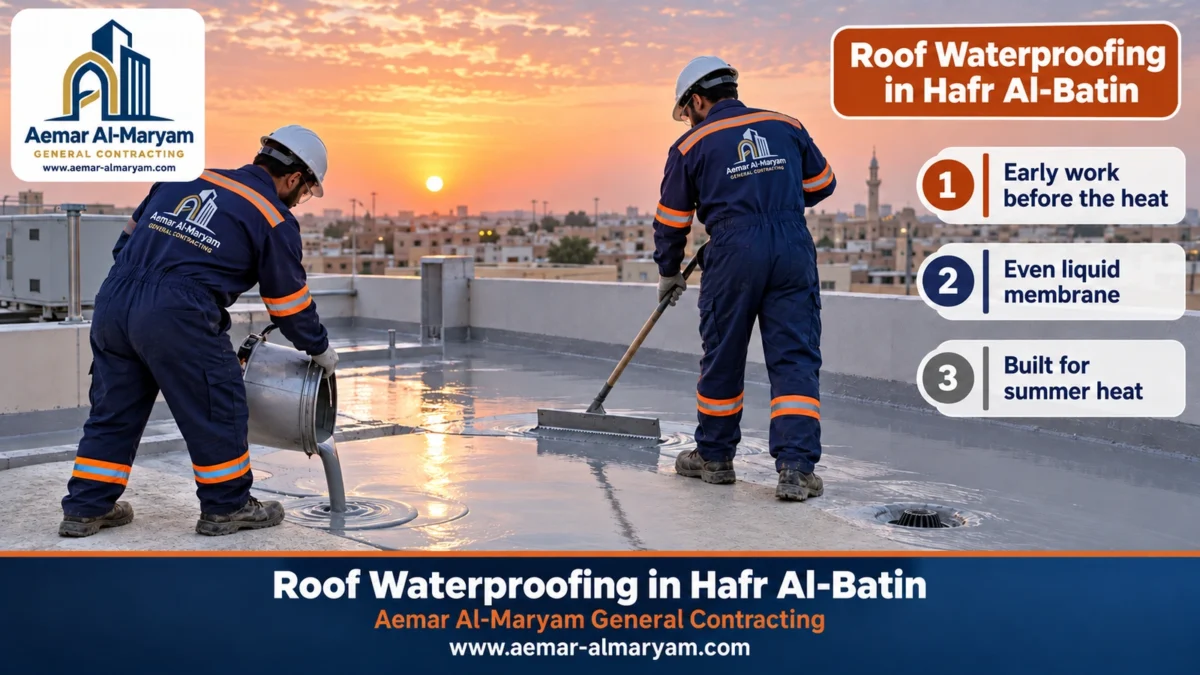
Roof waterproofing in Hafr Al-Batin has to survive a harsh, changeable inland desert climate: scorching summers, cold winters, wide swings between day and night, dust storms, and rain that is scarce for most of the year yet can arrive as a heavy burst in a short time. That is why, for most homes here, we recommend a real thermal layer topped by a flexible waterproofing membrane, with the drains and falls checked before anything else. Aemar Al-Maryam General Contracting carries out heat insulation with foam, boards and reflective coatings in Hafr Al-Batin, waterproofing with bitumen rolls and liquid membranes, tank and bathroom work, and instrument leak detection. Rolls start at SAR 13 per square metre, foam at SAR 23, foam with its protective coat at SAR 42, while the tiled three-layer build is SAR 46; none of this is final before a site visit. Phone or WhatsApp 0547879578.
Hafr Al-Batin lies far out in the northern interior, and we reach it from Dammam on a planned trip whose cost we settle at inspection. What sets its roofs apart from coastal ones is that the main threat is not salt and humidity but movement: concrete expands under the summer midday sun and contracts on winter nights, and any rigid layer that cannot follow that movement cracks over time. Add dust that chokes drains and sudden rain that exposes every weak slope. This guide explains how we choose a system for these conditions, how we prepare a roof for the rainy season and what each item costs.
Hafr Al-Batin at a glance
- Roof conditions: hard summer heat, winter cold, big day-night swings, dust, and occasional heavy downpours.
- What we usually recommend: thermal insulation under a flexible membrane, a reflective top coat, and drains and falls checked first.
- Where prices start: SAR 13/m² for rolls, 23 for foam, 42 for reflective-coated foam, 46 for the layered tiled system, 26 for bathrooms, 140 for a bathroom leak visit.
- Travel: from Dammam, priced at inspection and lower when more work shares the trip.
- Working hours: from dawn in summer, within the temperature limits on each datasheet.
- To book: WhatsApp 0547879578 with photos of the roof, drains, ceiling and your district.
Roof Waterproofing in Hafr Al-Batin: A System for Heat, Cold, Dust and Rain
Roof waterproofing in Hafr Al-Batin is a system of at least two layers: one that slows solar heat before it can enter the living space, and a membrane that keeps water off the roof slab, and both must be able to stretch and shrink with the roof. A house here faces more than a hot summer; it goes through wide swings within a single day and between seasons, and that, before price, is what decides the materials.
■ Heat insulation
Sprayed foam or boards buried under tiles, finished with a white coat that throws the sun back.
■ Flexible waterproofing
Polymer-modified bitumen or liquid polyurethane that tolerates roof movement.
■ Drains and falls
Sand cleared from outlets and slopes corrected where water sits after rain.
■ Tanks and bathrooms
Tank linings and pre-tiling bathroom membranes, each water-tested.
■ Leak detection
Moisture maps of roof and ceiling, thermal imaging and line pressure tests.
■ Within renovation
Re-waterproofing a roof together with crack repairs and a flaking ceiling in one project.
What temperature swings do to your roof
Concrete grows when it heats and shrinks when it cools, and a Hafr Al-Batin roof gets very hot at summer noon, cools at night and gets colder still on winter nights. That repeated movement shows up in familiar places:
- ✓Cracks where the roof meets the parapet: wall and slab move by different amounts, so whatever bridges them splits.
- ✓Rigid layers cracking: such as cement screeds left as the top layer or old inflexible paints.
- ✓Roll edges peeling away: when they were never properly fixed to the wall or were torched onto dust.
- ✓Crumbling tile grout: which opens a route for water under the tiles.
- ✓Upper rooms hot in summer and cold in winter: a sign that thermal insulation is missing or weak.
How to Choose a Roof Waterproofing Company in Hafr Al-Batin
Pick a roof waterproofing company in Hafr Al-Batin that asks about your roof before naming a product, explains how the system will cope with temperature swings, and tells you what it will do about drains and falls before the rain. Adverts are full of “expert installers” and “the best company”; what actually separates a good contractor is how it answers these:
| Ask the installer | A reassuring answer |
|---|---|
| Is the system flexible enough for the swings? | A flexible membrane (polyurethane or modified rolls), not a rigid screed on its own. |
| Which insulating material, at what depth? | Foam or boards with the thickness written down, never paint alone. |
| Will you check the drains and falls? | Yes, and fix anywhere water ponds before waterproofing. |
| How do you deal with dust during the job? | Sweeping and air-blowing before every coat, and pausing on stormy days. |
| When do you work in summer? | From dawn, inside the datasheet temperature range. |
| Will you water-test it? | Yes, for one to three days before protection. |
Heat Insulation in Hafr Al-Batin: How Much Difference Does It Make?
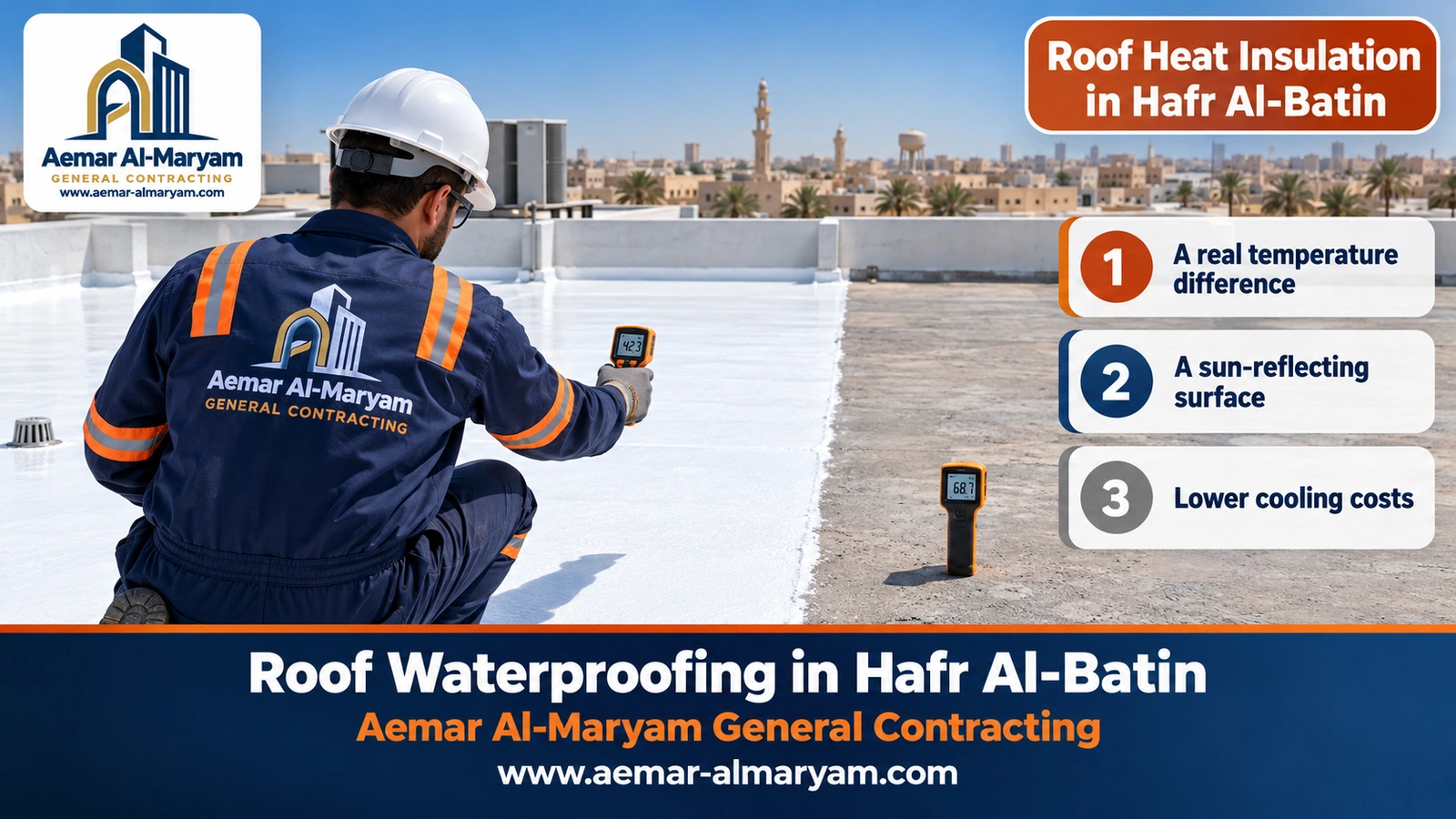
Heat insulation in Hafr Al-Batin is a poorly conducting layer laid over the roof slab that cuts the heat reaching the rooms in summer and the warmth escaping from them in winter. Point an infrared thermometer at bare concrete at summer noon and then at a reflective-coated patch beside it, and the surface temperature difference is obvious. But that is only the outer surface; how much reaches the room is decided by the insulation layer beneath the coating.
We will not quote a percentage saving on your power bill, since walls, windows and AC habits all play a part. What top-floor residents notice is that rooms stop holding the day’s heat until midnight, and feel warmer on cold winter nights.
Spray foam in Hafr Al-Batin and the price per square metre
Spray foam in Hafr Al-Batin cures in place into a hard, closed-cell blanket welded to the slab without a single joint, so there are no weld lines to open up as the roof moves, which is one of its biggest advantages in a changeable climate. A standard layer is SAR 23 per square metre; finished with a reflective coat that protects it and keeps water out, it becomes a water-and-heat system from SAR 42.
| Our standard | Detail | Why it matters in Hafr Al-Batin |
|---|---|---|
| Roofing grade only | Closed-cell, density in the mid-40s kg/m³ after spraying | Walkable and sun-tolerant |
| Thickness | Never under 25 mm; 3-5 cm is typical on existing houses | Noticeable insulation against inland heat and cold |
| Dust-free deck | Blown clean immediately before spraying | Dust stops foam gripping the concrete |
| Spray timing | Early morning in summer, within datasheet limits | A very hot deck upsets the reaction |
| Protective coat | Two flexible reflective coats, 0.5 mm dry minimum, on spraying day | Sunlight breaks down bare foam |
Drawn from a published sprayed-foam roofing specification and manufacturers’ datasheets.
Reflective coating over insulation, and the dust problem
From SAR 23 per square metre, white reflective acrylic is the best top layer over foam or on exposed roofs, because it sends much of the sunlight back and shields what lies beneath. In Hafr Al-Batin, though, dust settles on it as a brown film that cuts its reflectivity, so we suggest hosing the roof after the dusty season and recoating when it fades or cracks.
Insulation boards for a roof that will be tiled
For families who use the roof on cool winter nights, a tiled finish over boards and membrane keeps every layer hidden from sun and dust. Expect SAR 14 per square metre for the boards alone and SAR 46 for the finished build. We leave proper movement joints in the tiles so they do not arch with the temperature swings.
New homes
Saudi permits for new homes require thermal insulation, and SBC 602, the residential energy-conservation code, limits roof heat transfer differently in each climate zone. A new house gets exactly what its approved drawings show. For an older one we are upfront: 30-50 mm of retrofit insulation helps a lot without necessarily reaching new-build code levels.
Waterproofing in Hafr Al-Batin: Getting Ready for Sudden Heavy Rain
Waterproofing in Hafr Al-Batin is a continuous membrane protecting the roof slab from water. Rain is scarce here for most of the year, but when it comes it can fall hard in a short time, filling a roof within minutes. If the outlets are full of sand or the falls are weak, water sits and presses on every small crack in the membrane until it reaches the ceiling. Drainage, in other words, is half of waterproofing here.
Checking drains and falls before winter
- ✓Clear every outlet: remove sand, bags and leaves, and make sure water runs all the way down the pipe.
- ✓Pour water on the roof: see where it sits; any puddle still there after an hour needs its falls corrected.
- ✓Check the membrane edges on the parapet: are they bonded and capped, or open so water can get behind them?
- ✓Look for an overflow: an opening in the parapet that lets water out if the main drain blocks, so it never rises above the membrane edge.
- ✓Pipe the AC condensate: so it does not run across the roof all summer long.
Bitumen rolls in Hafr Al-Batin
Polymer-modified bitumen rolls remain among the most common systems and start at SAR 13 per square metre. For this climate we pick flexible modified rolls that cope with heat and cold, torch them onto a deck swept completely free of dust, overlap them by the widths the roll’s technical sheet gives (commonly no less than 75-100 mm on long edges and 100 mm-plus on the short ones), and carry them at least 150 mm up the parapet above the finished surface with the edge fixed. Left exposed, they need a granular finish or a reflective coat; better still, protect them with tiles.
Liquid waterproofing in Hafr Al-Batin
Liquid membranes suit Hafr Al-Batin because they form a continuous, elastic skin with no weld lines, and liquid polyurethane is the strongest choice where thermal movement is the issue:
■ Liquid polyurethane
Poured and spread with a notched squeegee into an even film; highly elastic, it follows expansion and contraction but needs a dry, clean deck. Priced at inspection.
■ Reflective acrylic
A white top layer that shields what is beneath it from the sun, in two or more coats. From SAR 23 per m².
■ Polyurea
Machine-sprayed hot, it hardens almost instantly and shrugs off scuffing and blown sand; our pick for commercial roofs. SAR 55 per m² upwards.
■ Flexible cementitious
For tanks, bathrooms and roofs that will be screeded and tiled. From SAR 15 per m² on roofs.
Success depends on the right dry thickness, on taping corners and outlets before the first coat, and on applying in moderate temperatures, because a product that flashes off too fast on a hot deck can crack or blister.
Dust Storms and Roof Waterproofing in Hafr Al-Batin
Dust is part of daily life in Hafr Al-Batin and it affects waterproofing both during and after the job. While working we sweep and air-blow the deck before every coat and stop if a dust storm blows in, because a soft layer picks up sand, loses adhesion and turns rough. After handover, sand gathers in corners and around outlets and blocks them before the first rain.
After every dust wave
Go up and clear the outlets and parapet corners, and rinse the reflective coat if it has changed colour. Fifteen minutes of cleaning protects waterproofing that cost you thousands of riyals.
Roof Insulation Materials in Hafr Al-Batin: Types and Where They Fit
Some materials stop water and some slow heat; in Hafr Al-Batin the key question is whether they can handle thermal movement:
| Material | Job | Flexibility | Fits in Hafr Al-Batin |
|---|---|---|---|
| Spray foam with reflective coat | Heat and water | One seamless layer | Uninsulated house and annex roofs |
| Polystyrene boards | Heat | Protected under tiles | Roofs that will be tiled and used |
| Modified bitumen rolls | Water | Flexible when polymer-modified | Insulated roofs or roofs to be tiled |
| Liquid polyurethane | Water | Very high | Roofs with many cracks and much movement |
| Reflective acrylic | Protection and reflection | Moderate | Top layer over foam |
| Rigid cement screed alone | Not enough | Poor | Not recommended as the only layer |
Waterproofing a Tiled Roof in Hafr Al-Batin Without Breaking It
A tiled roof in Hafr Al-Batin can be waterproofed without breaking it when the tiles are well bonded and do not ring hollow, water runs to the outlet, and the leak is limited to the grout. We rake the sand out of the joints and refill them with a flexible grout, then apply a clear or acrylic sealer to close the pores, from SAR 10 per square metre. Tiles that have arched or come loose with the temperature swings, or that hold standing water, must come up; the waterproofing is rebuilt and new tiles are laid with proper movement joints.
Best Roof Insulation for the Hafr Al-Batin Climate
The best roof system in Hafr Al-Batin combines a real thermal layer, a flexible membrane and sun protection, installed on a clean deck with working drains. Strengths and weaknesses side by side:
| System | From | Strengths here | Weaknesses | For |
|---|---|---|---|---|
| Foam handling water and heat, with reflective protective coat | SAR 42/m² | No seams to open with the heat, light and quick | Coat needs washing and renewal | Wide roofs and annexes |
| Layers: membrane, insulation boards, protective tiles | SAR 46/m² | Every layer buried away from sun and dust | Heavier; tiles need movement joints | Roofs used as terraces, new houses |
| Protected modified rolls | SAR 13/m² | Economical and proven | Water only | Already insulated roofs |
| Liquid polyurethane | At inspection | Very elastic for movement | Needs a dry, clean deck | Cracked roofs and repairs |
| Sealer brushed over tiles | SAR 10/m² | Tiles stay in place | Useless on lifted tiles | Small grout leaks |
In short, for Hafr Al-Batin
Uninsulated roof: foam with a reflective coat, or the layered system if you want tiles. Insulated roof leaking after rain: check the drains and falls first, then a flexible membrane.
Water Leak Detection in Hafr Al-Batin
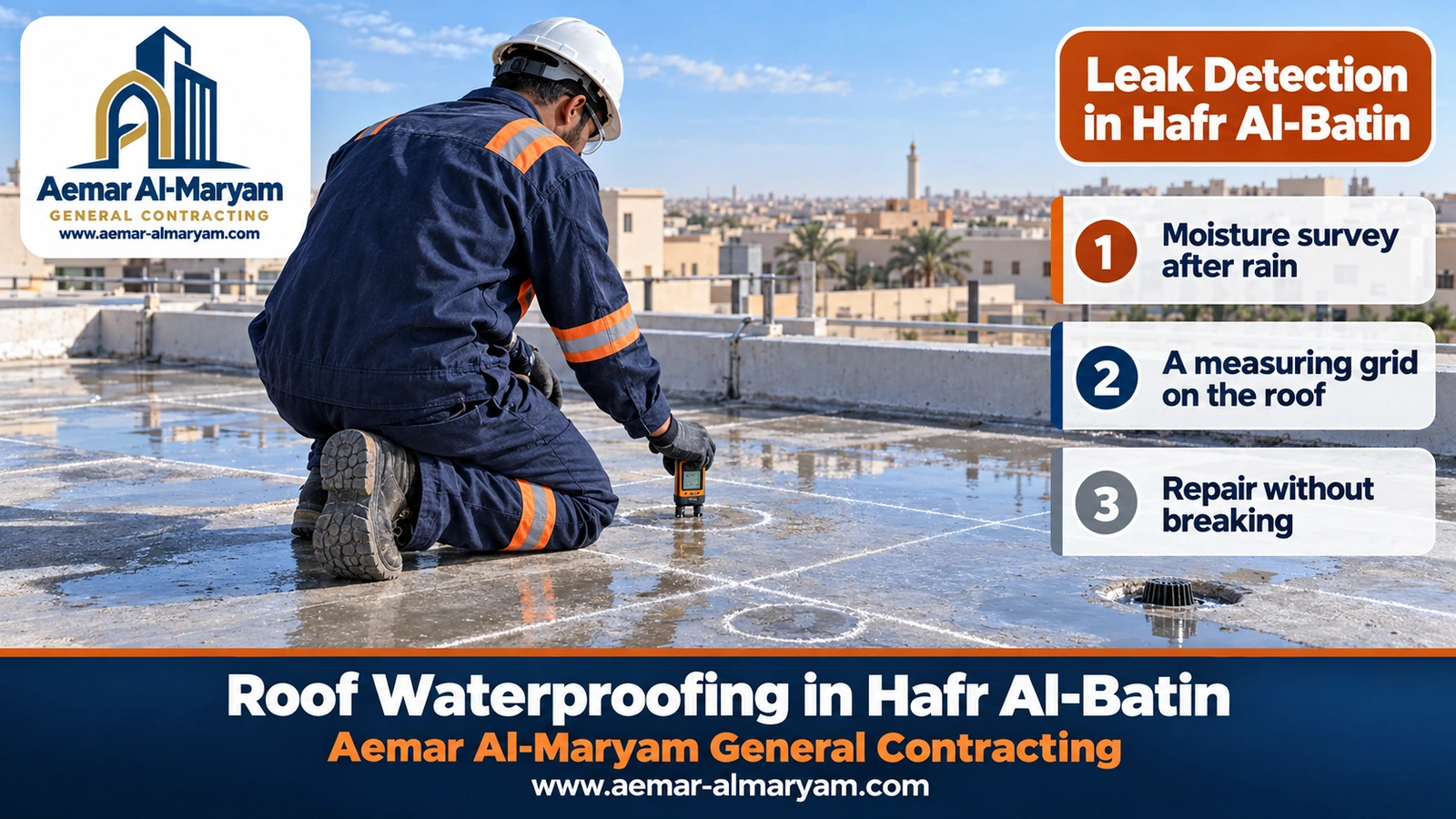
Finding a leak in Hafr Al-Batin begins by asking: does water come from the roof after rain, or from the plumbing at any time? If it is the roof, we chalk a grid on the deck and take a moisture reading at every point after rain, so the damp zone appears on the map and we know where water got in before lifting a single tile. If it is the plumbing, we begin with the meter: shut all taps, read the meter, and read it again after half an hour; a different number tells us water is escaping.
Then we use a thermal camera to trace how far the damp spreads in the ceiling, check the readings with a moisture probe, put each supply line under pressure to spot the one that loses it, and use dye on floor drains. We never rely on one instrument, because a thermal camera reads temperature, not water.
| Visit | From |
|---|---|
| Bathroom or kitchen | SAR 140 |
| Tank | SAR 140 |
| A flat with all its rooms | SAR 200 |
| Full floor or villa | SAR 280 |
| Repair after locating | At inspection |
Provisional until inspection, plus travel. Pipe repairs are handled by our plumbing team where needed.
Water Tank Waterproofing in Hafr Al-Batin
Tank waterproofing in Hafr Al-Batin is an internal lining that stops leaks in or out and keeps the water clean. An underground tank is emptied, cleaned and dried, its cracks and corners repaired, then lined: for drinking water, an epoxy carrying a certificate such as NSF/ANSI 61, on concrete cured at least 28 days, with ventilation during the work and the datasheet cure time respected before rinsing and filling, from SAR 46 per square metre; for non-drinking water, flexible cementitious coating from SAR 14.
A concrete roof tank in Hafr Al-Batin suffers heat in summer and cold in winter, so on request we insulate its top and sides to keep the water cooler in summer, and make sure its overflow runs to a drain rather than across the roof.
Bathroom Waterproofing in Hafr Al-Batin
Bathroom waterproofing in Hafr Al-Batin is a flexible membrane under the tiles, across the floor and up the walls, that keeps bathroom water away from the ceiling below and the next wall. We break out to the concrete, screed falls to the floor drain, prime and apply the membrane twice, tape embedded at every corner, drain and pipe entry, then keep water standing for at least 24 hours before tiling. Following international wet-room guidance, shower walls are coated to 1.8 m high and the wall beside a bath to 15 cm over its edge.
Here a bathroom membrane costs from SAR 26 a square metre, and a bathroom rebuilt from scratch (old tiles out, membrane, pipework, new tiles) starts at SAR 2,300, with details on the bathroom and kitchen renovation page.
Flood Testing in Hafr Al-Batin and Summer Evaporation
A flood test in Hafr Al-Batin means plugging the outlets and filling the roof over the new waterproofing for one to three days, holding 25-100 mm of water where the roof is lowest, in line with ASTM D5957. But in a dry Hafr Al-Batin summer the water evaporates quickly and the level can fall with no leak at all. So we mark the level on the wall, top up what evaporates, and judge the test by a dry ceiling below and sound edges and outlets, not by the level alone. We keep the depth modest too: each extra 10 cm of depth adds close to 100 kg per square metre.
Roof Insulation Prices in Hafr Al-Batin: Starting-Price Table
Hafr Al-Batin uses the same starting prices as the rest of the Eastern Province, plus travel, which we set at inspection:
| What you need | Starting price | Charged per |
|---|---|---|
| Modified bitumen membrane | SAR 13 | m² |
| Polystyrene thermal boards | SAR 14 | m² |
| Cementitious coat, to be covered later | SAR 15 | m² |
| Standard spray foam | SAR 23 | m² |
| White reflective acrylic | SAR 23 | m² |
| Foam with reflective coat, water and heat | SAR 42 | m² |
| Membrane, then boards, then protective tiles | SAR 46 | m² |
| Sprayed polyurea | SAR 55 | m² |
| Bonded tiles: clear sealer | SAR 10 | m² |
| Concrete tank: cementitious | SAR 14 | m² |
| Drinking tank: potable-certified epoxy | SAR 46 | m² |
| Bathroom: floor and walls | SAR 26 | m² |
| Bathroom rebuilt from scratch | SAR 2,300 | bathroom |
| Locating a leak: bathroom, kitchen or tank | SAR 140 | visit |
| Locating leaks: flat / villa or floor | SAR 200 / SAR 280 | visit |
| Falls, stripping old layers, foundations, post-detection repair | At inspection | – |
Treat these as guide prices pending inspection and agreement; condition, size, floor height, product, thickness and hoisting all move them, and they exclude travel from Dammam to Hafr Al-Batin, which is fixed at inspection. Everything else we do is on the main price table.
Example: what a 200 m² Hafr Al-Batin roof costs
Say a villa in Hafr Al-Batin has 200 m² of sound concrete roof, outlets that drain, and nothing old to rip off. Installation alone at starting prices, before falls, tiles or travel:
| Work | Sum | Cost from |
|---|---|---|
| Rolls on their own | 200 m² × 13 | SAR 2,600 |
| Standard foam layer | 200 m² × 23 | SAR 4,600 |
| Foam sealed under a reflective coat | 200 m² × 42 | SAR 8,400 |
| Layered system up to the tiles | 200 m² × 46 | SAR 9,200 |
An example only; the real cost follows measuring and inspecting.
Travel to Hafr Al-Batin
The drive from Dammam to Hafr Al-Batin is long, so multi-day systems and flood tests generally mean the crew sleeps in town. So the travel price stays open until inspection and is worked out from the days, crew and equipment involved. Your share of it falls when you group the roof, tank and bathroom in one trip, when a neighbour in the same district joins in, or when complete photos and measurements let inspection and installation happen on the same trip.
From First Photo to Finished Roof in Hafr Al-Batin
- 1Photos and estimate
Roof, outlet and ceiling photos on WhatsApp bring you a suggested system and a rough cost. - 2Inspection and schedule
We check falls, outlets and old layers, measure the area and fix the trip dates. - 3Cleaning and preparation
Sand and dust removed, cracks at the parapet repaired, falls corrected. - 4Starting at dawn
In summer we apply materials in the early hours within datasheet temperature limits. - 5Layers
Details and outlets first, then the flexible membrane and thermal layer, or foam and its coat. - 6Flood test
One to three days, topping up evaporation and watching the ceiling. - 7Protection and handover
Reflective coat or tiles with movement joints, a clean roof, and upkeep advice.
How Long Roof Insulation Lasts in Hafr Al-Batin
Waterproofing lasts when it is flexible, protected and its drains are kept clear. Studies of sprayed foam roofs speak of service beyond three decades when the protective coat is renewed about once every fifteen years. What usually shortens a roof’s life in Hafr Al-Batin is a reflective coat left under dust until it faded and cracked, choked outlets that let water stand after rain, and rigid layers that split with the temperature swings. Inspect your roof before winter and after each dusty spell, and recoat when it fades.
Common Roof Waterproofing Mistakes in Hafr Al-Batin
- ✓White paint instead of real insulation: it only cools the outer surface.
- ✓Waterproofing over dust: the layer does not bond and lets go in the first summer.
- ✓Applying at summer noon: products cure abnormally fast and crack or blister.
- ✓A rigid screed as the only layer: it cracks with the gap between day and night temperatures.
- ✓Ignoring the outlets before winter: one burst of rain is enough to flood the roof.
- ✓Roof tiles without movement joints: they arch and come loose as the roof expands.
Why Aemar Al-Maryam for Your Hafr Al-Batin Roof?
Because we choose the system for Hafr Al-Batin’s climate, not the coast’s: flexibility to handle the swings, a real thermal layer, and outlets and falls checked before waterproofing. Because we plan the trip from Dammam with a clear schedule that includes testing. And because you know the starting price before we set off and receive the line items in writing.
- ✓Inspection before treatment, and leak detection before breaking.
- ✓Work timed to the right hours in summer, protecting materials and crew.
- ✓Waterproofing coordinated with building renovation in Hafr Al-Batin and Hafr Al-Batin painting on the same trip.
- ✓New annex roofs insulated within annex and majlis construction in Hafr Al-Batin.
- ✓Accompanying cracks handled by our crack repair service.
Hafr Al-Batin Districts We Reach
We reach every district of the city, including:
Our Hafr Al-Batin area page lists everything we do in the city, and the general service is described under waterproofing and insulation. Elsewhere in the province, the most detailed guide is our Dammam roof waterproofing article, alongside roof waterproofing in Al-Ahsa and roof waterproofing in Khafji. Examples of our work are in the projects section.
How to Book Roof Waterproofing in Hafr Al-Batin
These details on WhatsApp 0547879578 decide the system, the quantities and how long the trip needs to be:
- ✓The whole roof: from two angles, showing outlets, parapets, tanks and AC units.
- ✓A photo of each outlet: plus any spot where water stands after rain.
- ✓Inside the house: a photo of the stain, the room name and when it first appeared.
- ✓Size and storeys: tiles or plain concrete on top, and roughly when it was last sealed.
- ✓Your main complaint: hot upper rooms, a leak, or both.
- ✓District and suitable days: so we can arrange the trip.
A roof built for Hafr Al-Batin’s summers and winters
Photograph your roof, its outlets and the ceiling stains and send them to us. We will suggest a thermal and waterproofing system suited to the city’s climate with an estimated cost, then arrange the inspection and installation trip.
Helpful links for Hafr Al-Batin
Tags